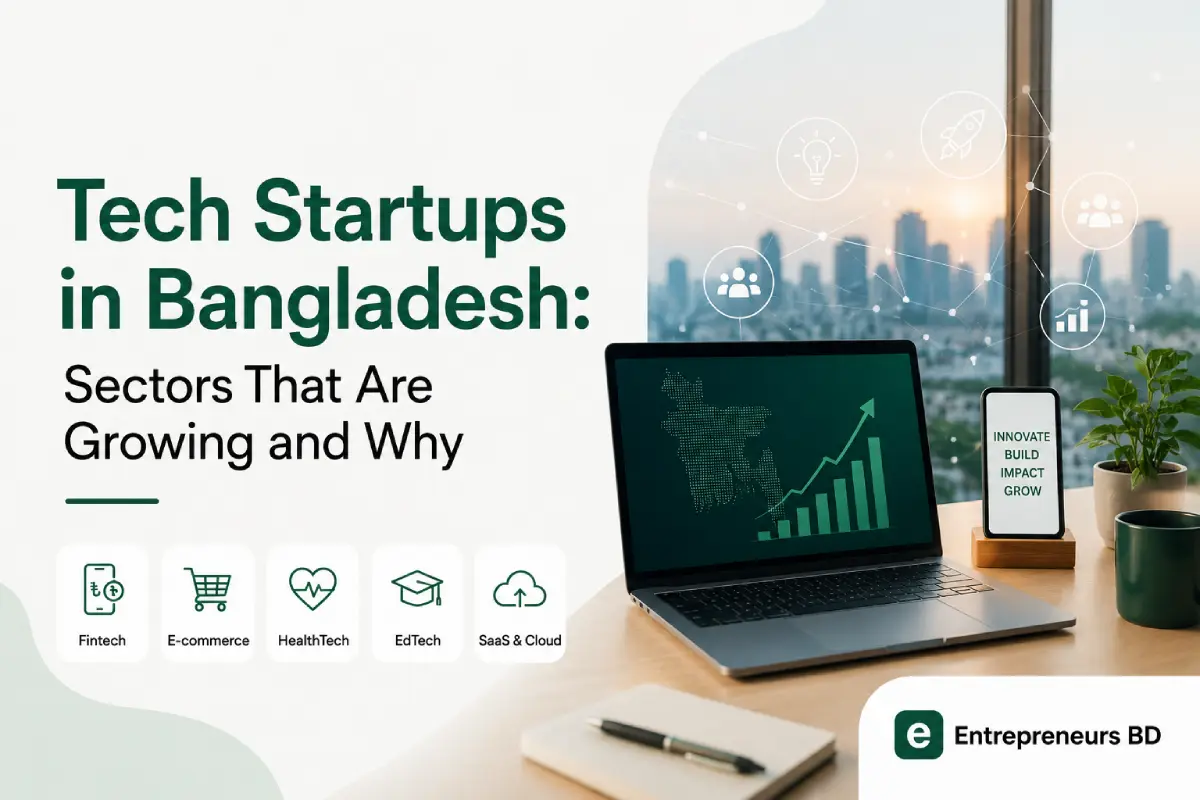
Tech Startups in Bangladesh: Sectors That Are Growing and Why
Bangladesh's fastest growing tech sectors in 2026 are fintech, e-commerce and logistics, agritech, and healthtech. Fintech leads because mobile financial services already reach a majority of the population. The others are growing because government capital, a young workforce, and rising smartphone use are solving problems that used to block small business growth.
Key Takeaways
Fintech remains the most funded startup sector in Bangladesh, built on mobile financial services that already reach tens of millions of users.
E-commerce, logistics, and mobility keep expanding because delivery and payment infrastructure has finally caught up with consumer demand.
Agritech and healthtech attract far less funding but solve problems that touch most Bangladeshi households directly, which keeps them growing.
A new government backed Fund of Funds and the National Startup Policy are pulling more institutional capital into these sectors in 2026.
Bangladesh's young population and rising smartphone use keep expanding the customer base that every one of these sectors depends on.
Tech startups in Bangladesh are no longer a small, scattered scene.
Thousands of them now operate across the country, and a handful of sectors pull in most of the funding, talent, and attention.
Fintech sits at the top, built on mobile financial services that already handle tens of millions of daily transactions. E-commerce, logistics, and mobility come next, followed by agritech, healthtech, and edtech.
Software exports and IT freelancing add a separate, steady stream of foreign earnings that keeps the wider ecosystem funded.
This article breaks down which sectors are actually growing in 2026, what is driving each one, and what that growth means if you are building, investing, or simply trying to understand where Bangladesh's digital economy is heading.
The Sectors Actually Driving Bangladesh's Tech Startup Growth
Ask ten people in Dhaka which sectors matter most, and fintech comes up first almost every time.
After that, the list gets more interesting. E-commerce and retail, software and IT enabled services, logistics and mobility, healthtech, agritech, and edtech round out the group that founders, accelerators, and the Bangladesh startup ecosystem as a whole keep coming back to.
The government's own National Startup Policy points in a similar direction. It names financial technology, digital commerce, transport and logistics technology, education technology, agriculture technology, and health technology among its priority areas, alongside newer categories like climate technology and frontier tech.
None of this is random. Each of these sectors solves a problem that affects a large share of the population directly: getting paid, buying something, moving goods, growing a crop, seeing a doctor, or learning a skill.
That is also why most of the money still goes to seed and pre-seed rounds. Founders are proving a model works in one city before anyone commits serious capital to scale it nationally.
Fintech Still Leads, and Mobile Money Explains Why
Fintech did not become Bangladesh's leading startup sector by accident.
Mobile financial services such as bKash, Nagad, and Rocket have spent over a decade building a network that reaches deep into rural areas where traditional bank branches never went.
Bangladesh Bank's own transaction data shows the scale involved: hundreds of millions of transactions move through these platforms every month, most of it in areas that once ran almost entirely on cash.
That existing rail is what makes fintech such fertile ground for new startups. A payments app, a lending product, or a savings tool can plug into a network that already has the trust of tens of millions of users, instead of building financial infrastructure from scratch.
Newer fintech products are now stacking on top of MFS rather than competing with it: merchant lending, insurance distribution, and business to business payment tools among them.
E-commerce, Logistics, and the Trust Problem They're Solving
E-commerce in Bangladesh grew for years despite, not because of, its delivery and payment infrastructure.
That is changing. Cash on delivery is slowly giving ground to digital payment, and last mile delivery networks have gotten noticeably more reliable in the last two years.
Grocery delivery, electronics, and books have each produced startups that built real operational capability rather than just a storefront. That distinction matters more in Bangladesh than in many markets, since logistics, not demand, has usually been the bottleneck.
Much of this growth also depends on small and medium businesses going online for the first time, a shift closely tied to the wider role of SMEs in the country's economy.
Clearer digital commerce rules, including updated e-commerce regulations, have also given merchants and shoppers more confidence to transact online instead of sticking to cash and in-person sales.
Mobility and ride-hailing sit close to this cluster too, since many of the same trust and payment problems apply to moving people as they do to moving goods.
Agritech and Healthtech: Smaller Funding, Bigger Reach
Agritech and healthtech in Bangladesh raise far less money than fintech or e-commerce, but they solve problems that touch nearly every household.
Total funding into food and agriculture startups remains modest by regional standards, concentrated mostly in early seed rounds. Even so, the sector has grown from almost nothing a decade ago into dozens of active companies.
Most of these startups focus on the same core problem: connecting farmers directly to buyers, input suppliers, or financing, cutting out layers of middlemen that used to eat into farmer income. Some are extending that model into tech-driven rural growth more broadly, beyond agriculture alone.
Healthtech follows a similar pattern. Telemedicine, diagnostics booking, and medicine delivery startups are still small individually, but together they are chipping away at a genuine access gap outside Dhaka and Chattogram.
Both sectors need patient capital and founders willing to work through trust and infrastructure problems that fintech and e-commerce founders rarely face.
Software Exports and Freelancing: The Quiet Growth Engine
Away from the startup headlines, Bangladesh's software and IT enabled services industry keeps growing in the background.
Export Promotion Bureau data shows ICT service exports rising year over year, with computer services, largely software development and outsourcing, making up the bulk of that figure.
Freelancing adds another layer on top of formal exports. Hundreds of thousands of Bangladeshi freelancers now earn through platforms serving clients abroad, in programming, design, and digital marketing.
This matters for the wider startup ecosystem for a simple reason: much of the technical talent that later joins or founds a startup first cut its teeth on freelance or outsourced software work. The future of freelancing in the country is closely tied to how many of those freelancers eventually build their own products instead of only billing hours.
Why the Capital and Policy Picture Changed in 2026
Two things shifted in 2026 that help explain why several of these sectors are growing faster now than a few years ago.
First, Startup Bangladesh Limited, the government's venture capital arm under the ICT Division, launched a Fund of Funds designed to channel local and international capital through professional venture fund managers rather than investing directly in individual startups. The goal is to fix a long standing gap where local investors accounted for only a small share of total startup funding.
Second, the National Startup Policy 2026 formally recognized startups as a distinct legal category and set out a plan to build funding routes from early stage capital through to public listing.
Neither of these replaces the role of early angel investors in Bangladesh, who still fund the earliest and riskiest stage that institutional capital tends to avoid.
There is broader evidence that capital is diversifying beyond garments and textiles. UN Trade and Development's analysis of Bangladesh's investment reforms points to gradual diversification into pharmaceuticals, telecommunications, and ICT as investor interest in the digital economy grows.
IFC's Bangladesh Country Private Sector Diagnostic makes a related point about digital financial services specifically, estimating that targeted reforms in that space alone could create tens of thousands of new formal jobs.
What This Growth Means If You're Building or Investing
If you are starting a company in one of these sectors, the growth numbers matter less than what is actually driving them.
Fintech and e-commerce reward founders who can execute on distribution and trust, since the underlying technology is rarely the hard part anymore. Agritech and healthtech reward founders willing to work slowly through relationships with farmers, clinics, or communities before scaling.
Before writing a business plan, it is worth going through the basics of registering a business in Bangladesh, since delays here often cost founders more time than raising the first round of funding.
It is also worth being honest about product market fit before chasing growth. A payments app or agritech platform that has not proven repeat usage in one district rarely does better by expanding to five more.
For investors, the practical takeaway is similar: seed and pre-seed rounds still dominate deal flow, which means most of the opportunity right now sits in backing founders early rather than waiting for later stage rounds that remain scarce.
Frequently Asked Questions
Which tech sector is growing fastest in Bangladesh right now?
Is fintech still the best sector for a new startup in Bangladesh?
How is agritech different from other tech sectors in Bangladesh?
What role does the government play in Bangladesh's startup growth?
Are software exports and freelancing still worth building around?
What is holding some sectors back despite the growth?
Building in the Sector That Actually Needs You
Bangladesh's tech startup story in 2026 is not one sector winning while the rest wait their turn.
Fintech built the payment rails. E-commerce and logistics are now using them to move goods with more confidence.
Agritech and healthtech are proving that the same digital tools work just as well for a farmer in Rangpur as for a shopper in Dhaka.
None of this happens without patient founders, and increasingly, without the kind of institutional capital that the Fund of Funds and the National Startup Policy are trying to build.
If you are deciding where to build, the honest answer is to look at which problem you understand best, not which sector raised the most money last quarter. Bangladesh still has enough unsolved problems in payments, health, agriculture, and education that a well built product can find real traction, provided the founder is willing to earn trust slowly rather than buy growth quickly.

Specializing in SaaS product marketing, SEO strategy, Content marketing, TikTok advertising, PPC, and digital growth.
View Full Profile & ContributionsRelated Articles
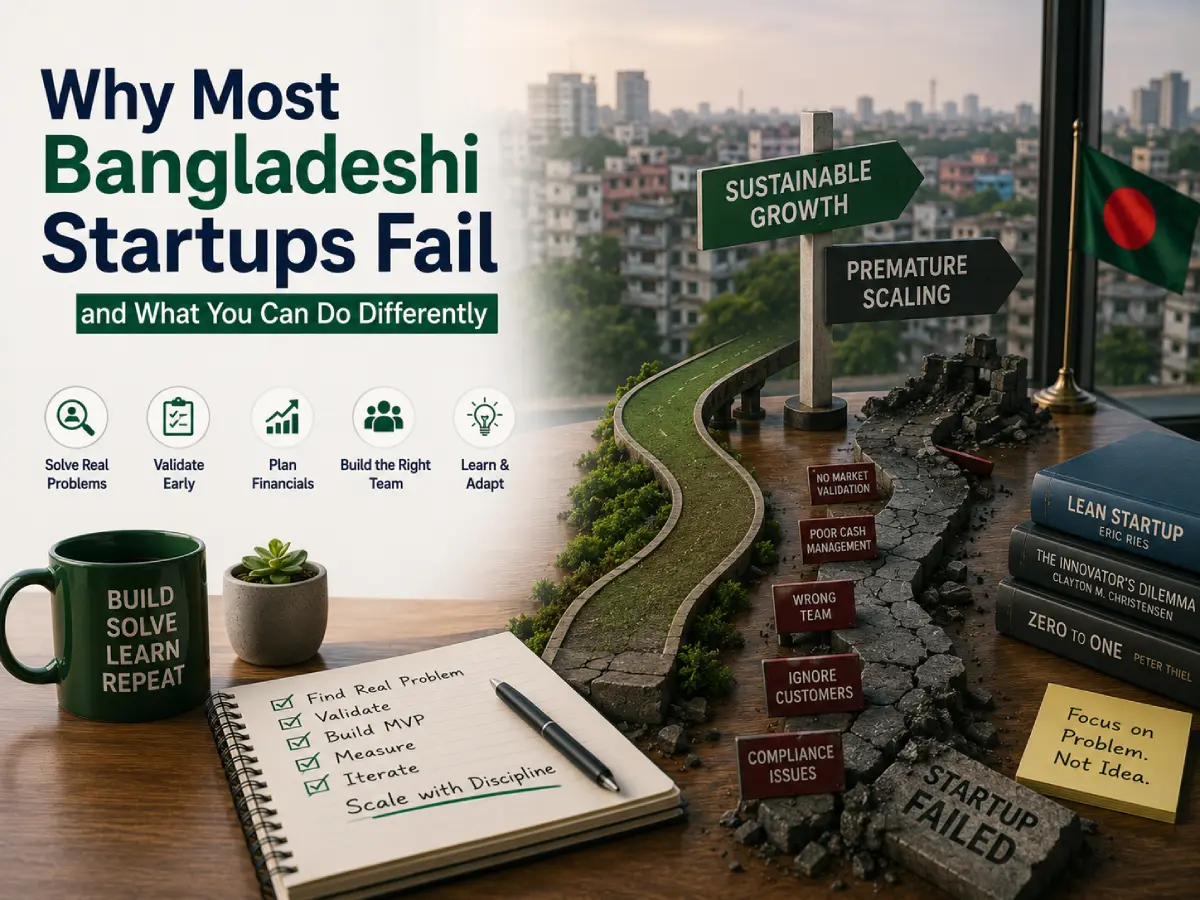
Why Most Bangladeshi Startups Fail — and What You Can Do Differently
Quick Answer: Most Bangladeshi startups fail because of poor market validation, weak financial planning, and founder-market mismatch, not lack of ideas or effort. The founders who survive focus on solving real problems, build lean, and learn from their market before scaling.
Customer Acquisition Strategies That Work for Bangladesh Startups
Quick Answer: The most effective customer acquisition strategies for Bangladesh startups combine low-cost digital channels (Facebook, WhatsApp Business, SEO), mobile financial service integration for frictionless payment, referral-driven growth, and hyperlocal targeting. Startups that blend paid acquisition with retention-focused tactics see the lowest long-term cost per customer.
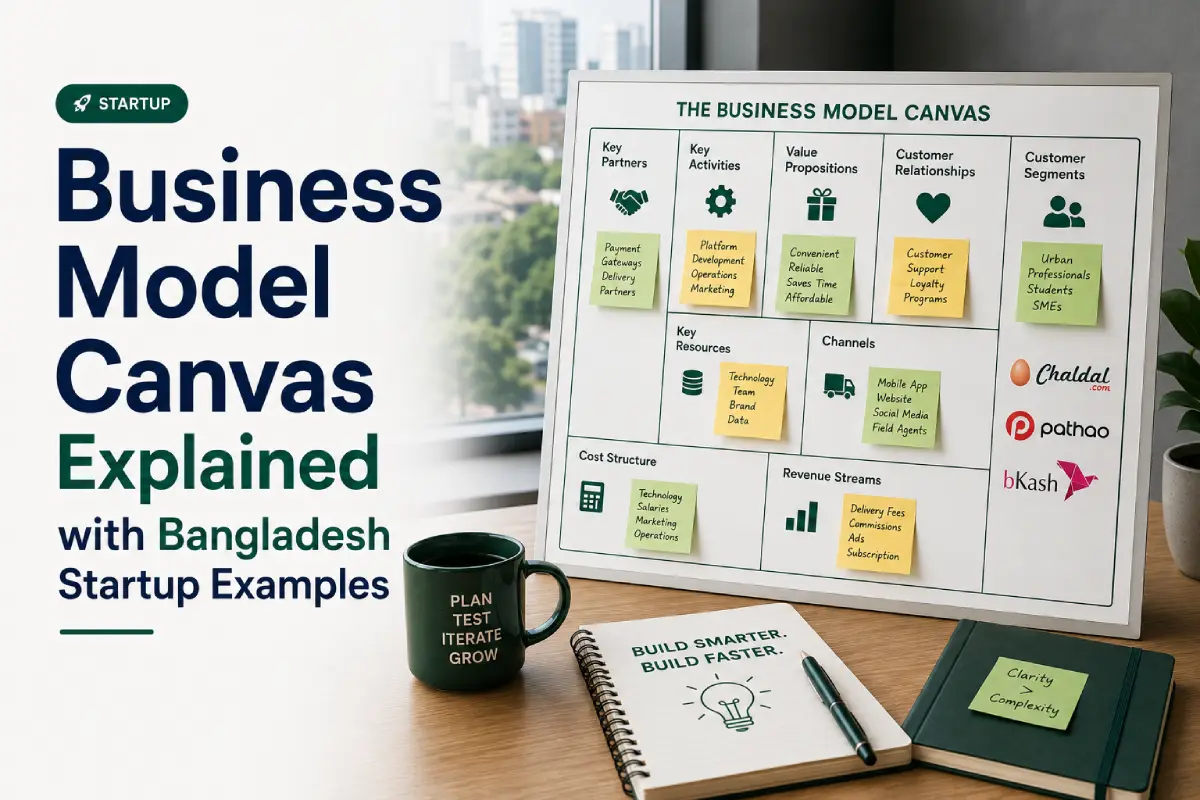
Business Model Canvas Explained with Bangladesh Startup Examples
Quick Answer: The Business Model Canvas (BMC) is a one-page strategic framework with 9 building blocks: Customer Segments, Value Propositions, Channels, Customer Relationships, Revenue Streams, Key Resources, Key Activities, Key Partnerships, and Cost Structure. It helps founders map, test, and communicate their entire business model before writing a single page of a business plan.
Comments (0)
No comments yet. Be the first to share your thoughts!