Customer Acquisition Strategies That Work for Bangladesh Startups
Quick Answer: The most effective customer acquisition strategies for Bangladesh startups combine low-cost digital channels (Facebook, WhatsApp Business, SEO), mobile financial service integration for frictionless payment, referral-driven growth, and hyperlocal targeting. Startups that blend paid acquisition with retention-focused tactics see the lowest long-term cost per customer.
Key Takeaways
Facebook and WhatsApp remain the highest-ROI acquisition channels for most early-stage Bangladeshi startups
Mobile financial services integration directly reduces checkout drop-off and improves conversion
Referral and community-driven growth outperform paid ads on a cost-per-customer basis
SEO and content marketing compound over time and reduce dependency on paid channels
Bangladesh-specific trust signals (local reviews, cash-on-delivery, Bangla-language support) heavily influence conversion rates
Getting a customer acquisition strategy right matters more in Bangladesh than in most markets, because margins are thin and paid advertising costs keep climbing while internet usage patterns shift month to month.
A founder who treats acquisition as "just run some Facebook ads" usually burns capital fast without building anything durable.
The startups that actually scale in Dhaka, Chattogram, or Sylhet tend to combine a few channels deliberately, track cost per customer from day one, and build in retention rather than chasing one-time sales.
This article breaks down the acquisition channels, budget approaches, and local realities that actually move the needle for Bangladeshi founders in 2026.
Why Customer Acquisition Works Differently in Bangladesh
Startups can't copy a US or Indian playbook and expect it to translate directly. Bangladesh has its own combination of payment behavior, trust barriers, and platform usage that shapes what actually converts.
Mobile financial services now sit at the center of commerce here. Bangladesh Bank's transaction data shows the sector processing well over a trillion taka a month, with account numbers continuing to climb past 239 million registered wallets across bKash, Nagad, Rocket and other providers.
Any acquisition funnel that doesn't account for MFS as a payment and even a marketing channel is leaving conversions on the table.
At the same time, internet access is not static. Bangladesh Telecommunication Regulatory Commission data shows subscriber numbers fluctuating month to month, recovering to around 131 million by April 2026 after a dip earlier in the year.
This means the addressable digital audience for a Bangladeshi startup grows unevenly, and acquisition plans built purely around raw reach numbers can be misleading if they're based on stale figures.
Trust also plays a bigger role here than in more mature e-commerce markets. Cash-on-delivery still dominates purchase decisions for first-time buyers, and reviews from other Bangladeshi customers carry more weight than brand messaging.
A strong online business strategy has to bake these trust factors in rather than treating them as an afterthought.
Low-Cost Digital Channels That Actually Convert
For most early-stage startups, budget is the binding constraint, not creativity. The channels below consistently deliver the best return for Bangladeshi founders working with limited marketing spend.
Facebook and Instagram
Facebook remains the default discovery platform for Bangladeshi consumers across nearly every age group and income bracket.
What separates startups that succeed here from those that don't is targeting discipline: hyperlocal audience segments by division or city, retargeting website visitors, and testing creative in Bangla alongside English.
Startups already running Facebook marketing in Bangladesh tend to see conversion improve once they pair ad spend with organic community posts rather than relying on ads alone.
WhatsApp Business and Messenger
Conversational commerce is quietly one of the highest-converting channels in the country.
Customers who message a business directly to ask about sizing, delivery time, or price negotiation convert at a far higher rate than those who simply browse a website.
Setting up automated but human-sounding replies, product catalogs, and quick payment links inside WhatsApp Business removes friction at exactly the point where hesitant buyers drop off.
Search Engine Optimization
Paid ads stop the moment the budget runs out. SEO keeps working. Startups that invest early in SEO tailored to Bangladeshi search behavior build a channel that compounds, particularly for informational and comparison-stage searches where buyers are still deciding.
This matters even more given the fluctuating internet subscriber base: organic search traffic is less exposed to sudden shifts in paid ad reach or platform algorithm changes than paid social.
Content and Community Marketing
Founders who publish genuinely useful content, whether that's a YouTube explainer, a blog post, or a Facebook group discussion, build acquisition assets that outlast any single campaign.
A documented content marketing approach for Bangladesh helps startups turn one piece of content into ongoing discovery traffic instead of a one-time post.
Referral and Word-of-Mouth Growth
Bangladeshi consumers trust people they know far more than they trust brand advertising. This makes referral programs unusually powerful here compared to markets where digital ad targeting is more mature and trust in brands is already established.
A working referral system doesn't need to be complicated. Simple mechanics work best: give the referrer and the new customer a small discount or credit, keep the redemption process to one or two steps, and make sharing possible directly inside WhatsApp or Messenger where conversations already happen.
Startups that build referral loops early often find their cost per acquired customer drops steadily as satisfied customers become an unpaid sales channel.
Local micro-influencers, particularly ones with a few thousand genuinely engaged followers in a specific city or niche, tend to outperform larger national influencers on a cost basis.
Their audiences are smaller but far more likely to trust a recommendation and actually convert.
Reducing Friction at Checkout and Payment
No acquisition strategy survives a broken checkout. A huge share of lost customers in Bangladesh happens not because the marketing failed, but because the payment or delivery process introduced doubt at the last step.
Integrating mobile financial services directly into checkout, rather than forcing customers to a separate payment page, reduces abandonment meaningfully. Given how dominant MFS platforms have become in daily transactions, a startup that makes bKash or Nagad payment feel native to the buying experience removes one of the biggest points of hesitation.
Cash-on-delivery should still be offered even for digitally-savvy startups, since many first-time buyers use it specifically to build trust before committing to prepaid transactions.
Startups running e-commerce operations should also revisit their eCommerce regulatory obligations early, since compliance issues discovered late can disrupt acquisition momentum right when a channel starts working.
Budget Allocation for Early-Stage Startups
Founders with limited runway often make the mistake of spreading a small budget across too many channels at once. A tighter approach works better in practice.
Start by putting most of the initial budget behind one or two channels that match where the target customer already spends time, rather than testing everything simultaneously.
Track cost per acquired customer weekly, not monthly, since early-stage budgets can't absorb a month of underperformance before adjusting.
Reinvest gains from the best-performing channel before expanding into a third or fourth channel.
It also helps to separate acquisition spend from retention spend from the outset. A startup that spends everything trying to acquire new customers but nothing keeping existing ones will keep paying the full acquisition cost repeatedly instead of letting repeat purchases lower the blended cost per customer over time.
Retention as a Growth Multiplier
Acquisition gets the attention, but retention determines whether a startup's growth is sustainable.
A repeat customer costs far less to serve than a new one, and in a market where paid channels are getting more competitive, retention becomes the difference between a startup that scales and one that plateaus.
Simple retention tactics work well in the Bangladeshi context: WhatsApp-based order updates, loyalty discounts for repeat purchases, and proactive customer service that resolves issues before they turn into public complaints on Facebook.
Startups thinking about long-term scaling in Bangladesh should treat retention infrastructure as seriously as acquisition spend, since it's what lets acquisition budgets go further as the customer base grows.
Frequently Asked Questions
What is the cheapest way to acquire customers for a startup in Bangladesh?
How important is Facebook advertising for Bangladeshi startups?
Should new startups offer cash on delivery?
How does mobile financial services integration affect conversion rates?
Is SEO worth investing in for an early-stage Bangladeshi startup?
What role do referral programs play in customer acquisition?
Building an Acquisition Strategy That Actually Lasts
Customer acquisition in Bangladesh rewards founders who treat it as a system rather than a series of disconnected campaigns.
The channels that work best (Facebook, WhatsApp, SEO, referral) all compound when they reinforce each other instead of competing for the same limited budget.
Startups that pair this with frictionless MFS-based checkout and a genuine retention plan end up spending less per customer over time, not more.
The founders who struggle are usually the ones chasing whichever channel is trending rather than building around how Bangladeshi customers actually discover, trust, and buy.
Start with one or two channels that fit the target customer's actual behavior, measure cost per customer honestly every week, and let retention do some of the acquisition work once the first wave of customers is happy.
That combination, more than any single tactic, is what separates startups that scale from those that stall out after the first burst of sales.

Specializing in SaaS product marketing, SEO strategy, Content marketing, TikTok advertising, PPC, and digital growth.
View Full Profile & ContributionsRelated Articles
Why Most Bangladeshi Startups Fail — and What You Can Do Differently
Quick Answer: Most Bangladeshi startups fail because of poor market validation, weak financial planning, and founder-market mismatch, not lack of ideas or effort. The founders who survive focus on solving real problems, build lean, and learn from their market before scaling.
Business Model Canvas Explained with Bangladesh Startup Examples
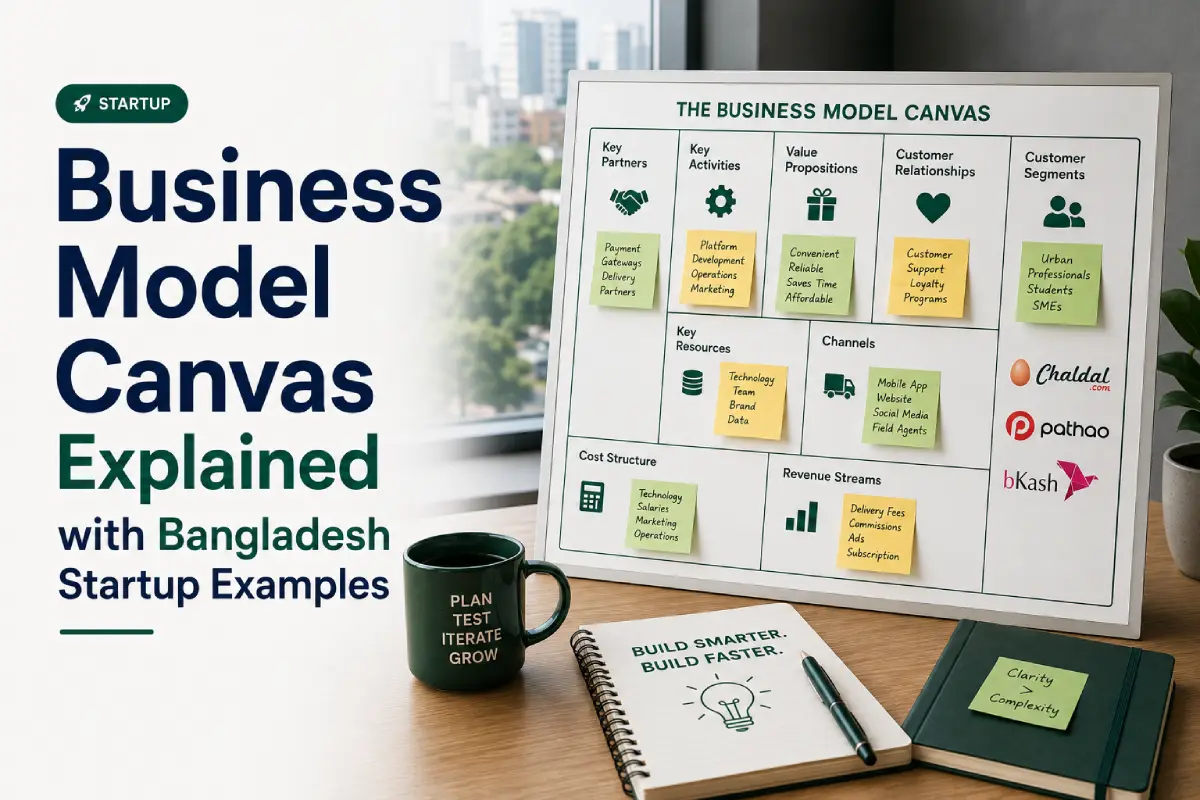
Quick Answer: The Business Model Canvas (BMC) is a one-page strategic framework with 9 building blocks: Customer Segments, Value Propositions, Channels, Customer Relationships, Revenue Streams, Key Resources, Key Activities, Key Partnerships, and Cost Structure. It helps founders map, test, and communicate their entire business model before writing a single page of a business plan.
How to Validate a Startup Idea in Bangladesh Before Spending Money
Quick Answer: To validate a startup idea in Bangladesh, first confirm the problem is real by talking to at least 20 potential customers. Then test your solution cheaply, through a landing page, a manual service, or a small pilot, and measure whether people take action. Validation means real behavior, not opinions or enthusiasm.
Comments (0)
No comments yet. Be the first to share your thoughts!