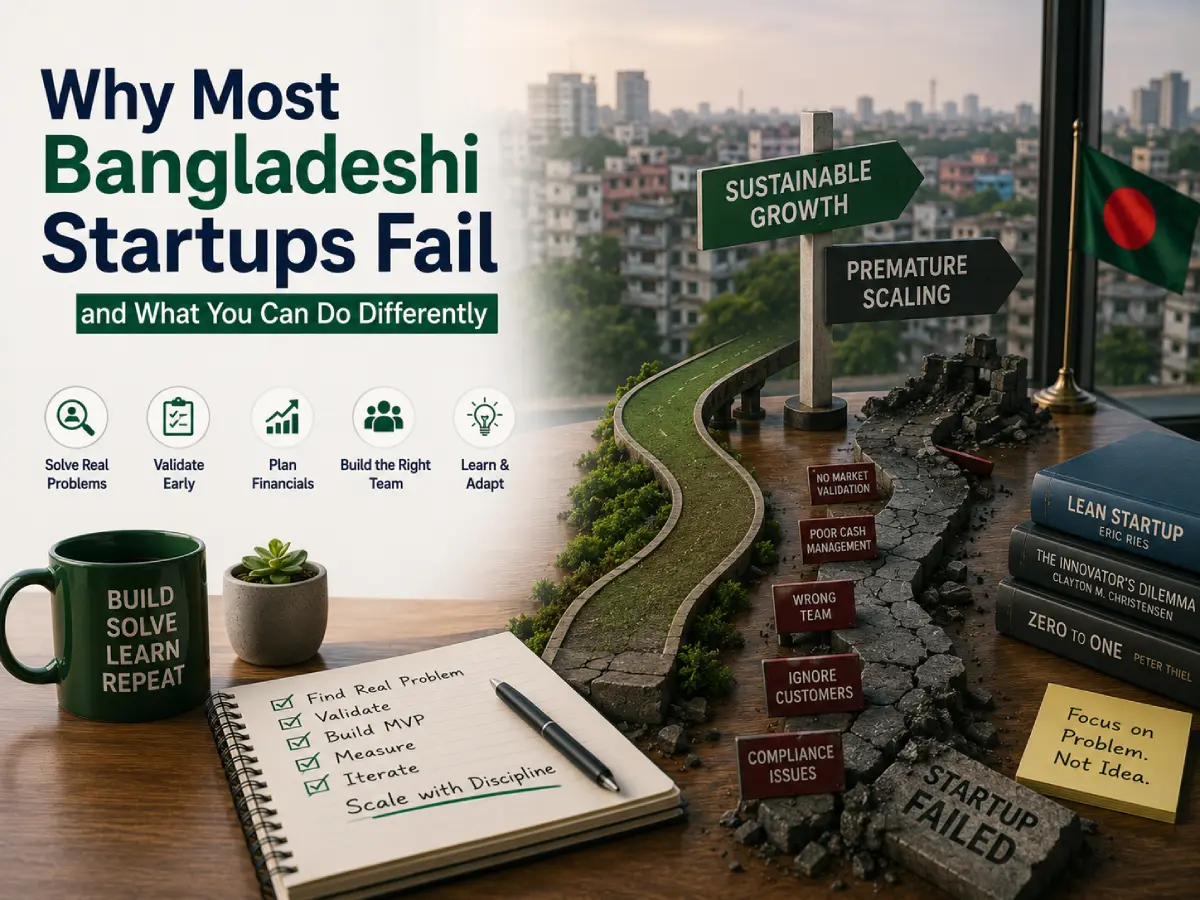
Why Most Bangladeshi Startups Fail — and What You Can Do Differently
Quick Answer: Most Bangladeshi startups fail because of poor market validation, weak financial planning, and founder-market mismatch, not lack of ideas or effort. The founders who survive focus on solving real problems, build lean, and learn from their market before scaling.
Key Takeaways
Over 90% of startups globally fail, and Bangladesh's ecosystem reflects similar or steeper rates due to structural challenges
Premature scaling before product-market fit is one of the top killers of early-stage Bangladeshi startups
Most founders skip proper market validation because they fall in love with their idea, not the problem
Access to formal funding is limited in Bangladesh, making cash flow discipline a survival skill
Founders who engage with the Bangladesh Investment Development Authority and understand the regulatory environment from day one avoid costly surprises later
Starting a business in Bangladesh has never been easier on paper. The country's young population, growing internet penetration, and expanding middle class make it look like fertile ground for startups. And in many ways, it is.
But here is the uncomfortable truth: the vast majority of new ventures in Bangladesh shut down within their first three years, and some run out of money.
Some built something nobody wanted. Others collapse under the weight of co-founder conflicts, regulatory blindsides, or markets that turned out to be much smaller than expected.
This is not a Bangladesh-specific tragedy. It mirrors startup failure patterns worldwide. But the reasons behind failure here carry a local texture that generic startup advice misses entirely.
This article breaks down the real reasons Bangladeshi startups fail, and more importantly, what you can do right now to build differently.
The Validation Trap: Building Before Listening
The single most common failure pattern is also the most avoidable: founders build before they validate.
You have an idea. It feels urgent, obvious, and exciting. So you spend six months building a product, hire a small team, launch it, and wait for customers to come. They don't.
This happens constantly in Bangladesh's tech and e-commerce startup space. Founders confuse their own enthusiasm with market demand.
They pitch to investors before they have spoken to even 20 potential customers. They build features instead of testing assumptions.
The fix is not complicated, but it requires ego discipline. Before writing a single line of code or registering your business, spend four to six weeks doing structured customer discovery. Not surveys.
Actual conversations. Ask people about their current behavior, not what they "would" do. Pay attention to what they already spend money on to solve the problem you think you are solving.
In the Dhaka startup ecosystem, especially, where everyone seems to know everyone, it is tempting to validate within your own social circle. That is confirmation bias wearing a friendly face.
Go outside your network. Talk to the street vendor, the SME owner in Mirpur, the garment worker in Ashulia. Your market is probably not your friends.
The Money Problem Nobody Wants to Talk About
Bangladesh's formal startup funding ecosystem is still young. Outside a handful of accelerators and a small group of angel investors, early-stage capital is hard to come by for most founders who are not already well-connected.
This creates a real structural problem. Founders bootstrap, stretch personal savings, and often bring in family money without treating it with the discipline it deserves.
When revenue does not come as fast as expected (it never does), the business starts hemorrhaging cash, and the founder's personal life bleeds into the damage.
The Bangladesh Bank's SME development framework outlines several loan products designed for small businesses and startups, but accessing them requires documentation that early-stage founders often have not organized.
Getting registered, maintaining basic accounts, and understanding your cash position monthly is not optional financial hygiene; it is survival infrastructure.
Practical rules for cash management when bootstrapping:
Calculate your runway at all times. Know exactly how many months you can operate with zero new revenue
Separate personal and business finances from day one, even if it feels unnecessary at the early stage
Delay every cost that does not directly produce revenue or validate your core assumption
Charge for your product earlier than feels comfortable
Giving your product away for free to build a "user base" is a strategy that works in very specific contexts. For most Bangladeshi startups, it delays the only feedback that matters: whether someone values what you built enough to pay for it.
Regulatory Reality and the Cost of Ignoring It
Many founders in Bangladesh treat the legal and regulatory setup as a back-burner task, something to "figure out later." This approach has ended promising businesses abruptly.
Operating without proper registration, ignoring VAT obligations, or misunderstanding sector-specific licensing requirements creates compounding liability.
The Registrar of Joint Stock Companies and Firms (RJSC) handles company incorporation in Bangladesh, and the process is more accessible now than it was five years ago. But incorporation is just the beginning.
Depending on your sector, you may need additional licenses from BIDA, clearances from the Ministry of Commerce, or compliance with NBR guidelines on VAT and income tax. The National Board of Revenue's e-tax portal is the starting point for understanding your tax obligations as a business entity.
Founders who treat compliance as an early investment rather than an obstacle build businesses that can scale, attract legitimate investors, and operate without the anxiety of irregular status.
The founders who ignore it often find themselves unable to open business bank accounts, issue proper invoices, or close deals with corporate clients who require verified vendor documentation.
The Co-founder and Team Problem
Bangladesh's startup scene has produced some notable co-founder fallouts, most of which never make it into the press. Two friends with complementary skills decide to build together, skip any formal discussion about equity, roles, or what happens if one person wants to exit, and launch with a handshake.
Six months later, when the business is struggling and stress is high, those unspoken agreements become explosive disagreements.
Treating your co-founder relationship with the same seriousness as a business contract is not a sign of distrust. It is the opposite. It means you respect the relationship enough to protect it with clarity.
At minimum, agree on equity split (and document it), define decision-making authority for different areas, discuss what happens if one founder wants to leave, and be honest about how much each person can commit financially and time-wise in the first year.
The same logic applies to early hires. Bringing on team members because they are available, affordable, or a friend of a friend, without assessing whether they genuinely fit the role and the stage of the company, is a pattern that slows down startups far more than most founders admit.
Scaling Before the Foundation Is Set
The startup narrative rewards speed. Move fast, scale fast, raise more, grow headcount. This works in ecosystems with deep capital pools and large markets.
In Bangladesh, it regularly destroys startups that would have survived if they had stayed lean for longer.
Scaling means amplifying whatever is already working. If your unit economics are broken (you lose money on every transaction, your customer acquisition cost is higher than lifetime value, or your retention is poor), scaling only amplifies those losses. You burn more money faster.
A healthier framework: before you think about scaling, ask whether you can consistently acquire customers at a cost lower than what they pay you over their lifetime, whether your core operation can handle 3x volume without breaking, and whether your existing customers are coming back.
If the answer to any of these is unclear, scaling is premature.
Frequently Asked Questions
What is the main reason startups fail in Bangladesh?
How can I get funding for my startup in Bangladesh?
Do I need to register my startup before testing my idea?
How do I know if I have found product-market fit in Bangladesh?
What sectors have the most startup success in Bangladesh?
How do I handle co-founder disputes before they become a crisis?
Build for the Market You Actually Have
Bangladesh's startup ecosystem is still being built. The infrastructure, capital, and talent pipeline are growing, but they are not yet forgiving of the same mistakes that well-funded Silicon Valley startups can absorb and recover from.
That is actually an advantage in disguise. It forces discipline.
The founders who succeed here are not necessarily the ones with the boldest vision. They are the ones who validate relentlessly, manage money carefully, comply early, build teams with intention, and scale only when the foundation justifies it.
The ecosystem does not need more startups. It needs more startups that last. Build something that solves a real problem for real people in Bangladesh, charge for it honestly, and run it with the financial and legal hygiene it deserves. That approach is less glamorous than the growth-hack playbook, but it is what actually works here.

Specializing in SaaS product marketing, SEO strategy, Content marketing, TikTok advertising, PPC, and digital growth.
View Full Profile & ContributionsRelated Articles

Customer Acquisition Strategies That Work for Bangladesh Startups
Quick Answer: The most effective customer acquisition strategies for Bangladesh startups combine low-cost digital channels (Facebook, WhatsApp Business, SEO), mobile financial service integration for frictionless payment, referral-driven growth, and hyperlocal targeting. Startups that blend paid acquisition with retention-focused tactics see the lowest long-term cost per customer.
Business Model Canvas Explained with Bangladesh Startup Examples
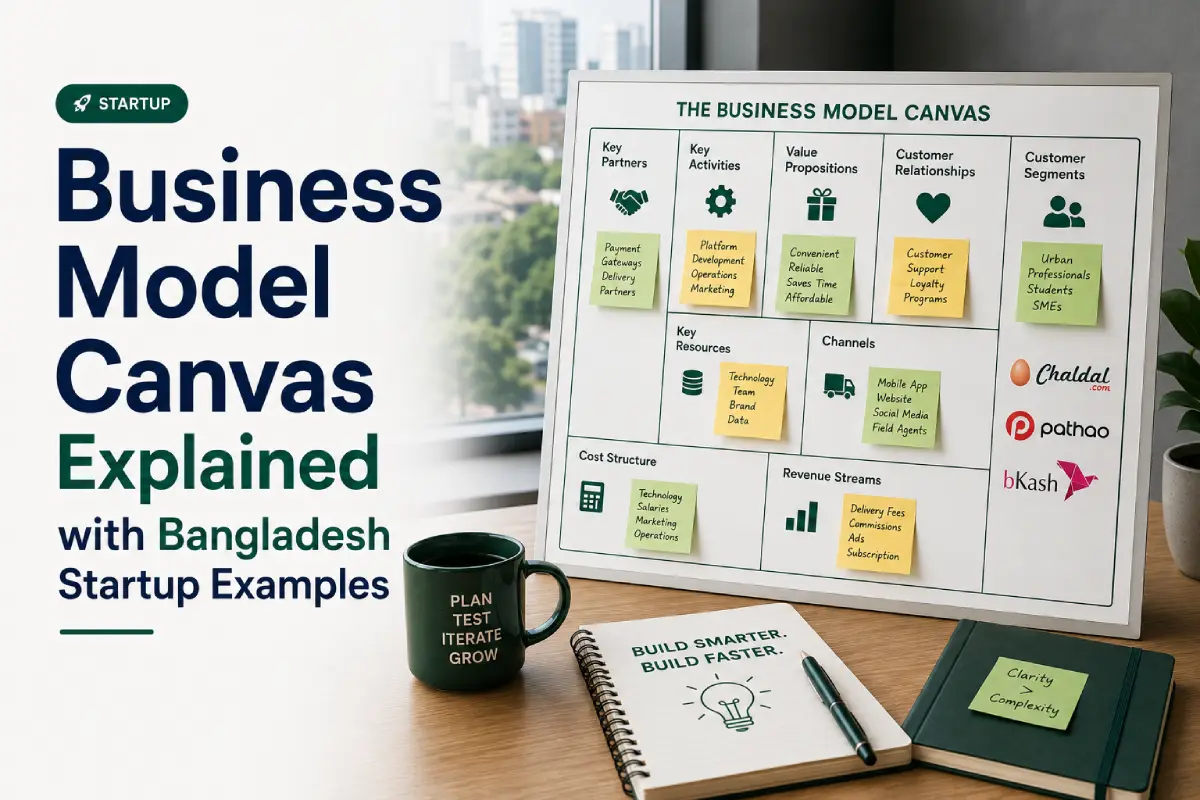
Quick Answer: The Business Model Canvas (BMC) is a one-page strategic framework with 9 building blocks: Customer Segments, Value Propositions, Channels, Customer Relationships, Revenue Streams, Key Resources, Key Activities, Key Partnerships, and Cost Structure. It helps founders map, test, and communicate their entire business model before writing a single page of a business plan.
How to Validate a Startup Idea in Bangladesh Before Spending Money
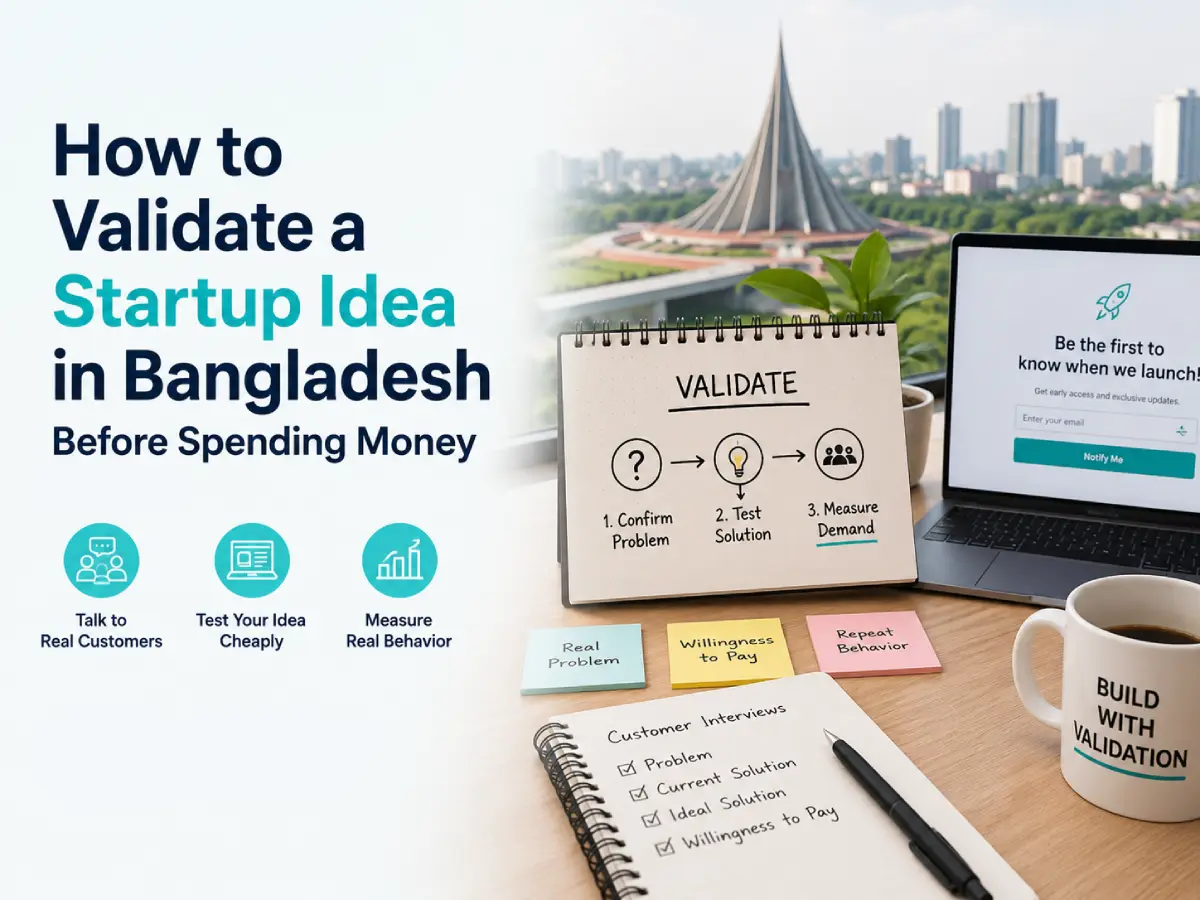
Quick Answer: To validate a startup idea in Bangladesh, first confirm the problem is real by talking to at least 20 potential customers. Then test your solution cheaply, through a landing page, a manual service, or a small pilot, and measure whether people take action. Validation means real behavior, not opinions or enthusiasm.
Comments (0)
No comments yet. Be the first to share your thoughts!