Business Model Canvas Explained with Bangladesh Startup Examples
Quick Answer: The Business Model Canvas (BMC) is a one-page strategic framework with 9 building blocks: Customer Segments, Value Propositions, Channels, Customer Relationships, Revenue Streams, Key Resources, Key Activities, Key Partnerships, and Cost Structure. It helps founders map, test, and communicate their entire business model before writing a single page of a business plan.
Key Takeaways
The Business Model Canvas condenses your entire business strategy onto a single visual page
All 9 blocks are interconnected; changing one affects the others
Bangladesh startups like Chaldal, Pathao, and bKash are built on distinct, mappable BMC logic
The BMC is a living tool, not a one-time exercise; revise it as your startup evolves
Founders registered through BIDA benefit from using BMC to present models clearly to investors and partners
Most Bangladeshi startup founders spend weeks writing business plans that no investor reads past page three. The Business Model Canvas solves that problem.
Developed by Alexander Osterwalder and Yves Pigneur, the BMC gives you a structured, visual way to design your business model on a single sheet. It forces clarity. You cannot hide weak logic behind paragraphs of prose when you only have nine boxes to fill.
For founders building in Bangladesh, the BMC is especially useful because local market conditions change fast.
Customer behavior in Dhaka differs from Chattogram. Logistics constraints shift seasonally. A framework you can update in 30 minutes beats a 40-page plan that takes three weeks to revise.
This article explains each block, then maps it to real Bangladesh startup examples so you can see what good BMC thinking actually looks like in practice.
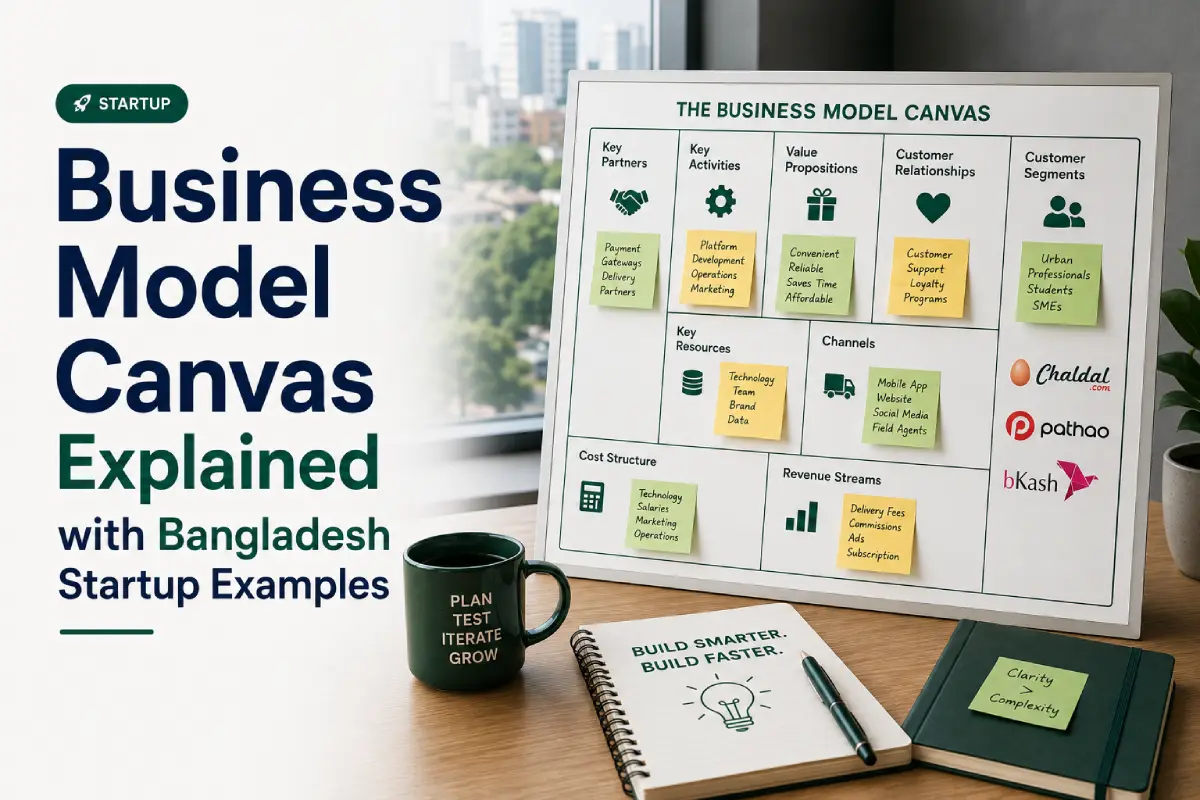
What Is the Business Model Canvas
The Business Model Canvas is a strategic management template that visualizes how a company creates, delivers, and captures value.
It was introduced in Osterwalder's 2010 book Business Model Generation and has since become the standard tool in startup accelerators, MBA programs, and investor pitch prep worldwide.
The canvas is divided into nine blocks arranged across four areas:
Desirability (left side): what customers want and how you reach them
Viability (right side): how you make money
Feasibility (center): what you need to deliver
Profitability (bottom): the financial logic that holds it together
The entire framework fits on one page. That constraint is the point. If you cannot explain your business model in nine boxes, you have not yet understood it clearly enough to execute it.
The 9 Blocks of the Business Model Canvas
Here is what each block covers and what Bangladeshi founders most often get wrong:
Customer Segments: Who exactly are you serving? "Everyone" is not a segment. Chaldal started with urban Dhaka households who had internet access and disposable income. That specificity drove every other decision.
Value Propositions: What problem do you solve, and why does your solution beat the alternative? For Pathao, the value proposition in its early ride-hailing phase was simple: faster, cheaper urban mobility than CNGs, bookable from a phone.
Channels: How do customers discover, buy, and receive your product? In Bangladesh, mobile-first channels dominate. WhatsApp, Facebook, and app stores are often more effective than websites alone.
Customer Relationships: How do you acquire and retain customers? bKash built retention through habit formation: once your salary arrives via bKash, your entire financial behavior follows.
Revenue Streams: How does money flow in? Transaction fees, subscriptions, commissions, and service charges are all distinct models with different unit economics.
Key Resources: What assets make your model work? For Chaldal, this is warehouse infrastructure and a managed cold chain. For a SaaS startup, it is code and engineers.
Key Activities: What do you do every day to deliver the value proposition? Pathao's core activity is marketplace liquidity management: enough drivers online at the right times.
Key Partnerships: Who do you rely on that you do not own? Chaldal partners with FMCG suppliers. bKash built its agent network through partnerships with local retailers and the Bangladesh Bank's mobile financial service framework.
Cost Structure: What are your highest costs? Knowing whether your business is cost-driven or value-driven shapes every pricing and hiring decision.
How Bangladesh Startups Map to the BMC
Looking at real local examples makes the framework click faster than any abstract explanation.
Chaldal (Grocery Delivery) Chaldal's customer segment is time-poor, urban, middle-class households. Its value proposition is same-hour grocery delivery without the chaos of a market visit.
Key resources are its Dhaka-based dark stores (micro-warehouses) positioned for last-mile speed. Revenue comes from product markups and delivery fees. Its highest cost is warehouse operations and rider logistics.
The BMC for Chaldal is a masterclass in how physical infrastructure becomes a competitive moat.
Pathao (Ride-Hailing and Logistics) Pathao started as a ride-hailing app and expanded into food delivery and parcel logistics. Its customer segments are distinct: commuters, restaurants, and eCommerce sellers.
Each segment has its own value proposition. This is a multi-sided platform model, where the BMC must account for the interaction between supply-side partners (drivers, restaurants) and demand-side users.
Key partnerships with local restaurants and the growing eCommerce sector became central to revenue diversification.
bKash (Mobile Financial Services) operates what the BMC framework calls a "freemium-to-transactional" model. The product is free to access, but charges for cash-out and transfers. Customer segments span unbanked rural users, urban professionals, and businesses.
Its key resource is its agent network across Bangladesh, which sits at over 300,000 points as of the company's published figures.
Regulatory alignment with Bangladesh Bank's mobile financial services policy is itself a key partnership that smaller competitors cannot easily replicate.
How to Fill Out a BMC for Your Bangladesh Startup
Start from the customer, not the product. Most founders make the mistake of beginning with Key Activities or Revenue Streams. The right sequence is:
Define your Customer Segments first, with brutal specificity
Write your Value Proposition for each segment
Map your Channels to reach them
Define the Customer Relationships required to keep them
Build out Revenue Streams from what customers will actually pay for
Work backwards to identify Key Resources, Key Activities, and Key Partnerships
Sum the Cost Structure last, once the model is clear
Use a whiteboard or a free digital tool like Miro or Canva's BMC template. Fill it in pencil, not pen. Your first version will be wrong. That is expected. The BASIS startup support ecosystem connects founders with mentors who can review and pressure-test your canvas before you take it to investors.
Revisit your BMC every quarter, or any time a major assumption breaks.
Frequently Asked Questions
Is the Business Model Canvas the same as a business plan?
Can a small business or sole trader in Bangladesh use the BMC?
How long does it take to complete a Business Model Canvas?
What is the biggest mistake Bangladeshi founders make with the BMC?
Do investors in Bangladesh expect to see a Business Model Canvas?
How is the BMC different from a SWOT analysis?
Start with One Page, Build from There
The Business Model Canvas does not replace strategic thinking. It organizes it. For founders in Bangladesh navigating fast-moving markets, regulatory considerations, and limited early capital, having a clear one-page model is not a nice-to-have; it is a decision-making tool you will return to constantly.
Map your canvas today. Show it to someone who will challenge every assumption. Then revise it. The founders behind Chaldal, Pathao, and bKash did not get their models right on the first draft. They got them right by iterating faster than anyone else.
That is what the Business Model Canvas enables. Not perfection on day one, but clarity at every stage.

Specializing in SaaS product marketing, SEO strategy, Content marketing, TikTok advertising, PPC, and digital growth.
View Full Profile & ContributionsRelated Articles
Why Most Bangladeshi Startups Fail — and What You Can Do Differently
Quick Answer: Most Bangladeshi startups fail because of poor market validation, weak financial planning, and founder-market mismatch, not lack of ideas or effort. The founders who survive focus on solving real problems, build lean, and learn from their market before scaling.

Customer Acquisition Strategies That Work for Bangladesh Startups
Quick Answer: The most effective customer acquisition strategies for Bangladesh startups combine low-cost digital channels (Facebook, WhatsApp Business, SEO), mobile financial service integration for frictionless payment, referral-driven growth, and hyperlocal targeting. Startups that blend paid acquisition with retention-focused tactics see the lowest long-term cost per customer.
How to Validate a Startup Idea in Bangladesh Before Spending Money
Quick Answer: To validate a startup idea in Bangladesh, first confirm the problem is real by talking to at least 20 potential customers. Then test your solution cheaply, through a landing page, a manual service, or a small pilot, and measure whether people take action. Validation means real behavior, not opinions or enthusiasm.
Comments (0)
No comments yet. Be the first to share your thoughts!