The Role of SMEs in Bangladesh in 2026: Growth, Challenges, and Future Outlook
Quick Answer: SMEs in Bangladesh make up over 90% of all industrial units, employ around 30.6 million people, and contribute approximately 25% of GDP. In 2026, the sector continues to grow at roughly 6% annually, but persistent challenges around access to finance, informality, and low productivity mean that scale and quality remain elusive for most enterprises.
Key Takeaways
The Bangladesh Bureau of Statistics Economic Census 2024 recorded 11.7 million economic units, up nearly 50% from 2013.
SMEs account for around 25% of GDP, well below the 32% target set in the SME Policy 2019.
Over 56% of MSMEs operate informally, limiting their access to credit and formal support.
The IFC estimates Bangladesh's SME financing gap at 19% of GDP.
The SME Foundation proposed a unified Preferential Tax Regime ahead of the 2026-27 national budget to simplify compliance for small businesses.
SMEs in Bangladesh are everywhere. The neighbourhood tailor, the small food processor supplying a regional supermarket chain, the ceramic workshop in Rajshahi, the IT services firm in Sylhet. Collectively, these businesses are not just economic activity; they are the skeleton of Bangladesh's private sector.
Yet the numbers tell a more complicated story. The sector is vast, growing, and undeniably important.
It is also informal, underfinanced, and operating far below its productive potential. Understanding this tension is essential for anyone running, investing in, or building policy around small and medium enterprises in Bangladesh right now.
What SMEs Actually Contribute to Bangladesh's Economy
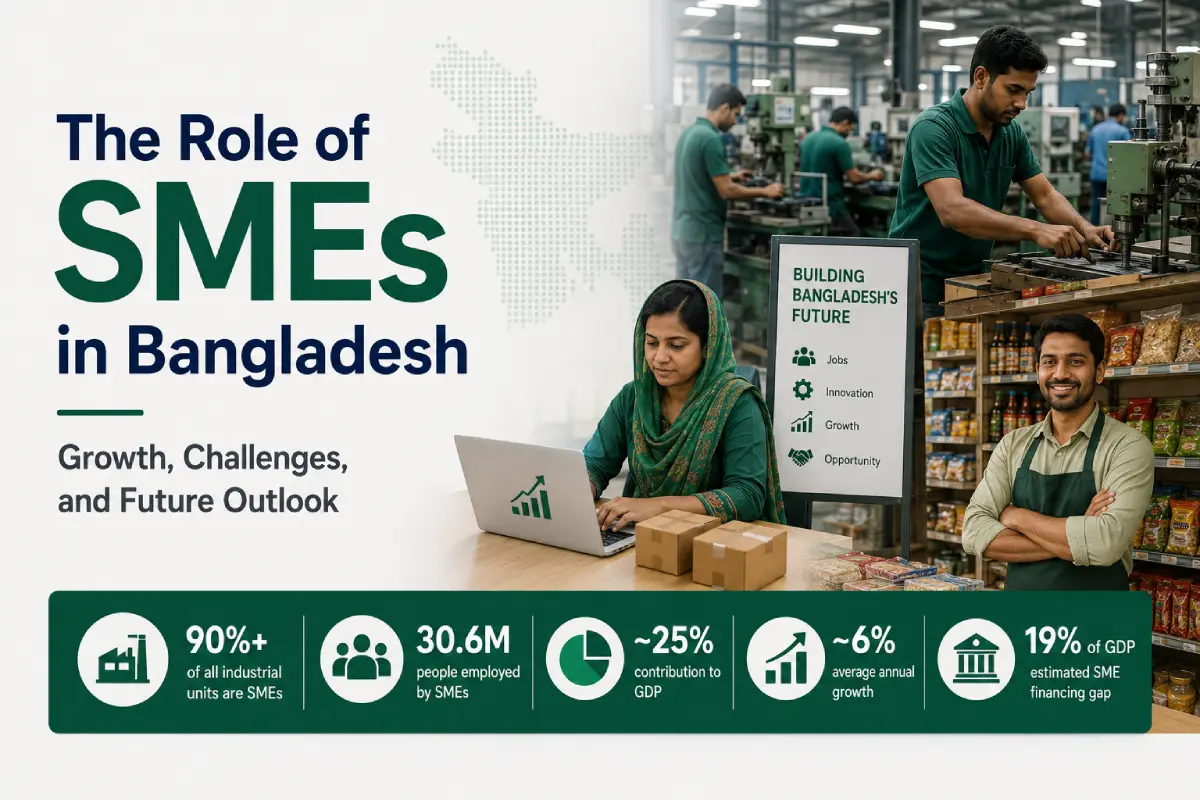
The Bangladesh Bureau of Statistics Economic Census 2024 recorded 11.7 million economic units across the country, a 49.68% jump from the 7.8 million counted in 2013. Total employment across these units reached 30.6 million people, reflecting a 25% rise over the same period.
CMSMEs, which cover cottage, micro, small, and medium enterprises, account for 90% of all industrial units and roughly 80% of non-agricultural employment, according to the Planning Division of Bangladesh. Their share of manufacturing value added stands at 45%.
On GDP contribution, the figure consistently cited is around 25%. A Bangladesh Bank study from 2022 put it at 24.45%. The government's own SME Policy 2019 set a target of raising that share to 32% by 2024. That target was not met.
For context, Indonesia's SMEs contribute around 59% to GDP. Vietnam contributes roughly 50%. Bangladesh's SMEs produce significantly less per enterprise. The Bangladesh Economic Review 2024, published by the Ministry of Finance, confirms that SME financing and support disbursement have been growing, but the structural productivity gap persists.
Structural Challenges Holding the Sector Back
The three problems that have defined SMEs in Bangladesh for a decade remain largely unchanged in 2026: informality, limited access to finance, and low productivity.
Informality is the root constraint. The Economic Census 2024 found that over 56% of MSMEs operate outside formal registration. Unregistered businesses cannot access institutional credit, cannot benefit from government stimulus packages, and have no digital financial footprint. Without a credit history or registered address, they remain invisible to banks.
Financing is chronically insufficient. The World Bank's assessment of MSME financing in Bangladesh estimates the SME financing gap at 19% of GDP. Roughly 39% of MSMEs are financially constrained, and fewer than 40% have meaningful access to formal credit. Banks disburse around 20% of total loans to SMEs, but the bulk of that goes to medium enterprises, not cottage or micro businesses.
Productivity lags behind regional peers. The output per SME in Bangladesh averages around $9,266 annually, compared to $225,287 per SME in Vietnam. That gap is not just a number; it reflects differences in technology adoption, workforce skill levels, market access, and product diversification. Most Bangladeshi SMEs remain concentrated in trading and retail, with limited movement into manufacturing or value-added services.
Government Policies and Support Frameworks in 2026
Bangladesh Bank has been the most active institution in SME financing. Its SME and Special Programmes Department runs multiple refinancing schemes, a Credit Guarantee Scheme (CGS) of BDT 20 billion for cottage and small enterprises, and a dedicated Start-up Fund for new entrepreneurs. Banks have been directed to increase their CMSME loan portfolios to 25% of total disbursements.
The SME Foundation, which operates under the Ministry of Industries, has stepped up its advocacy role. Ahead of the 2026-27 national budget, it submitted a proposal to the National Board of Revenue to establish a Preferential Tax Regime (PTR) for MSMEs, consolidating scattered tax and VAT benefits into a single, simplified framework. If implemented, this would be a meaningful improvement for the large share of entrepreneurs who lack the resources to navigate fragmented compliance systems.
BIDA continues to work on improving the business environment for formal enterprises, but the gap between BIDA's mandate and the realities of micro-enterprises remains wide.
Where the SME Sector Is Heading
Three forces are reshaping the SME landscape in Bangladesh right now.
Digitisation is gradually changing how small businesses operate. Mobile financial services have given millions of micro-entrepreneurs access to basic financial tools. E-commerce platforms have opened new sales channels for rural producers. The expansion of agent banking into sub-districts is slowly broadening the credit access frontier.
Bangladesh's LDC graduation in November 2026 will end duty-free export preferences in several markets. For export-oriented SMEs, particularly those in processed food, leather goods, and handicrafts, this is a genuine risk. Adapting to new trade terms will require investment in product quality, certifications, and international marketing; capabilities most small enterprises currently lack.
Workforce quality and skills gaps remain a drag. Most CMSMEs rely on semi-skilled workers and invest minimally in training. Without addressing this, the sector will continue to compete on price alone, a race that smaller, less-capitalized firms eventually lose.
Frequently Asked Questions
How many SMEs are there in Bangladesh in 2026?
What percentage of GDP do SMEs contribute to Bangladesh?
What are the biggest challenges facing SMEs in Bangladesh?
How does Bangladesh Bank support SME financing?
What is the SME Foundation's role in Bangladesh?
Will Bangladesh's LDC graduation affect SMEs?
The Real Work Starts at the Enterprise Level
SMEs in Bangladesh carry real weight: 11.7 million units, 30 million workers, and a quarter of national income. That is a foundation. It is not yet the engine it could be.
The sector's growth rate of roughly 6% annually shows momentum, but growth in numbers alone does not solve the underlying issues of informality, poor productivity, and credit exclusion. What Bangladesh needs from its SME sector is not just more enterprises; it is better-equipped, more formally integrated, and more productive ones.
For entrepreneurs operating in this space in 2026, the most actionable steps remain the same: formalise your business with RJSC, build a documented financial record, and engage with Bangladesh Bank's existing SME refinancing schemes. Policy improvement takes time. Positioning your business to benefit from it should not wait.

Specializing in SaaS product marketing, SEO strategy, Content marketing, TikTok advertising, PPC, and digital growth.
View Full Profile & ContributionsRelated Articles
The Innovation of Tanvir A. Mishuk: From Fintech Pioneer to AI Entrepreneur
Tanvir A. Mishuk is a fintech entrepreneur recognised for advancing digital financial inclusion in Bangladesh through innovations like e-KYC and USSD based banking access. He has since founded App AI Pty Ltd, an artificial intelligence company based in Australia, applying lessons from financial technology to a new generation of AI driven solutions.
HealthTech in Bangladesh: Opportunities, Regulations, and Early-Stage Players
HealthTech in Bangladesh covers telemedicine, e-pharmacy, diagnostics logistics, and digital health records serving a population with limited doctor access outside major cities. No single unified health-tech law exists yet; founders answer to DGDA, BMDC, and DGHS depending on the product. Early movers like Praava Health and Arogga built durable models around trust and last-mile delivery, not app polish.
What is Social Entrepreneurship in Bangladesh 2026
Quick Answer: Social entrepreneurship in Bangladesh means building a self-sustaining business that solves a social problem, whether poverty, illiteracy, healthcare access, or climate vulnerability, without relying on charity. Bangladesh pioneered this model globally through Grameen Bank and BRAC, and the approach continues to grow across health, agriculture, and clean energy in 2026.
Comments (0)
No comments yet. Be the first to share your thoughts!