How to Fund Your Startup in Bangladesh: All Realistic Options Compared
Startups in Bangladesh can raise capital through five realistic channels: personal savings and family support, bank loans backed by Bangladesh Bank refinance schemes, government equity funds like Startup Bangladesh Limited, angel investors and venture capital, and a small but growing pool of grants and accelerator programs. Most founders combine two or three of these rather than relying on one alone.
Key Takeaways
Bangladesh Bank's 2025 master circular lets banks lend startups up to Tk 8 crore at a capped 4 percent interest rate.
Startup Bangladesh Limited and the new BSIC fund invest as equity, not loans, so founders avoid repayment obligations.
Bangladesh Angels Network fills the gap between personal savings and formal venture capital, with checks from 50,000 to 500,000 dollars.
Crowdfunding is legal but still small in Bangladesh, so relationship-based capital still dominates early rounds.
Proper business registration is a precondition for nearly every formal funding route covered here.
Every founder in Bangladesh eventually asks the same question. Where does the money actually come from?
Validating the idea, registering the business, and building something people will pay for usually come first. But once a business is real, funding your startup in Bangladesh becomes the next hard decision, because the financing landscape here looks nothing like the venture-heavy startup culture in Silicon Valley or Bangalore.
Bangladesh does not lack capital entirely, but it distributes it unevenly. Bank loans remain the biggest pool of money by far. Angel investors are a small and tightly connected group. Pure equity crowdfunding barely exists in practice.
Government-backed vehicles have expanded fast since 2025, adding routes that did not exist even two years ago. This guide compares every realistic option so you can figure out which one fits your stage, your sector, and how much control you are willing to give up.
Start With What You Already Have: Bootstrapping and Founder Networks
For most Bangladeshi founders, the first money in the business is their own.
Savings, a family loan, or income from a day job usually covers the first six to twelve months. This bootstrapped phase is where you test the product and build the early traction that later investors want to see.
It also forces early registration and paperwork that otherwise gets postponed forever. Formalizing your business registration in Bangladesh early makes it far easier to open a business bank account, sign supplier contracts, or apply for a loan later.
Friends and family money is common too, but treat it like real capital. Put terms in writing, even as a simple informal loan agreement, so relationships survive if the business does not.
Bank Loans and Bangladesh Bank's Refinance Schemes
Commercial banks remain the biggest source of startup money in Bangladesh, even though founders often overlook them.
Bangladesh Bank's master circular on startup financing, issued in July 2025, raised loan ceilings for startups to between Tk 2 crore and Tk 8 crore.
The same circular capped the interest or profit rate participating banks can charge at 4 percent, a sharp discount against the 13 to 15 percent typical for ordinary business loans.
Cottage, micro, small, and medium enterprises can also tap Bangladesh Bank's Cluster Financing Scheme, worth Tk 3,000 crore, at a concessional 7 percent rate. Women entrepreneurs get their own refinance window at around 5 percent.
The government-owned SME Foundation runs a separate revolving fund at 6 percent for priority sectors and export or import substitute industries.
None of this is free money. Most banks still ask for a personal guarantee or, for pure startup loans, an academic certificate as security, since many early stage founders lack collateral. The tradeoff is fixed repayment with no equity given up, plus a credit history that helps the next round.
Government Equity Funds: Startup Bangladesh and BSIC
If you do not want debt on the books, the government now offers a genuine equity alternative through Startup Bangladesh Limited, the state owned venture capital company under the ICT Division.
Startup Bangladesh invests through equity, convertible debt, or grants rather than loans. It has backed 36 approved startups with roughly Tk 109 crore so far.
Its current fund structure combines a Tk 400 crore fund of funds with a Tk 300 crore co-investment fund, with plans to scale the total to Tk 1,000 crore over time. The FY2026-27 national budget added another Tk 500 crore Startup Fund under the ICT Division, aimed at women and young entrepreneurs.
A newer option is the Bangladesh Startup Investment Company, or BSIC, launched in May 2026 and backed by 39 commercial banks pooling a share of their annual profits.
BSIC targets the later seed and Series A gap, the stage where founders previously had to fly abroad for a 2 to 5 million dollar round.
Whichever government route you approach, come with a clear pitch deck and real financials, since these funds run a full investment committee process, not a grant application.
Angel Investors, Venture Capital, and Crowdfunding
Angel investors fill the gap between founder savings and formal venture capital.
Bangladesh Angels Network, the country's largest domestic angel platform, has put more than 21 million dollars into over 50 startups since 2019 through a network of 500-plus individual investors. Typical checks range from about 50,000 to 500,000 dollars, and a sister group called BWIN focuses on women led startups and women investors.
Before approaching any angel or VC, decide how much of the company you are actually willing to give up. A poorly planned equity split among co-founders early on makes every later round messier to negotiate.
Domestic early stage investment has been volatile. Local angel and VC funding fell sharply between 2023 and 2024, though 2026 budget measures and new vehicles like BSIC are meant to rebuild that base.
Crowdfunding exists on paper. The Bangladesh Securities and Exchange Commission introduced crowdfunding guidelines in 2021, but the market for retail equity crowdfunding is still thin. Most active platforms lean toward donation or reward based campaigns rather than equity. Treat crowdfunding as a validation tool for now, not your primary funding plan.
The Funding Reality on the Ground in Bangladesh
Bangladesh's startup financing stack now runs in layers, from ideation to growth.
At the bottom, the government run iDEA project under the ICT Ministry supports early ideation stage entrepreneurs with small grants and mentorship. International accelerators such as 500 Global, Orbit Startups, and Plug and Play have started operating locally, usually taking a small equity stake for a structured few month program.
Above that sits Startup Bangladesh's fund of funds, then BSIC for later stage rounds, then whatever foreign or diaspora capital a company can attract once it has real traction.
The overall numbers put this in perspective. Bangladeshi startups have raised close to a billion dollars since 2013 across more than 450 deals, but the pace slowed considerably through 2024 and 2025 as global venture capital pulled back from frontier markets.
That slowdown is exactly why the government pushed so many new instruments into the system in 2026. The startup refinance circular, the new budget fund, and BSIC all exist because the previous financing stack had real gaps at the seed and Series A stages.
How to Choose the Right Funding Path for Your Stage
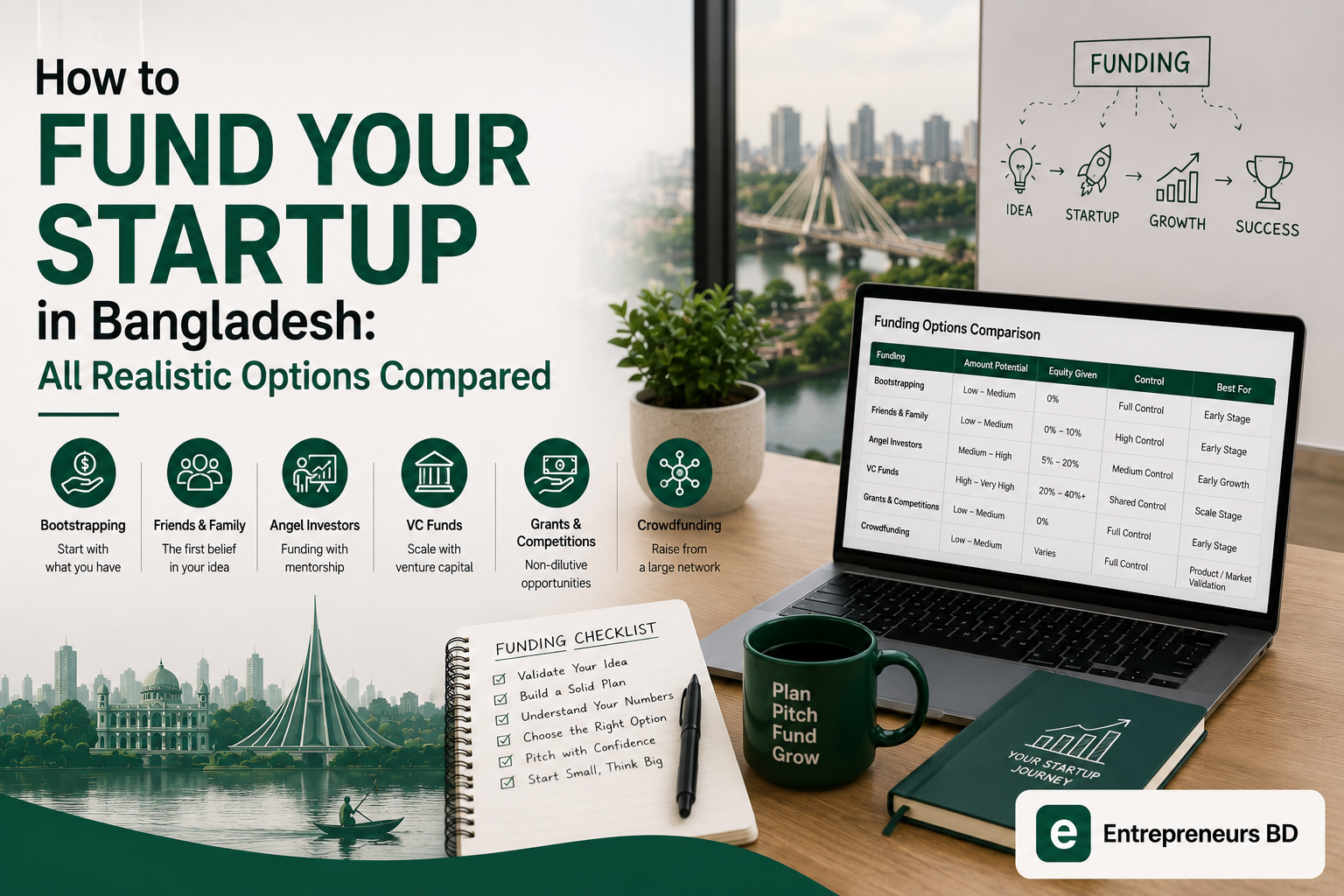
Matching the funding type to your stage saves months of wasted pitching. Here is a rough map of what fits where.
Funding type | Best for | Typical size | Main tradeoff |
|---|---|---|---|
Bootstrapping | Idea and pre-seed | Personal savings | Slow but full control |
Bank or CMSME loan | Registered business with revenue | Tk 5 lakh to Tk 8 crore | Repayment, some collateral |
Government equity fund | Tech startup with a working product | Tk 20 lakh and up | Due diligence, reporting |
Angel investor | Early traction, first paying customers | 50,000 to 500,000 USD | Equity given up, active input |
Venture capital or BSIC | Proven growth, ready to scale | 2 million USD and above | Board seats, growth pressure |
Grants and accelerators | Very early stage or specific sectors | Small, often non-dilutive | Time commitment, limited amount |
A few practical steps before you approach anyone.
Get your legal basics in order first. A startup legal checklist covering registration, licenses, and tax compliance is something every serious investor or bank will ask about.
Apply to more than one bank scheme at once. Interest rates and approval speed vary a lot between institutions, even under the same Bangladesh Bank circular.
Do not chase equity investors before you have paying customers. Traction is what actually moves a pitch meeting forward, not a polished slide deck alone.
Keep a simple cap table from day one. It should always be obvious how much of the company each funding round actually costs you.
Frequently Asked Questions
What is the easiest way to fund a small startup in Bangladesh?
Can foreign investors put money directly into a Bangladeshi startup?
What interest rate applies to bank loans for startups in Bangladesh?
Is crowdfunding legal in Bangladesh?
How much equity should a first time founder give up to an angel investor?
Do I need to register my business before applying for a bank loan or government fund?
Pick the Funding Path That Matches Your Stage, Not Your Ambition
Founders often chase the most prestigious sounding option first, usually venture capital, when a bank loan or a government equity fund would fit their actual stage far better.
The honest truth about funding your startup in Bangladesh in 2026 is that the system now has more real options than it did even two years ago, but none of them are effortless.
Bank loans reward founders who already have some revenue and are willing to accept fixed repayments. Government funds like Startup Bangladesh and BSIC reward technical products with real traction. Angel investors reward founders who can already show paying customers and a credible growth story.
Start with the option that matches where your business actually is today, not where you hope it will be in a year. Prove traction at each stage, and the next round of capital, whichever type it is, gets considerably easier to close.

Specializing in SaaS product marketing, SEO strategy, Content marketing, TikTok advertising, PPC, and digital growth.
View Full Profile & ContributionsRelated Articles
Startup Grants for Bangladeshi Entrepreneurs: Government and NGO Programs You Can Apply For
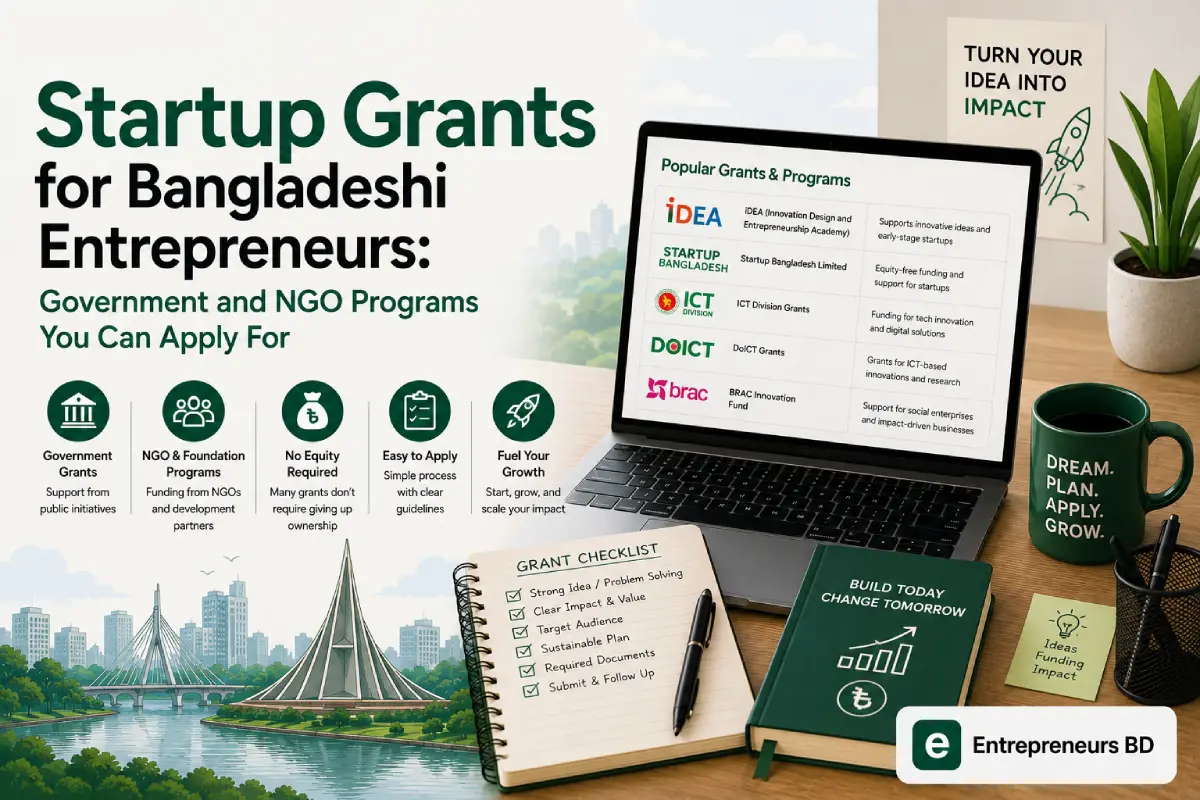
Bangladeshi entrepreneurs can apply for grants and low-cost financing through the ICT Division's iDEA project (up to BDT 10 lakh), SME Foundation's Credit Wholesaling Program, and Bangladesh Bank's refinance schemes for women and new entrepreneurs. Most require a trade license, a clear business plan, and an online application.
Fintech in Bangladesh: Key Players, Regulations, and Opportunities for Founders
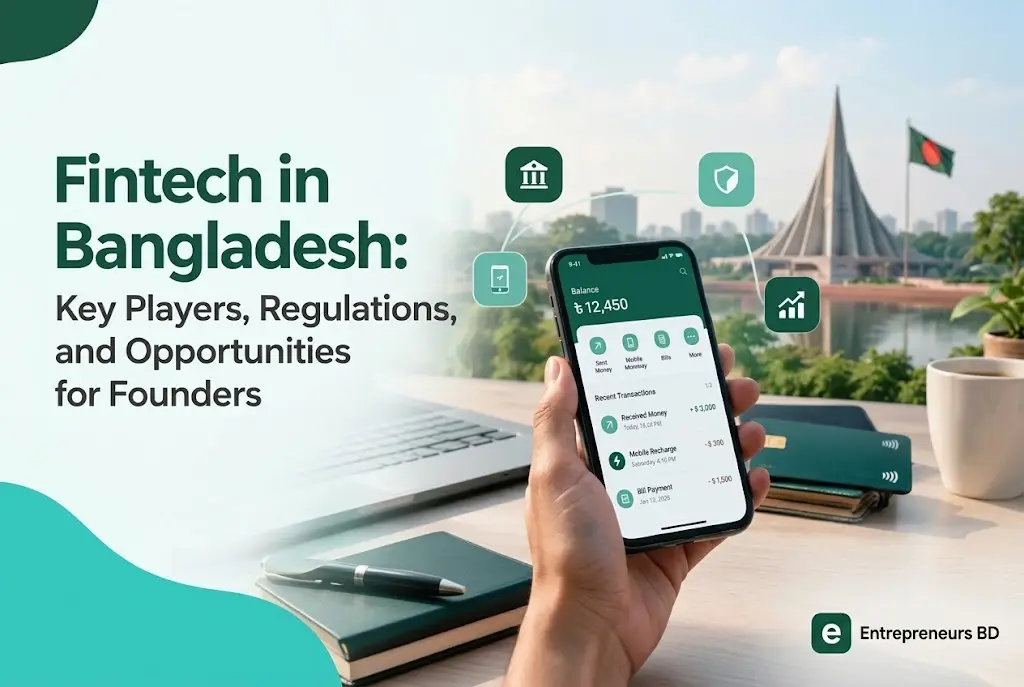
For the payment and digital-finance businesses covered here, four regulated models matter most: MFS, PSP, PSO and digital banking. MFS requires a bank, financial institution or government entity to hold at least 51% of the provider and control its board. PSPs don't carry that requirement. PSOs run payment infrastructure and can't issue e-money. Digital banks are licensed under the Bank Company Act and now require Tk 300 crore in paid-up capital.
Angel Investors in Bangladesh: Who They Are and How to Reach Them
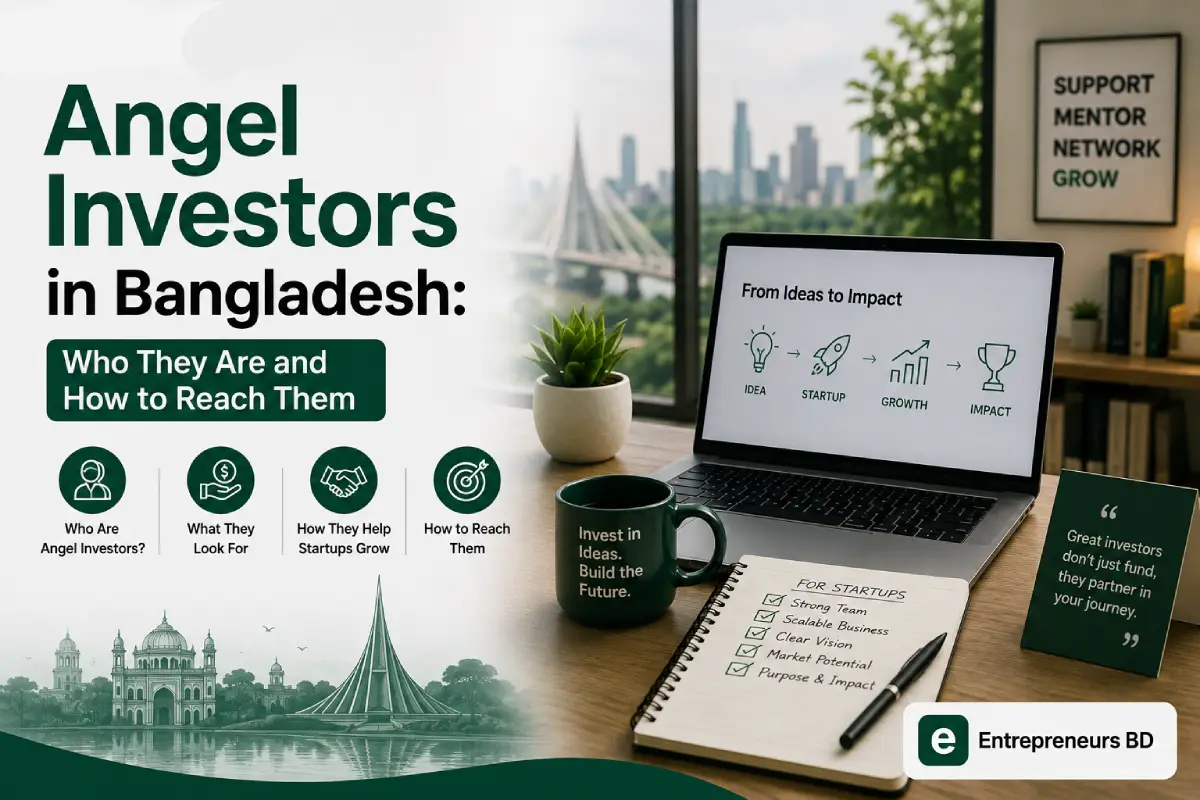
Angel investors in Bangladesh are individuals, family offices, and diaspora professionals who fund early-stage startups in exchange for equity. Most operate through organized networks like Bangladesh Angels Network (BAN) and Bangladesh Women Investors Network (BWIN), which vet founders, run pitch sessions, and syndicate deals among members.
Comments (0)
No comments yet. Be the first to share your thoughts!