How to Start an Online Business in Bangladesh: Platforms, Permits, and Profit
To start an online business in Bangladesh, most sellers need a trade licence from their local city corporation or pourashava, a TIN from the NBR, and a DBID number to sell online. VAT registration only starts once your yearly turnover crosses Tk 50 lakh.
Key Takeaways
A trade licence from your local authority is the normal starting point for a commercial online business, though what you need depends on your product and location.
Selling goods or services on digital platforms to buyers in Bangladesh is on the NBR list of activities where you must show proof that you filed your tax return.
VAT registration starts above Tk 50 lakh yearly turnover. Between Tk 30 lakh and Tk 50 lakh, you enlist for turnover tax instead.
Online sellers are also supposed to get a DBID number from the Ministry of Commerce, which most new founders have never heard of.
Your channel decision (Facebook, Daraz, or your own site) shapes your payment setup, your delivery cost, and your margin.
Starting an online business in Bangladesh is cheap. Staying legal and profitable is the harder part.
Two things changed in 2026 that new founders keep missing. The Finance Act 2026 took effect on 1 July 2026 and moved VAT returns from monthly to quarterly. It also widened where a BIN (VAT number) has to be shown. Separately, Bangladesh Bank issued new rules in July 2026 that make it much easier for freelancers to bring foreign income home.
This guide covers the four things that actually decide whether your business survives its first year: which selling channel fits your product, which registrations apply to you, how to get paid without losing sales, and how to work out your real profit per order.
One note before we start. Rules change every year through the Finance Act and through circulars. Everything here was checked in September 2026. Before you act on any tax or licence point, confirm it with the relevant office or a tax professional.
Pick Your Selling Channel First
Your channel decides your payment setup, your delivery costs, and how much of each sale you keep.
Channel | Works well for | Main advantage | Main drawback |
|---|---|---|---|
Facebook and Instagram | Fashion, handicrafts, food, small-batch products | Very low cost to start, buyers already there | You depend on ad costs and the algorithm |
Daraz | Electronics, household goods, standard products | Buyers already searching for your product | Category commission plus payment fee cuts margin |
Your own website | Repeat-purchase brands with proven demand | You own the customer list and checkout | You have to bring your own traffic |
Upwork, Fiverr, LinkedIn | Freelance and service businesses | Access to foreign clients paying in USD | Heavy competition on price |
Social selling is popular in Bangladesh for a simple reason. Mobile internet is where most people are. BTRC data showed 135.94 million internet subscribers and 189.83 million active mobile subscribers at the end of June 2026, and mobile connections make up most of that. That does not automatically mean Facebook is the best channel for your product. It means the audience is reachable there cheaply while you test.
If you are still deciding what to sell, it is worth reading how other founders validate a startup idea in Bangladesh before spending money on stock.
Daraz publishes its own fee structure, and commission changes by category. Rather than trusting a number you read on a blog, check the current seller charges on Daraz for your exact category before you price anything.
For your own store, WooCommerce and Shopify both work. Local hosting keeps your costs in taka. Just remember that a website with no traffic sells nothing, so most founders start on a marketplace or social page and build the site later once they know what sells.
The Registrations You Actually Need
Here is the honest version. Not every rule applies to every seller, and the order is not fixed.
Registration | Who it applies to | Where you get it |
|---|---|---|
Trade licence | Commercial businesses, including online ones | Your city corporation, pourashava, or union parishad |
TIN | Anyone who has to file an income tax return | NBR e-TIN portal |
DBID | Businesses selling online to consumers | Ministry of Commerce, issued through RJSC |
Turnover tax enlistment | Yearly turnover between Tk 30 lakh and Tk 50 lakh | NBR e-VAT system |
VAT registration (BIN) | Yearly turnover above Tk 50 lakh, plus some sectors regardless of size | NBR e-VAT system |
RJSC registration | Partnerships and limited companies only | Registrar of Joint Stock Companies and Firms |
Trade licence
The trade licence comes from the local authority where your business operates. In Dhaka, that is DNCC or DSCC depending on your address. Outside city areas, it is the pourashava or union parishad.
Fees are not a flat number. They are set by business category, and there are a lot of categories. DSCC alone has issued around 246,180 trade licences across 294 business categories, each with its own fee. So check your own zonal office schedule instead of budgeting from a number you saw online.
One change worth knowing: under the VAT rules now in force, a BIN has to be furnished for several routine things, including trade licence renewal, opening a bank account, and getting a mobile financial service merchant account. If an office asks you for one, that is why.
TIN and the return you have to file
A TIN by itself is not the whole story. What matters is whether you have to file a return, and whether you have to show proof that you filed.
Section 264 of the Income Tax Act 2023 lists the situations where you must produce proof of return submission.
Two of them hit online sellers directly:
Obtaining or renewing a trade licence in a city corporation or pourashava area.
Selling any goods or services through digital platforms to consumers in Bangladesh.
Read that second one again. If you sell online to buyers in Bangladesh, the law already expects you to be in the return filing system. The list gets amended by each year's Finance Act, so check the current version before you assume you are outside it.
Registering for a TIN on the NBR portal is free and takes under half an hour.
DBID: the one most founders skip
Since 2022, the Ministry of Commerce has required online and Facebook-based businesses to hold a Digital Business Identification number, issued through RJSC. It can be obtained using the owner's national ID even without a trade licence, provided the business has a website or social media page. The guideline also requires online businesses to display their DBID number on their website or social media page.
Take-up has been low, and enforcement has been light. That does not make it optional on paper. Start at dbid.gov.bd to check the current process. For the wider rulebook around online selling, our guide to e-commerce regulations in Bangladesh goes deeper.
VAT or turnover tax: the numbers that actually matter
This is where most online guides get it wrong, so here are the bands.
Yearly turnover | What applies |
|---|---|
Up to Tk 30 lakh | Nothing. You are outside the VAT net. |
Tk 30 lakh to Tk 50 lakh | Turnover tax enlistment. You get an Enlistment Certificate. |
Above Tk 50 lakh | VAT registration. Standard rate is 15%. |
Tk 30 lakh is not the VAT threshold. It is the point where you enlist for turnover tax. The NBR VAT compliance guidance sets out this structure.
Some businesses have to register no matter how small they are. Importers, exporters, anyone supplying against a tender, and certain specified goods and services are all in that group. If you plan to import stock, assume you need a BIN from day one.
The turnover tax charge itself is in transition. It has been 4% of turnover. The Finance Act 2026 lets the government replace that with a fixed sector-based amount capped at Tk 2,00,000, and the 4% continues until that notification comes. Confirm the current charge with your VAT circle rather than assuming.
Registration itself costs nothing, and VAT returns are now filed quarterly instead of monthly.
Which business structure fits
Structure | Best when | Liability | Registered with |
|---|---|---|---|
Sole proprietorship | You are starting alone and testing demand | Personal. Business debts are your debts. | Trade licence only |
Partnership | Two or more owners sharing profit | Personal, shared between partners | RJSC |
Private limited company | You are taking investment or bringing in partners | Limited to your shareholding | RJSC |
A trade licence lets you operate as a sole proprietor. It does not cover your tax filing, your VAT position, or any product-specific approval you might need. Those are separate obligations that a licence does not solve.
Most founders start as a sole proprietor and convert later. If you are weighing that decision, compare sole proprietorship against a limited company in Bangladesh before you file anything.
Extra approvals for some products
Online business is not one legal category. What you sell changes the picture:
Food and drink: expect food safety and BSTI requirements.
Cosmetics and medicine: separate regulatory approval applies.
Imported goods: you will need an Import Registration Certificate and a BIN, and customs duties apply.
Regulated services: financial, health, and education services have their own rules.
If you are unsure, ask before you launch, not after your first shipment is stuck at customs. The startup legal checklist for Bangladesh is a useful sanity check here.
Getting Paid Without Losing Sales
Payment friction is where Bangladeshi online businesses quietly lose money. A buyer who cannot pay easily just leaves.
bKash: two different accounts
Most guides mention only the merchant account. There are two routes, and the difference matters when you are starting out.
Merchant account | Personal Retail Account | |
|---|---|---|
Trade licence needed | Yes | No. bKash points sellers without a trade licence to this account. |
Who it suits | Registered businesses | Very small and new online sellers |
Limits | Higher | Lower per-transaction limits |
bKash states on its online business page that if you do not have a trade licence, you may open a Personal Retail Account. Treat it as a bridge while you get registered, not a permanent setup. Also note that a BIN is now among the things asked for when opening an MFS merchant account, so check the current document list before you apply.
Card and online checkout
For a website checkout you need a payment gateway. SSLCOMMERZ, ShurjoPay, and aamarPay are the common local choices, and they bundle cards, mobile wallets, and internet banking into one integration.
Fees vary by provider, payment method, and your monthly volume, and larger merchants negotiate. Do not budget from a generic percentage. Ask each provider for their current rate card and setup fee in writing, then compare.
Adding a second payment option often matters more than shaving a fee. If bKash is your only method, every buyer who uses Nagad is a lost sale.
Receiving Money From Foreign Clients
If you serve clients abroad, this section changed a lot in July 2026, and it changed in your favour.
Bangladesh Bank's consolidated FEPD-1 Circular No. 26, issued on 30 July 2026, covers merchandise exports, service exports, and e-commerce. Alongside it, a circular issued on 22 July 2026 eased the rules for freelancers and individual service exporters.
The main points:
Freelancers may receive inward remittances of up to US$20,000 without submitting a formal declaration.
Payments of up to US$10,000 per transaction may be received through Online Payment Gateway Service Providers, provided funds are repatriated within the prescribed timeframe.
Platform statements, emails, invoices, and contracts now count as proof of foreign income, instead of traditional paper export documents.
ICT freelancers may keep up to 50% of export earnings in a foreign currency account under the Exporters' Retention Quota, while other service exporters may keep up to 30%.
That last one is the ERQ account, and it is not a general "resident foreign currency account" that anyone can open. It is for eligible exporters and freelancers, and banks usually ask for a Freelancer ID.
One correction to advice you will see everywhere. Wise is not a full solution for a Bangladesh-based freelancer. Wise lists Bangladesh as unavailable for USD account details, so you cannot simply open Wise USD details and have clients pay you there. Wise works well in the other direction, for sending money into Bangladesh in taka to a bank account, bKash, or Nagad.
Payoneer remains the practical option for most freelancers, especially if you work through Upwork or Fiverr. Whatever you use, declare the income in your annual return. Our piece on the future of freelancing covers where the market is heading.
Working Out Your Real Profit
Gross sales look healthy while margins quietly go negative.
Here is the formula that stops that:
Net profit per order = price − product cost − packaging − delivery − payment fee − marketplace commission − ad cost per order − returns cost − tax
Now a real example. Paperfly publishes its delivery charges: Tk 70 same city, Tk 110 periphery, and Tk 130 for the rest of Bangladesh for a parcel up to 1 kg, with Tk 20 per additional kg. COD is 0% same city and 1% elsewhere.
Say you sell a kurti in Dhaka for Tk 1,200:
Line item | Amount |
|---|---|
Selling price | Tk 1,200 |
Product cost | Tk 600 |
Packaging | Tk 20 |
Delivery (same city) | Tk 70 |
Ad cost per order | Tk 200 |
Net profit | Tk 310 |
That is about 26%, which looks fine. Now add one failed delivery for every five orders. You still pay the delivery attempt and you still paid for the ad. Those two orders' worth of cost lands on the four that succeeded, and your real margin drops closer to 15%.
This is exactly why founders think a product line is profitable when it is not. Track it from day one, even in a Google Sheet. Once you know your true cost per sale, you can work on customer acquisition with numbers instead of guesses.
There is no universal advertising percentage that makes campaigns profitable. It depends on your margin, your average order value, and how often customers buy again. A product with a Tk 600 gross margin can absorb far more ad spend than one with a Tk 100 margin.
Your First 30 Days, In Order
Decide what you are selling and to whom.
Check whether your product needs an extra approval.
Pick your first channel and test with a small batch.
Apply for a trade licence at your local authority.
Register for a TIN on the NBR portal.
Apply for your DBID.
Work out your VAT or turnover tax position from your expected turnover.
Set up payments, with at least two options for buyers.
Choose a courier and get its current rate card in writing.
Open a simple sheet for income, costs, and returns.
This is a typical order, not a legal sequence. If you are forming a company, RJSC registration comes earlier. If you are importing, your BIN and IRC come earlier too.
Frequently Asked Questions
Do I need a trade licence to sell on Facebook or Daraz in Bangladesh?
How much does it cost to start an online business in Bangladesh legally?
Can a student or an unemployed person start an online business in Bangladesh?
When do I have to register for VAT?
Can I run an online business in Bangladesh and accept payments from foreign clients?
What is a DBID and do I need one?
Get Registered, Then Get Selling
The founders who fail here rarely fail because their product was bad. They fail because their margin was never real, or because a payment account got frozen when they could not produce a document.
Neither problem takes much money to avoid. A trade licence, a TIN, a DBID, and a spreadsheet that tracks true cost per order will put you ahead of most sellers on Facebook right now.
Two dates are worth remembering as you plan. The Finance Act 2026 took effect on 1 July 2026 and reshaped VAT filing. Bangladesh Bank's freelancer rules landed in July 2026. Anything you read that predates those, including older guides on this topic, may be quoting rules that no longer apply.
Start with the channel that matches your product. Register properly while you are small, because it is far cheaper than fixing it at scale. Price for real profit, not gross sales. Then spend your energy on the part that actually compounds, which is finding customers who come back. If you are ready for that stage, our guide to e-commerce marketing in Bangladesh picks up where this one ends.
Last checked: September 2026. Tax and licensing rules in Bangladesh change every year through the Finance Act and through NBR and Bangladesh Bank circulars. Verify current requirements with the relevant authority or a qualified professional before acting.

Specializing in SaaS product marketing, SEO strategy, Content marketing, TikTok advertising, PPC, and digital growth.
View Full Profile & ContributionsRelated Articles

The Innovation of Tanvir A. Mishuk: From Fintech Pioneer to AI Entrepreneur
Tanvir A. Mishuk is a fintech entrepreneur recognised for advancing digital financial inclusion in Bangladesh through innovations like e-KYC and USSD based banking access. He has since founded App AI Pty Ltd, an artificial intelligence company based in Australia, applying lessons from financial technology to a new generation of AI driven solutions.

HealthTech in Bangladesh: Opportunities, Regulations, and Early-Stage Players
HealthTech in Bangladesh covers telemedicine, e-pharmacy, diagnostics logistics, and digital health records serving a population with limited doctor access outside major cities. No single unified health-tech law exists yet; founders answer to DGDA, BMDC, and DGHS depending on the product. Early movers like Praava Health and Arogga built durable models around trust and last-mile delivery, not app polish.
What is Social Entrepreneurship in Bangladesh 2026
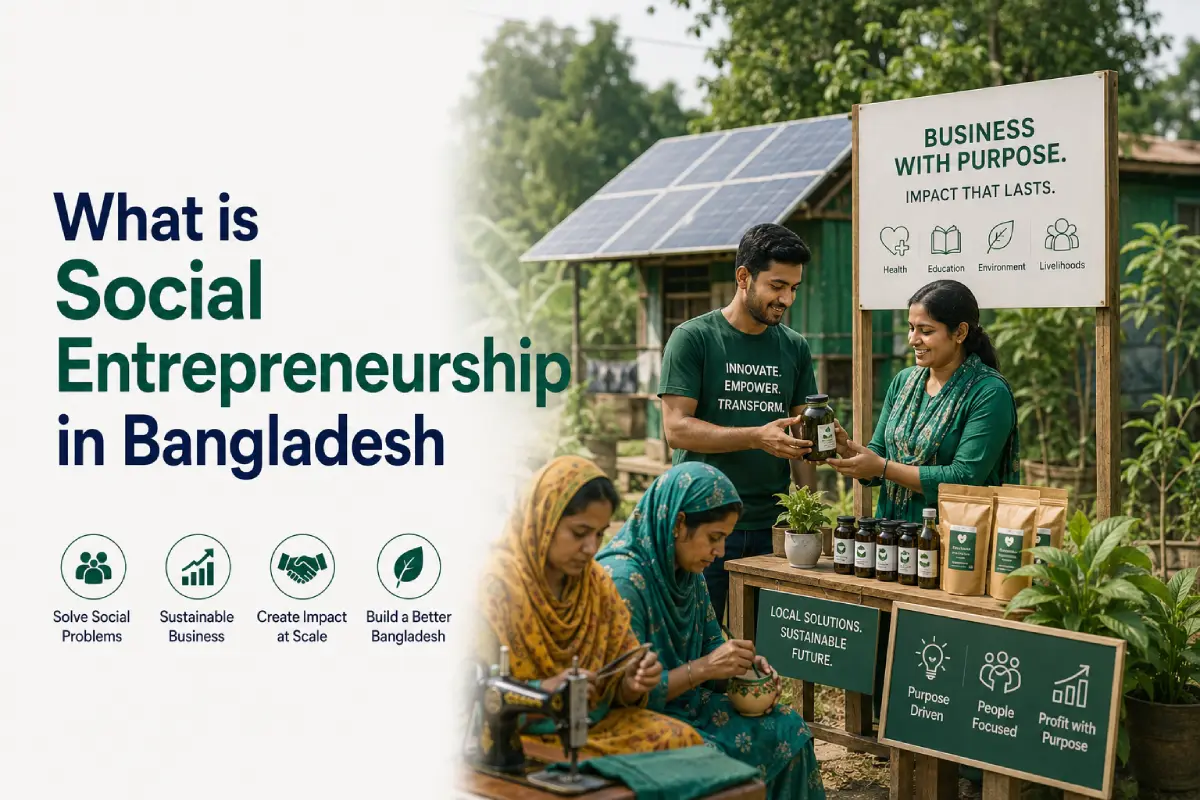
Quick Answer: Social entrepreneurship in Bangladesh means building a self-sustaining business that solves a social problem, whether poverty, illiteracy, healthcare access, or climate vulnerability, without relying on charity. Bangladesh pioneered this model globally through Grameen Bank and BRAC, and the approach continues to grow across health, agriculture, and clean energy in 2026.
Comments (0)
No comments yet. Be the first to share your thoughts!