Legal Checklist Every Bangladesh Startup Must Complete in Year One
Quick Answer: Every Bangladesh startup must complete six core legal steps in year one: register the business entity with RJSC, obtain a trade license from the relevant city corporation or municipality, register for TIN with NBR, enroll for VAT if applicable, open a dedicated business bank account, and file the first annual return on time. Missing any of these creates financial and legal risk that compounds quickly.
Key Takeaways
Company registration with the RJSC is the first and most foundational legal step for any Bangladeshi startup
A trade license is a separate requirement from company registration and must come from your local city corporation or municipality
TIN registration with NBR is mandatory for all businesses and founders personally
VAT registration is required once annual turnover crosses BDT 30 lakh, or immediately in certain regulated sectors
Trademark registration through DPDT is frequently skipped in year one, but carries serious long-term brand risk
Filing annual returns and maintaining statutory records is a legal obligation, not an optional administrative task
Starting a business in Bangladesh without sorting out the legal side first is like building on sand. It holds for a while, and then something shifts.
The first year sets the entire compliance foundation for your company, and the gaps you leave open in year one tend to grow into serious problems by year three or four.
Most founders concentrate heavily on the product, the team, and the first customers. That focus makes sense. But the legal checklist sits quietly in the background, and regulators do not care whether you were too busy to complete it.
This guide covers every legal obligation a Bangladesh startup must meet in year one, in the order they should be handled, with the actual authorities and documents involved.
It is written for founders who want to stay out of trouble, not for lawyers who already know the rules.
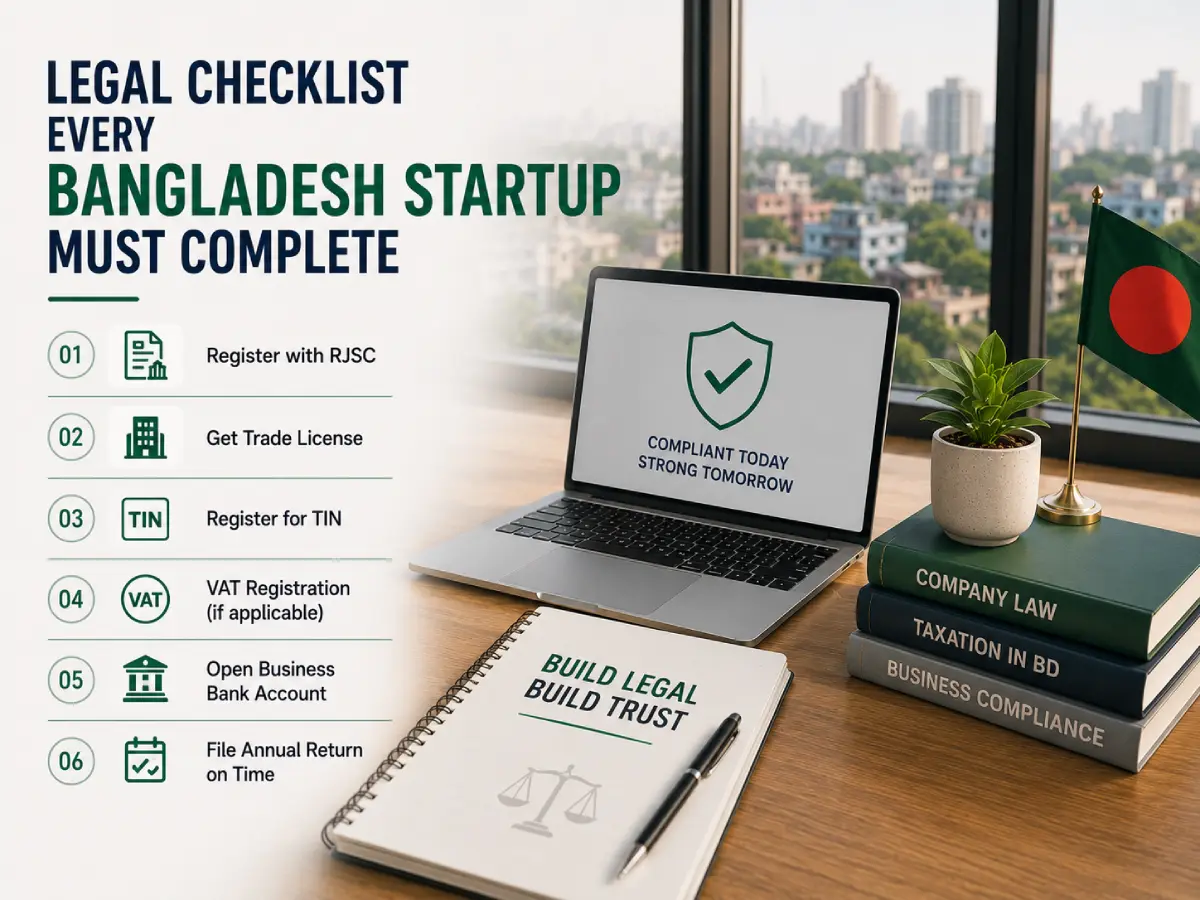
Choose Your Business Structure Before Anything Else
The legal structure you choose determines which regulatory body oversees your company, how you pay taxes, and what your personal liability exposure looks like. The three most common structures for Bangladesh startups are:
Private Limited Company: the most widely used structure for funded startups. It gives you limited liability protection and makes it considerably easier to bring in investors. Requires at least two directors and two shareholders.
Sole Proprietorship: the simplest structure to set up. There is no separate legal entity, which means the founder bears full personal liability for all business debts. Suitable for early-stage freelancers or very small single-person operations, but it limits future funding options significantly.
Partnership: less common, but used when two or more individuals run a business together without a corporate structure. Governed by the Partnership Act 1932.
For most technology or product startups planning to raise external investment, a private limited company is the right call. Make this decision before spending time on anything else, because every registration step that follows depends on it.
Register Your Company with RJSC
The Registrar of Joint Stock Companies and Firms is the authority responsible for company registration in Bangladesh. This is the primary legal recognition of your business entity, and everything else builds from this point.
For a private limited company, you must submit a Memorandum of Association, Articles of Association, Form IX (consent of directors), Form X (list of directors), and a name clearance certificate. The RJSC online registration portal now handles most of this digitally, which has cut down processing time compared to the fully paper-based system that existed previously.
The name clearance must happen first. Apply through the portal and expect approval within two to three business days if your proposed company name is unique and does not conflict with existing registrations.
After document submission and fee payment, incorporation typically takes seven to fourteen working days. You receive a Certificate of Incorporation and a Certificate of Commencement of Business. Keep certified copies of both. You will present them repeatedly throughout year one for everything from bank account opening to regulatory filings.
Obtain a Trade License from Your Local Authority
Company registration and trade license are two entirely separate legal requirements. Many founders discover this distinction only after operating without the license for months.
A trade license authorizes you to conduct business from a specific physical address within a specific jurisdiction.
If your startup is located within Dhaka city, you apply to either the Dhaka North City Corporation or the Dhaka South City Corporation, depending on your ward location.
Startups in Chattogram apply through the Chattogram City Corporation, and those in smaller municipalities apply to their respective local authority.
Required documents generally include your National Identity Card, company incorporation certificate, a copy of the office space rental agreement, and passport-sized photographs of the proprietor or managing director.
Trade licenses must be renewed annually. Operating without a valid, current license carries both financial penalties and the risk of being flagged during any tax audit or regulatory inspection.
Register for TIN with the National Board of Revenue
Every registered business in Bangladesh requires a Tax Identification Number. This applies to the company as a legal entity and to each director as an individual. Neither can be skipped.
Registration is done through the NBR e-TIN portal. The process is fully online, takes under an hour if your documents are ready, and generates a 12-digit TIN immediately upon approval.
Documents required: National ID or passport, the company incorporation certificate, and a utility bill or other proof of office address.
Having a TIN does not mean you immediately owe income tax. What it does mean is that you are now within the tax system and must file income tax returns annually, even if your startup recorded a loss in year one.
Filing a return that shows a loss is not only legal but strategically important. It preserves your right to carry that loss forward and offset it against profits in later years, which can meaningfully reduce your tax bill when growth picks up.
Register for VAT If Your Business Qualifies
VAT registration in Bangladesh is governed by the VAT and Supplementary Duty Act 2012, administered by the National Board of Revenue VAT wing. Businesses with annual turnover exceeding BDT 30 lakh are required to register for VAT and obtain a Business Identification Number (BIN).
If your startup operates in a zero-rated or VAT-exempt sector, registration requirements differ. But if you are providing services, trading goods, or operating in any sector above the turnover threshold, BIN registration through the VAT online portal is mandatory.
There is also a practical commercial reason to register early, even if you are currently below the threshold. Many mid-size and enterprise clients in Bangladesh will issue purchase orders only to BIN-registered vendors, for their own input tax credit compliance. Skipping VAT registration early can quietly close doors before you realize it.
Open a Dedicated Business Bank Account
This step is partly administrative and partly legal, but it carries real legal consequences if you skip it. Running business transactions through a personal account creates serious complications during tax filing, audit, and any regulatory review.
To open a business account, you will need the incorporation certificate, trade license, TIN certificate, Memorandum and Articles of Association, a board resolution authorizing the account opening, and copies of NIDs of all authorized signatories.
If your startup plans to receive foreign investment or earn revenue from the export of services, you will need a Foreign Currency Account through a scheduled bank.
Bangladesh Bank regulates all foreign exchange transactions and maintains specific guidelines for startups receiving investment from abroad. Speak to your bank about FC account requirements before the first foreign transfer arrives.
Protect Your Intellectual Property in Year One
Trademark registration is the single most skipped item on the legal checklist for Bangladesh startups in year one. It is also one of the most expensive omissions to correct after the fact.
The Department of Patents, Designs, and Trademarks handles all IP registrations in Bangladesh. You can file a trademark application for your brand name, logo, tagline, or product identifier through the DPDT official application process.
Filing early is not just advisable; it is strategically critical. Bangladesh follows a first-to-file trademark system. If a third party registers your brand name before you do, they hold the legal rights to it regardless of how long you have been using it in the market. Reclaiming a brand name through litigation is expensive, slow, and uncertain in outcome.
The government fees for a single-class trademark application are modest relative to the cost of a brand dispute. File in year one and treat it as infrastructure, not an optional extra.
File Your First Annual Return Before Year One Closes
Before your first year ends, your company is legally required to file an annual return with the RJSC. This document updates the register with your current directors, shareholders, share capital structure, and registered office address. It is a statutory obligation under the Companies Act 1994, not an optional report.
Alongside this, prepare and submit your income tax return to NBR. Even with zero revenue or a net loss, the return must be submitted within the prescribed deadline. For companies whose accounting year follows the July to June fiscal calendar, the filing deadline is typically November 30.
Missing either deadline carries penalties. Repeated non-compliance can lead to your company being struck off the RJSC register, which is a considerably bigger problem to undo than paying a late fee on time.
Frequently Asked Questions
How long does company registration take in Bangladesh through RJSC?
Is a trade license required even if the company is already registered with the RJSC?
Do all Bangladesh startups need to register for VAT immediately in year one?
What happens if a Bangladesh startup misses the annual return filing deadline with the RJSC?
Can one person register a private limited company in Bangladesh?
How much does trademark registration cost in Bangladesh, and is it worth it in year one?
Build the Foundation Before You Need It
Legal compliance is not bureaucracy for its own sake. Every item on this checklist protects something concrete: your personal liability, your ability to raise investment, your tax standing, and your brand identity.
Founders who handle the legal side early rarely think about it again. Founders who delay tend to spend years two or three unwinding problems that were entirely avoidable with earlier action.
Start with RJSC registration, get your trade license, sort your TIN, and file your first annual return on time. Layer in VAT registration and DPDT trademark filing as your business takes shape.
If foreign investment is on the roadmap, bring in a lawyer who understands BIDA requirements and foreign equity regulations before the first term sheet arrives.
The Bangladesh startup ecosystem is growing fast in 2026. Investors, enterprise clients, and institutional partners increasingly ask about legal standing before any serious conversation moves forward. Clean compliance is no longer a nice-to-have quality signal. It is the baseline for being taken seriously.

Specializing in SaaS product marketing, SEO strategy, Content marketing, TikTok advertising, PPC, and digital growth.
View Full Profile & ContributionsRelated Articles
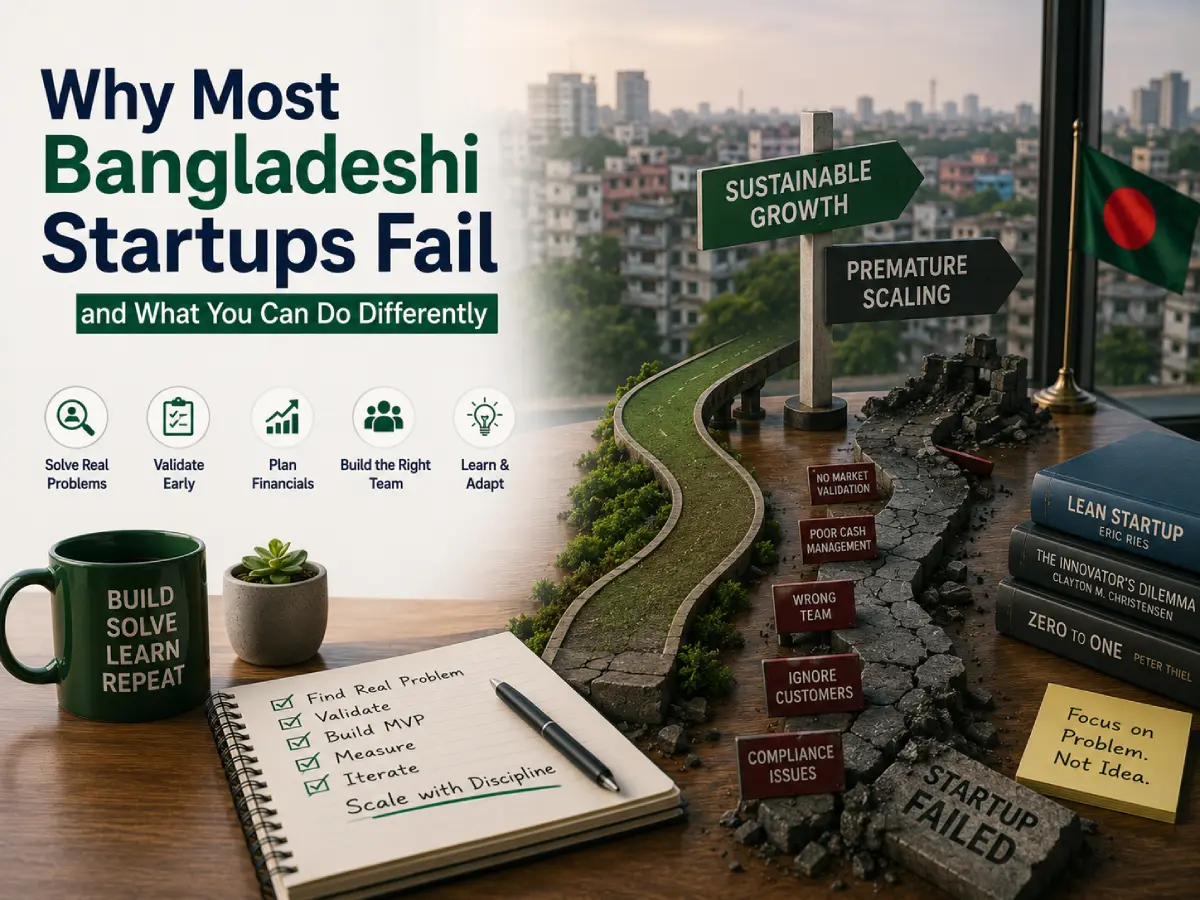
Why Most Bangladeshi Startups Fail — and What You Can Do Differently
Quick Answer: Most Bangladeshi startups fail because of poor market validation, weak financial planning, and founder-market mismatch, not lack of ideas or effort. The founders who survive focus on solving real problems, build lean, and learn from their market before scaling.

Customer Acquisition Strategies That Work for Bangladesh Startups
Quick Answer: The most effective customer acquisition strategies for Bangladesh startups combine low-cost digital channels (Facebook, WhatsApp Business, SEO), mobile financial service integration for frictionless payment, referral-driven growth, and hyperlocal targeting. Startups that blend paid acquisition with retention-focused tactics see the lowest long-term cost per customer.

Business Model Canvas Explained with Bangladesh Startup Examples
Quick Answer: The Business Model Canvas (BMC) is a one-page strategic framework with 9 building blocks: Customer Segments, Value Propositions, Channels, Customer Relationships, Revenue Streams, Key Resources, Key Activities, Key Partnerships, and Cost Structure. It helps founders map, test, and communicate their entire business model before writing a single page of a business plan.
Comments (0)
No comments yet. Be the first to share your thoughts!