Sole Proprietorship in Bangladesh: Pros, Cons, and How to Register
Quick Answer: A sole proprietorship in Bangladesh is a business owned and operated by a single individual with no legal separation between the owner and the business. It is the simplest and cheapest structure to register, requiring only a trade license from the local City Corporation or municipality. However, the owner bears unlimited personal liability for all debts and obligations.
Key Takeaways
Sole proprietorship is the most common business structure for small businesses and freelancers in Bangladesh
Registration requires a trade license, TIN certificate, and VAT registration (if applicable), with no need for RJSC filing
The owner holds unlimited personal liability, meaning personal assets can be used to settle business debts
It is the fastest structure to set up, often within 7 to 14 working days
This structure suits solo traders, consultants, small retailers, and home-based businesses, but has real scaling limitations
Sole Proprietorship in Bangladesh: Pros, Cons, and How to Register
Starting a business in Bangladesh does not always mean forming a company. For thousands of small traders, freelancers, and solo operators, a sole proprietorship is the practical first step.
It is affordable, fast to register, and relatively simple to manage. But it comes with trade-offs that can become significant as a business grows.
This guide covers what sole proprietorship actually means under Bangladeshi law, the genuine advantages and disadvantages you should weigh before choosing this structure, and a clear walkthrough of the registration process from trade license to TIN to VAT.
If you are comparing business structures or deciding whether a sole proprietorship fits your situation, this is the right place to start.
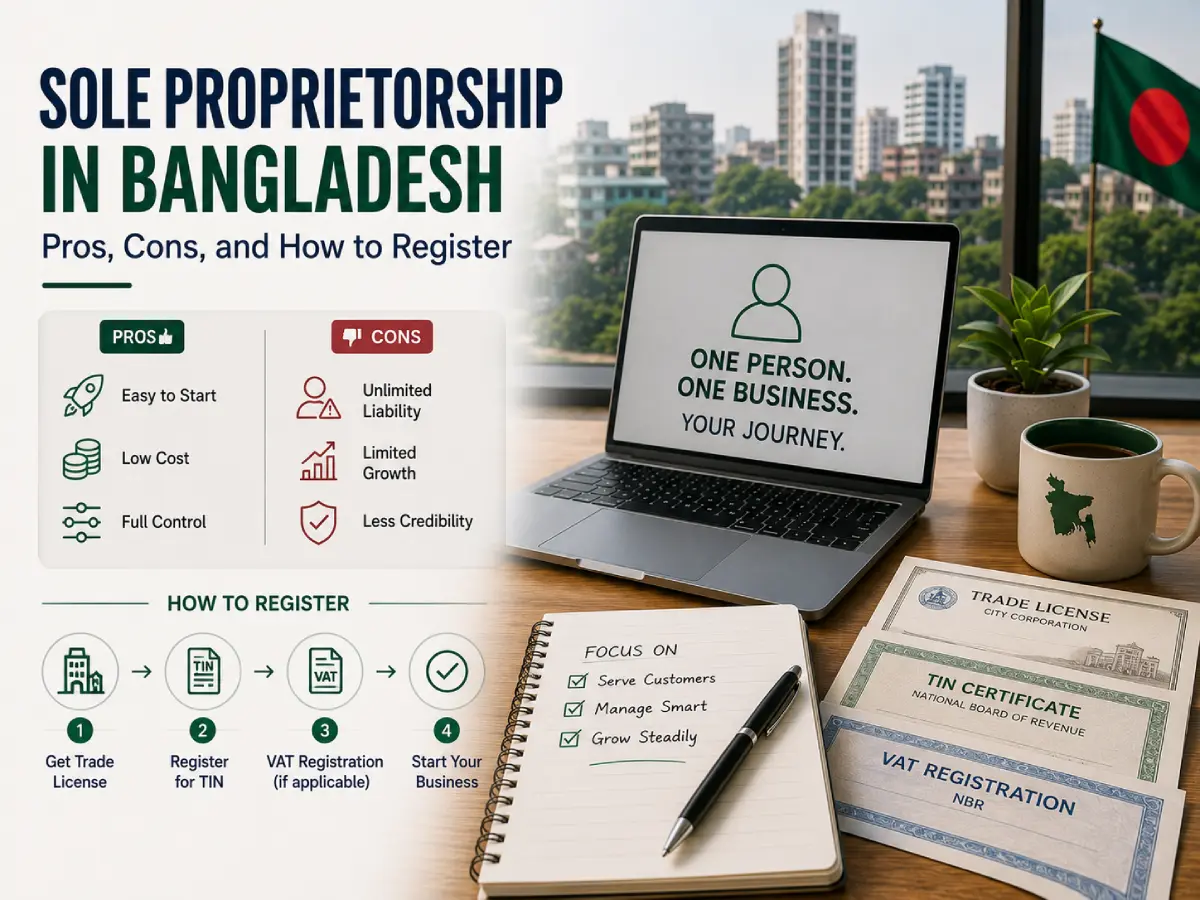
What Is a Sole Proprietorship in Bangladesh?
A sole proprietorship is a business structure where one person owns, controls, and runs the entire operation. There is no separate legal entity. The business and the owner are legally the same person.
This means all revenue belongs to the owner directly. It also means all debts, legal disputes, and liabilities fall personally on the owner. There is no corporate shield.
Bangladesh does not have a single dedicated law governing sole proprietorships the way it does for companies under the Companies Act 1994. Instead, a sole proprietorship is primarily established through a trade license issued by the relevant City Corporation or municipality, combined with tax registration from the National Board of Revenue.
This structure is incredibly common in Bangladesh. Most small shops, market stalls, freelance service providers, home-based businesses, and single-owner consultancies operate as sole proprietorships.
Advantages of Sole Proprietorship
Lowest cost to set up
Trade license fees in Bangladesh range from a few hundred to a few thousand taka depending on the business category and location. There are no minimum capital requirements and no registration fees with the Registrar of Joint Stock Companies and Firms (RJSC), unlike a private limited company.
Fastest registration timeline
A trade license application through Dhaka North City Corporation (DNCC) or Dhaka South City Corporation can typically be processed within 7 to 14 working days if documents are in order. In smaller municipalities, it can be even quicker.
Full control, no board required
There are no shareholders, directors, or board meetings. The owner makes every decision independently without needing consensus or approval from partners.
Simple tax filing
Sole proprietors report business income on their personal income tax return. There is no separate corporate tax filing. This simplifies compliance significantly for small operators.
Easy to dissolve
If the business does not work out, closing a sole proprietorship requires only letting the trade license lapse and settling any outstanding obligations. No RJSC dissolution process is needed.
Disadvantages of Sole Proprietorship
Unlimited personal liability
This is the most serious drawback. If the business incurs debts or faces a legal claim, creditors can pursue the owner's personal assets, including savings, property, and other belongings. There is no legal separation protecting personal finances.
Difficult to raise capital
Banks and investors generally prefer lending to or investing in registered companies rather than sole proprietors. Sole proprietorships cannot issue shares, which limits equity financing options significantly.
Dependent on one person
If the owner falls ill, travels, or becomes unavailable, the business stops. There is no continuity structure. This creates operational fragility for businesses with staff or ongoing contracts.
Limited credibility for large contracts
Government procurement and corporate procurement in Bangladesh often require vendors to be registered companies. A sole proprietorship may be excluded from tenders that require a Certificate of Incorporation from the RJSC.
No clear succession path
A sole proprietorship legally ceases upon the death of the owner. Unlike a company, it cannot be transferred in the same way, which creates estate complications.
How to Register a Sole Proprietorship in Bangladesh
There is no single "sole proprietorship registration" document in Bangladesh. Registration is established through a combination of the following steps.
Step 1: Obtain a Trade License
The trade license is the foundational document. Apply to the City Corporation or municipality covering your business address.
For Dhaka, this means applying to either DNCC or DSCC, depending on location. Required documents typically include:
National ID card of the owner
Passport-size photograph
Proof of business premises (rental agreement or ownership documents)
Completed application form
Fees vary by business category and are updated by each City Corporation. Check the respective portals for current fee schedules.
Step 2: Register for a TIN Certificate
Every business owner in Bangladesh must register for a Taxpayer Identification Number (TIN) with the National Board of Revenue. TIN registration is now handled online through the NBR e-TIN portal. You will need your National ID and trade license details.
Step 3: VAT Registration (if applicable)
If your annual turnover exceeds the VAT threshold (BDT 30 lakh as of the current VAT and Supplementary Duty Act), you must register for VAT through the VAT Online portal. Many small sole proprietors fall below this threshold and are exempt, but it is worth confirming your category.
Step 4: Open a Business Bank Account
Most banks in Bangladesh require a trade license, TIN certificate, and the owner's NID to open a business account under a proprietorship name. A dedicated business account is important for separating personal and business finances, even though they are legally the same entity.
Step 5: Sector-Specific Licenses (if required)
Certain industries require additional licenses. Food businesses may need a BSTI certification. Import and export businesses need an Import Registration Certificate (IRC) or Export Registration Certificate (ERC) from the Office of the Chief Controller of Imports and Exports. Check sector requirements before starting operations.
Frequently Asked Questions
Is a sole proprietorship the same as a one-person company in Bangladesh?
Do I need to register with RJSC for a sole proprietorship?
Can a sole proprietor hire employees in Bangladesh?
How long does a trade license remain valid?
Can a sole proprietor convert to a private limited company later?
What taxes does a sole proprietor pay in Bangladesh?
Final Thoughts
Sole proprietorship works well when you are starting small, testing a business idea, operating as a freelancer or consultant, or running a local retail business where liability risk is manageable. The low cost and fast setup genuinely matter for early-stage entrepreneurs in Bangladesh.
Where it starts to break down is when personal liability becomes a real risk, when you need to raise capital from outside investors, or when corporate clients and government contracts require you to operate as a registered company.
Many successful Bangladeshi entrepreneurs begin as sole proprietors and convert to a private limited company once the business justifies it. That transition is not complicated, and starting as a sole proprietor does not lock you in permanently.
If you are at the stage of deciding between structures, weigh your liability exposure, your capital needs, and your target clients. Those three factors will usually point you toward the right answer faster than anything else.

Specializing in SaaS product marketing, SEO strategy, Content marketing, TikTok advertising, PPC, and digital growth.
View Full Profile & ContributionsRelated Articles
The Innovation of Tanvir A. Mishuk: From Fintech Pioneer to AI Entrepreneur
Tanvir A. Mishuk is a fintech entrepreneur recognised for advancing digital financial inclusion in Bangladesh through innovations like e-KYC and USSD based banking access. He has since founded App AI Pty Ltd, an artificial intelligence company based in Australia, applying lessons from financial technology to a new generation of AI driven solutions.

HealthTech in Bangladesh: Opportunities, Regulations, and Early-Stage Players
HealthTech in Bangladesh covers telemedicine, e-pharmacy, diagnostics logistics, and digital health records serving a population with limited doctor access outside major cities. No single unified health-tech law exists yet; founders answer to DGDA, BMDC, and DGHS depending on the product. Early movers like Praava Health and Arogga built durable models around trust and last-mile delivery, not app polish.
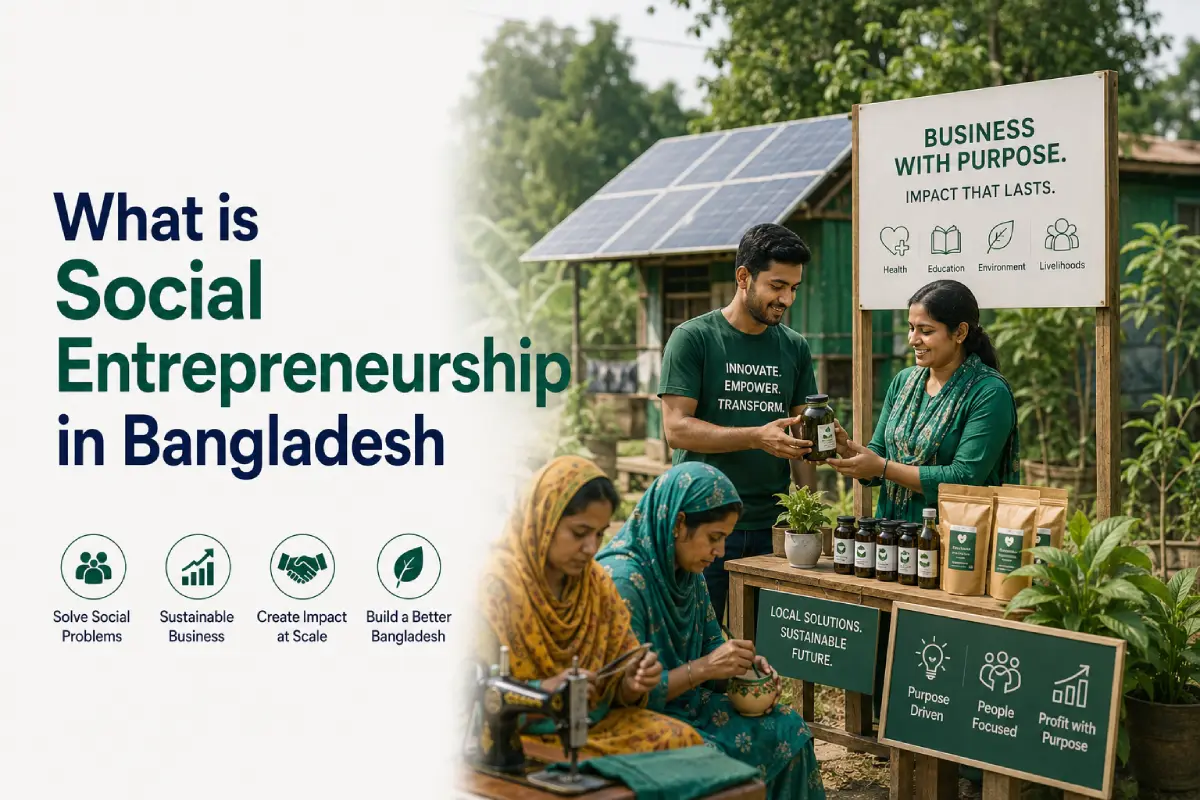
What is Social Entrepreneurship in Bangladesh 2026
Quick Answer: Social entrepreneurship in Bangladesh means building a self-sustaining business that solves a social problem, whether poverty, illiteracy, healthcare access, or climate vulnerability, without relying on charity. Bangladesh pioneered this model globally through Grameen Bank and BRAC, and the approach continues to grow across health, agriculture, and clean energy in 2026.
Comments (0)
No comments yet. Be the first to share your thoughts!