Private Limited Company in Bangladesh: Formation, Cost, and Requirements
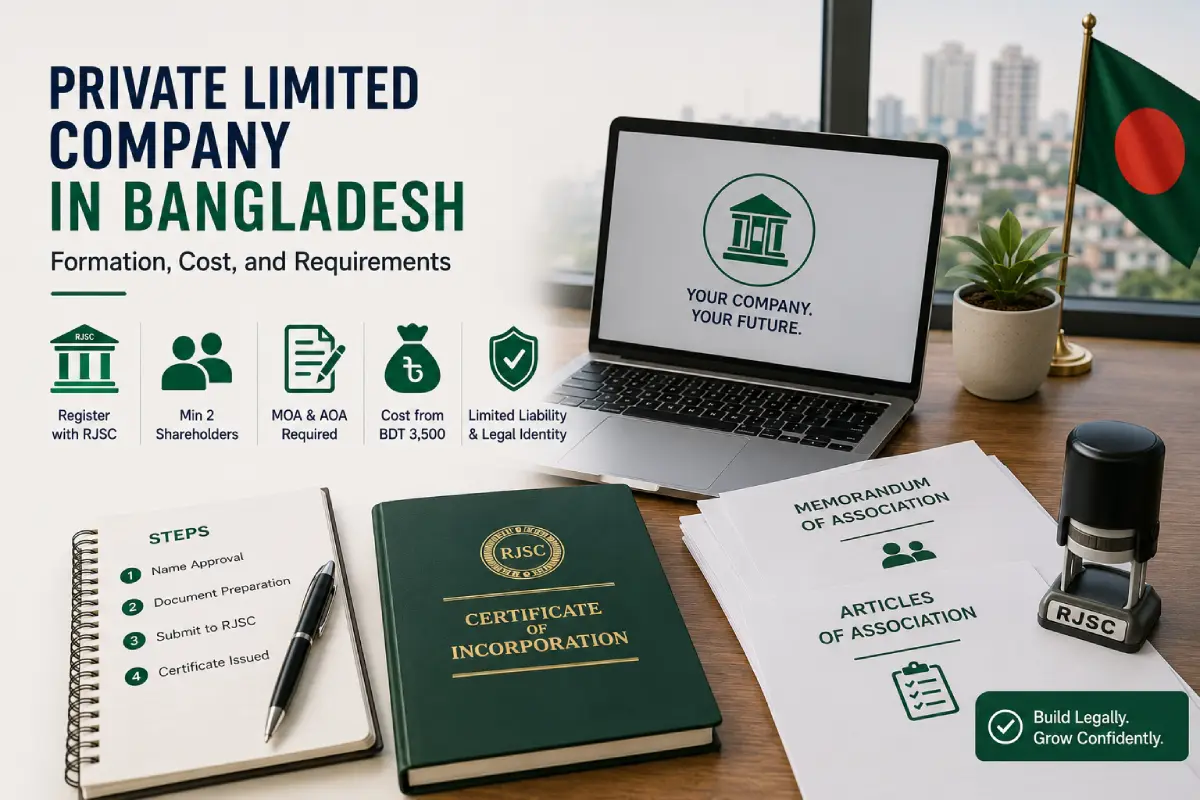
Quick Answer: A private limited company in Bangladesh is registered through the Registrar of Joint Stock Companies and Firms (RJSC). Formation requires a minimum of 2 shareholders, a Memorandum and Articles of Association, and government fees starting from BDT 3,500. The full process typically takes 10 to 30 working days.
Key Takeaways
Registration is handled by RJSC under the Companies Act 1994
Minimum 2 and maximum 50 shareholders; minimum 2 directors required
Core documents include the Memorandum of Association (MOA) and Articles of Association (AOA)
Total formation costs typically range from BDT 15,000 to BDT 50,000, depending on authorised capital
A private limited company offers limited liability, a separate legal identity, and easier access to formal financing
Starting a private limited company (Pvt. Ltd.) is the most common route for serious business founders in Bangladesh. It gives you a separate legal identity, limits personal liability, and signals credibility to banks, investors, and corporate clients from day one.
But the paperwork can feel opaque if you're doing it for the first time. Registration spans multiple agencies, the fee structure depends on your authorised capital, and small errors in documentation can cause delays of weeks.
This guide covers everything you need: the legal structure, who qualifies, what documents you'll need, what it actually costs, and the step-by-step registration process through the RJSC.
What a Private Limited Company Actually Means
A private limited company is a distinct legal entity, separate from its owners. It can own assets, sign contracts, open bank accounts, and be held liable in its own name. Your personal assets are protected if the business faces legal or financial trouble.
Key structural features under the Companies Act 1994:
Minimum 2 shareholders, maximum 50
Shares cannot be offered to the general public
Minimum 2 directors (can overlap with shareholders)
No minimum paid-up capital requirement (authorised capital determines registration fees)
Liability of shareholders is limited to their share value
This structure suits startups, SMEs, and any founder who wants a formal business infrastructure without going public.
Requirements Before You Register
Before approaching RJSC, you need to have several things settled:
Company name: Must be unique. Run a name availability check on the RJSC name clearance portal. Names that are too similar to existing companies, or that include restricted words like "Bank," "Insurance," or "Government," will be rejected.
Registered office address: You need a physical address in Bangladesh. A residential address is acceptable at the formation stage.
Shareholders and directors: Confirm the identities, National ID numbers, and shareholding percentages of all parties. Foreign nationals can be directors or shareholders, but additional BIDA compliance may apply depending on the sector.
Authorised capital: This is the maximum share capital your company is authorised to issue. It does not need to be paid up immediately, but it determines your registration fee.
Memorandum and Articles of Association (MOA and AOA): These are the core constitutional documents. The MOA defines your company's name, registered office, objectives, and liability clause. The AOA sets internal governance rules. Both must be prepared before filing.
Formation Costs: What to Budget
Costs break into three categories: government fees, stamp duties, and professional fees.
Government registration fees (paid to RJSC) are based on authorised capital:
Authorised Capital | Approximate RJSC Fee |
Up to BDT 2,00,000 | BDT 3,500 |
BDT 2,00,001 to BDT 5,00,000 | BDT 5,000 |
BDT 5,00,001 to BDT 10,00,000 | BDT 7,500 |
Above BDT 10,00,000 | Scaled upward |
Stamp duty is charged on the MOA and AOA. Rates vary by document and capital amount, governed by the Stamp Act 1899 as applicable in Bangladesh.
Professional fees (lawyers or company secretaries) typically range from BDT 8,000 to BDT 30,000, depending on the firm and complexity.
Total realistic budget for a standard formation: BDT 15,000 to BDT 50,000, excluding any costs for trade license, TIN registration, or VAT registration, which are separate post-incorporation steps.
Step-by-Step Registration Process
Step 1: Name clearance: Apply for name clearance through the RJSC online portal. This costs a small fee and usually takes 1 to 3 working days. You'll receive a clearance certificate valid for 30 days.
Step 2: Prepare incorporation documents: Draft the MOA and AOA in line with the Companies Act 1994. You'll also need Form I (declaration on registration), Form VI (notice of registered office), and Form IX (consent of directors).
Step 3: Pay stamp duty: Purchase the appropriate adhesive stamps from authorised vendors and affix them to the MOA and AOA as required.
Step 4: Submit to RJSC: File all documents through the ROC online portal or in person at the RJSC office. Pay the registration fee. At this stage, you'll also need notarised copies of the National IDs or passports of all directors and shareholders.
Step 5: Receive Certificate of Incorporation: If documents are in order, RJSC issues the Certificate of Incorporation. This is your company's birth certificate. Timeline is typically 7 to 15 working days after submission, though delays are common if documents need corrections.
Step 6: Post-incorporation compliance: After incorporation, you must obtain a Trade License from your relevant City Corporation (DNCC or DSCC) or municipality, register for a Tax Identification Number (TIN) through the NBR eTax portal, and register for VAT if your projected annual turnover crosses the registration threshold. Companies with employees must also register with the relevant labour authorities.
Frequently Asked Questions
Can a single person form a private limited company in Bangladesh?
What is the minimum authorised capital required?
Can foreign nationals own shares in a Bangladeshi private limited company?
Yes. Foreign nationals can be shareholders and directors. However, if the company involves foreign investment, it must comply with BIDA regulations and may need to register through BIDA's investment facilitation process, depending on the business sector and the percentage of foreign ownership.
How long does the full registration process take?
Is a company secretary required at formation?
What happens if I file incorrect documents with RJSC?
Your Next Step After Incorporation
Getting the Certificate of Incorporation is not the finish line. It is the starting line for formal compliance.
Your immediate priorities after registration: open a dedicated business bank account using your incorporation certificate, complete TIN registration through the NBR eTax portal, obtain your trade license from the relevant city corporation, and assess whether your business activities require VAT registration under the VAT and Supplementary Duty Act 2012.
If you have foreign investors or plan to raise capital, engage with BIDA early. Certain sectors require prior approval, and retrofitting compliance is far harder than building it in from the start.
A private limited company gives you the legal foundation to operate credibly, hire employees formally, issue contracts, and access financial products that sole proprietorships cannot. The setup cost is modest relative to what you gain. The key is doing it right the first time.

Specializing in SaaS product marketing, SEO strategy, Content marketing, TikTok advertising, PPC, and digital growth.
View Full Profile & ContributionsRelated Articles

Business Registration in Bangladesh: All Legal Structures Explained
Quick Answer: Business registration in Bangladesh depends on your chosen legal structure. A sole proprietorship is registered via a trade license at your local city corporation. Partnerships and private limited companies are registered through the Registrar of Joint Stock Companies and Firms (RJSC). Each structure has different liability, tax, and compliance implications.

Why Data and Analytics Matter in Modern Entrepreneurship
Quick Answer: Data and analytics help entrepreneurs replace guesswork with evidence. Instead of relying on instinct alone, you use real numbers — from sales figures to customer behaviour — to make decisions that are faster, cheaper, and far more likely to succeed. In 2026, it is not a competitive advantage; it is a baseline requirement.

Facebook Marketing for Bangladeshi SMEs: Strategy, Ads, and ROI
Quick Answer: Facebook marketing for Bangladeshi SMEs involves building an optimized Business Page, posting consistently for organic reach, and running targeted paid ads using Meta Ads Manager. With over 50 million Facebook users in Bangladesh and low ad costs compared to Western markets, SMEs can generate strong ROI even on modest budgets of BDT 5,000–20,000 per month.
Comments (0)
No comments yet. Be the first to share your thoughts!