How to Validate a Startup Idea in Bangladesh Before Spending Money
Quick Answer: To validate a startup idea in Bangladesh, first confirm the problem is real by talking to at least 20 potential customers. Then test your solution cheaply, through a landing page, a manual service, or a small pilot, and measure whether people take action. Validation means real behavior, not opinions or enthusiasm.
Key Takeaways
Talking to potential customers before building anything is the single most effective validation method, and it costs nothing
A validated idea has paying customers or clear behavioral proof of demand; "people liked it" is not validation
Bangladesh's market has unique demand patterns, price sensitivities, and trust signals that differ sharply from Western startup playbooks
A landing page, a Facebook group, or a manual service can validate demand without writing a single line of code
Most Bangladesh startup failures trace back to building something nobody wanted. Validation is the cheapest way to avoid that outcome
Most startup ideas fail not because of poor execution, but because the founders never confirmed that a real problem existed, or that people would actually pay to solve it—a pattern that appears in many of the common startup failure reasons in Bangladesh.
Validating a startup idea in Bangladesh is both easier and harder than founders expect. Easier, because the market is accessible, potential customers are reachable through Facebook groups, local communities, and direct conversation.
Harder, because Bangladeshi customers are often polite and encouraging in person, which means positive reactions frequently mask a lack of genuine intent to pay.
This guide walks through a structured, low-cost validation process built specifically for the Bangladesh market. It covers how to define your assumptions, how to test them without building a full product, how to read customer signals honestly, and how to know when you have enough evidence to move forward, or when to stop and rethink. Every step is designed to give you real information, not false confidence.
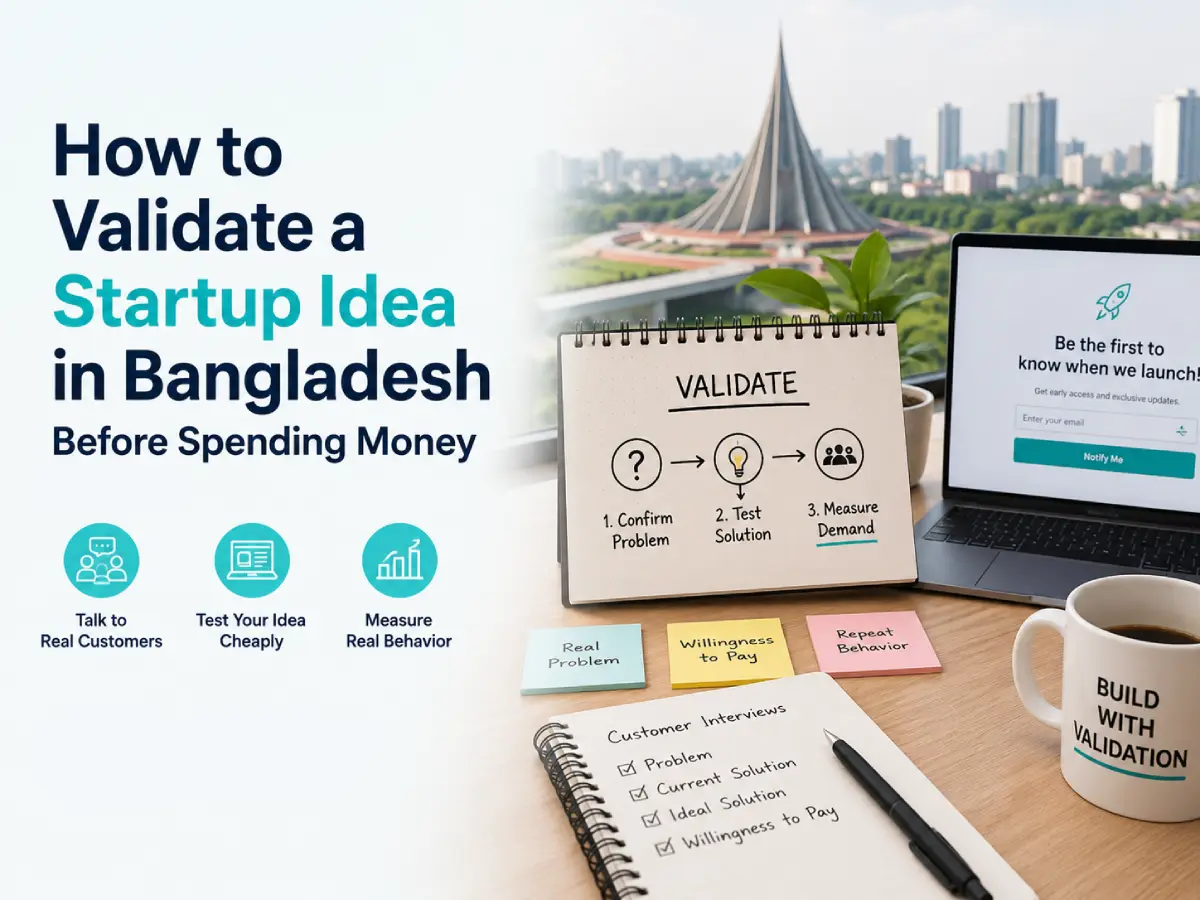
What Startup Validation Actually Means
Validation is not getting people to say your idea is good. It is finding evidence that a specific group of people has a problem they want solved badly enough to pay for a solution, and that your proposed solution is believable to them.
The distinction matters because in Bangladesh, social politeness is deeply embedded in culture. Ask a friend, a relative, or even a stranger whether your idea is good, and they will almost certainly say yes.
That yes means nothing unless it is backed by behavior: a pre-order, a deposit, a signed-up email address, or time spent using a prototype.
Validated ≠ approved. Validated means real demand has been demonstrated through real action.
Step 1: Write Down Your Core Assumptions
Before talking to anyone, write down every assumption your idea is built on. If you're struggling to organize those assumptions, using a Business Model Canvas can make the process much clearer.
Most startup ideas rest on three to five assumptions that, if wrong, would make the business unworkable.
A useful format is the Assumption Map:
Problem assumption: [Specific group] has [specific problem] and it bothers them enough to actively seek a solution.
Solution assumption: [Your solution] solves that problem better than what they currently use.
Willingness-to-pay assumption: [Specific group] will pay [specific amount] for this solution.
Channel assumption: You can reach this group through [specific channel] at a cost that makes the business viable.
Write these out explicitly and do not skip this step. It forces you to be precise about what you are actually testing, and it prevents you from moving the goalposts later when results are uncomfortable.
Step 2: Define Your Target Customer Precisely
"Everyone in Bangladesh" is not a target customer. Neither is "SMEs" nor "students." The more specific your customer definition, the faster and cheaper your validation will be.
A useful customer definition has at least four elements: who they are, where they are, what specific problem they have, and what they currently do about it.
Weak: "Small business owners in Bangladesh who need marketing help."
Strong: "Boutique clothing shop owners in Dhaka's Mirpur area who sell on Facebook but are losing customers to competitors running better ads, and currently manage their own pages without any professional support."
The stronger definition tells you exactly who to talk to, where to find them, and what question to ask them.
Step 3: Talk to Real People (Customer Discovery)
Customer discovery is the most important and most skipped step in Bangladesh startup validation because it lays the foundation for achieving genuine product-market fit. It involves having honest, structured conversations with 15 - 30 people who match your target customer definition, before you build anything.
How to Find People to Talk To
In Bangladesh, direct outreach works well through:
Facebook groups relevant to your target segment. There are active groups for entrepreneurs, garment buyers, students, homemakers, freelancers, and almost every other demographic
Local markets and business clusters, Gausia, New Market, Bashundhara City, Chawkbazar, Tongi Industrial Area, depending on your sector
LinkedIn for B2B targets in corporate or professional sectors
University campuses for student-facing products
Your own network, but be disciplined about filtering for actual target customers, not supportive friends
What to Ask in Customer Discovery Conversations
The goal is to understand the problem, not to pitch your solution.
Use open-ended questions:
"Tell me about how you currently handle [problem area]."
"What is the most frustrating part of that process?"
"When was the last time this was a problem for you? What did you do?"
"What have you already tried to fix it?"
"How much does this problem cost you, in time, money, or both?"
Notice what is absent from that list: "Would you use my app?" or "Do you think this is a good idea?" Those questions generate validation theater, not real information.
Listen for pain language, words like "frustrating," "waste of time," "always a problem," "I wish." If you hear polite indifference, that is your signal. If you hear genuine frustration and specific stories, that is meaningful.
The Bangladesh-Specific Honesty Problem
In Bangladeshi social culture, saying "no" or expressing criticism directly, especially to someone who is clearly excited about their idea, feels impolite. This means founders often walk away from customer conversations feeling validated when they were just being treated with courtesy.
Counter this by asking about past behavior, not future intentions. "Have you ever paid for something similar before?" carries far more weight than "Would you pay for this?" Past behavior is fact. Future intention is social nicety.
Step 4: Test Demand With a Low-Cost Experiment
After customer discovery, you should have a clearer picture of whether the problem is real and widespread. Instead of building a complete product, start with a Minimum Viable Product (MVP) or another low-cost experiment to test demand.
A validation experiment has three elements: a specific hypothesis, a minimum viable test, and a pre-defined success metric.
Low-Cost Validation Methods for Bangladesh Startups
Landing page test: Build a single-page website describing your solution and what it costs. Drive traffic to it via Facebook ads (BDT 500–2,000 is enough for a meaningful test). Measure how many people sign up, enquire, or attempt to pay. A landing page can be built for free using tools like Carrd or Google Sites. The Bangladesh Telecommunication Regulatory Commission (BTRC) reports 132.8 million internet users in Bangladesh. Reaching potential customers digitally is genuinely accessible.
Manual service (Wizard of Oz test): Offer your service manually before automating it. If you want to build a grocery delivery app, take orders via WhatsApp first and fulfill them yourself. If you want to build an HR software, do the HR work manually in a spreadsheet for your first clients. This gives you real customers, real revenue, and real insight into the operations before you write a line of code.
Facebook group or page pilot: Create a Facebook group or page around the problem your startup solves, not your brand. This approach also serves as an effective social media marketing strategy for Bangladesh businesses while validating demand.
Grow it organically, and if people join, engage, and ask where to buy or how to get help, you have confirmed that demand exists. Facebook remains the dominant social platform in Bangladesh with over 50 million users, making it the most accessible validation channel for consumer-facing ideas.
Pre-order or deposit: Ask potential customers to pay a small deposit or pre-order before you build. This is the highest-quality validation signal available; someone parting with actual money is a genuine commitment. Even BDT 200–500 as a reservation fee weeds out polite supporters from real customers.
Competitor proxy test: If a competitor exists, even a rough one, study their customer reviews, complaints, and social media comments. In Bangladesh, Facebook page reviews and comment sections of competitors are often rich with unfiltered customer frustration. That frustration is your opportunity map.
Step 5: Define What "Validated" Looks Like Before You Start
The most important discipline in validation is deciding your success metric before you run the experiment, not after you see the results.
This is where founders consistently cheat themselves. They run a test, get mediocre results, and then rationalize why those results are actually encouraging. Pre-committing prevents this.
Examples of pre-defined validation thresholds:
"If 30 out of 100 landing page visitors sign up, we proceed."
"If 5 out of 20 people we approach agree to pay a deposit, we proceed."
"If we can acquire 3 paying customers for our manual service within 2 weeks, we will proceed."
Set the bar before the test. If you hit it, you have evidence. If you miss it, you have information, and information is valuable.
Step 6: Read the Results Honestly
Real validation looks like:
People taking action without being pushed, signing up, paying, sharing, returning
Customers referring others before you even ask
People expressing frustration when your test ends or is unavailable
Willingness to pay at the price point you need for a viable business
False validation looks like:
"Everyone I talked to said it's a great idea", without behavioral evidence
High landing page visits but zero sign-ups
Lots of Facebook page likes, but nobody is making an enquiry
People saying they'd pay "if the price were lower", and the lower price doesn't make your business viable
The Bangladesh market is price-sensitive, which makes the willingness-to-pay test especially important when you're trying to reach sustainable product-market fit.
A solution that only works at a price customers won't pay is not a validated idea; it is a pricing problem wearing a product problem's face.
What to Do When Your Idea Fails Validation
Most ideas fail their first round of validation. This is useful, not discouraging.
A failed validation test means one of three things: the problem is not painful enough for people to pay to solve, your solution is not the right fit for the problem, or you are targeting the wrong customer segment.
Before abandoning the idea entirely, ask: which assumption failed? Often, a pivot in the target customer, the pricing model, or the delivery method can turn a failed test into a viable one. The BIDA entrepreneurship resources and local incubators like Grameenphone Accelerator and Startup Bangladesh often provide structured support for founders at this exact stage.
Frequently Asked Questions
How many customer conversations are enough to validate an idea in Bangladesh?
Can I validate a startup idea without a website or prototype in Bangladesh?
Is the Bangladesh market too small for my startup idea to be viable?
What is the difference between validation and market research in Bangladesh?
How long should startup idea validation take in Bangladesh?
Should I keep my startup idea secret while validating it in Bangladesh?
Start With a Conversation, Not a Business Plan
The cheapest, fastest, and most reliable thing you can do for your startup idea right now is to go talk to ten people who might be your customers. Not tomorrow, not after you have a pitch deck, today.
The founders who build sustainable businesses in Bangladesh are not the ones with the most sophisticated market analyses - they're the ones who develop the right entrepreneurial mindset and stay closest to their customers.
They are the ones who stayed closest to their customer the longest and updated their thinking based on what they actually heard and saw, not what they hoped to be true.
Validation is not a one-time event either. The most successful Bangladesh startups, from Shajgoj to Chaldal to Shikho, kept testing assumptions well beyond their initial launch. Markets shift, customer needs evolve, and the feedback loop never really closes.
If your idea survives honest validation, you will have something rare and valuable: not just confidence in your concept, but actual evidence. That evidence is what makes every subsequent decision - what to build, how to price it, and where to find customers - faster and cheaper to get right.

Specializing in SaaS product marketing, SEO strategy, Content marketing, TikTok advertising, PPC, and digital growth.
View Full Profile & ContributionsRelated Articles
Why Most Bangladeshi Startups Fail — and What You Can Do Differently
Quick Answer: Most Bangladeshi startups fail because of poor market validation, weak financial planning, and founder-market mismatch, not lack of ideas or effort. The founders who survive focus on solving real problems, build lean, and learn from their market before scaling.
Customer Acquisition Strategies That Work for Bangladesh Startups
Quick Answer: The most effective customer acquisition strategies for Bangladesh startups combine low-cost digital channels (Facebook, WhatsApp Business, SEO), mobile financial service integration for frictionless payment, referral-driven growth, and hyperlocal targeting. Startups that blend paid acquisition with retention-focused tactics see the lowest long-term cost per customer.
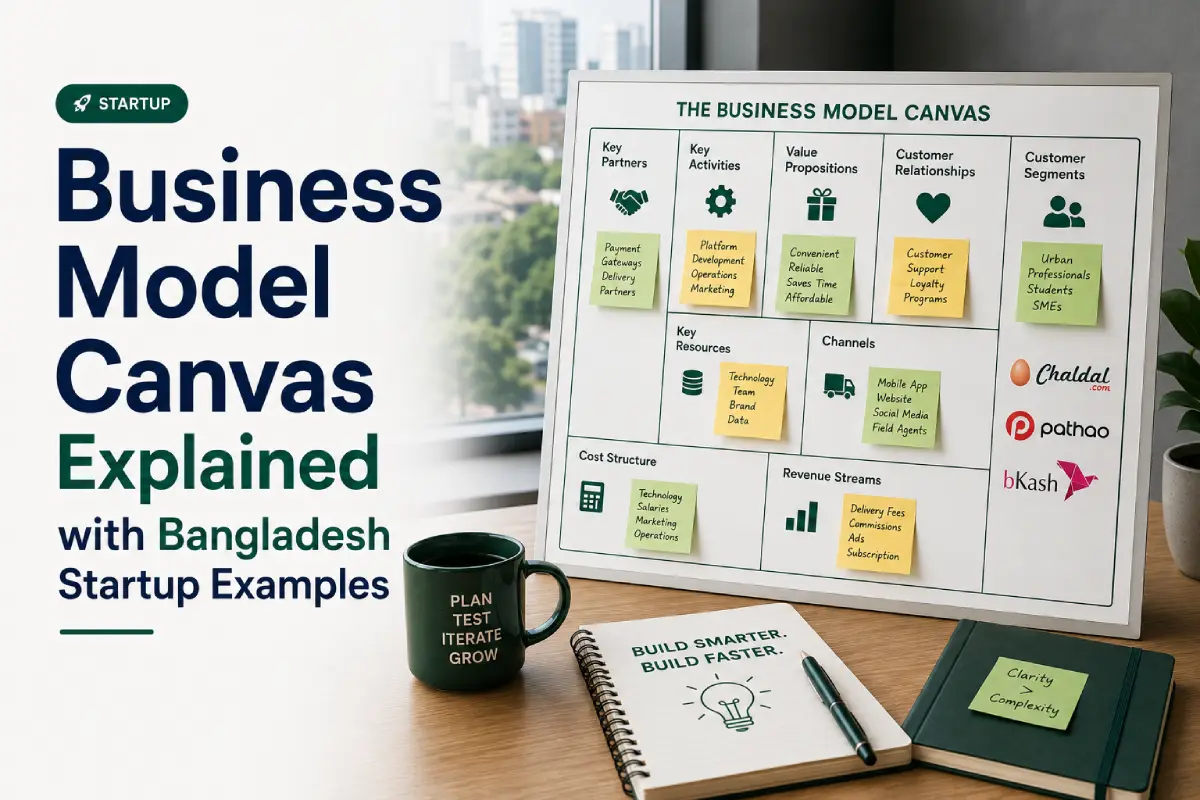
Business Model Canvas Explained with Bangladesh Startup Examples
Quick Answer: The Business Model Canvas (BMC) is a one-page strategic framework with 9 building blocks: Customer Segments, Value Propositions, Channels, Customer Relationships, Revenue Streams, Key Resources, Key Activities, Key Partnerships, and Cost Structure. It helps founders map, test, and communicate their entire business model before writing a single page of a business plan.
Comments (0)
No comments yet. Be the first to share your thoughts!