What Is Equity Dilution? How Funding Rounds Reduce a Founder's Ownership
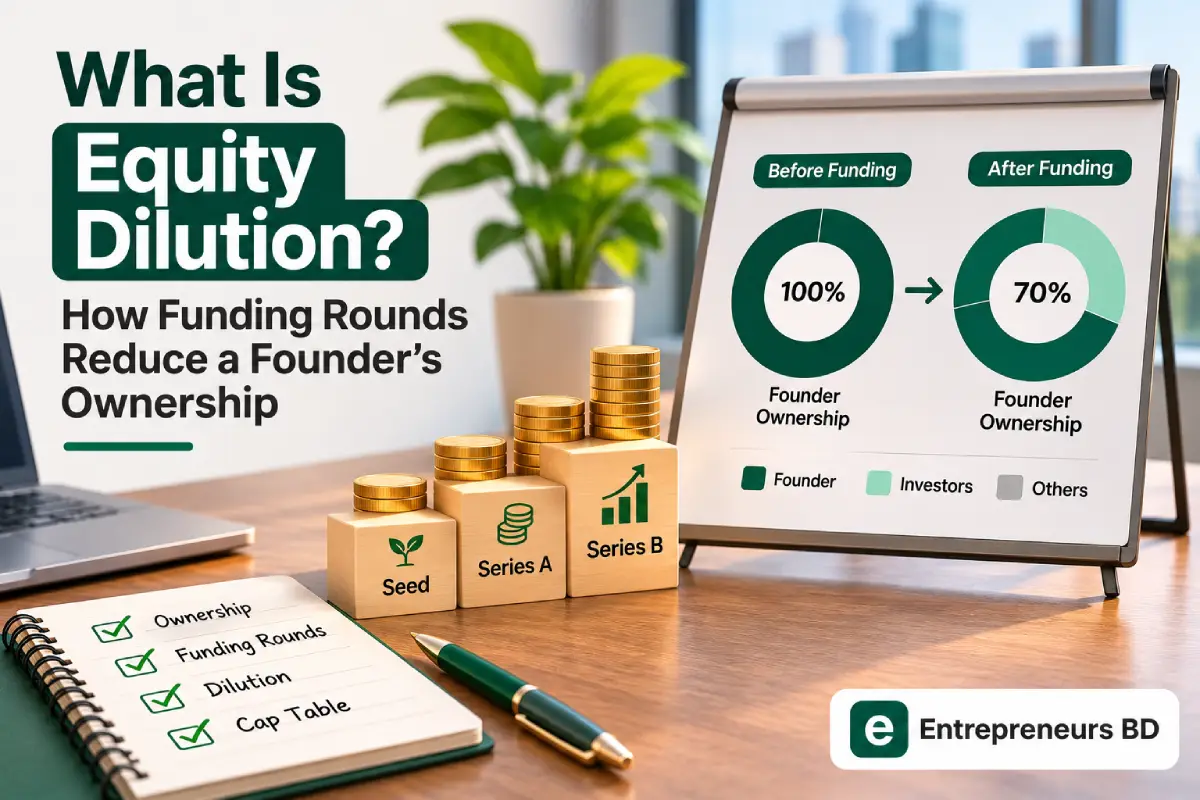
Equity dilution is the fall in an existing shareholder's ownership percentage when a company issues new shares. In a funding round, investors receive newly created shares, so founders own a smaller slice of the company. Dilution does not automatically reduce the value of a founder's stake, but a higher headline valuation is not guaranteed cash either.
Key Takeaways
In a simple new-share issue you keep every share you had, but those shares become a smaller percentage of the total.
In a straightforward priced round, the new investor's stake equals the investment divided by the post-money valuation.
An option pool created before the round dilutes all existing shareholders, including founders and earlier investors, not the new investor.
Ownership, economic rights and control are three different things: a lower percentage does not automatically mean lost control, and a higher one does not guarantee it.
In Bangladesh, new shares are issued under the Companies Act 1994, the company's articles and any shareholder agreements, with a return of allotment filed at RJSC.
Equity dilution is the part of fundraising most first-time founders understand last. You sign a term sheet, the money arrives, and your ownership percentage changes. The real consequences often only become clear later, when you review the updated cap table, the voting rights and the investor protections you agreed to.
The arithmetic is simple. What makes dilution tricky is that it compounds across rounds, and that some of the biggest effects come from terms that look minor on paper. If you have already divided ownership among your co-founders through a startup equity split, this article picks up from there.
Below, you will see what equity dilution means, the difference between issued and fully diluted ownership, a worked BDT example from founding to Series A, the terms that quietly add dilution, and how share issuance works under Bangladeshi company law.
What Is Equity Dilution?
Equity dilution happens when a company issues new shares, which lowers the percentage of the company that each existing shareholder owns. Nobody takes your shares away. The total number of shares grows, so your shares represent a smaller fraction of it.
Suppose you own 600,000 of a company's 1,000,000 shares, which is 60%. If the company issues 500,000 new shares to an investor, you still hold 600,000 shares, but now out of 1,500,000. Your stake falls to 40%.
Companies issue new shares for three main reasons:
Raising capital from angels, venture funds or strategic investors
Reserving an employee stock option pool (ESOP) to attract and keep talent
Converting earlier instruments, such as convertible notes, into shares at a later round
Not every share deal dilutes you. In a secondary sale, an existing shareholder sells shares they already own to a buyer. No new shares are created, so other shareholders' percentages stay the same. Dilution comes from primary issuance, where the company creates new shares.
Dilution versus value
A smaller percentage does not automatically make you worse off. A founder holding 40% of a company with a BDT 10 crore equity valuation has an implied stake of BDT 4 crore, which can be worth more than owning 100% of a much smaller business.
That figure is a paper value, though. It does not account for company debt, investors' liquidation preferences, different share rights or exit costs, and a valuation set in a funding round is not a price anyone has promised to pay you. Good dilution funds growth that increases what your remaining shares are actually worth. Bad dilution sells ownership cheaply or for money that does not move the business.
Issued Shares vs Fully Diluted Ownership
Two cap table views matter, and investors usually negotiate on the second one.
Issued and outstanding shares are shares the company has actually allotted to shareholders.
Fully diluted shares also count everything that could become shares: options reserved in an ESOP, warrants, and convertible instruments.
This is why your share count can stay the same while your fully diluted percentage drops. An option pool reserved today is not yet anyone's shares, but it is counted when an investor works out their percentage. Before any round, check exactly which securities the term sheet includes in the capitalisation used to set the share price.
How Funding Rounds Reduce a Founder's Ownership
A straightforward priced primary round can be modelled with three figures:
Pre-money valuation: what the company is valued at before the new money
Investment amount: the cash the investor puts in
Post-money valuation: pre-money plus the investment
The new investor's ownership is the investment divided by the post-money valuation. In a simple round where existing shareholders do not buy any of the new shares, each of them keeps the remaining fraction of their previous stake. If the investor takes 20%, everyone else keeps 80% of what they held.
Real rounds can differ. Existing shareholders may take up new shares through pre-emption or pro-rata rights, convertible instruments may convert at the same time, and the round may change the option pool or create share classes with special rights. Each changes who absorbs the dilution.
How the pre-money figure gets set is its own discipline, covered in our guide to startup valuation. For dilution, the key point is that a higher pre-money valuation means fewer new shares for the same money, assuming the same fully diluted share count and share rights.
A Worked Example: From Founding to Series A
Here is how ownership could move for a hypothetical two-founder startup in Dhaka. The numbers are illustrative, and the one-million-share structure is a choice for easy maths, not a legal requirement. Companies can use a different number and nominal value of shares, within their authorised capital.
Stage 1: Founding
Two co-founders incorporate a private limited company and issue 1,000,000 shares, 500,000 each.
Shareholder | Shares | Ownership |
|---|---|---|
Founder A | 500,000 | 50% |
Founder B | 500,000 | 50% |
Total | 1,000,000 | 100% |
Stage 2: Seed round
A seed investor puts in BDT 2 crore at a BDT 8 crore pre-money valuation. Post-money is BDT 10 crore, so the investor takes 20%.
The price per share is BDT 8 crore divided by 1,000,000 shares, or BDT 80. At that price, BDT 2 crore buys 250,000 new shares.
Shareholder | Shares | Ownership |
|---|---|---|
Founder A | 500,000 | 40% |
Founder B | 500,000 | 40% |
Seed investor | 250,000 | 20% |
Total | 1,250,000 | 100% |
Each founder fell from 50% to 40%, a 20% relative reduction.
Stage 3: Series A with an option pool
A venture fund offers BDT 10 crore at a BDT 40 crore pre-money valuation, for 20% post-money. It also requires an employee option pool equal to 10% of the post-money company, included in the pre-money valuation.
Because the pool sits inside the pre-money capitalisation, all existing shareholders absorb its dilution: both founders and the seed investor. The new investor still receives the agreed 20%, calculated after the pool is included.
After the round, on a fully diluted basis, the Series A fund holds 20%, the pool holds 10%, and the remaining 70% is shared by the existing shareholders in their previous proportions.
Shareholder | Fully diluted ownership | Implied value at BDT 50 crore post-money |
|---|---|---|
Founder A | 28% | BDT 14 crore |
Founder B | 28% | BDT 14 crore |
Seed investor | 14% | BDT 7 crore |
Series A fund | 20% | BDT 10 crore |
ESOP pool (reserved) | 10% | BDT 5 crore |
Total | 100% | BDT 50 crore |
Three things are worth noticing:
Everyone before the round fell by the same 30% relative amount. The founders went from 40% to 28% and the seed investor from 20% to 14%.
The pool shrinks the effective pre-money value. The headline pre-money is BDT 40 crore, but the founders and seed investor together hold 70%, worth BDT 35 crore at the post-money price. The other BDT 5 crore is the pool.
BDT 14 crore per founder is an implied paper value. It is not cash, and in a sale the founders could receive less, depending on the company's finances and any investor preferences.
For comparison, Carta's 2026 founder ownership report, based on US-heavy data from rounds raised in 2021 to 2025, puts median founding team ownership at about 56% after seed and 36% after Series A. Those are whole-team figures from a different market, not Bangladesh benchmarks, but they show this example is not unusual.
Terms That Add Hidden Dilution
The headline percentage on a term sheet rarely tells the whole story. These clauses can shift more ownership, or more value, than the round itself.
The option pool shuffle
As the example shows, a pool created in the pre-money valuation dilutes only existing holders. Negotiate its size against a realistic hiring plan for the period until your next expected round, estimating the equity specific roles will need, rather than accepting a round percentage.
Anti-dilution protection
Investors holding preference shares often ask for protection if a later round is priced lower than theirs (a down round). This usually works by adjusting the price at which their preference shares convert into ordinary shares:
Full ratchet: the conversion price drops to the new, lower price, regardless of how many new shares were issued. Their preference shares then convert into more ordinary shares, shifting significant dilution onto other shareholders.
Broad-based weighted average: the conversion price is adjusted by a formula that weighs the lower price against how many new shares were issued and the existing capitalisation. It generally produces a much smaller adjustment and is a common negotiated alternative to full ratchet.
If a term sheet includes full ratchet, treat it as a serious negotiation point.
Convertible notes and other future-equity instruments
These instruments convert into shares at a later round, and two features drive how many shares the holder gets:
A valuation cap sets a maximum valuation for conversion, so if the next round is priced higher, the holder converts at the lower capped price.
A discount lets the holder convert at a lower price than the new round's investors.
Accrued interest, and whether the cap is measured pre-money or post-money, can also change the result. Include these instruments in your fully diluted cap table and model their conversion at several possible next-round valuations, using the exact terms in the documents. Have a Bangladeshi corporate lawyer review any such instrument, since it must work within local company and foreign exchange rules.
Liquidation preferences
These do not change your ownership percentage, but they decide who is paid first in a sale. A 1x non-participating preference is a common venture-financing arrangement, though terms vary by investor and deal. Higher multiples, or participating preferences, can mean founders receive far less in an exit than their percentage suggests.
Equity Dilution in Bangladesh: How It Works Locally
In Bangladesh, a startup raising equity is usually a private limited company formed under the Companies Act 1994. A sole proprietorship cannot issue company shares to investors. To raise equity, you generally need to incorporate a company and transfer the business, assets and contracts into it through the proper legal and tax steps. Our guide to setting up a limited company in Bangladesh covers incorporation.
Share issuance has to comply with three layers: the Companies Act, the company's memorandum and articles of association, and any shareholders' or investment agreements. Negotiated investor rights usually live in the shareholders' agreement, but some may also need to appear in the articles to bind the company and its members. A term sheet alone protects nobody.
In practice, issuing new shares usually involves:
Checking authorised capital. Authorised capital is the maximum share capital the memorandum allows. If the new shares would exceed it, the company must first increase it through the required shareholder process and notify RJSC.
Following the statutory offer to existing members. Under Section 155 of the Act, when directors increase subscribed capital within the authorised limit, the new shares are to be offered to existing members in proportion to their paid-up capital, with at least 15 days to accept. Bangladeshi courts have rectified share registers where companies skipped this step, so check the procedure with a lawyer, along with any extra pre-emption terms in the articles and shareholders' agreement.
Obtaining the right approvals. A board resolution typically approves the allotment, while shareholder approval may be needed for related steps, such as increasing authorised capital, changing the articles or waiving existing rights.
Filing the return of allotment. The company files Form XV, the return of allotment required by Section 151 of the Act, with RJSC within the prescribed period, plus any other filings the transaction triggers.
Venture capital and private equity funds structured as alternative investment funds are regulated under the BSEC Alternative Investment Rules, which cover fund registration and fund-manager requirements. Not every startup investor operates this way, however: angels, corporates and offshore funds investing directly may sit outside that framework. Our overview of venture capital in Bangladesh explains who the active investors are.
The law itself may change. A draft third amendment to the Companies Act was under consultation in September 2026. Until it is passed and published in the Gazette, the current Act applies, so check for updates before closing a round.
Learning from multi-round companies
ShopUp raised several funding rounds from international investors as it expanded its B2B commerce platform. Its fundraising history shows how Bangladeshi startups use successive rounds to finance growth, although public information does not reveal the exact dilution or the value of its founders' remaining stakes.
The lesson is not to avoid dilution. It is to dilute only for capital that has a clear plan to increase the company's value.
How to Manage Dilution as a Founder
You cannot avoid dilution if you raise outside money, but you can control how much and on what terms.
Keep a fully diluted cap table from day one. Track every share, option, warrant and convertible instrument, and model each future round before you negotiate it.
Raise what you need for clear milestones. Taking more money than you can use at a low valuation is expensive dilution.
Strengthen your position before raising. Sustainable revenue growth, strong retention and improving unit economics can support a better valuation. Growth alone does not guarantee one: investors also weigh margins, burn rate, capital efficiency and market conditions.
Negotiate the option pool size, not just the valuation, and tie it to real hiring plans.
Push for broad-based weighted average anti-dilution instead of full ratchet.
Put founder vesting in writing. A properly drafted co-founder agreement should say what happens to a departing founder's unvested shares, such as a repurchase or transfer right. Unvested shares do not return to the company automatically, so have the mechanism reviewed by a corporate lawyer before shares are issued.
Track control, not just ownership. Control depends on board seats, voting rights, investor consent rights and shareholder agreements. Special resolutions under Section 87 of the Act need a three-fourths majority of votes cast, so whether a holder can block one depends on attendance and voting, not a fixed ownership number.
Frequently Asked Questions
Is equity dilution always bad for founders?
How do I calculate dilution from a funding round?
How much dilution is normal in a seed round?
Does an ESOP dilute founders?
Can existing shareholders stop dilution?
Do I need RJSC approval to issue new shares in Bangladesh?
Dilution Is a Trade, So Make It a Good One
Every share you issue is a trade: ownership for capital, talent or time. The founders who come out well are not the ones who avoided dilution. They are the ones who knew exactly what each round cost them, in ownership, in economic rights and in control, and made sure the money was worth it.
For Bangladeshi founders, the legal side deserves as much attention as the maths. Section 155 offers, authorised capital limits, RJSC filings and how investor rights are written into your articles and shareholders' agreement all shape what dilution actually means for you.
Start today with one practical step: build a fully diluted cap table and model your next two rounds. Plug in realistic valuations, add an option pool and any convertible instruments, and see where your ownership lands. If the number surprises you, it is far better to find out now than after the term sheet is signed.
If you are preparing to raise, pair this with a clear picture of who funds local startups at each stage, starting with angel investors in Bangladesh.

Specializing in SaaS product marketing, SEO strategy, Content marketing, TikTok advertising, PPC, and digital growth.
View Full Profile & ContributionsRelated Articles

Startup Grants for Bangladeshi Entrepreneurs: Government and NGO Programs You Can Apply For
Bangladeshi entrepreneurs can apply for grants and low-cost financing through the ICT Division's iDEA project (up to BDT 10 lakh), SME Foundation's Credit Wholesaling Program, and Bangladesh Bank's refinance schemes for women and new entrepreneurs. Most require a trade license, a clear business plan, and an online application.

Fintech in Bangladesh: Key Players, Regulations, and Opportunities for Founders
For the payment and digital-finance businesses covered here, four regulated models matter most: MFS, PSP, PSO and digital banking. MFS requires a bank, financial institution or government entity to hold at least 51% of the provider and control its board. PSPs don't carry that requirement. PSOs run payment infrastructure and can't issue e-money. Digital banks are licensed under the Bank Company Act and now require Tk 300 crore in paid-up capital.

What Is Venture Capital? How VC Funding Works for Early-Stage Companies
Venture capital is equity funding that professional investment funds give to young, high-growth companies in exchange for part ownership. The fund pools money from outside investors, spreads it across many startups in stages, and makes its return mainly when a few of those companies are sold or listed years later.
Comments (0)
No comments yet. Be the first to share your thoughts!