What Is Venture Capital? How VC Funding Works for Early-Stage Companies
Venture capital is equity funding that professional investment funds give to young, high-growth companies in exchange for part ownership. The fund pools money from outside investors, spreads it across many startups in stages, and makes its return mainly when a few of those companies are sold or listed years later.
Key Takeaways
VC buys ownership instead of lending money: there is no repayment schedule, but founders give up equity and some control.
Most VC funds have a fixed life of around ten years, which shapes how fast they want you to grow and exit.
New equity rounds usually dilute existing shareholders, and the term sheet decides who is paid first in a sale.
Domestic VC funds in Bangladesh are BSEC-registered trusts; many foreign VCs invest through offshore holding companies.
In H1 2026, Bangladeshi startups raised USD 6 million, all of it from foreign investors.
A Dhaka founder with 2,000 paying users and a burn she cannot cover from revenue will hear the same advice from everyone: raise venture capital. Before you take that advice, it helps to know what you are actually signing up for.
This guide explains what venture capital is and how VC funding works from inside the deal: how funds are built, why they invest the way they do, what each round costs you in ownership, and how Bangladesh's rules and 2026 market change the picture. For those investing locally and at what size, see our guide to active VCs in Bangladesh.
What Is Venture Capital and How Does a VC Fund Work?
Venture capital is private equity funding for early-stage, high-growth companies that are usually too young or asset-light to borrow much from banks. The fund buys a minority stake. The startup gets cash with no repayment schedule, and the fund hopes its shares will be worth many times more after an acquisition or listing.
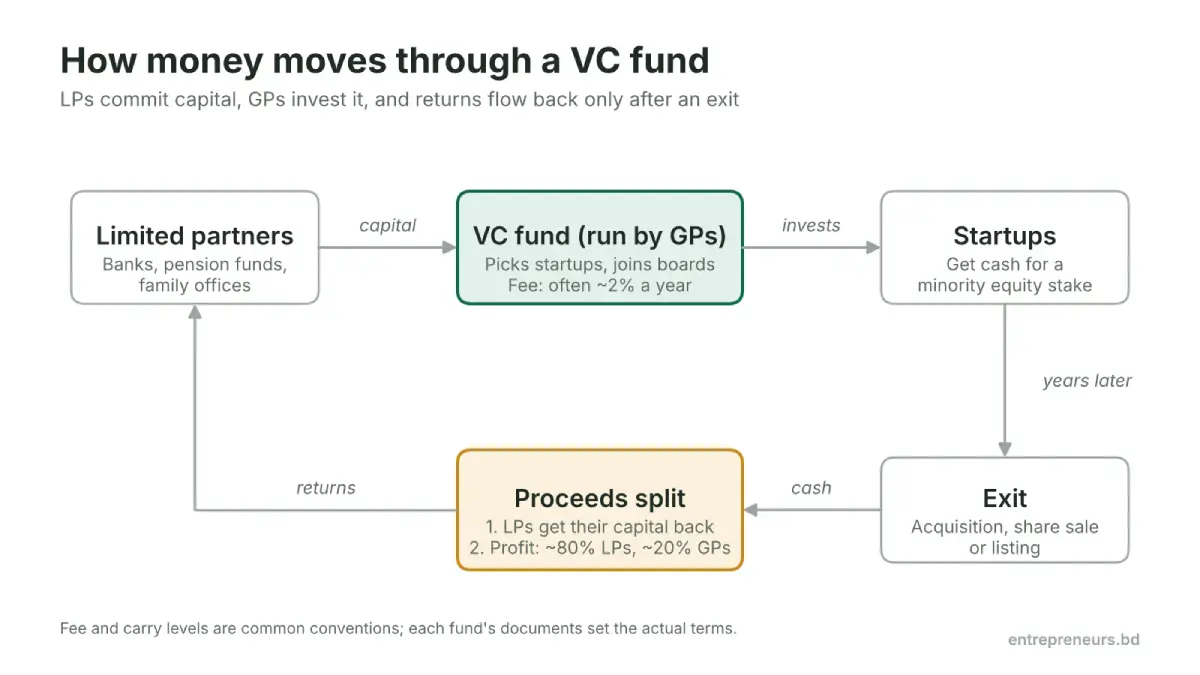
The money usually belongs to someone else. A fund has three layers:
Limited partners (LPs): banks, pension funds, development finance institutions, family offices and wealthy individuals who commit the capital and stay passive.
General partners (GPs): the team that runs the fund, picks startups and often joins boards.
Portfolio companies: the startups the fund backs.
GPs typically earn an annual management fee of around 2% plus carried interest of around 20% of profits, paid after LPs get their money back. These are conventions, not rules; each fund's documents set the details.
Funds usually last about ten years, sometimes with extensions. A fund late in its life has less time to wait for your exit, so ask how old it is and how much it still has to invest.
Why VCs Want Outsized Returns
In most VC portfolios, many companies return little or nothing and a few winners produce most of the profit. This power law explains why investors pass on solid but small businesses, push for speed over steady profit, care more about market size than today's revenue, and keep reserves for their breakout companies.
A simplified illustration: a BDT 100 crore fund aiming to return three times its money needs BDT 300 crore. If it owns 10% of a company at exit, that company must sell for BDT 3,000 crore for one deal to hit the target alone.
VC Funding Stages: Pre-Seed to Series B and Beyond
Stages are gated by evidence, not time, and milestones vary by market and sector. A typical pattern:
Stage | What the company usually has | Typical investors | What the money is for |
|---|---|---|---|
Pre-seed | A prototype or idea under test | Founders, friends, angels, accelerators | Building an MVP |
Seed | A working product, early users or revenue | Angel networks, seed funds | Reaching product-market fit |
Series A | Signs of repeatable growth | Institutional VCs | Team and sales engine |
Series B and later | A model ready to scale | Growth funds, foreign VCs | New markets and products |
At the early end the line between angels and funds blurs, so learn how angel investors differ before you pitch either.
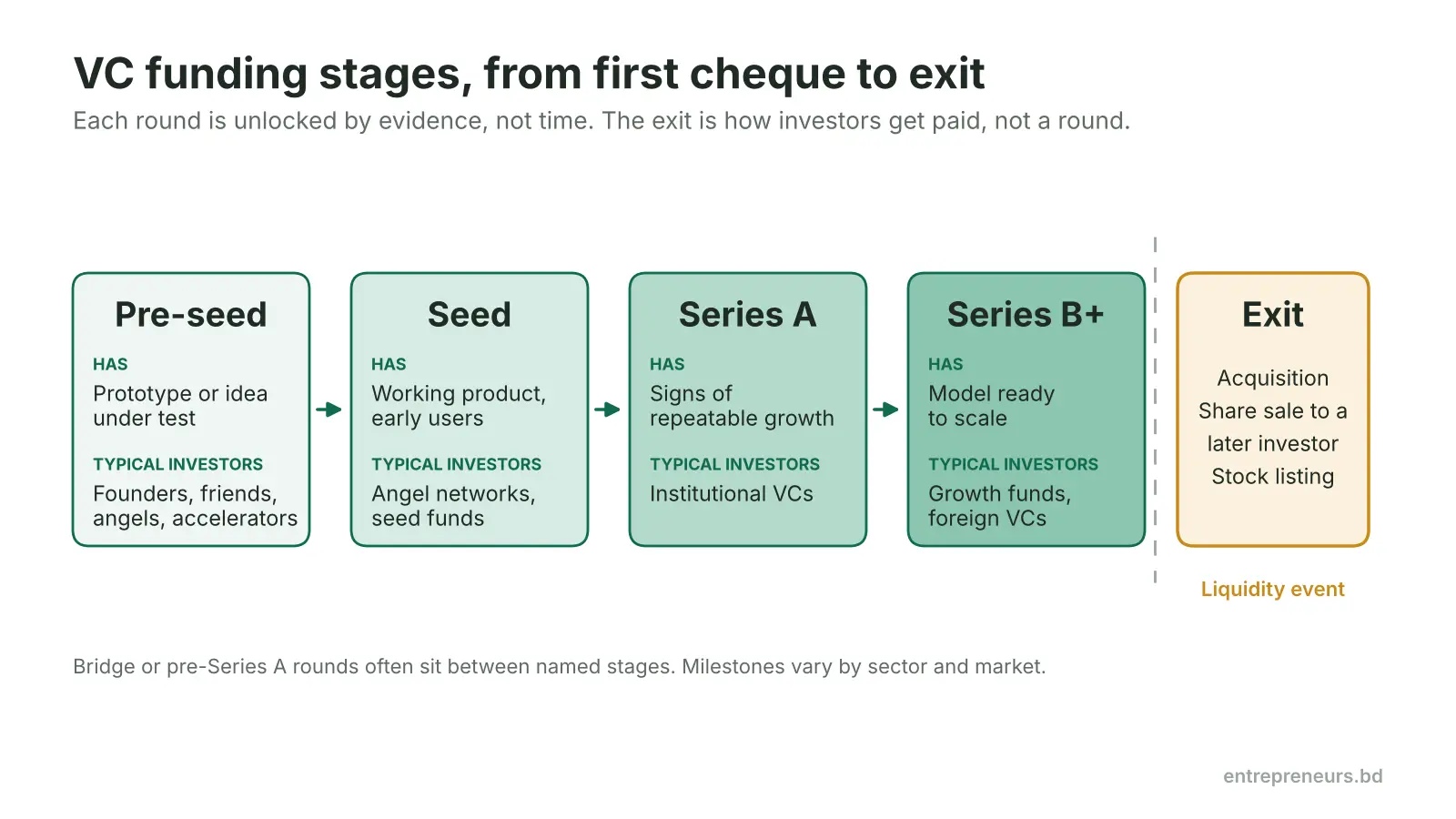
Investors get their money back through an exit, which is a liquidity event, not a funding round: an acquisition, a share sale to a later investor or, rarely in Bangladesh, a stock market listing.
How a VC Round Works, Step by Step
First meeting. Usually via a warm introduction or accelerator. A clear startup pitch deck gets you to the next conversation.
Partner meeting. Your champion presents the deal to the other partners.
Term sheet. A mostly non-binding offer on valuation, amount and key rights, often with an exclusivity period.
Due diligence. Financials, cap table, contracts, IP and tax. In Bangladesh, expect checks on RJSC filings, trade licence, TIN and VAT registration, and every past share transfer.
Legal documents and closing. A subscription agreement, shareholders' agreement and amended articles, then the money moves. Foreign money must come through an authorised dealer bank.
After the cheque. Board participation, regular reporting and help with the next round.
Term Sheets and Dilution: The Maths Founders Need
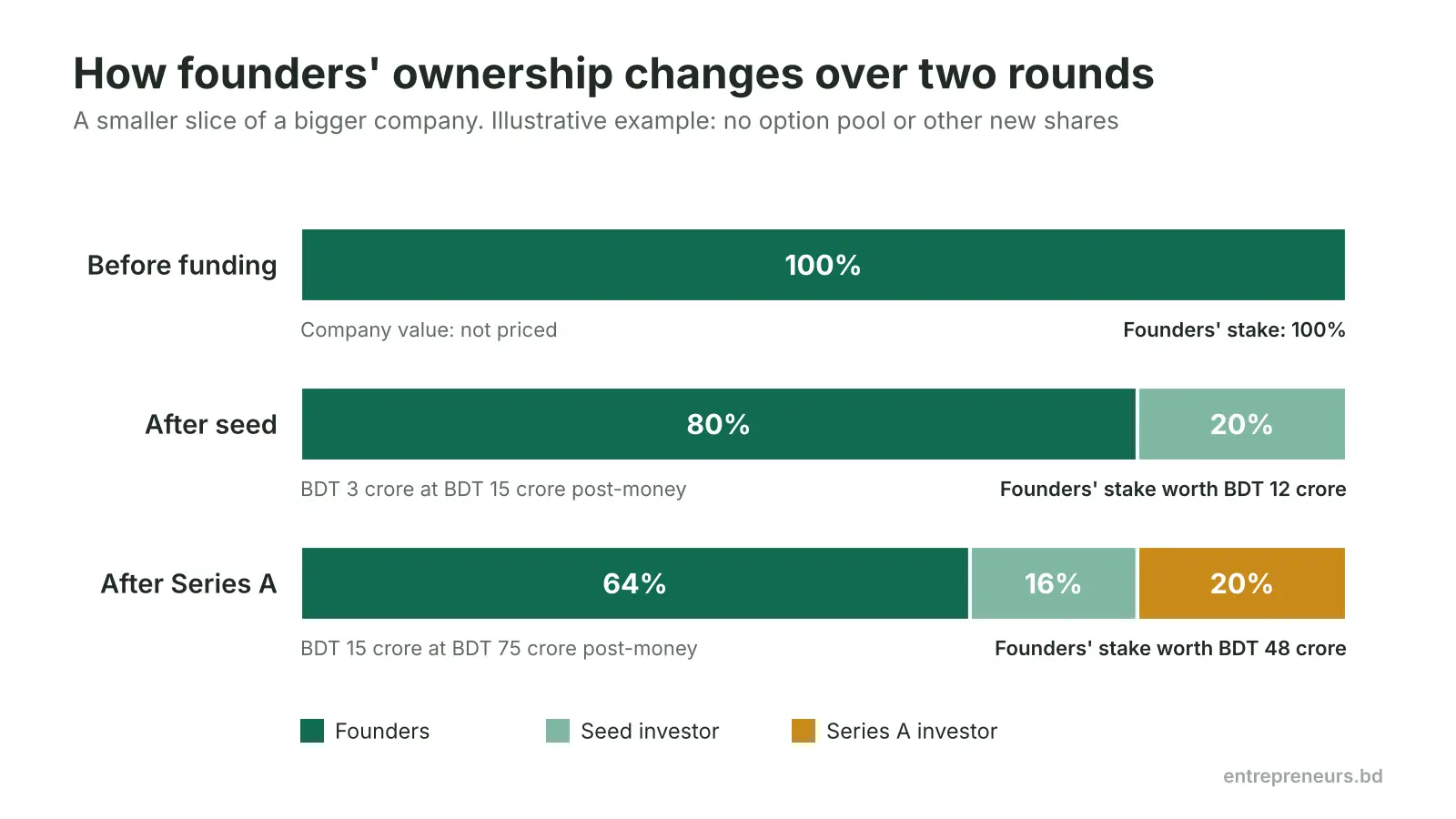
Post-money valuation equals pre-money valuation plus the new investment, and the investor's stake is the investment divided by post-money. When new shares are issued, every existing holder's percentage falls.
An illustrative path, assuming no option pool or other new shares:
Round | Pre-money | Raised | Post-money | New investor gets | Founders own after |
|---|---|---|---|---|---|
Before funding | None | None | None | None | 100% |
Seed | BDT 12 crore | BDT 3 crore | BDT 15 crore | 20% | 80% |
Series A | BDT 60 crore | BDT 15 crore | BDT 75 crore | 20% | 64% |
The founders' stake falls to 64% but its paper value rises from BDT 12 crore to BDT 48 crore. Paper value becomes cash only at an exit. How the pre-money figure is set is covered in our guide to startup valuation.
Terms that often matter as much as valuation:
Liquidation preference. Preferred investors are paid first in a sale. Assume the Series A investor holds a senior 1x non-participating preference, the company sells for BDT 10 crore after debts, and no one ranks ahead. The investor takes all BDT 10 crore and founders get nothing. In a large sale, it would convert to ordinary shares and take its 20% instead.
Option pool. An employee share pool, often created before the round so it dilutes only existing owners.
Anti-dilution. Protection if a later round is priced lower; weighted-average versions are far kinder to founders than a full ratchet.
Board seats and vetoes over new fundraising, asset sales or major changes.
Founder vesting, commonly four years with a one-year cliff.
How Venture Capital Works in Bangladesh
Domestic funds are regulated by BSEC
VC funds set up in Bangladesh fall under the BSEC Alternative Investment Rules, issued in 2015 and since amended. Each fund is a trust whose fund manager and trustee must be registered with the Bangladesh Securities and Exchange Commission. A foreign fund wanting to operate as such a fund inside Bangladesh must register or invest through a registered local fund, though many foreign VCs invest via offshore structures instead.
Foreign investors and offshore holding companies
Bangladesh Bank's FEID Circular No. 02 of March 2025 lets startups operating under 10 years remit up to USD 10,000, through their bank, to set up one legal entity abroad. Share swaps with foreign companies are possible, but Bangladesh Bank reviews each proposal individually. A separate March 2026 master circular eased share transfers and repatriation for foreign shareholders in unlisted companies, as BIDA's press release explains. Take legal advice first, and see our guide to foreign investment for startups.
The 2026 funding drought
Bangladeshi startups raised USD 6 million across six deals in H1 2026, down 95% from USD 120 million a year earlier, according to LightCastle's H1 2026 report. The drop looks steeper because H1 2025 included one USD 110 million M&A deal behind SILQ, formed from ShopUp and Sary. More telling: global investors supplied all H1 2026 capital, and late-stage funding was a single Series A of about USD 625,000.
The deals that closed were small and early, such as the seed and grant funding raised by iFarmer.
The local Series A gap
Since 2013, about 80% of startup capital has gone to late-stage deals, 98% of it from foreign investors, the Dhaka Tribune reported from the same research. The bank-backed BSIC, launched in May 2026 with a USD 35 million first fund, co-invests alongside a lead investor rather than replacing one.
Is Venture Capital Right for Your Company?
VC fits when the market is large, revenue can grow much faster than costs, and founders accept outside control and an exit within roughly a decade.
Funding route | What you get | What it costs you |
|---|---|---|
Full ownership | Growth limited by revenue | |
Angel investment | Early capital and contacts | Equity at a low valuation |
Venture capital | Large growth capital | Dilution, investor rights, exit pressure |
Bank loan | Capital without dilution | Repayments and eligibility rules |
Grants | Non-dilutive money | Eligibility and reporting rules |
For debt, Bangladesh Bank's startup finance circular of July 2025 caps the rate banks charge eligible startups at 4%, with loan limits of Tk 2 crore (under two years old), Tk 5 crore (two to six years), and Tk 8 crore (six to twelve years). Founders must be at least 21, and each bank still applies its own credit policy.
Frequently Asked Questions
Do founders have to repay venture capital?
What is the difference between pre-money and post-money valuation?
How is venture capital different from angel investment?
How long does it take to raise a VC round?
Can a sole proprietorship raise venture capital in Bangladesh?
What happens to VC investors if the startup fails?
Next Step: Prepare Your Fundraising Data Room
With 2026 funding scarce and almost all of it foreign, founders who raise are those whose paperwork survives foreign diligence. Start your data room today:
Incorporation documents, articles and RJSC filings
Share register, clean cap table and a signed co-founder agreement with vesting
Last twelve months of financial statements and unit economics
Trade licence, TIN, VAT registration and tax returns
Key customer, supplier and employment contracts, plus IP records

Specializing in SaaS product marketing, SEO strategy, Content marketing, TikTok advertising, PPC, and digital growth.
View Full Profile & ContributionsRelated Articles
Startup Grants for Bangladeshi Entrepreneurs: Government and NGO Programs You Can Apply For
Bangladeshi entrepreneurs can apply for grants and low-cost financing through the ICT Division's iDEA project (up to BDT 10 lakh), SME Foundation's Credit Wholesaling Program, and Bangladesh Bank's refinance schemes for women and new entrepreneurs. Most require a trade license, a clear business plan, and an online application.
Fintech in Bangladesh: Key Players, Regulations, and Opportunities for Founders
For the payment and digital-finance businesses covered here, four regulated models matter most: MFS, PSP, PSO and digital banking. MFS requires a bank, financial institution or government entity to hold at least 51% of the provider and control its board. PSPs don't carry that requirement. PSOs run payment infrastructure and can't issue e-money. Digital banks are licensed under the Bank Company Act and now require Tk 300 crore in paid-up capital.
Angel Investors in Bangladesh: Who They Are and How to Reach Them
Angel investors in Bangladesh are individuals, family offices, and diaspora professionals who fund early-stage startups in exchange for equity. Most operate through organized networks like Bangladesh Angels Network (BAN) and Bangladesh Women Investors Network (BWIN), which vet founders, run pitch sessions, and syndicate deals among members.
Comments (0)
No comments yet. Be the first to share your thoughts!