What Is a Term Sheet? Key Clauses Every Founder Should Understand
A term sheet is a short, mostly non-binding document that sets out the main terms of an investment before lawyers draft the final agreements. It covers how much the investor pays, how much equity they receive, and the rights attached to that equity, such as liquidation preference, board seats, anti-dilution protection, and founder vesting.
Key Takeaways
A term sheet is a negotiating blueprint, not a funding guarantee: most of it is non-binding until the definitive agreements are signed
Two offers at the same valuation can pay founders very differently once liquidation preference and the option pool are counted
Control clauses (board seats, veto rights, vesting) often matter more over five years than the headline valuation
Market-standard terms exist: 1x non-participating preference, broad-based weighted average anti-dilution, and four-year vesting with a one-year cliff
In Bangladesh, term sheet rights must be written into the company's articles, and foreign money must follow Bangladesh Bank's share issuance and reporting rules
Most founders see their first term sheet at the moment they are least prepared to read it. After months of pitching, an investor finally says yes, and a four-page PDF lands in the inbox. The temptation is to check the valuation, feel relief, and sign. That is usually where the trouble starts.
A term sheet is the blueprint for your relationship with an investor. The headline number matters, but the clauses on pages two and three decide who gets paid first when the company is sold, who controls the board, and what happens to your shares if you step away. Two offers at the same valuation can leave a founder with very different outcomes.
If you are raising your first institutional round, this guide works alongside our wider look at startup funding in Bangladesh. Below, you will learn what a term sheet is, which parts actually bind you, how each key clause works with worked examples in taka, and how Bangladeshi company law and Bangladesh Bank rules shape the deal once a foreign investor is involved.
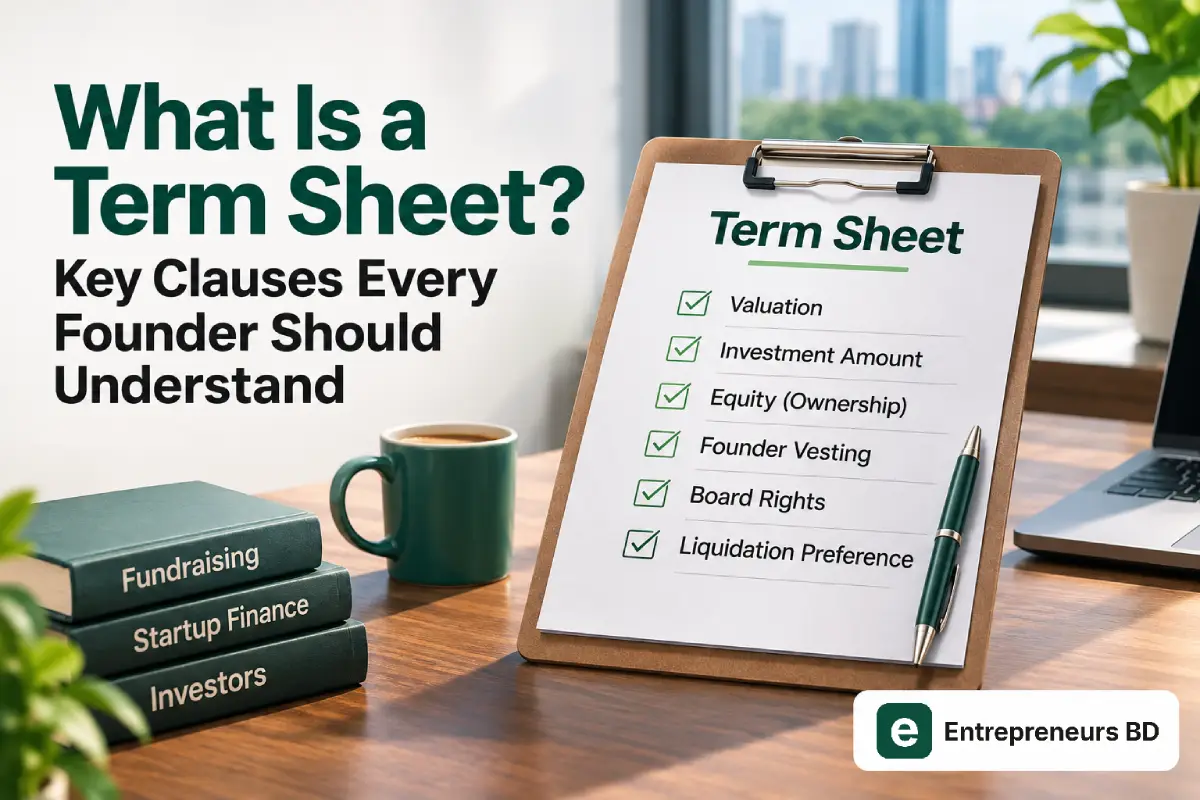
What Is a Term Sheet in Startup Funding?
A term sheet is a summary of the commercial and control terms an investor proposes for a funding round. It usually runs two to ten pages, is signed by the founders and the lead investor, and becomes the basis for the definitive documents: the share subscription agreement and the shareholders' agreement.
Think of it as the agreed outline before anyone pays for full legal drafting. Angel investors sometimes skip it for small cheques, but institutional venture capital firms almost always issue one, because it locks the big decisions early and keeps lawyers from arguing about points nobody has agreed.
Which Clauses Are Binding and Which Are Not
Most of a term sheet is non-binding. Valuation, investment amount, preference, board seats and vesting are all statements of intent until the final agreements are signed. A small group of clauses usually binds both sides from the day of signature:
Exclusivity (no-shop): you agree not to negotiate with other investors for a set period, commonly 30 to 60 days
Confidentiality: neither side discloses the terms without consent
Costs: who pays legal and due diligence fees, often the company up to a capped amount
Governing law and dispute resolution: which country's law applies to the binding parts
The practical consequence cuts both ways. A signed term sheet is not money in the bank, and an investor can still walk away after due diligence. But reopening agreed terms later, known as re-trading, damages trust on both sides. Negotiate now, not after signing.
Where the Term Sheet Sits in a Funding Round
Pitch meetings and an expression of interest
Term sheet negotiated and signed
Due diligence on legal, financial, tax and technical records
Definitive agreements drafted from the term sheet
Board and shareholder resolutions, amended articles, and share allotment filings
Funds transferred and shares issued
In Bangladesh, steps three to six commonly take several weeks to a few months, longer when foreign currency and regulatory reporting are involved.
Key Term Sheet Clauses on Money: Valuation, Preference and Dilution
The economic clauses decide how value is split between founders and investors, today and at exit. Read them together, because each one changes what the others are worth.
Pre-Money and Post-Money Valuation
Pre-money valuation is what the company is worth before the new money arrives. Post-money is pre-money plus the investment. If an investor puts in Tk 5 crore at a Tk 20 crore pre-money valuation, the post-money is Tk 25 crore and the investor owns 20%.
Always confirm which number the term sheet means. A "Tk 25 crore valuation" can mean 20% or 16.7% for the same cheque depending on whether it is pre or post. Our guide to startup valuation methods covers how that number gets set in the first place.
Option Pool
Investors usually want a pool of shares reserved for future employees, often 10% to 15% of the company. The question is whether that pool is carved out before or after their money comes in.
In the example above, a 10% post-money pool created from pre-money shares leaves founders with 70% after the round. If the same pool were created after the round and shared by everyone, founders would hold 72%. The clause quietly reduces your effective pre-money valuation from Tk 20 crore to Tk 17.5 crore. Size the pool to a real hiring plan, not a round number.
The pool is not a formality in Bangladesh either. When ShopUp announced its US$75 million Series B in 2021, it also reported tripling its employee share pool, a sign that top local hires now negotiate for equity.
Liquidation Preference
Liquidation preference decides who gets paid first when the company is sold or wound up. The market standard is a 1x non-participating preference: the investor gets either their money back or their percentage of the sale, whichever is higher, but not both.
A participating preference lets the investor take their money back and then also share in what remains. Here is the same Tk 5 crore investment for 20%, at three exit values:
Exit value | Investor gets (1x non-participating) | Investor gets (1x participating) | Left for founders and others (participating) |
|---|---|---|---|
Tk 4 crore | Tk 4 crore | Tk 4 crore | Tk 0 |
Tk 15 crore | Tk 5 crore | Tk 7 crore | Tk 8 crore |
Tk 100 crore | Tk 20 crore | Tk 24 crore | Tk 76 crore |
At a modest exit, participation moves Tk 2 crore from the founding team to the investor. Push back on anything above 1x, and on participation without a cap.
Anti-Dilution Protection
Anti-dilution protects investors if a later round is priced lower than theirs, called a down round. It works by adjusting the price at which their preferred shares convert into ordinary shares.
A full ratchet resets the investor's price to the new, lower price, no matter how small the new round is. If you raised at Tk 100 per share and later sell even a few shares at Tk 50, the earlier investor's holding effectively doubles and founders absorb the hit. Broad-based weighted average anti-dilution adjusts the price in proportion to how many new shares are issued, and it is the version most founders should accept.
Dividends and Conversion
Most venture term sheets give preferred shares a non-cumulative dividend, paid only if the board declares one. Preferred shares normally convert into ordinary shares automatically at an IPO and at the holder's option before a sale. Cumulative dividends, which pile up every year, are rare in early-stage deals and worth questioning.
Control Clauses: Who Makes the Decisions
Economic terms decide how the pie is split. Control terms decide who steers the company while the pie is being baked, and they are far harder to undo later.
Board Composition
The term sheet sets how many directors sit on the board and who appoints them. A common seed or Series A board is two founder seats and one investor seat, sometimes with an independent director added later by mutual agreement.
Founders should keep board control for as long as the company's stage justifies it. Giving an investor a majority at seed means every hiring plan, budget and strategic shift needs their approval. Also check how the board fills vacancies and who appoints the independent director.
Protective Provisions and Veto Rights
Protective provisions list decisions that need the investor's consent even if they hold a minority stake. Typical items include:
Issuing new shares or creating a new share class
Selling the company or most of its assets
Changing the memorandum or articles of association
Taking on debt above an agreed threshold
Paying dividends or buying back shares
Changing the core business
A reasonable list protects the investor's money. An unreasonable one hands over day-to-day control. Negotiate thresholds, for example board approval for borrowing above Tk 50 lakh rather than for any loan at all.
Founder Vesting
Investors are buying into the team as much as the idea, so they usually ask that founder shares vest over time. The standard is four years with a one-year cliff: leave in month eleven and you keep nothing, stay a year and 25% vests, the rest vests monthly. If your co-founder agreement already has vesting, the term sheet should match it rather than restart the clock.
Ask for acceleration on a sale. Double-trigger acceleration, where unvested shares vest if the company is sold and you are let go, is a fair middle ground. In Bangladesh, the Companies Act restricts a company that wants to buy back its own shares, so unvested shares are usually reclaimed through a transfer to other shareholders or a nominee, written into the articles.
Transfer Rights: ROFR, Tag-Along and Drag-Along
These clauses govern what happens when someone wants to sell shares:
Right of first refusal (ROFR): existing shareholders can buy shares before an outsider
Tag-along (co-sale): if founders sell, investors can sell on the same terms
Drag-along: if a set majority approves a sale, minority holders must sell too
Drag-along is the one to read twice. Make sure the approval threshold includes founders, not just the investors, so a sale cannot be forced on you at a price that only clears the liquidation preference. Mapping who holds what, as covered in our startup equity split guide, shows exactly where that threshold falls.
Information Rights and Pre-Emption
Investors normally ask for monthly or quarterly management accounts, an annual budget, and audited statements within a set time after year end. They also ask for pre-emption rights: the right to keep their percentage by investing in future rounds. Both are standard. Just make sure the reporting schedule is one your finance team can actually meet.
How Term Sheets Work for Startups in Bangladesh
Most term sheet templates circulating online were written for US or Singapore companies. A Bangladeshi private limited company can grant the same rights, but the paperwork and the regulators are different.
The Articles of Association Must Carry the Rights
A contract between shareholders binds the people who sign it. To bind the company itself, investor rights such as vetoes, transfer restrictions and board appointment rights need to be written into the articles of association and filed with RJSC. Private company articles already restrict share transfers, and transfer of shares under the Companies Act 1994 runs through the company's register, so drag-along and ROFR clauses have to fit that process.
If the investor gets a separate class of preference shares, changes to that class's rights later need the class holders' consent under the Act's rules on special class rights. In practice, many local deals pair ordinary or preference shares with contractual rights in the shareholders' agreement and then mirror those rights in the articles.
When the Investor Is Foreign
Foreign money does not need Bangladesh Bank's prior approval, but it does need to follow the process. According to the central bank's FDI guidance for investors, the remittance must arrive through the banking channel before shares are issued, and the issuance must be reported to the Foreign Exchange Investment Department through your bank within 14 days.
This turns into conditions precedent in the term sheet: the investor will not wire funds until the company has opened the right accounts and the articles are amended. Build those weeks into your runway, and read our guide on foreign investment for startups before the first call with an overseas fund.
Local Venture Funds
Venture capital and private equity funds set up in Bangladesh are registered under the BSEC Alternative Investment Rules, first issued in 2015 and amended since. Those rules govern the fund, not your company, but a fund's own investment limits and reporting duties can show up as information rights or conditions in its term sheet.
Offshore Holding Structures
Many Bangladeshi startups that raise from global investors set up a holding company abroad, often in Singapore or the US, with the Bangladeshi company as a subsidiary. The term sheet is then governed by that country's law and usually follows a standard template from that market. Founders in this position need two sets of advice: one for the holding company deal, and one for how money and ownership flow into the Bangladeshi subsidiary.
One more local detail: valuations in these deals are usually set in US dollars while costs are in taka. A weaker taka between term sheet and closing changes how far the money goes, so model the round in both currencies.
How to Review and Negotiate a Term Sheet
You will rarely get every clause you want. The goal is to win the clauses that matter most and concede the ones that do not. Work through these steps before you sign.
Model the payout at three exit values. Build a simple sheet showing what founders, employees and investors each receive at a low, middle and high exit. Preference and participation problems only become visible in the numbers.
Rank clauses by long-term impact. Board control, liquidation preference, drag-along thresholds and anti-dilution type usually matter more than a small change in valuation.
Anchor on market-standard terms. Ask for 1x non-participating preference, broad-based weighted average anti-dilution, four-year vesting with credit for time already served, and double-trigger acceleration. Deviations should come with a reason.
Check the option pool against your hiring plan. List the roles you will hire in the next 18 to 24 months and size the pool to that, not to the investor's default number.
Read the binding clauses closely. Know how long exclusivity lasts, what costs you are covering, and whether there is a cap on legal fees.
Reference-check the investor. Talk to two or three founders from their portfolio, including one whose company struggled. How an investor behaves in a bad quarter tells you more than any clause.
Hire a lawyer who has closed venture deals. General corporate counsel is not enough. You want someone who has drafted shareholders' agreements for funded startups, and offshore counsel if there is a holding company abroad.
Plan the regulatory timeline. Map out the RJSC filings, articles amendment and, for foreign money, the bank and FEID reporting steps, so closing does not slip past your cash runway.
One tactical point: negotiate the term sheet in a single round of written comments where possible. Repeated back-and-forth on small points burns goodwill you will need later for the definitive agreements.
Frequently Asked Questions
Is a term sheet legally binding in Bangladesh?
How long does it take to go from a signed term sheet to receiving funds?
What is a standard liquidation preference for an early-stage startup?
Can founders negotiate a term sheet from an angel investor?
What is the difference between a term sheet and a shareholders' agreement?
Do I need a lawyer to review a term sheet?
Read Page Two Before You Celebrate Page One
A term sheet compresses years of your company's future into a few pages. The valuation is the number everyone talks about, but the preference stack, the option pool, the board and the drag-along threshold decide what that valuation actually means for you and your team.
Bangladesh's startup ecosystem is still young, and many founders in 2026 are negotiating their first institutional round with investors who have done dozens. That gap in experience is normal. Closing it is your job, and it starts with knowing which clauses are standard and which are not.
Before your next investor meeting, take one action: build a three-row exit table for the offer you have, or the one you expect, and see what lands in your column at a small, medium and large exit. If the numbers surprise you, you have found the clause to negotiate. Then bring in a lawyer who has closed venture deals, map your RJSC and Bangladesh Bank steps, and sign only when you understand every line.

Specializing in SaaS product marketing, SEO strategy, Content marketing, TikTok advertising, PPC, and digital growth.
View Full Profile & ContributionsRelated Articles

Why Most Bangladeshi Startups Fail — and What You Can Do Differently
Quick Answer: Most Bangladeshi startups fail because of poor market validation, weak financial planning, and founder-market mismatch, not lack of ideas or effort. The founders who survive focus on solving real problems, build lean, and learn from their market before scaling.

Customer Acquisition Strategies That Work for Bangladesh Startups
Quick Answer: The most effective customer acquisition strategies for Bangladesh startups combine low-cost digital channels (Facebook, WhatsApp Business, SEO), mobile financial service integration for frictionless payment, referral-driven growth, and hyperlocal targeting. Startups that blend paid acquisition with retention-focused tactics see the lowest long-term cost per customer.

How to Start an Export Business in Bangladesh: Compliance, Buyers, and Logistics
To start an export business in Bangladesh, set up your business with a trade license and tax registration, open a bank account with an authorized dealer bank, and get an ERC from CCI&E. Then confirm your HS code, BIN and product permits, check the buyer's import rules, agree payment terms, and repatriate proceeds within four months.
Comments (0)
No comments yet. Be the first to share your thoughts!