Fintech in Bangladesh: Key Players, Regulations, and Opportunities for Founders
For the payment and digital-finance businesses covered here, four regulated models matter most: MFS, PSP, PSO and digital banking. MFS requires a bank, financial institution or government entity to hold at least 51% of the provider and control its board. PSPs don't carry that requirement. PSOs run payment infrastructure and can't issue e-money. Digital banks are licensed under the Bank Company Act and now require Tk 300 crore in paid-up capital.
Key Takeaways
A startup cannot independently establish and control an MFS provider, but it may participate as a minority equity partner alongside a qualifying bank, FI, or government entity.
PSPs don't carry the MFS ownership rule. Minimum paid-up capital is Tk 20 crore for a PSP and Tk 50 lakh baseline for a PSO.
Digital bank sponsors now need Tk 300 crore in paid-up capital, up from Tk 125 crore before August 2025.
A shared e-KYC framework took effect 1 September 2026, and daily trust-account data reporting became mandatory in January 2026.
Domestic funding architecture expanded in 2026 through BSIC's Tk 425 crore Onkur fund and Startup Bangladesh's Tk 400 crore Fund of Funds, though most of this capital hadn't reached startups by late August.
Fintech in Bangladesh has more than a decade of scale behind it and is also one of the country's most heavily regulated technology sectors.
People look at bKash's scale and assume the wallet market is open. It isn't, at least not through the route bKash used.
The rules that built that scale close off the same path for most new entrants. For founders who don't want to become regulated payment providers, the more accessible opportunities usually sit around that regulated layer: infrastructure, the credit layer, merchant tooling, or software the licensed players buy rather than build.
That distinction matters more here than in almost any other part of Bangladesh's tech startup scene.
This piece covers who dominates the market, what each Bangladesh Bank licence actually permits, what changed in 2026, and which gaps look genuinely open.
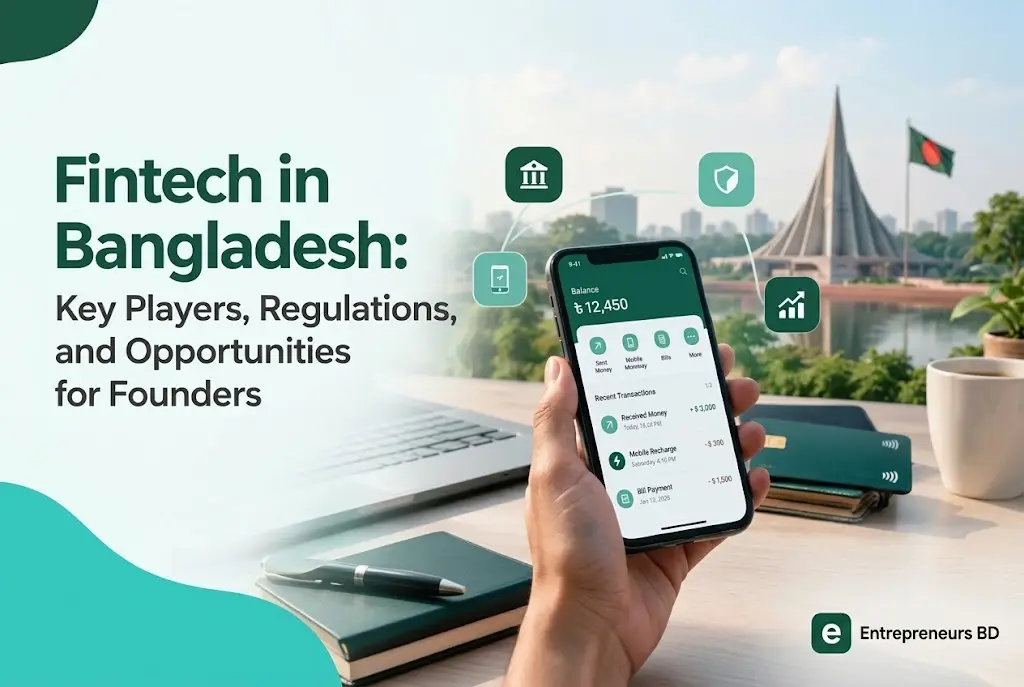
Who dominates Bangladesh's MFS market
The clearest published market-share figures for MFS still date from December 2022, when Bangladesh Bank data put bKash at 39.9%, Nagad at 18.1% and Rocket at 11.7%. Those numbers keep getting recycled as if current; treat them as historical, not present-day.
More recent reporting continues to describe bKash as the clear leader, followed by Nagad and Rocket, but a comparably clean, dated 2026 breakdown wasn't available at the time of writing.
bKash operates under BRAC Bank's 51% controlling stake and became Bangladesh's first unicorn, valued above $2 billion in its 2021 funding round. It reported Tk 315.77 crore in profit for FY2024, up 67% year on year.
Nagad is the more complicated case study. It grew fast from 2019 through a structure linked to the Bangladesh Post Office, operating under interim MFS approval rather than a conventional final licence. In 2024, Bangladesh Bank cancelled its board and appointed an administrator; the government has since said it intends to fully privatise Nagad.
The lesson for founders is straightforward: distribution advantages do not substitute for a durable regulatory and governance structure.
Behind the wallets sits a second tier most people never notice. PSOs perform authorised payment-system functions — which can include merchant acquiring, switching or ATM/CRM services depending on what a specific licence covers. Examples include shurjoPay, SSLCOMMERZ, aamarPay and PayStation, but Bangladesh Bank's published list of PSOs runs well beyond these names.
The newest licensed PSP is NEO PSP Limited, a Banglalink subsidiary, licensed 11 August 2026 to run the Mukto Pay service. That took the number of licensed PSPs to 10 as of that date: NEO PSP, iPay Systems, D Money Bangladesh, Recursion FinTech, Green & Red Technologies, Progoti Systems, ABG Technologies, Digital Payments, Sheba Fintech and Shamadhan Services.
Layer | Examples (not exhaustive) | What they do |
|---|---|---|
MFS providers | bKash, Nagad, Rocket, Upay, mCash | Issue e-money and operate agent cash-in/cash-out networks |
PSPs | NEO PSP (Mukto Pay), iPay Systems, D Money, Progoti Systems | Provide payment services and may issue e-money under licence |
PSOs | SSLCOMMERZ, shurjoPay, aamarPay, PayStation | Perform authorised payment-system functions |
Digital banks | See status note below | Provide banking services through a branchless digital model |
Digital bank status: Nagad Digital Bank was listed as Bangladesh's first digital bank in June 2024, but Bangladesh Bank suspended its licence in August 2024 pending review, and it remains suspended. Separately, in the second application round that closed in November 2025, eight of the twelve applicants had reportedly reached final assessment by late August 2026, awaiting a board decision. Bangladesh Bank hasn't publicly named the eight. These are two distinct situations, not one continuous story.
What each Bangladesh Bank licence actually permits
Read the licence rules before the market research. In Bangladesh, they decide the business model.
The MFS Regulations, 2022 permit only bank-led, FI-led or government entity-led MFS. A parent bank or financial institution must hold at least 51% of the equity and control the board. Mobile network operators are excluded as equity partners; fintech companies are permitted as minority equity partners.
Minimum paid-up capital is Tk 45 crore. An MFS provider doesn't take deposits or lend from its own funds; where it distributes credit products, it acts as an agent for a licensed bank or financial institution rather than as the lender itself.
A startup cannot independently establish and control an MFS provider under this model, but it may participate as a minority equity partner alongside a qualifying bank, FI or government entity.
PSPs sit on different ground: they don't carry the MFS requirement for a 51%-controlling bank, FI or government partner. A PSP can be independently owned and may issue e-money or payment instruments under its licence. Minimum paid-up capital is Tk 20 crore.
PSOs perform specified payment-system functions — merchant acquiring, switching, ATM/CRM services, depending on what the individual licence authorises — but cannot issue e-money. The baseline capital requirement is Tk 50 lakh, adjustable by Bangladesh Bank depending on the service.
Proposed change, not yet in force: a 2025 draft PSO regulation would replace that flat baseline with category-specific minimums — roughly Tk 1 crore for merchant acquiring up to Tk 20 crore for ATM/CRM services — plus an ongoing capital reserve tied to transaction volume, and personal liability for directors, the CEO and treasury officers over settlement-account shortfalls. This remains a draft.
The digital bank route is different in kind, not degree: it's a bank licensed under Section 31 of the Bank Company Act, not another payment-system category. Under Version 2 of the digital bank guidelines, issued 20 August 2025, a digital bank must commence with Tk 300 crore in paid-up capital, up from Tk 125 crore before that date.
Sponsors must incorporate as a public limited company and take the bank public within five years. The bank can have no branch, sub-branch, agent or ATM of its own, and cannot offer over-the-counter service or lend to medium or large industry. Cloud infrastructure must be hosted inside Bangladesh, and the CEO needs fifteen years of banking or fintech experience, five in technology-based banking.
Licence | Core function | Ownership requirement | Minimum paid-up capital |
|---|---|---|---|
MFS | Issue e-money, run agent network | Bank/FI/government entity holds 51%+ and board control | Tk 45 crore |
PSP | Payment services, may issue e-money | No bank-parent requirement | Tk 20 crore |
PSO | Authorised payment-system functions; no e-money | No bank-parent requirement | Tk 50 lakh baseline (higher, category-based minimums proposed in a pending draft) |
Digital bank | Full banking through a branchless model | Public limited company | Tk 300 crore |
Applicants should expect Bangladesh Bank's process for PSP and PSO licences to involve preliminary review and, where applicable, a No Objection Certificate followed by final licensing and inspection — the exact steps vary by category, so confirm the current procedure with the Payment Systems Department. Its Regulatory FinTech Facilitation Office is the right first call for a genuinely novel model, reachable through the payment systems page.
What changed in 2026
Five regulatory developments are especially relevant for fintech founders this year.
Bangla QR became mandatory nationwide on 1 July 2026. Banks, MFS providers, PSPs and PSOs were required to replace proprietary merchant QR codes with the interoperable Bangla QR standard under the "one country, one QR" framework. Non-compliance carries fines up to Tk 30 lakh and potential imprisonment under the Payment and Settlement Systems Act, 2024. The first 48 hours processed over 77,000 transactions worth more than Tk 22 crore.
A shared e-KYC framework took effect 1 September 2026. BRPD Circular No. 08 (11 March 2026) creates a common risk-based e-KYC standard across scheduled banks, finance companies, MFS providers, PSPs, PSOs and other licensed payment services, replacing earlier fragmented instructions. It distinguishes simplified and regular e-KYC by risk and transaction threshold rather than imposing identical requirements everywhere.
Trust and settlement account data reporting tightened on 5 January 2026. Bangladesh Bank now requires MFS, PSP, PSO and utility-service licensees to maintain daily records of account balances, investments, and e-money and merchant liabilities, with the prescribed data submitted to Bangladesh Bank by the 10th of the following month, and penalties for inaccurate reporting.
Digital bank capital doubled-plus, and a second licensing round is underway. The Tk 300 crore minimum, effective from the August 2025 Version 2 guidelines, applies to the second application round that closed in November 2025, where eight of twelve applicants had reportedly reached final assessment by late August 2026.
Interoperability launched unevenly in late 2025 and is still filling in. The National Payment Switch began live interoperable transactions on 1 November 2025, with only three MFS operators and six banks joining at launch; bKash and Nagad were both initially outside the system. Nagad received its interoperable payment system licence in December 2025, and participation has broadened since. The relevant 2026 question is no longer whether interoperability exists, but how completely and reliably it's being used across providers — that picture is still filling in rather than settled.
Where the money is in 2026
Financial services has been one of Bangladesh's strongest-funded startup categories historically, but the mix shifts between reporting periods. According to LightCastle Partners' H1 2026 dataset, software and technology led at 35% of investment share, with financial services second at 29% and healthcare at 26%.
The bigger H1 2026 story was contraction: total startup funding fell 95% year on year to $6.0 million, per that same dataset, though it was up 51% from the second half of 2025 — a sign of possible stabilisation, not recovery.
Government and bank-led capital moved to fill part of that gap. On 12 May 2026, 39 commercial banks launched Bangladesh Startup Investment Company PLC and its first fund, Onkur Bangladesh Fund 1, with Tk 425 crore committed — one of the more significant new pools of domestic institutional venture capital. Banks contribute up to 1% of annual net profits each year, so the fund is designed to keep growing.
As of late August 2026, BSIC said it expected to complete its first three investments before year-end, after appointing its MD and CEO that same month.
Separately, on 16 August 2026, Startup Bangladesh Limited began operating the Tk 400 crore Bangladesh Fund of Funds. Unlike BSIC or Startup Bangladesh's existing direct-investment arm, this fund invests through selected local and international venture capital fund managers rather than directly into startups, with a 1:1 matching requirement — meaning a manager receiving Fund of Funds capital must commit an equal amount toward Bangladesh. Founders generally access it indirectly, through the participating VC funds rather than by applying to the Fund of Funds itself.
For founders, the practical significance is that two new institutionally backed, government- or bank-linked capital sources now exist for seed through Series A deals, even though neither had substantially deployed capital as of late August. That changes the conversation with international funds considering venture capital in Bangladesh.
Openings worth building for
Bangladesh Bank reported 239.3 million registered MFS accounts against 89.38 million classified as active — a transaction within the prior three months — in its January 2025 data. Part of that gap reflects genuinely low usage; part of it reflects people holding accounts across multiple providers, which inflates the registered total relative to unique users.
That gap raises a useful founder question: why do so many registered accounts see so little use, and what would change that?
A few areas look genuinely open, separate from the licensed MFS/PSP/PSO/digital-bank tier itself — though each carries its own regulatory edge worth checking before building:
Merchant tooling for small retailers. Bangla QR compliance is now mandatory nationwide, creating demand for reconciliation, inventory and bookkeeping tools built around it.
Credit-adjacent technology. A founder may be able to build scoring, collections or underwriting technology that licensed institutions use, provided the product itself doesn't perform a regulated lending function or trigger licensing on its own.
e-KYC and fraud tooling. The September 2026 e-KYC framework applies across banks, MFS, PSPs and PSOs, which could create demand for onboarding, identity-verification and risk-scoring products built to plug into it.
Compliance and reporting software. The daily TSA data requirement and existing BFIU/AML obligations vary by licence type; tooling that helps a smaller PSP or PSO meet them is worth investigating.
Remittance-adjacent services. MFS providers can facilitate authorised inward-remittance disbursement, while outward and cross-border payment activity remains subject to separate foreign-exchange and payment rules — a boundary to design around, not route around.
A pure software vendor selling to a licensed institution usually doesn't need a payment licence itself, but that depends entirely on whether the product ever controls, holds, routes or settles customer funds, or otherwise performs a regulated payment function. Check that before assuming your idea is licence-free.
The founders who did well here understood the licence map first. Kamal Quadir built bKash using the bank-led MFS structure, with BRAC Bank as the controlling shareholder, rather than fighting the ownership rule.
Practical steps before you build
Decide which licence layer your product actually touches, and confirm whether you need one at all — the answer depends on the function, not just the customer.
If you need a PSP or PSO licence, confirm the current approval steps with the Payment Systems Department, and check whether the 2025 PSO draft has been finalised by the time you apply.
If applying for a payment-system licence, make sure your memorandum of association explicitly covers payment services.
Talk to the Regulatory FinTech Facilitation Office before committing engineering time to anything novel.
Work through a startup legal checklist covering AML, e-KYC and TSA reporting obligations relevant to your model.
If your model depends on a bank or MFS provider for settlement or distribution, model that commercial relationship's economics before you build.
Frequently Asked Questions
Can a startup get an MFS licence in Bangladesh without a bank partner?
How much capital does a digital bank licence require in 2026?
What is the difference between a PSP and a PSO licence?
Are digital bank licences currently being issued?
What changed for KYC and compliance in 2026?
Where can a Bangladeshi fintech startup raise money now?
Build for the layer you can legally own
Bangladeshi fintech rewards founders who read the circulars rather than the headlines. The market looks like a payments race from the outside, which makes the instinct to chase the wallet understandable.
The MFS model is bank-, FI- or government-led under current rules, which rules out an independent wallet startup on that specific path. PSP is the more realistic non-bank route into payment services.
Some of the clearest opportunities sit in areas licensed players may not build themselves: merchant software, credit-adjacent infrastructure, e-KYC and fraud tooling, compliance reporting, and the friction between a registered account and an active one.
Two things are true at once in 2026. Regulation is tighter, with higher capital floors, a shared e-KYC standard, daily settlement-account reporting, and a central bank that has shown it will suspend a licence and cancel a board. Domestic capital architecture has also expanded, through BSIC and the Fund of Funds, even where the money hasn't fully reached founders yet.
Start with the Payment Systems Department, not the pitch deck. Read the MFS Regulations and the digital bank guidelines end to end, work out which side of the licence line your product sits on, and design around that answer.
This is a general overview, not legal advice. Confirm current requirements with Bangladesh Bank or qualified local counsel before building a regulated financial product.

Specializing in SaaS product marketing, SEO strategy, Content marketing, TikTok advertising, PPC, and digital growth.
View Full Profile & ContributionsRelated Articles
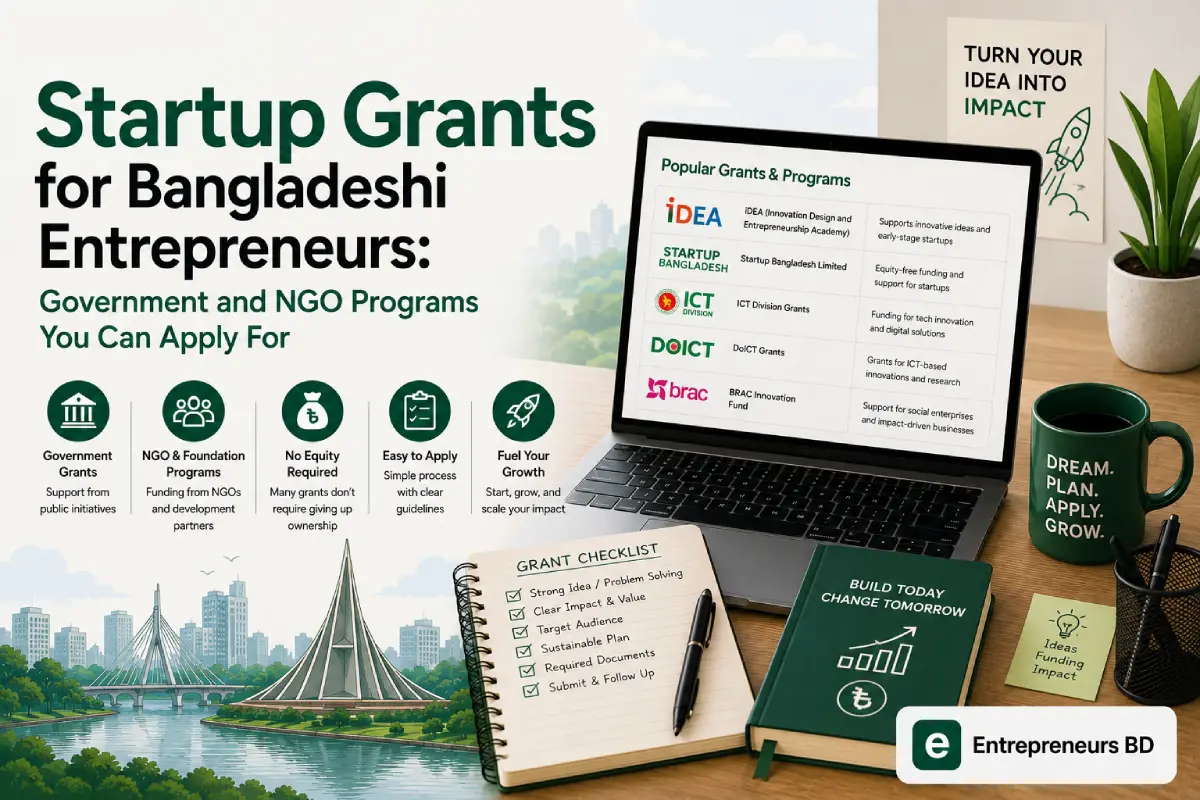
Startup Grants for Bangladeshi Entrepreneurs: Government and NGO Programs You Can Apply For
Bangladeshi entrepreneurs can apply for grants and low-cost financing through the ICT Division's iDEA project (up to BDT 10 lakh), SME Foundation's Credit Wholesaling Program, and Bangladesh Bank's refinance schemes for women and new entrepreneurs. Most require a trade license, a clear business plan, and an online application.
Angel Investors in Bangladesh: Who They Are and How to Reach Them
Angel investors in Bangladesh are individuals, family offices, and diaspora professionals who fund early-stage startups in exchange for equity. Most operate through organized networks like Bangladesh Angels Network (BAN) and Bangladesh Women Investors Network (BWIN), which vet founders, run pitch sessions, and syndicate deals among members.
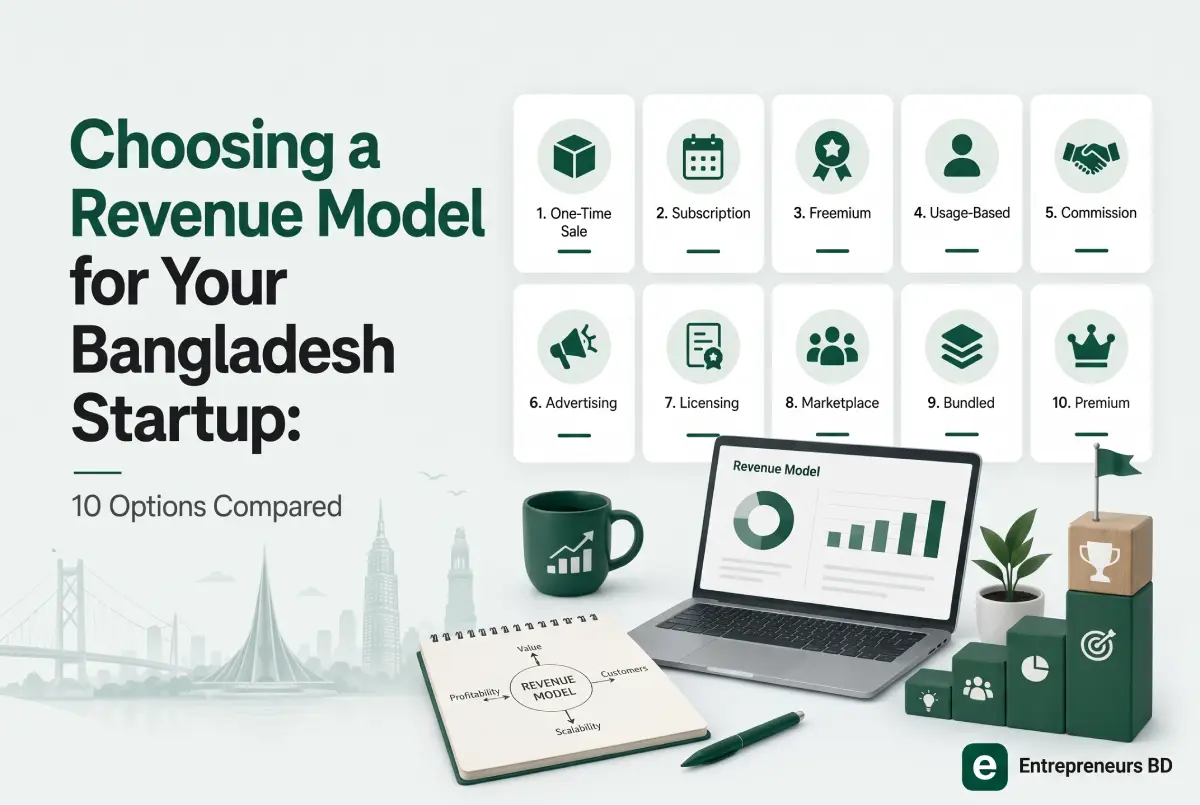
Choosing a Revenue Model for Your Bangladesh Startup: 10 Options Compared
The right revenue model for a Bangladesh startup depends on your product type, your customers' willingness to pay upfront, and the payment infrastructure available (bKash, Nagad, Rocket). Subscription and commission-based models suit digital services and marketplaces. Freemium and advertising work best for high-traffic platforms. Most successful Bangladeshi startups eventually combine two or more models.
Comments (0)
No comments yet. Be the first to share your thoughts!