How to Split Equity Between Co-Founders in Bangladeshi Startups
Quick Answer: There is no universally correct way to split equity between co-founders, but a fair split is based on contributions: the idea, capital invested, skills, full-time commitment, and risk each person takes on. Most successful Bangladeshi startups avoid a 50/50 split and instead use a structured, contribution-weighted model backed by a vesting schedule and a signed co-founder agreement.
Key Takeaways
Equal splits feel fair but often create problems later. Base the split on actual contributions.
Vesting schedules protect the company if a co-founder leaves early.
In Bangladesh, equity in a private limited company is represented through share allocation registered with the RJSC.
A co-founder agreement should be drafted before any product is built or money is raised.
Role evolution matters. The equity split should reflect who does what long-term, not just at launch.
Splitting equity between co-founders is one of the most consequential decisions a startup team makes, and it's almost always made too quickly, based on gut feeling rather than logic.
Two friends build something together and agree on 50/50 because it feels equal. Six months later, one is working 12-hour days while the other is still at their day job. The tension that follows can kill the company faster than any market problem.
In Bangladesh, this dynamic plays out regularly across the growing startup ecosystem in Dhaka, Chittagong, and beyond. Local founders rarely have access to structured guidance on equity, which means most startups either rely on informal agreements or make decisions they regret during their first funding round.
This guide walks through how to think about equity splits properly, what factors matter most in the Bangladeshi context, and how to protect yourself and your co-founders legally.
Why the Equity Conversation Feels So Awkward
Most founding teams avoid the equity conversation early because it feels transactional. You're building something with people you trust. Putting a number on each person's worth feels uncomfortable.
But equity is not about worth as a person. It is about the risk each co-founder takes, the value they bring to the table, and their long-term commitment to the venture. Treating it this way removes the emotional charge and makes the conversation easier to have.
The bigger risk is waiting. When you delay the equity conversation, you're essentially agreeing by default to split everything equally. That implicit agreement becomes harder to change once someone has spent months building the product or brought early customers in.
Have the equity conversation in week one, not month six.
The Four Factors That Should Drive Your Equity Split
No formula applies to every startup. But four consistent factors should shape any co-founder equity conversation.
Contribution of the Core Idea
Ideas alone are worth very little. Execution is worth almost everything. However, the person who identified the specific market problem, validated it, and created the initial vision does carry some weight in the equity conversation.
That said, this contribution should account for no more than 5 to 10 percent of the weighting. One person identifying an opportunity and another building the entire technical infrastructure are not equivalent contributions.
Capital Brought In
If a co-founder contributes personal capital to fund the company's early operations, that investment should be factored in. This can either be structured as equity (ownership) or as a convertible note or loan, depending on what the team agrees.
In Bangladesh, early-stage startups often operate on self-funded capital before approaching angel investors or organizations like Bangladesh Venture Capital Limited. If one co-founder is fronting the early costs, the equity split should reflect that risk.
Skills and Role Scope
Map out what each co-founder will do daily for the next two to three years. The person responsible for the technical architecture, the one managing customer acquisition, and the one handling operations and finance are all carrying distinct workloads.
Weight equity toward the roles that are hardest to replace and most critical to the company's survival at the current stage. For a software startup, that is usually the lead engineer. For a marketplace model, it might be the person building supplier or buyer relationships on the ground.
Full-Time Commitment and Risk
A co-founder who has left their job, turned down other income, and is fully committed to the startup is taking a fundamentally different level of risk than someone who is contributing part-time while drawing a salary elsewhere.
This is one of the most common equity imbalances in Bangladeshi startups. Someone joins as a technical advisor or part-time co-founder and expects equal equity with the person who quit their job to run the business every day. That imbalance becomes a source of conflict quickly.
Part-time co-founders should receive significantly less equity initially, with a path to increase their stake once they commit full-time.
Why You Should Not Split 50/50
A 50/50 split is common because it feels fair. In practice, it creates a structural governance problem: neither co-founder can break a deadlock. When two equally empowered founders disagree on a major decision, the company stalls.
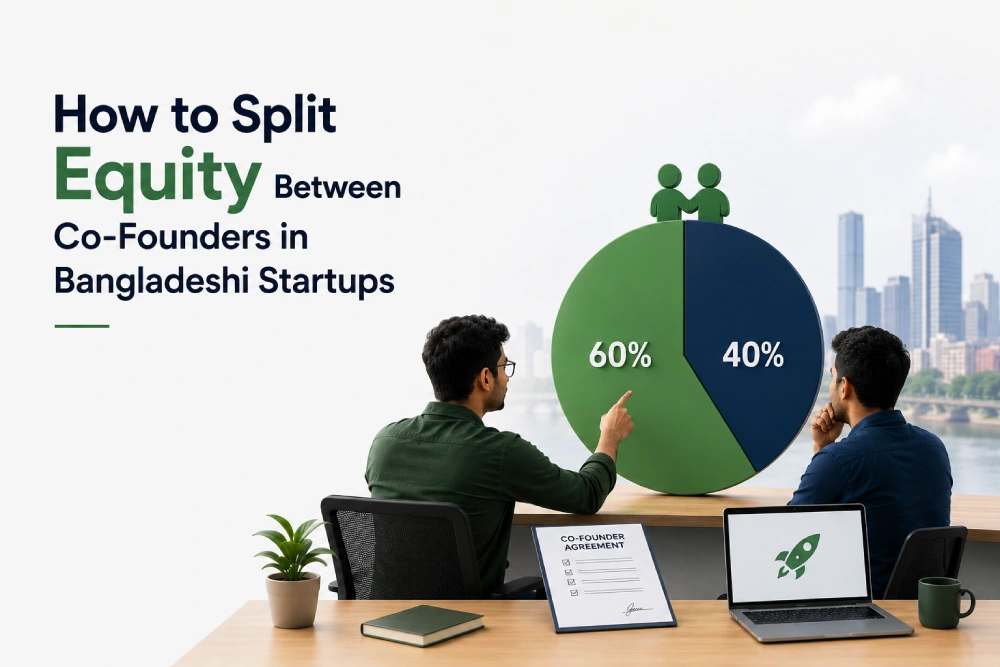
Most experienced startup advisors and early-stage investors push founders toward a clear majority holder, typically 51 to 60 percent, for the lead founder. This person has final say when the team cannot reach a consensus.
If your skills are genuinely equal, your commitment is identical, and your capital contributions are the same, a 50/50 split might make sense, but only if you also put in place a formal deadlock resolution mechanism in your co-founder agreement.
Vesting: How You Protect the Company Over Time
Vesting is the process by which co-founders earn their equity over time rather than receiving it all upfront. A standard vesting schedule runs over four years, with a one-year cliff.
This means a co-founder who leaves in month ten receives no equity. A co-founder who stays for the full four years earns 100 percent of their allocated shares.
In the Bangladeshi context, this is handled through a shareholders' agreement rather than a formal vesting plan tied to an ESOP, since most early startups here are private limited companies with share structures managed through RJSC filings. Your shareholders' agreement should include buyback provisions that take effect if a co-founder exits before the vesting period ends.
How to Register Equity in Bangladesh
In Bangladesh, a private limited company (Pvt. Ltd.) is the most appropriate structure for a venture-backed startup. Equity is represented through shares, which are registered through the Registrar of Joint Stock Companies and Firms under the Companies Act, 1994.
Here is what the process looks like:
Incorporate the company with RJSC and define the authorized share capital.
Allocate shares to each co-founder based on your agreed equity percentages.
Document the share structure in the Memorandum and Articles of Association.
Create a separate shareholders' agreement that includes vesting terms, transfer restrictions, and exit conditions.
If you plan to raise external funding, ensure your cap table is clean and documented before approaching investors.
Investors in Bangladesh, including local angel networks and international funds entering the market, will do a legal review of your cap table during due diligence. A messy or undocumented equity structure is a serious red flag.
Frequently Asked Questions
Can co-founders change the equity split after the company is incorporated?
What happens to a co-founder's equity if they leave the startup?
How should a technical co-founder's equity compare to a business co-founder's?
Should a co-founder who contributes money get more equity?
Do I need a lawyer to set up a co-founder agreement in Bangladesh?
How many co-founders is too many?
Make the Decision in Writing Before You Build
The equity split conversation is uncomfortable precisely because it forces co-founders to be explicit about contribution, commitment, and expectations. That discomfort is worth pushing through early.
In Bangladesh's startup environment, where formal equity culture is still developing, many founders assume a handshake agreement is enough. It is not. The moment you bring in external funding, apply to a startup program, or face a disagreement, that informal agreement provides no protection.
Write down your equity split, your vesting terms, your decision-making framework, and your exit conditions. Get it registered where required. Then build your company with that foundation in place.
The startups that handle this correctly from day one spend their energy on customers and products. The ones that skip it spend their energy on co-founder disputes during the exact moments when the company needs clarity most.

Specializing in SaaS product marketing, SEO strategy, Content marketing, TikTok advertising, PPC, and digital growth.
View Full Profile & ContributionsRelated Articles

Why Most Bangladeshi Startups Fail — and What You Can Do Differently
Quick Answer: Most Bangladeshi startups fail because of poor market validation, weak financial planning, and founder-market mismatch, not lack of ideas or effort. The founders who survive focus on solving real problems, build lean, and learn from their market before scaling.

Customer Acquisition Strategies That Work for Bangladesh Startups
Quick Answer: The most effective customer acquisition strategies for Bangladesh startups combine low-cost digital channels (Facebook, WhatsApp Business, SEO), mobile financial service integration for frictionless payment, referral-driven growth, and hyperlocal targeting. Startups that blend paid acquisition with retention-focused tactics see the lowest long-term cost per customer.

Business Model Canvas Explained with Bangladesh Startup Examples
Quick Answer: The Business Model Canvas (BMC) is a one-page strategic framework with 9 building blocks: Customer Segments, Value Propositions, Channels, Customer Relationships, Revenue Streams, Key Resources, Key Activities, Key Partnerships, and Cost Structure. It helps founders map, test, and communicate their entire business model before writing a single page of a business plan.
Comments (0)
No comments yet. Be the first to share your thoughts!