Startup Grants for Bangladeshi Entrepreneurs: Government and NGO Programs You Can Apply For
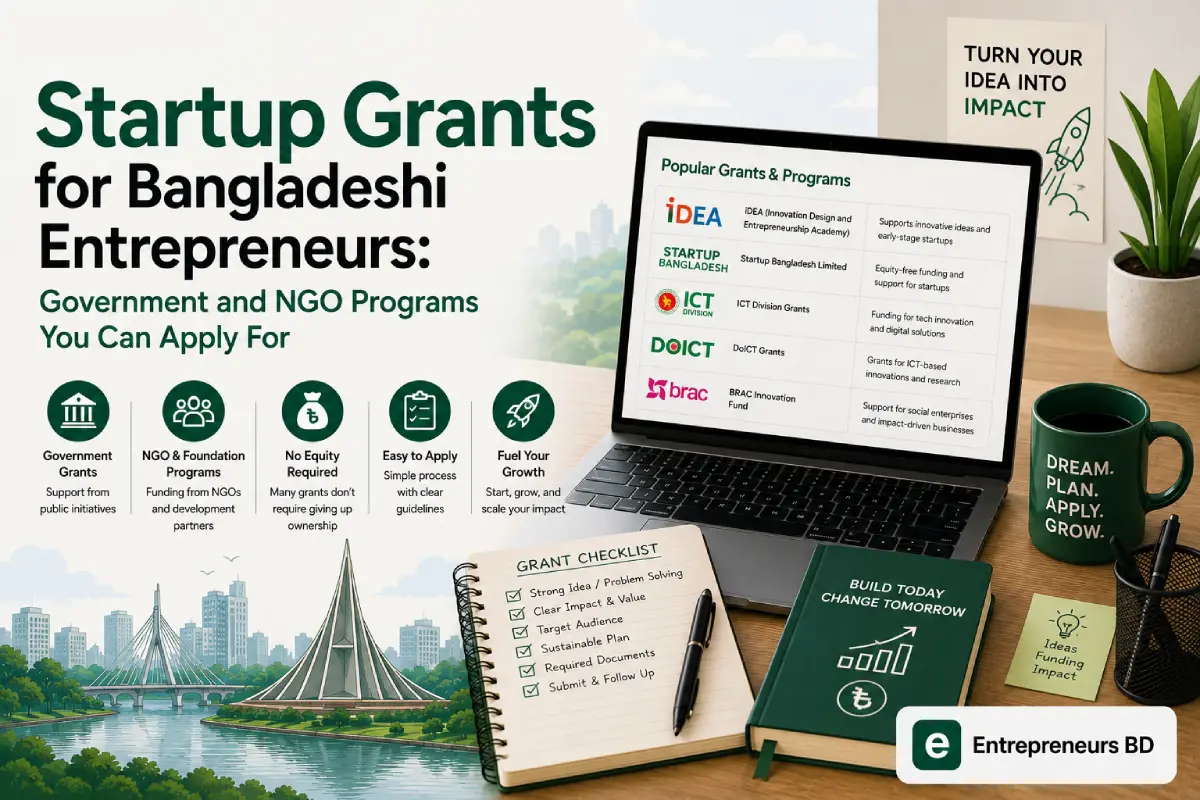
Bangladeshi entrepreneurs can apply for grants and low-cost financing through the ICT Division's iDEA project (up to BDT 10 lakh), SME Foundation's Credit Wholesaling Program, and Bangladesh Bank's refinance schemes for women and new entrepreneurs. Most require a trade license, a clear business plan, and an online application.
Key Takeaways
The iDEA project under the ICT Division offers non-repayable grants up to BDT 10 lakh for tech startups and BDT 50,000 for ICT-based SMEs.
SME Foundation runs a Credit Wholesaling Program offering collateral-free, single-digit interest loans to entrepreneurs outside Dhaka.
Bangladesh Bank reserves refinance funds specifically for women entrepreneurs at rates as low as 5 percent.
NGO apex bodies like PKSF channel enterprise loans through partner organizations, reaching entrepreneurs banks often overlook.
Finding real funding as a Bangladeshi entrepreneur usually means wading through vague blog posts and outdated lists. Most of what circulates online mixes up loans, grants, and equity investment as if they were the same thing.
They are not. A grant does not need to be repaid. A refinance scheme is a discounted loan. Equity investment means giving up a share of your company.
This guide separates the two categories that matter most for early founders: government programs and NGO-backed financing. Each entry includes who runs it, what it offers, and who typically qualifies.
Government Grants and Funding Programs
Bangladesh's government has built out a real funding infrastructure over the past decade, mostly through the ICT Division and Bangladesh Bank. These are the programs worth knowing.
iDEA Project (ICT Division)
The Innovation Design and Entrepreneurship Academy, known as iDEA, runs under the ICT Division and has operated since 2016. It is the closest thing Bangladesh has to a national startup grant office.
iDEA offers a Pre-Seed Startup Grant of up to BDT 10 lakh for early-stage, ICT-based startups. The pre-seed startup grant page describes it as a non-equity, non-repayable award meant for prototype development, MVP building, and early market entry.
There is also a separate SME Grant of BDT 50,000 for existing small businesses that want to adopt digital tools. Applicants need a valid trade license, an active business, and evidence of at least one year of financial activity.
Both grants are applied for online through iDEA's own portal, and selection runs through pitch review and an expert panel.
SME Foundation Credit Wholesaling Program
SME Foundation, a government-established body under the Ministry of Industries, runs the Credit Wholesaling Program to reach entrepreneurs that commercial banks tend to skip.
The Credit Wholesaling Program page explains that loans are collateral-free and carry single-digit interest, disbursed through partner banks and non-bank financial institutions rather than SME Foundation itself.
Preference goes to small and women entrepreneurs based outside Dhaka, which makes this one of the few programs actively designed for founders in secondary cities and rural areas.
Bangladesh Bank Refinance Schemes
Bangladesh Bank does not hand out grants directly, but it funds discounted loans that function almost like one once you account for the rate gap against market lending.
Its refinance scheme for women entrepreneurs, detailed in SMESPD Circular No. 2, caps the customer-level interest rate at 5 percent. A woman qualifies if she owns a proprietary business or holds at least 51 percent of a registered partnership or private company.
There is a parallel scheme for new entrepreneurs in the cottage, micro, and small sectors, capped around 7 percent interest. Both schemes work through participating banks, so you apply at the bank branch, not directly with Bangladesh Bank.
Since eligibility depends on how your business is legally structured, it is worth reviewing business registration in Bangladesh before you approach a bank about either scheme.
NGO and Development Partner Programs
Government funding gets most of the attention, but NGO-linked apex bodies quietly move more capital to small entrepreneurs than most people realize.
PKSF Enterprise Development (Agrosor)
Palli Karma-Sahayak Foundation, known as PKSF, was established by the Government of Bangladesh in 1990 to reduce poverty through employment generation. It functions more like an NGO funding intermediary than a typical government office.
Its Agrosor program, described on the PKSF Enterprise Development page, classifies any business with an investment between BDT 40,000 and BDT 1.5 million as a microenterprise. Individual entrepreneurs can borrow up to BDT 1 million through the program.
PKSF does not lend directly. It channels funds through hundreds of partner organizations, mostly local NGOs and microfinance institutions, so the actual application happens at the local partner level.
This structure matters if you are running a home-based or first-generation business without a banking history, since PKSF's partner network was built specifically to reach that group. Founders exploring this route alongside a side venture may also find our piece on side business ideas in Bangladesh useful for scoping the right investment size.
Business Development Services Portal
In mid-2026, the ILO, SME Foundation, and the Ministry of Industries jointly launched a national Business Development Services Portal, funded in part by the Government of Canada. It consolidates finance, training, and licensing information into a single access point for MSMEs, aiming to cut through the fragmentation that has long made Bangladesh's support ecosystem hard to navigate for first-time founders.
This does not replace the individual programs above, but it is a useful starting point if you are unsure which scheme fits your business stage.
Bangladesh Context: Choosing the Right Program
Most founders make the same mistake: applying to every program at once instead of matching the funding type to their business stage.
If you have a working prototype and a tech angle, iDEA is the strongest fit. If you run an established small business needing working capital, SME Foundation or a Bangladesh Bank refinance loan through your bank branch makes more sense.
If you are early-stage, informal, or outside Dhaka with no collateral, PKSF's partner network is often more realistic than a bank-administered scheme. Many of these programs also expect a registered business entity, so confirming your legal structure early saves rework later, whether that means a sole proprietorship or a private limited company.
Practical Steps to Apply
Getting funded rarely comes down to luck. It comes down to preparation.
Start by confirming your trade license and, where relevant, your RJSC registration are current, since nearly every program above asks for one or both.
Build a short business plan with realistic financial projections, even for a BDT 50,000 SME Grant. Reviewers use it to judge whether you understand your own numbers.
Apply to one or two programs that genuinely match your stage rather than spreading a single generic application across five portals. Reviewers can tell the difference.
Frequently Asked Questions
Do I need a registered company to apply for these grants?
Can a new business with no revenue apply for the iDEA Pre-Seed Grant?
Are Bangladesh Bank refinance loans the same as a grant?
How do I access PKSF funding if I am not connected to an NGO?
Can women entrepreneurs combine multiple grant programs?
Start With the Program That Fits Your Stage
Chasing every funding opportunity at once usually produces weak applications across the board. Pick the one or two programs that actually match where your business stands today.
If your product is still a prototype, iDEA deserves your energy first. If you are running an established shop or workshop that needs working capital, start the conversation with your bank about Bangladesh Bank's refinance schemes.
And if you are outside Dhaka with no collateral and no banking history, do not overlook PKSF's partner network. It was built for exactly that gap, and it moves real money to entrepreneurs the bigger programs tend to miss.

Specializing in SaaS product marketing, SEO strategy, Content marketing, TikTok advertising, PPC, and digital growth.
View Full Profile & ContributionsRelated Articles
Fintech in Bangladesh: Key Players, Regulations, and Opportunities for Founders
For the payment and digital-finance businesses covered here, four regulated models matter most: MFS, PSP, PSO and digital banking. MFS requires a bank, financial institution or government entity to hold at least 51% of the provider and control its board. PSPs don't carry that requirement. PSOs run payment infrastructure and can't issue e-money. Digital banks are licensed under the Bank Company Act and now require Tk 300 crore in paid-up capital.
Angel Investors in Bangladesh: Who They Are and How to Reach Them
Angel investors in Bangladesh are individuals, family offices, and diaspora professionals who fund early-stage startups in exchange for equity. Most operate through organized networks like Bangladesh Angels Network (BAN) and Bangladesh Women Investors Network (BWIN), which vet founders, run pitch sessions, and syndicate deals among members.
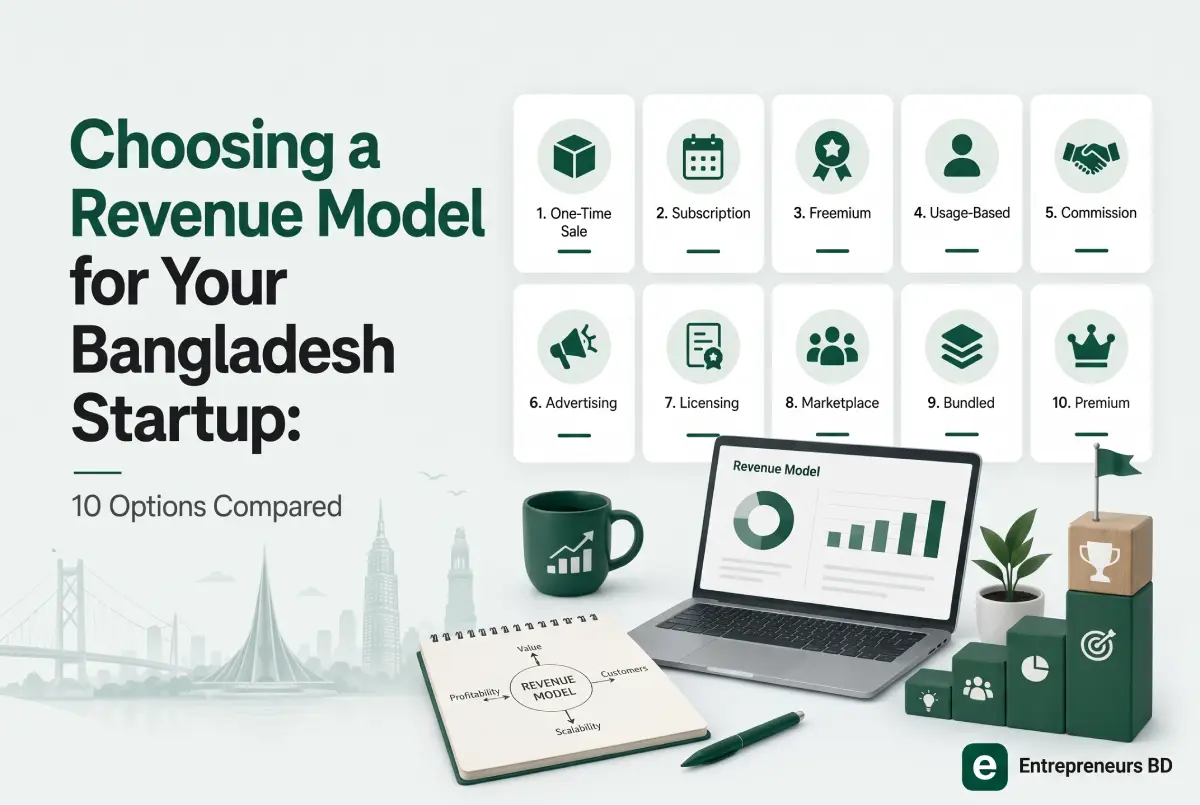
Choosing a Revenue Model for Your Bangladesh Startup: 10 Options Compared
The right revenue model for a Bangladesh startup depends on your product type, your customers' willingness to pay upfront, and the payment infrastructure available (bKash, Nagad, Rocket). Subscription and commission-based models suit digital services and marketplaces. Freemium and advertising work best for high-traffic platforms. Most successful Bangladeshi startups eventually combine two or more models.
Comments (0)
No comments yet. Be the first to share your thoughts!