Co-Founder Agreement in Bangladesh: What to Include and Why It Matters
A co-founder agreement is a legally binding document that defines each founder's equity share, roles, decision-making authority, and exit terms. In Bangladesh, where startup disputes often arise from informal understandings, this document is the single most important thing you can sign before writing a line of code or spending a single taka.
Key Takeaways
A co-founder agreement prevents equity and role disputes before they destroy the business
Equity splits should reflect contribution, not just equal shares among friends
Vesting schedules protect the company if a founder leaves early
Bangladesh's Companies Act 1994 and Contract Act 1872 form the legal backbone of these agreements
Without a written agreement, resolving co-founder conflicts through Bangladeshi courts is slow and expensive
Starting a business with a partner feels exciting. If you're still planning your venture, it's worth understanding how to start a business in Bangladesh before deciding how ownership and responsibilities will be shared. You trust each other, share a vision, and the last thing on your mind is what happens if one of you wants to leave two years later, stops contributing, or simply disagrees on the company's direction. That gap in planning is where most co-founding relationships break down.
A co-founder agreement in Bangladesh is not a formality. It is a practical instrument that turns an informal partnership into a documented, enforceable working arrangement.
Startups operating out of Dhaka, Chattogram, or anywhere else in Bangladesh are not immune to co-founder disputes. Many early-stage companies have collapsed not because the market rejected their idea, but because the founders could not agree on who owned what when things got hard.
This guide covers exactly what the agreement should contain, how Bangladeshi law applies, and how to approach drafting one without overcomplicating it.
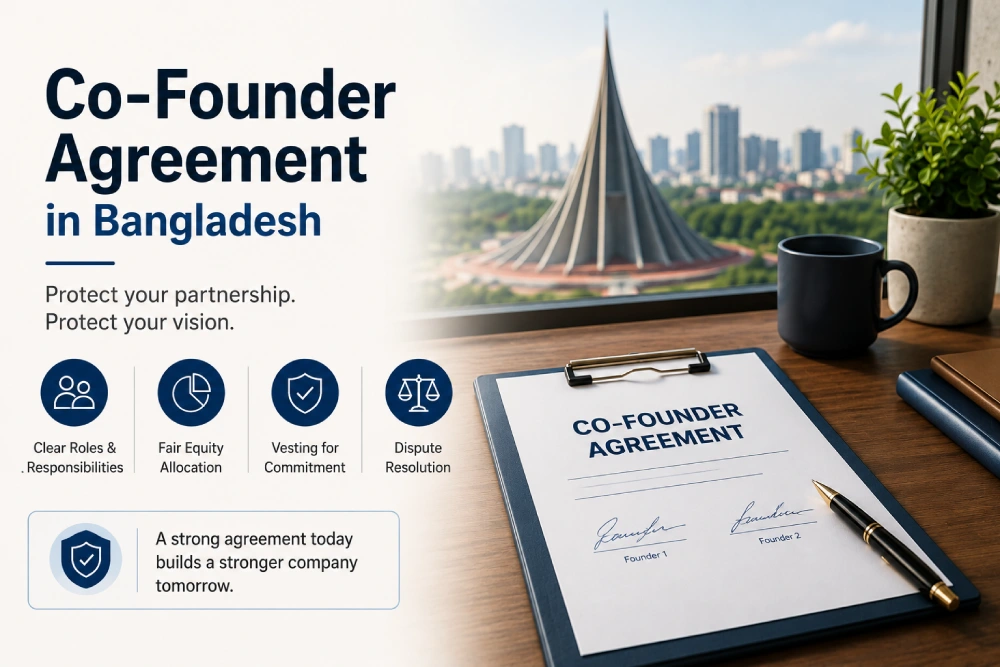
What Is a Co-Founder Agreement?
A co-founder agreement is a private contract between the people starting a company together. It documents each person's ownership percentage, their defined role, how decisions get made, what happens if someone exits, and how intellectual property developed for the business is handled.
It sits alongside (not instead of) formal company registration documents. If you haven't completed the business registration process in Bangladesh, it's helpful to understand how registration works before preparing founder documents. When you register a private limited company in Bangladesh through the Registrar of Joint Stock Companies and Firms, the Memorandum and Articles of Association handle the public-facing legal structure.
The co-founder agreement handles the internal, founder-to-founder operating reality that those documents do not cover.
Core Clauses Every Co-Founder Agreement Must Include
Getting the structure right matters more than getting it perfect. Here are the sections no agreement should skip.
Equity Split and Ownership
This is the most sensitive clause and the one most often handled poorly. Many first-time founders in Bangladesh split equity equally out of politeness or convenience, 50/50 or 33/33/33, without factoring in who is contributing more capital, working full-time versus part-time, or bringing critical assets to the business.
Equity should reflect reality: past contribution, future commitment, and the risk each person is taking. If you're unsure how ownership should be divided, our guide on how to split startup equity in Bangladesh explains common approaches, vesting considerations, and mistakes to avoid. Define percentages clearly and document the rationale. If the split changes later, the agreement should specify how and under what conditions.
Roles, Responsibilities, and Decision-Making
Who is the CEO? Who owns the product? Who controls finance? Ambiguity here leads to overlapping authority, duplicate decisions, and resentment. Define each co-founder's title, functional area, and scope of authority.
Also, define how major decisions get made. Does the CEO have the final call on hiring? Does a product pivot require unanimous approval? Spell out voting thresholds for high-stakes decisions so these conversations happen before a disagreement forces them.
Vesting Schedule
A vesting schedule is a clause that says: you earn your equity over time, not all at once. A standard structure is a four-year vest with a one-year cliff. This means a co-founder must stay for at least one year to receive any equity, then earn the remainder monthly over the following three years.
Without vesting, a co-founder can join, receive full equity, and leave six months later. The remaining founders are left running the company while someone who is no longer contributing still owns a meaningful stake. Vesting prevents this directly.
Intellectual Property Assignment
Any product, code, design, brand asset, or method developed for the company must belong to the company, not to an individual founder. This clause assigns all IP created within the scope of the business to the legal entity.
This matters especially in Bangladesh's growing software and digital product sector. If a technical co-founder leaves and the IP assignment was never formalized, they could legally claim ownership over the core product. Courts would look at written contracts first, and if none exist, the dispute becomes expensive and uncertain.
Exit Terms and Buyout Provisions
What happens when a co-founder wants to leave? What if they want to sell their shares to an outside party? A right of first refusal clause gives remaining founders the option to purchase a departing founder's shares before they can be sold externally. This protects the cap table and prevents unwanted third parties from entering the ownership structure.
Also, define "bad leaver" versus "good leaver" scenarios. A co-founder fired for misconduct should not walk away with the same equity treatment as one who leaves voluntarily after three years of solid contribution.
Salary and Compensation
Early-stage founders often draw no salary or a minimal salary. Document what each person is earning (even if it is zero), the conditions under which salaries will be raised, and who authorizes compensation changes. This removes awkward conversations later and protects against one founder quietly adjusting their own pay.
Non-Compete and Confidentiality
Founders have full access to the company's strategy, customer data, and technology. A confidentiality clause prevents that information from being shared externally. A non-compete clause prevents a departing founder from immediately starting or joining a direct competitor.
Under the Bangladesh Contract Act 1872, non-compete clauses must be reasonable in geographic scope and duration to be enforceable. Overly broad restrictions, for example, a lifetime global ban, may not hold up legally. Keep non-competes specific: a two-year restriction within Bangladesh in the same industry vertical is far more defensible.
Why the Bangladesh Legal Context Makes It Non-Negotiable
Bangladesh operates under the Companies Act 1994 for private limited companies and the Partnership Act 1932 for partnership structures. Neither of these statutes automatically protects co-founders the way a private agreement does.
The Companies Act governs what happens at the company level. It does not resolve disputes between founders about who gets to stay, who gets bought out, or how equity is handled on exit.
Partnership law gives each partner equal standing unless a written deed says otherwise. That means if you registered as a partnership and never wrote down who holds more authority, both partners legally have equal say, regardless of who does more work or contributes more capital.
BIDA's One Stop Service simplifies business registration for investors, but registration alone does not create the internal governance you need. The co-founder agreement fills that gap. It should also be part of a broader startup legal checklist in Bangladesh so that company formation, contracts, intellectual property, and compliance are addressed together.
In practice, Bangladeshi courts take significant time to resolve commercial disputes. A 2026 startup that enters litigation over a co-founder conflict may not see a resolution for years.
A well-drafted agreement, especially one with a defined arbitration clause specifying a faster dispute resolution mechanism, keeps conflicts out of the court system entirely.
How to Draft a Co-Founder Agreement in Bangladesh
You do not need to hire an expensive law firm to get this done, but you do need someone with commercial law experience to review the final document. Here is a practical approach.
Start with a founder conversation. Before writing anything, the co-founders should have a direct, honest discussion about equity split rationale, roles, salary expectations, and what happens if someone wants to leave. Document the outcomes of that conversation.
Use those notes as the basis for a draft. You can find reputable templates from international sources and adapt them, but the Bangladesh-specific legal references (Companies Act, Contract Act, Partnership Act) must be accurate. Do not rely on generic templates that reference foreign laws.
Have a Bangladeshi commercial lawyer review the final version. Legal review typically costs between BDT 10,000 and BDT 40,000, depending on the complexity and the firm. That is a fraction of what a co-founder dispute will cost if it goes unresolved.
Sign before incorporating. The co-founder agreement should be signed before or at the same time as company registration. Retrofitting it after the company is incorporated, shares are issued, and roles are assumed, is harder and sometimes creates conflicting obligations.
Frequently Asked Questions
Is a co-founder agreement legally enforceable in Bangladesh?
Can two friends start a business with just a verbal agreement in Bangladesh?
What is a fair equity split for Bangladeshi co-founders?
Does a co-founder agreement replace the Memorandum and Articles of Association?
What happens if a co-founder leaves without a formal agreement in place?
Should the co-founder agreement include a dispute resolution clause?
Write the Agreement Before You Need It
The best time to draft a co-founder agreement is before you register the company, before the first customer is signed, and before any tension exists between the founders. Most founders delay because things feel fine, and drafting a legal document feels adversarial. That is the wrong frame.
A co-founder agreement is not a sign of distrust. It is a sign that both parties are serious enough about the business to protect it. Every founder relationship has eventual stress points: fundraising pressure, slow growth, personal life changes, and strategic disagreements.
What separates the partnerships that survive those moments from the ones that collapse is whether the ground rules were written down before the pressure arrived.
In Bangladesh's growing startup ecosystem, where investor scrutiny is increasing and formal governance matters more at every funding stage, a co-founder agreement is also a signal to the market.
It tells investors, partners, and future employees that your founding team operates with clarity and professionalism.
Draft it, sign it, and move forward with confidence.

Specializing in SaaS product marketing, SEO strategy, Content marketing, TikTok advertising, PPC, and digital growth.
View Full Profile & ContributionsRelated Articles

Business Registration in Bangladesh: All Legal Structures Explained
Quick Answer: Business registration in Bangladesh depends on your chosen legal structure. A sole proprietorship is registered via a trade license at your local city corporation. Partnerships and private limited companies are registered through the Registrar of Joint Stock Companies and Firms (RJSC). Each structure has different liability, tax, and compliance implications.

Why Data and Analytics Matter in Modern Entrepreneurship
Quick Answer: Data and analytics help entrepreneurs replace guesswork with evidence. Instead of relying on instinct alone, you use real numbers — from sales figures to customer behaviour — to make decisions that are faster, cheaper, and far more likely to succeed. In 2026, it is not a competitive advantage; it is a baseline requirement.

Facebook Marketing for Bangladeshi SMEs: Strategy, Ads, and ROI
Quick Answer: Facebook marketing for Bangladeshi SMEs involves building an optimized Business Page, posting consistently for organic reach, and running targeted paid ads using Meta Ads Manager. With over 50 million Facebook users in Bangladesh and low ad costs compared to Western markets, SMEs can generate strong ROI even on modest budgets of BDT 5,000–20,000 per month.
Comments (0)
No comments yet. Be the first to share your thoughts!