Venture Capital in Bangladesh: Active VCs, Ticket Sizes, and What They Look For
Bangladesh has a small but active VC pool. Startup Bangladesh Limited, Anchorless Bangladesh, BD Venture, BVCL, and the new bank backed BSIC lead the field, writing checks from roughly BDT 25 lakh to several million dollars depending on stage. Most look for a working product, real revenue growth, and a founding team that can execute.
Key Takeaways
Bangladesh's startup ecosystem has raised close to USD 1 billion since 2010, but 2025 funding was heavily concentrated in one large deal.
Local capital is still scarce. Foreign investors supplied nearly all of 2025's funding, with domestic sources contributing under USD 1 million.
Government backed vehicles, especially Startup Bangladesh Limited and the newly launched BSIC, are trying to close that local funding gap.
Ticket sizes range from roughly USD 25,000 for early angel style checks to several million dollars for growth stage rounds.
Fintech, e-commerce, logistics, and agritech remain the sectors most VCs actively chase.
Raising venture capital in Bangladesh looks different depending on who you ask. Ask a founder chasing a pre-seed check and they will tell you the market feels thin. Ask someone tracking the headline numbers and they will point to a record year for total funding.
Both things are true at once, and understanding why matters if you are trying to raise. This article walks through who is actually writing checks in Bangladesh right now, how much they typically invest, and what they look for before they say yes.
We also cover the new institutional players entering the market in 2026 and what that means for founders planning a raise.

The State of VC in Bangladesh Right Now
Bangladeshi startups raised about USD 124 million in 2025, roughly three times the USD 42 million raised in 2024. That sounds like strong momentum.
The catch is concentration. Nearly all of that jump came from a single transaction, the merger financing behind ShopUp and Sary forming SILQ Group. Strip that deal out and the average check size drops from around USD 10 million to closer to USD 1 million.
There were zero Series A rounds recorded in 2025, compared to six rounds worth USD 21 million in 2024. That gap is exactly what newer funds like BSIC are trying to fill.
Since 2010, the ecosystem has crossed roughly USD 1 billion across more than 450 deals, according to LightCastle Partners' Startup Investment Report 2025. Fintech, e-commerce, logistics, and software remain the sectors that have attracted the most consistent attention, a trend also visible in the broader Bangladesh startup ecosystem.
Active Venture Capital Firms to Know
A handful of funds account for most of the institutional activity in the country. Here is who is writing checks in 2026.
Startup Bangladesh Limited is the government's own VC arm under the ICT Division. It invests in seed, early, and growth stage startups and impact enterprises, with a stated focus on fintech, healthtech, enterprise software, e-commerce, edtech, and agritech.
Anchorless Bangladesh, founded in 2019 by Rahat Ahmed, is a New York based fund that channels global capital into Bangladeshi founders. It is sector agnostic but has built a strong track record backing companies with a clear path to regional or international expansion, including Pathao, Shikho, and Loop Freight.
BD Venture has operated since 2012, making it one of the longest running VC firms in the country. It focuses on fintech, e-commerce, logistics, healthtech, and agritech, working across Bangladesh and the US.
Bangladesh Venture Capital Limited targets seed and Series A stage companies in fintech, AI, healthcare, edtech, and agritech, and pairs capital with hands on mentorship for founders still shaping their business model.
IDLC Venture Capital, the VC arm of IDLC Finance and registered with the Bangladesh Securities and Exchange Commission, invests in early stage tech and tech enabled companies.
Bangladesh Angels Network fills the gap below institutional VC, connecting individual angel investors with founders who are not yet ready for a formal fund. Founders exploring this route can read more about angel investors in Bangladesh before approaching either type of investor.
The biggest new entrant is Bangladesh Startup Investment Company, or BSIC, launched in May 2026 by a consortium of 39 commercial banks. Its first vehicle, the Onkur Bangladesh Fund, holds roughly USD 35 million and is mandated to invest in seed, late seed, and Series A stage companies, exactly the gap that produced zero Series A deals in 2025. Details on its structure and mandate are available on the BSIC official site.
Ticket Sizes: What Founders Can Actually Expect
Ticket sizes in Bangladesh vary widely by stage and by fund. Here is a rough guide based on publicly disclosed ranges from active investors.
Angel and pre-seed checks: roughly USD 25,000 to USD 200,000, often from Bangladesh Angels Network or individual investors.
Seed stage: roughly USD 200,000 to USD 1.5 million, the sweet spot for funds like Anchorless Bangladesh and BVCL.
Early to growth stage: BDT 50 lakh to BDT 5 crore per round (roughly USD 41,000 to USD 410,000) from Startup Bangladesh Limited, according to its official FAQ page.
Late seed and Series A: multi million dollar rounds, the stage BSIC's Onkur fund is specifically targeting.
These numbers move over time and depend heavily on your sector, traction, and how much local versus foreign capital is involved in the round. If you are still deciding how much equity to give up at each stage, it is worth reading about startup equity split considerations before you start pitching.
What Bangladeshi VCs Actually Look For
Investment criteria vary by fund, but a few themes come up again and again across public statements from Startup Bangladesh Limited, Anchorless Bangladesh, and BD Venture.
A working product matters more than a polished idea. Most funds want to see a minimum viable product already in the hands of real users, not just a plan.
Growth evidence beats projections. Funds consistently ask for a demonstrated track record of a growing customer base and revenue, not just a forecast in a spreadsheet.
A scalable model is non negotiable. Investors want to see how the business can expand beyond its first city or first customer segment, which is where a clear business model canvas helps during due diligence.
Sector alignment helps. Fintech, healthtech, e-commerce, agritech, and enterprise software remain the categories most funds actively chase, partly because they map onto national digital economy priorities.
Team execution ability is often the deciding factor. Funds are backing people as much as products, especially at seed stage where the product itself will likely change.
Bangladesh Context: Why Local Capital Still Lags
Despite the activity above, local capital participation remains thin. Domestic investors contributed well under USD 1 million across just a few deals in 2025, while foreign investors supplied nearly all of the rest.
Bangladesh Bank has been pushing to change this. Since 2021, every scheduled bank has been required to set aside 1 percent of its net profit into a dedicated Startup Equity Investment Fund, a rule outlined through the central bank's own capital market circulars. That mandate is part of what funded BSIC's launch in 2026.
The gap has real consequences for founders. Without a large domestic investor base, Bangladeshi companies often have to look abroad even for relatively small early rounds, adding time and complexity to the raise. Founders working in fintech in particular can look at how figures like Tanvir A Mishuk built fintech ventures in Bangladesh despite that same structural gap.
How to Prepare Before You Approach a VC
A few practical steps make a real difference before you send your first pitch deck.
Validate before you pitch. Investors can tell within minutes whether a founder has actually tested demand or is guessing, so working through how to validate a startup idea first saves everyone time.
Build a clean data room. Have your financials, cap table, and key metrics ready before a fund asks, not after.
Tailor your pitch deck to the fund. A startup pitch deck built for Startup Bangladesh Limited's impact criteria looks different from one built for Anchorless Bangladesh's growth focus.
Know your realistic ticket size. Approaching a fund whose typical check is far larger or smaller than what you need wastes time on both sides.
Get warm introductions where possible. Most active funds in Bangladesh are small teams, and a credible introduction still moves faster than a cold email.
Frequently Asked Questions
Which VC firms are actively investing in Bangladesh in 2026?
What is a typical VC ticket size in Bangladesh?
Do Bangladeshi VCs only invest in tech startups?
How much equity do VCs usually take in Bangladesh?
What is BSIC and why does it matter for founders?
Why is local investor participation so low in Bangladesh?
Where This Leaves Bangladeshi Founders
The numbers tell a mixed story, but the direction is encouraging. A record funding year, a new bank backed VC platform, and a regulatory push toward domestic capital all point toward a market that is slowly maturing.
Founders should not wait for the ecosystem to feel abundant before they start preparing. The funds above are actively looking for the right companies right now, and the ones who get funded are usually the ones who show up with a working product, real traction, and a clear sense of who they are pitching to.
If you are building in Bangladesh today, the smartest move is to treat every fund on this list as a distinct audience with its own criteria, rather than pitching one generic deck to all of them.

Specializing in SaaS product marketing, SEO strategy, Content marketing, TikTok advertising, PPC, and digital growth.
View Full Profile & ContributionsRelated Articles
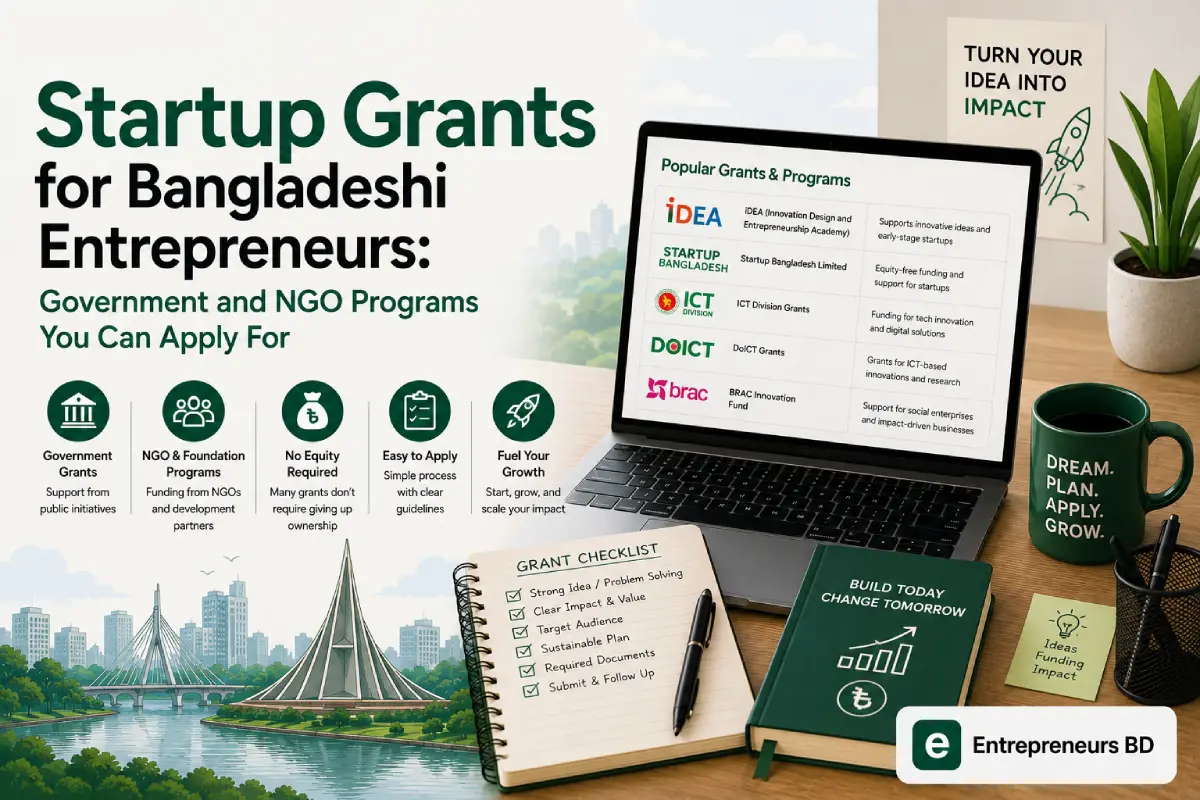
Startup Grants for Bangladeshi Entrepreneurs: Government and NGO Programs You Can Apply For
Bangladeshi entrepreneurs can apply for grants and low-cost financing through the ICT Division's iDEA project (up to BDT 10 lakh), SME Foundation's Credit Wholesaling Program, and Bangladesh Bank's refinance schemes for women and new entrepreneurs. Most require a trade license, a clear business plan, and an online application.
Fintech in Bangladesh: Key Players, Regulations, and Opportunities for Founders
For the payment and digital-finance businesses covered here, four regulated models matter most: MFS, PSP, PSO and digital banking. MFS requires a bank, financial institution or government entity to hold at least 51% of the provider and control its board. PSPs don't carry that requirement. PSOs run payment infrastructure and can't issue e-money. Digital banks are licensed under the Bank Company Act and now require Tk 300 crore in paid-up capital.
Angel Investors in Bangladesh: Who They Are and How to Reach Them
Angel investors in Bangladesh are individuals, family offices, and diaspora professionals who fund early-stage startups in exchange for equity. Most operate through organized networks like Bangladesh Angels Network (BAN) and Bangladesh Women Investors Network (BWIN), which vet founders, run pitch sessions, and syndicate deals among members.
Comments (0)
No comments yet. Be the first to share your thoughts!