What Is Bootstrapping in Business? Meaning, Benefits, and Risks Explained
Bootstrapping in business means building a company with the founder's own money and the revenue it earns, instead of outside investors. It keeps full ownership and forces early profitability, but it puts the founder's personal finances at risk and usually means slower growth than a well-funded competitor.
Key Takeaways
Bootstrapping means funding a business from personal savings, customer payments, and reinvested profit, without selling any ownership
Its biggest benefit is control: no investor owns a share, sets your targets, or pushes you toward an exit
Its biggest risk is personal: losses come out of the founder's pocket, and growth can never outrun cash flow
It suits businesses that can charge customers early and struggles in capital-heavy or winner-takes-most markets
In Bangladesh, most small firms already rely on their own savings, and new concessional start-up finance now offers a middle path
Ask most Bangladeshi founders how they paid for their first year and the answer is rarely "investors." It is a savings account, a contribution from family, a client who paid in advance, or freelance income that quietly covered the rent while the real product took shape. That is bootstrapping in business, and it is far more common than the funding announcements in the news suggest.
The term gets used loosely, though. Some people call any business without venture capital bootstrapped. Others insist a single bank loan disqualifies you. And many founders end up self-funding by default without ever weighing what it costs them.
This guide explains what bootstrapping actually means, the forms it takes, how it compares with loans, grants, and equity funding, and where its benefits and risks really sit. It closes with a simple fit test so you can judge whether it suits your business. If you have already decided to self-fund and want the day-to-day playbook, our guide to bootstrapping a startup covers cost control and lean growth in detail.
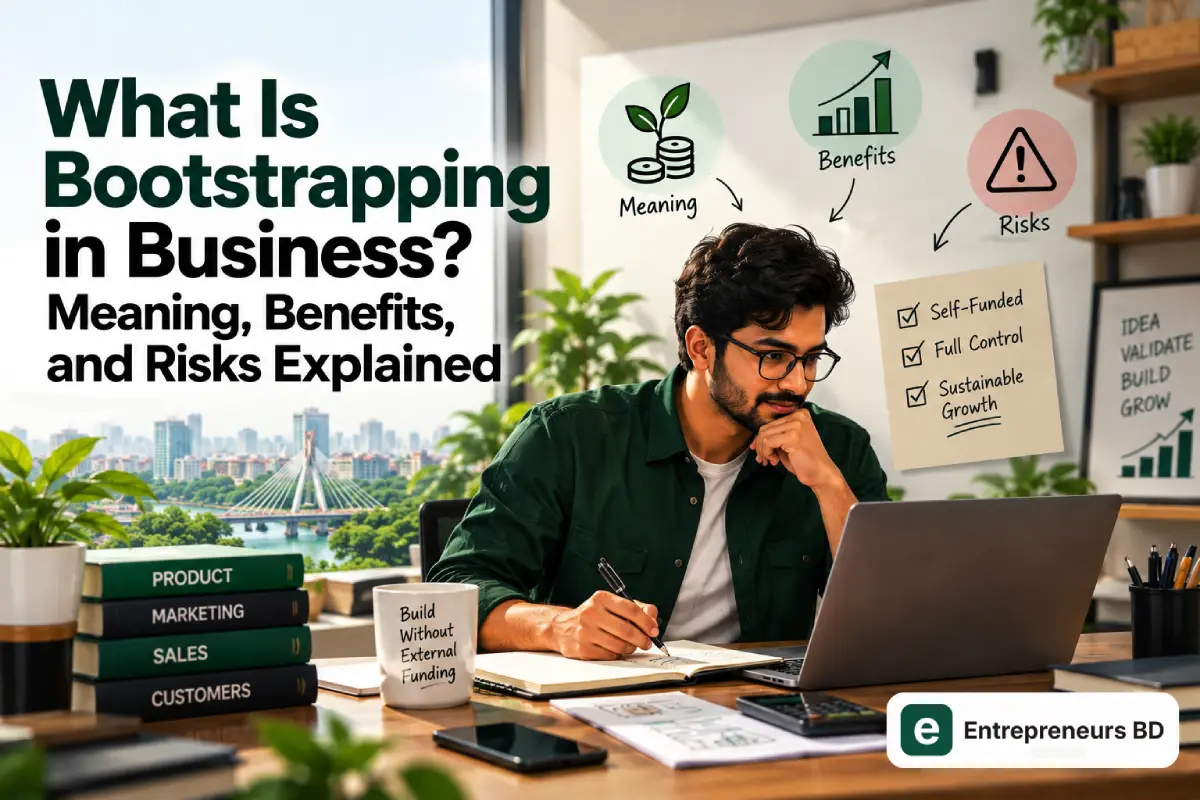
What Is Bootstrapping in Business?
Bootstrapping in business is the practice of starting and growing a company using only internal resources: the founder's own money, the cash customers pay, and the profit the business reinvests. No outside party buys shares, so the founders keep full ownership and every decision stays with them.
The phrase comes from the old saying about pulling yourself up by your own bootstraps, which originally described something impossible. In business it took on a more hopeful meaning: getting a company off the ground without anyone giving you a lift.
What counts as bootstrapping, and what does not
Definitions vary, but the dividing line is almost always ownership. A useful way to sort funding sources:
Clearly bootstrapping: personal savings, revenue from customers, advance payments and deposits, reinvested profit, and unpaid founder time
Grey area: money from family or friends (bootstrapped if it is a gift or an informal loan, not if they take a share), and bank loans (ownership stays intact, so many people count them, but strict definitions exclude debt)
Not bootstrapping: selling shares to angel investors, venture capital funds, corporate investors, or equity crowdfunding backers
Grants sit in their own category. They do not cost you equity, but they are outside money with conditions attached, so most founders describe them as non-dilutive funding rather than bootstrapping.
The term applies equally to a scalable startup and a steady neighbourhood business. If you are unsure which of those you are building, our explainer on what a startup is draws the line clearly.
Five Common Ways Businesses Bootstrap
Bootstrapping is not one method. Most self-funded companies combine two or three of these.
Founder savings
The simplest form: you put your own money in and spend it carefully. It is fast and requires nobody's approval, but it is also the most limited, because it ends the day your savings do.
Customer-funded growth
Here the business gets paid before or while it delivers, so customers effectively finance operations. Think deposits for event catering, advance payments on custom furniture, milestone billing on software projects, or annual subscriptions paid upfront.
This works better in some Bangladeshi sectors than others. Consumer e-commerce, where cash on delivery remains common, makes upfront payment hard. B2B services, export work, and digital products sold to international buyers make it far easier.
Service-to-product
Many founders run a service business, such as an agency, consultancy, or freelance practice, and use its income to fund a product. WPManageNinja followed this path: it grew out of its founder's web development agency, turning problems he kept solving for clients into WordPress plugins that could be sold to thousands of businesses.
Reinvested profit
Each month's surplus pays for the next step: a new hire, more stock, a better tool. It is the most sustainable form of bootstrapping and also the slowest, because growth can only move as fast as profit accumulates.
Sweat equity
Founders often pay themselves far below market rate, or nothing at all, during the early years. That unpaid time is a real investment, even though it never shows up on a balance sheet. It is worth tracking honestly, because it is part of what the business actually cost you.
Bootstrapping vs Other Ways to Fund a Business
Every funding route is a trade-off between control, speed, and who carries the risk. This comparison shows where bootstrapping sits.
Funding source | Ownership | Personal risk | Growth speed | Main cost | Best suited to |
|---|---|---|---|---|---|
Bootstrapping | Founders keep 100% | High: your own money is on the line | Paced by revenue | Slower growth, founder income forgone | Businesses that can earn early |
Bank or concessional loan | Founders keep 100% | High if secured by collateral or personal guarantee | Faster than revenue alone | Interest and fixed repayments | Businesses with predictable cash flow |
Grants and competitions | Founders keep 100% | Low | One-off boost | Application time and reporting rules | Early, innovation-focused projects |
Angel investment | Founders sell a minority stake | Shared with investor | Faster | Equity and some outside influence | Early startups with a strong team |
Venture capital | Founders sell sizeable stakes across rounds | Shared with investors | Fastest | Equity, board seats, pressure to scale and exit | Large, scalable markets |
The pattern is simple. The less ownership you give up, the more of the risk you carry and the slower you usually grow. Equity money buys speed but costs control.
For most Bangladeshi founders, the choice is narrower than the table suggests. Venture capital in Bangladesh is scarce and concentrated in a handful of deals each year, so self-funding is often the realistic starting point rather than a philosophical stance.
Benefits of Bootstrapping a Business
The advantages are real, but they are not the ones motivational posts usually list. Here is what bootstrapping genuinely gives you.
You keep full ownership and control
Every share you sell is permanent. Sell 20% in a seed round and another 20% in the next, and you own 64% of your company before it is even established. A bootstrapped founder keeps all of it, along with every decision about pricing, hiring, and direction.
Revenue proves demand early
A customer who pays is the most honest market research you will ever get. Because a bootstrapped business cannot survive on promises, it finds out quickly whether people actually want what it sells, rather than discovering it after spending an investor's money.
Discipline becomes a habit
When every taka comes from your own account or your customers, spending decisions get sharper. That habit tends to produce a lean cost structure that stays useful long after the business can afford more.
You set the pace and the goal
Most venture funds need to return money to their own investors within roughly a decade, which creates pressure to grow fast and eventually sell or list. A bootstrapped company can choose steady growth, stay in a profitable niche, or never sell at all.
You negotiate from strength if you raise later
Bootstrapping now does not rule out investment later. A company that already has paying customers and healthy margins can raise on far better terms than one pitching an idea, because it does not need the money to survive.
You are less exposed to funding cycles
Investment dries up periodically, both globally and in Bangladesh. A business that has never depended on the next funding round does not stall when investors go quiet.
Risks and Disadvantages of Bootstrapping
Bootstrapping is often presented as the noble, risk-free option. It is neither. These are the costs founders should weigh honestly.
Your personal finances absorb the losses
With no investor sharing the downside, every loss is yours. The structure you choose matters here: as the guide to a sole proprietorship in Bangladesh explains, the owner and the business are legally the same, so business debts can reach personal assets. Personal guarantees on loans or leases carry the same exposure.
Growth is capped by cash flow
Imagine a small accessories supplier that lands a large order from a garment factory. Raw materials must be bought now, but payment arrives in 90 days. Without outside capital, the business may have to turn down the very order that would have transformed it. Bootstrapped firms lose opportunities like this regularly.
Well-funded competitors can outspend you
In markets where the biggest player tends to take most of the value, capital itself becomes a weapon. Ride-sharing and mobile financial services in Bangladesh were built with substantial outside investment: Pathao and bKash both raised significant capital to subsidise early growth and build networks. A self-funded rival in those categories would have struggled to keep up.
You may underinvest in the business
Frugality can tip into starvation. Skipping a key hire, running on unreliable tools, or never spending on marketing saves money in the short term but can quietly cap what the business ever becomes.
Burnout and opportunity cost are real
Bootstrapping founders often spend years earning less than they could in a salaried job, while carrying the stress of a business that depends entirely on them. That cost is personal, and it often falls on families too.
Decisions rest on a few people
With no board or investors asking hard questions, blind spots can go unchallenged. Many bootstrapped founders counter this by building an informal circle of mentors or advisers who will tell them what they do not want to hear.
Is Bootstrapping Right for Your Business?
Use this as a quick fit test. Read each row and note which column describes your business more accurately.
Bootstrapping tends to work when... | Bootstrapping tends to struggle when... |
|---|---|
Customers pay before or soon after delivery | You must spend heavily long before the first sale |
Startup costs are modest | Equipment, licences, or regulatory capital are expensive |
The market rewards quality and niche focus | The market rewards whoever grows biggest fastest |
Gross margins are healthy | Margins are thin and depend on huge volume |
You can live on a reduced income for a while | You need a full salary from the first month |
You want long-term control | Your goal is rapid scale followed by an exit |
If most of your answers land in the left column, bootstrapping is a sensible default. If several land on the right, plan a hybrid route from the start, such as bootstrapping through validation and then using a loan, a grant, or equity to fund the capital-heavy stage.
Bootstrapping in Bangladesh: The Local Reality
For many Bangladeshi entrepreneurs, bootstrapping is less a strategy than a starting condition. An IFC private sector report published in 2020 found access to finance among the top obstacles for private firms, with smaller firms more likely to lean on their own savings. Lending that still relies heavily on collateral leaves many first-time founders with few alternatives.
The upside is that some of the country's most successful software companies were built this way. Nizam Uddin and Tareq Hasan started weDevs in a rented house in Rajshahi in 2012. When they released a premium version of their WordPress plugin in early 2013, it began generating roughly $8,000 to $10,000 a month, and the company has funded its own growth ever since, eventually building Dokan into one of the most widely used marketplace plugins in the WordPress ecosystem.
The lesson is not that anyone can do the same. It is that digital products sold to a global market are unusually well suited to bootstrapping: margins are high, customers pay upfront, and revenue arrives in foreign currency.
Founders who need capital without giving up ownership also have more options than a few years ago. Bangladesh Bank's start-up financing master circular (SMESPD Circular No. 02, issued July 2025) lets banks lend to eligible startups at a capped interest rate of 4%, with limits of up to Tk 8 crore depending on the startup's stage, and also allows banks to take equity stakes from their own start-up funds. Check the current terms with participating banks before you plan around them.
On the equity side, Startup Bangladesh Limited operates as the ICT Division's flagship venture capital fund. And for founders who want early capital without debt or dilution, the various startup grants in Bangladesh can extend a bootstrapped runway at the stage where it matters most.
How to Bootstrap Without Betting Everything
Choosing to self-fund does not mean accepting unlimited risk. These guardrails keep bootstrapping a deliberate decision rather than a slow drift.
Set a personal investment ceiling. Decide the maximum amount of your own money you will put in before you start. Crossing that line later should be a conscious choice, not something that happens one small top-up at a time.
Put a time box on the experiment. Define a milestone, such as covering monthly costs or reaching a set number of paying customers, and a date by which you expect to hit it. If the date passes, reassess honestly.
Choose your legal structure with liability in mind. A sole proprietorship is cheap and simple, but a private limited company separates business debts from personal assets. The right choice depends on how much risk the business carries.
Design the business to collect cash early. Deposits, upfront annual plans, and milestone billing all reduce how much of your own money the business consumes.
Write down your trigger for outside money. For example: "If demand exceeds what we can deliver, and cash is the only constraint, we will consider a loan or investment." Deciding this in advance stops pride or fear from making the call later.
Keep records clean from day one. Separate accounts, proper bookkeeping, and filed returns cost little, and they keep every future financing option open.
Frequently Asked Questions
Is bootstrapping the same as self-funding?
Does taking a bank loan still count as bootstrapping?
Is money from family and friends considered bootstrapping?
Which types of businesses are hardest to bootstrap?
How do investors view a bootstrapped company?
Can a bootstrapped business still become large?
Choosing Bootstrapping With Your Eyes Open
Bootstrapping in business is not a badge of honour, and it is not a consolation prize for founders who could not raise money. It is a trade: you keep ownership, control, and the freedom to set your own pace, and in return you carry the risk personally and accept that growth will follow cash flow.
In Bangladesh, where most founders start with their own savings anyway, the real question is not whether to bootstrap but how deliberately. The founders who do it well know exactly how much they are willing to risk, design their business to get paid early, and decide in advance what would make outside capital worth taking.
Before you put another taka into your business, write three things down: the most you will invest personally, the milestone that proves the business works, and the signal that would make a loan, grant, or investor the smarter choice. Those three lines will turn bootstrapping from a default into a strategy.

Specializing in SaaS product marketing, SEO strategy, Content marketing, TikTok advertising, PPC, and digital growth.
View Full Profile & ContributionsRelated Articles
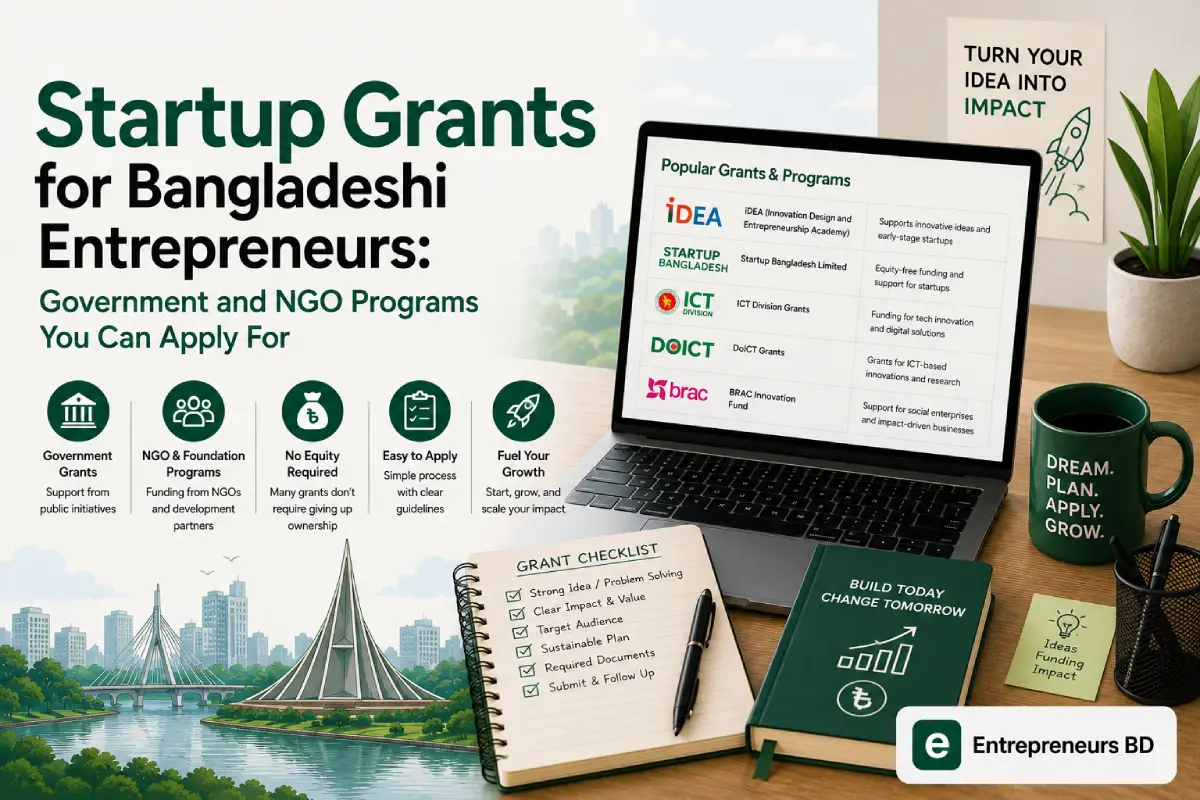
Startup Grants for Bangladeshi Entrepreneurs: Government and NGO Programs You Can Apply For
Bangladeshi entrepreneurs can apply for grants and low-cost financing through the ICT Division's iDEA project (up to BDT 10 lakh), SME Foundation's Credit Wholesaling Program, and Bangladesh Bank's refinance schemes for women and new entrepreneurs. Most require a trade license, a clear business plan, and an online application.
Fintech in Bangladesh: Key Players, Regulations, and Opportunities for Founders
For the payment and digital-finance businesses covered here, four regulated models matter most: MFS, PSP, PSO and digital banking. MFS requires a bank, financial institution or government entity to hold at least 51% of the provider and control its board. PSPs don't carry that requirement. PSOs run payment infrastructure and can't issue e-money. Digital banks are licensed under the Bank Company Act and now require Tk 300 crore in paid-up capital.
What Is Venture Capital? How VC Funding Works for Early-Stage Companies
Venture capital is equity funding that professional investment funds give to young, high-growth companies in exchange for part ownership. The fund pools money from outside investors, spreads it across many startups in stages, and makes its return mainly when a few of those companies are sold or listed years later.
Comments (0)
No comments yet. Be the first to share your thoughts!