What Is a Startup? Startup vs Small Business in 2026
A startup is a young company that pursues fast, scalable growth while it is still testing whether its business model works. A small business typically runs an established model in a defined market for steady income. The difference is mostly strategic intent and uncertainty, not size, age, or technology.
Key Takeaways
Treat "startup" as a description of strategy: scalable growth pursued under uncertainty.
Small businesses usually refine an established model, and the two categories can overlap.
Funding options overlap too: savings, revenue, grants, loans, angels, and venture capital.
Both models carry real risk, but the risks differ in type and timing.
In Bangladesh, tax law defines "startup" for specific benefits, so check eligibility separately from the business meaning.
What is a startup? In plain terms, it is a company trying to grow far beyond its starting size while it is still working out the model that will get it there. A small business, by contrast, usually takes a model customers already understand and runs it well for a particular market.
The distinction shapes how you fund, hire, and measure progress. Bangladesh's large cottage, micro, small, and medium enterprise sector explains why the role of SMEs receives so much policy attention, while startups represent a different way of building a company.
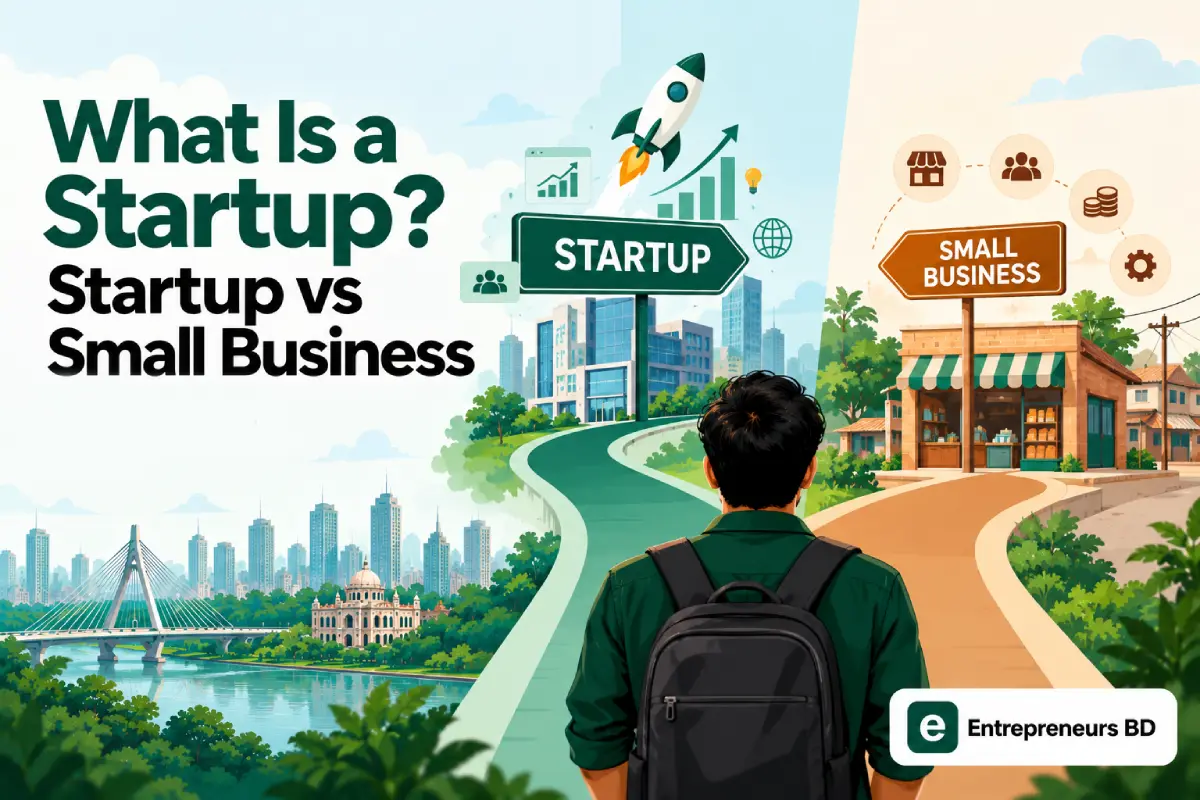
What Is a Startup? A Working Definition
Under the working definition used in this guide, a startup is a company pursuing a scalable growth opportunity before it has fully proven how that growth will work. Two features carry most of the weight.
Uncertainty about the model
A startup is still validating who will pay, how much, and through which channel. Lean-startup thinking describes this as searching for a repeatable business model, often by launching a minimum viable product and learning from real customer behaviour. Many startups combine proven pieces, such as delivery or digital payments, in a new way.
Potential to scale
The model should be able to serve far more customers without costs rising at the same pace. Software and platforms can have low costs for each additional user, but not always: cloud hosting, support, payment fees, delivery, and compliance all grow with volume.
What Is a Small Business?
A small business is best defined by size and operating context: a company with limited assets, staff, or revenue, usually serving a defined market with a largely established model.
In Bangladesh, size has formal meaning. Cottage, micro, small, and medium enterprises (CMSMEs) are classified under the National Industrial Policy 2022, which remains in force. Thresholds differ between manufacturing and service businesses, and individual loans or incentives may apply their own criteria.
"Small" describes size, while "startup" describes strategy, so a young startup can still qualify as a micro or small enterprise.
Startup vs Small Business: Common Differences
The comparison below shows typical emphasis, not strict rules. Plenty of real companies sit somewhere between the two columns.
Factor | Startup (typical) | Small business (typical) |
|---|---|---|
Strategic emphasis | Rapid, scalable growth | Sustainable income and stability |
Business model | Still being validated | Largely established |
Main uncertainty | Customer demand and financing | Operations and cash flow |
Path to profit | May be planned for later | Usually needed sooner |
Common funding | Savings, grants, angels, venture capital | Savings, revenue, bank loans, supplier credit |
Long-term goals | Market leadership, acquisition, or independence | Ownership, steady expansion, or sale |
Growth and profit
Startups usually aim to grow faster than conventional local firms, but the right pace depends on the model, customer acquisition cost, retention, and available capital. Some startups plan for losses while they invest in product or market share. That is defensible only when the evidence shows the economics improving.
A small business generally needs a credible route to positive cash flow early, because it rarely has outside capital to absorb losses.
Funding
Venture investors look for companies with the potential for very large outcomes, which is why they favour startups. Yet venture capital in Bangladesh is thin and concentrated in a handful of deals.
LightCastle Partners' 2025 investment review recorded US $124 million across 12 deals, but a single US$110 million deal behind the formation of SILQ Group drove the total, leaving roughly US$14 million for everyone else. Its H1 2026 report counted just US $6 million across six deals, down 95% year on year.
Most local startups will grow through revenue, grants, or angel money first, and bootstrapping a startup is often the realistic default.
Risk
Both models carry real risk; they simply fail in different ways. Startups face the risk that demand never materialises or the money runs out before the model works. Small businesses face rent, supplier dependence, debt, seasonality, and thin margins.
Four numbers that decide survival
These four concepts are related but not interchangeable:
Profit: revenue minus expenses over a period. A profitable firm can still run short of cash.
Cash flow: the timing of money coming in and going out. Slow-paying customers hurt both models.
Runway: how many months the business can operate at its current cash burn.
Unit economics: whether serving one more customer earns more than it costs, including acquisition and delivery.
Growth that worsens unit economics only makes losses bigger, so startups should track all four from the first month.
Where the Line Blurs
Real companies rarely sort neatly into two boxes.
Small businesses can launch scalable products. A logistics operator that builds fleet software for its own trucks may start selling it to other operators.
Startups can settle into steady businesses. A company that hoped to go national but finds solid demand in one city may wisely choose profitable stability.
Technology is not the test. A food or agriculture company testing a new distribution model can be a startup too.
The more useful question is whether you are pursuing a model that could grow much faster than its costs.
Startups and Small Businesses in Bangladesh
Chaldal illustrates the startup model. It set out to change how Dhaka households buy groceries, built warehousing and delivery operations over time, and raised several rounds of outside investment to fund that scale.
Its recent history also shows the risks of capital-heavy growth. In March 2026, The Daily Star reported protests by Chaldal staff in Jashore over unpaid wages, with the company saying salaries were being cleared in phases. Scale creates opportunity, but it does not guarantee sustainable economics.
The largest Bangladeshi deal of 2025 involved ShopUp, whose merger with Saudi-based Sary formed SILQ Group.
Some startups exist to serve small businesses. TallyKhata offers a digital ledger that shopkeepers can use to record sales and customer credit. The app aims to scale across many shops, while each shop stays a small business.
What "startup" means legally
Bangladesh's Income Tax Act 2023 defines which startups can access specific tax treatment, with conditions that include incorporation under the Companies Act, 1994 and turnover limits. The FY2026-27 budget then added zero turnover tax and VAT relief for eligible startups with turnover up to Tk 100 crore, according to LightCastle's H1 2026 report, so check the current rules with the NBR before relying on them.
Three meanings are worth separating:
Business meaning: a company pursuing scalable growth under uncertainty.
Tax meaning: a company that meets the statutory startup criteria, confirmed with the NBR or a tax adviser.
Programme meaning: a company that meets a specific fund's, grant's, or accelerator's eligibility rules.
Calling yourself a startup does not by itself qualify you for any benefit. Similarly, a business applying for an SME loan is assessed on cash flow, collateral, and the lender's own size criteria.
How to Decide Which Model Fits
Use these questions as a thought exercise, not a formal test.
How does growth affect costs? If doubling customers roughly doubles staff, rent, and inventory, you likely have a conventional small-business model. If costs grow far more slowly, the model may scale.
What still needs proving? Known demand and pricing point toward a small business. Untested assumptions about demand, price, or channel point toward a startup approach.
How long is your personal runway? This concerns you, not the business model. If you need income soon, budget living costs and validation time before deciding how aggressively to build.
Which capital fits? Savings, revenue, loans, grants, and equity each carry different costs and conditions.
What growth path do you want? Rapid expansion across markets suggests startup thinking; steady, owner-controlled growth suggests a small business. An exit is optional in both.
Many founders run a profitable service business and validate a scalable product alongside it, with a separate budget, customer interviews, and clear milestones before investing heavily.
Frequently Asked Questions
Is every new business a startup?
Does a startup have to be a tech company?
Is there a legal definition of a startup in Bangladesh?
Which legal structure should a startup use?
Can a small business become a startup?
Which is riskier, a startup or a small business?
Match Your Model to Your Evidence
Bangladesh needs both kinds of company. Startups test new ways to deliver groceries, payments, education, and logistics at scale, while small businesses supply much of the country's employment and everyday services.
The real danger is a mismatch between model and money: raising equity for a business whose economics cannot scale, or underfunding a scalable idea until a better-capitalised rival takes the market.
Before your next major decision, write down three things: what you still need to prove, how your costs behave as you grow, and how long you can fund the search. Those answers will tell you which model you are building, which kind of capital suits it, and which tax rules or programmes are worth checking for eligibility.

Specializing in SaaS product marketing, SEO strategy, Content marketing, TikTok advertising, PPC, and digital growth.
View Full Profile & ContributionsRelated Articles
Why Most Bangladeshi Startups Fail — and What You Can Do Differently
Quick Answer: Most Bangladeshi startups fail because of poor market validation, weak financial planning, and founder-market mismatch, not lack of ideas or effort. The founders who survive focus on solving real problems, build lean, and learn from their market before scaling.
Customer Acquisition Strategies That Work for Bangladesh Startups
Quick Answer: The most effective customer acquisition strategies for Bangladesh startups combine low-cost digital channels (Facebook, WhatsApp Business, SEO), mobile financial service integration for frictionless payment, referral-driven growth, and hyperlocal targeting. Startups that blend paid acquisition with retention-focused tactics see the lowest long-term cost per customer.
How to Start an Export Business in Bangladesh: Compliance, Buyers, and Logistics
To start an export business in Bangladesh, set up your business with a trade license and tax registration, open a bank account with an authorized dealer bank, and get an ERC from CCI&E. Then confirm your HS code, BIN and product permits, check the buyer's import rules, agree payment terms, and repatriate proceeds within four months.
Comments (0)
No comments yet. Be the first to share your thoughts!