What Profit Margin Should Your Bangladesh Business Target by Industry
Profit margins in Bangladesh vary wildly by industry, from 5% for garment exporters to 80% for tailoring services. This guide breaks down real gross margin benchmarks across retail, RMG, restaurants, SaaS, freelancing, and e-commerce, plus what actually moves your margin locally.
There's no single "good" profit margin in Bangladesh. A tea stall running at 50% gross margin can be healthy. So can an RMG exporter running at 8%.
These businesses simply operate in different cost structures. The right target depends on your industry, not on a general rule of thumb.
Most Bangladeshi small and medium businesses land somewhere between 20% and 30% gross margin overall. That average hides a lot of variation, though. Garment exporters often run gross margins as low as 8% to 15%. Service businesses like tailoring, printing, or optical shops can clear 50% to 80%.
This guide breaks down realistic margin targets by industry. It uses benchmark data from Bangladeshi accounting and business sources. Use it to judge your own numbers against real businesses in your sector.
Gross Margin vs. Net Margin: Know Which One You're Targeting
Gross margin and net margin answer different questions. Mixing them up is the most common reason business owners misjudge their own performance.
Gross margin is what's left of revenue after subtracting the direct cost of producing or sourcing what you sell. This covers raw materials, imported goods, and direct labor. It's calculated as (Revenue − Cost of Goods Sold) ÷ Revenue.
Net margin goes further. It also subtracts rent, salaries, utilities, loan interest, and tax. A business can post a strong 40% gross margin. It can still end the year with a thin 5% net margin, once every other cost gets counted.
Most of the industry benchmarks in this guide are gross margin figures. That's the number most Bangladeshi SMEs track month to month. Where net margin data is available and meaningfully different, it's noted separately. For how margin fits into a wider revenue plan, see Choosing a Revenue Model for Your Bangladesh Startup.
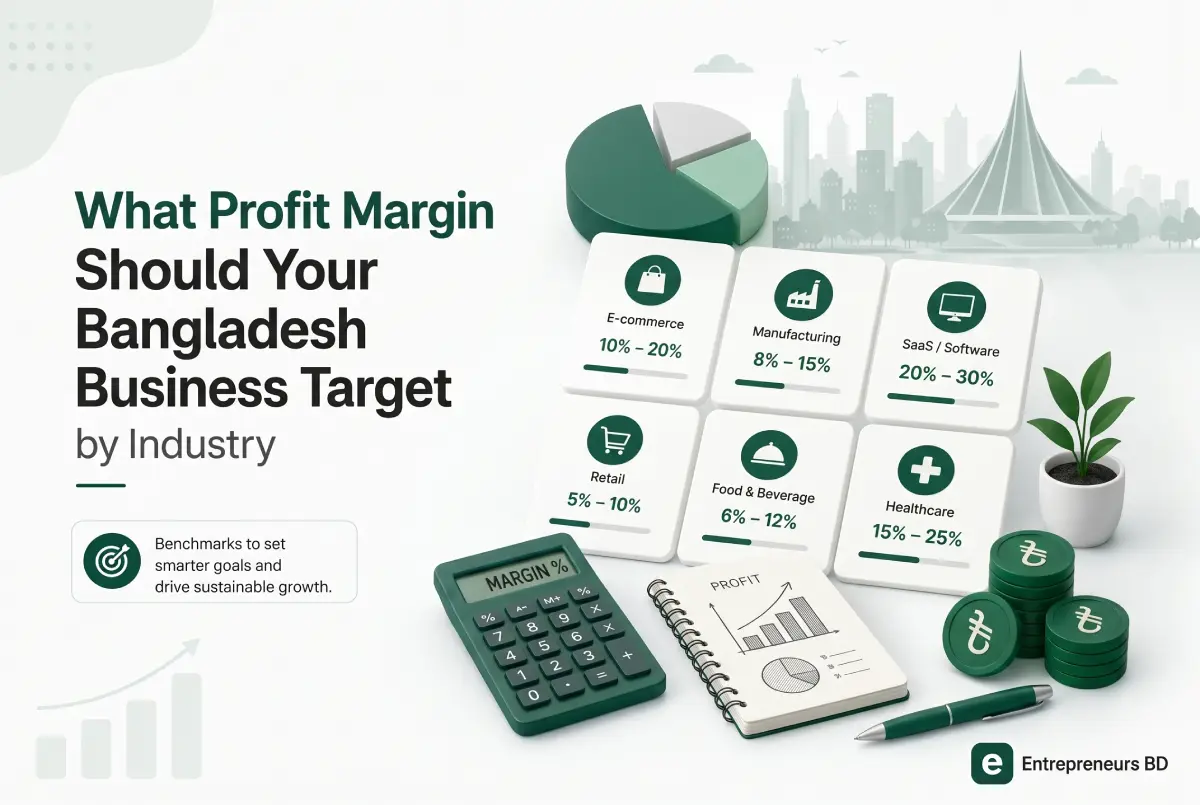
Profit Margin Benchmarks by Industry in Bangladesh
The table below summarizes typical gross margin ranges across major Bangladeshi business categories. It's compiled from Bangladeshi SME accounting benchmarks, sector reports, and industry data.
Industry | Typical Gross Margin | Business Type |
|---|---|---|
Garments Export (RMG) | 8% to 15% | Manufacturing / Export |
Local Fashion Retail | 50% to 60% | Boutique, E-commerce |
Software / SaaS | 38% to 44% | Subscription products |
Restaurants | ~40% to 42% | Dine-in & Cloud kitchen |
Electronics Retail | 30% to 38% | Retail importers |
Grocery – Retail | 15% | Trade |
Grocery – Wholesale | 7% | Trade |
Clothes – Wholesale | 5% to 8% | Trade |
Clothes – Retail | 10% | Trade |
IT Freelancing / Services | 20% to 30% | Service |
Tailoring | ~80% | Service |
Construction Contracting | ~5% | Service |
E-commerce (general) | 16% to 40%+ | Online retail |
Bakery | ~30% | Production |
Medicines – Retail/Wholesale | 10% | Trade |
These are typical ranges, not guarantees. Location, scale, and how well you manage sourcing all shift the actual number up or down for any given business.
Retail and Trading Businesses
Retail and wholesale trading in Bangladesh usually runs on thinner margins than new business owners expect. That's because these businesses compete mainly on price, not on differentiation.
Grocery retail typically nets around 15% gross margin. Wholesale grocery runs closer to 7%, since wholesalers move higher volume at a lower per-unit markup.
Clothing follows the same pattern. Retail clothing shops often see about 10% gross margin. Wholesale clothing traders operate on an even thinner 5% to 8%.
Local fashion retail and boutique e-commerce sit at the other end. These often reach 50% to 60% gross margin, since they sell on style and brand rather than competing purely on unit price. This is one reason many Bangladeshi entrepreneurs move from wholesale trading toward branded retail, once they have the capital. See How to Start a Business in Bangladesh for that path.
Manufacturing and Garments (RMG)
Bangladesh's garment export sector runs on some of the tightest margins in the economy. This is part of why the industry depends so heavily on volume and export scale to stay profitable.
RMG factories typically operate at 8% to 15% gross margin on FOB pricing. Net margin after finance costs and tax usually falls to 3% to 8%. Rising production costs, labor wages, and utility rates have squeezed this further in recent years. Small factories without strong compliance and safety certifications tend to sit at the lower end of that range.
Other manufacturing categories fare better. Bakery production runs around 30% gross margin. General production or assembly work often lands between 20% and 30%, depending on how much of the process is automated versus manual.
Food and Restaurant Business
Restaurants in Bangladesh usually post healthier gross margins than manufacturing. Net margins are thinner, though, once rent, staff, and food cost volatility are counted.
Gross margin for a typical Bangladeshi restaurant runs around 40% to 42%. Net profit margin after all operating costs is usually closer to 5% to 10%. Fast food and delivery-focused concepts tend to outperform fine dining on margin. They carry lower staffing and real estate costs per order.
Cloud kitchens and delivery partnerships have become a common way for Dhaka restaurant owners to improve their margin. This adds sales volume without a proportional rise in rent, since it skips the cost of a second physical location.
Services: Tailoring, Printing, and Specialty Trades
Service businesses that sell skill and labor, rather than physical goods, post some of the highest margins on this list. Their main cost is time, not materials.
Tailoring, optical services, and prescription printing routinely run at 50% to 80% gross margin. Materials make up a small share of the total price charged. Photography, engineering workshops, and printing presses typically land in the 30% to 40% range.
The tradeoff is that these businesses scale with the owner's own hours, not with capital. Growth usually means training and adding more skilled people, not buying more inventory.
Technology, SaaS, and Freelancing
Bangladesh's technology and freelancing sector runs on a very different cost structure than physical goods businesses. This is part of why margins here often surprise first-time founders.
Software and SaaS businesses in Bangladesh typically post gross margins of 38% to 44%. Server, hosting, and technical support costs drive most of that, not materials. Independent IT freelancers report a wider spread. Close to half operate at 10% to 30% profit margin, and the broader freelance IT sector is often cited around 20% to 30%.
Freelancers usually have minimal overhead beyond their own time and a working setup. Most of that margin gap comes down to pricing, not cost. See Business Models & Monetization for how a service model and a product model carry very different margin ceilings.
E-commerce
E-commerce margins in Bangladesh vary more than almost any other category. That's largely because "e-commerce" covers everything from dropshipping to branded direct sales.
A small e-commerce operation might see gross margin anywhere from 16% for dropshipping-style resale up to 40% or higher for branded products with direct sourcing. Delivery, packaging, payment fees, and returns all eat into that headline number more than most new sellers expect.
See Dropshipping in Bangladesh for how margin gets squeezed in resale selling. See Starting an Online Business in Bangladesh for the wider setup.
What Actually Moves Your Margin in Bangladesh
A handful of local, structural factors shift margins up or down more than most owners realize. Often, these matter more than the specific industry a business is in.
Import costs and the USD/BDT exchange rate: many Bangladeshi businesses import raw materials or finished goods. A weaker taka directly raises cost of goods sold and compresses margin, even with no change in the business itself.
VAT and Supplementary Duty: standard VAT sits at 15%. Supplementary Duty can reach as high as 65.5% on some imported and regulated goods. Many SMEs can't fully pass these costs on to customers, which quietly erodes gross margin. See Tax for Startups in Bangladesh for how this plays out in practice.
Rent, labor, and utility costs: these don't hit gross margin directly. But rising operational costs pressure the net margin a business actually keeps, especially in Dhaka and other major cities.
Supplier credit terms: tight supplier credit stops a business from buying in bulk. That means a higher per-unit cost, which lowers gross margin before a single sale is made.
Local competition and pricing pressure: retail and manufacturing sectors in Bangladesh are especially price-competitive. This pushes many businesses to shave margin to hold onto volume, rather than lose customers to a cheaper competitor.
How to Improve Your Margin
A few practical, low-cost levers tend to move margin the most for Bangladeshi small businesses. None of these require a complete change in the business model.
Sourcing through established local wholesale hubs can meaningfully cut cost of goods sold. Keraniganj for garments and Patuatuli for electronics are two well-known examples. Reviewing pricing regularly against actual costs also helps. Prices left unchanged for months quietly fall behind rising costs, often without anyone noticing until it shows up in the numbers.
Tracking gross margin monthly, not just at year-end, gives a founder time to react before a slipping number becomes a real problem. See Financial Planning for Startups in Bangladesh for building margin tracking into a wider financial habit. See Finance & Funding for Entrepreneurs and Business Planning for how this fits the bigger picture.
Frequently Asked Questions
What is a good profit margin for a small business in Bangladesh?
Why do garment exporters have such low profit margins?
Is gross margin or net margin more important to track?
How often should I calculate my business's profit margin?
Do e-commerce businesses in Bangladesh have better margins than physical retail?

Specializing in SaaS product marketing, SEO strategy, Content marketing, TikTok advertising, PPC, and digital growth.
View Full Profile & ContributionsRelated Articles

Startup Grants for Bangladeshi Entrepreneurs: Government and NGO Programs You Can Apply For
Bangladeshi entrepreneurs can apply for grants and low-cost financing through the ICT Division's iDEA project (up to BDT 10 lakh), SME Foundation's Credit Wholesaling Program, and Bangladesh Bank's refinance schemes for women and new entrepreneurs. Most require a trade license, a clear business plan, and an online application.

Fintech in Bangladesh: Key Players, Regulations, and Opportunities for Founders
For the payment and digital-finance businesses covered here, four regulated models matter most: MFS, PSP, PSO and digital banking. MFS requires a bank, financial institution or government entity to hold at least 51% of the provider and control its board. PSPs don't carry that requirement. PSOs run payment infrastructure and can't issue e-money. Digital banks are licensed under the Bank Company Act and now require Tk 300 crore in paid-up capital.

Angel Investors in Bangladesh: Who They Are and How to Reach Them
Angel investors in Bangladesh are individuals, family offices, and diaspora professionals who fund early-stage startups in exchange for equity. Most operate through organized networks like Bangladesh Angels Network (BAN) and Bangladesh Women Investors Network (BWIN), which vet founders, run pitch sessions, and syndicate deals among members.
Comments (0)
No comments yet. Be the first to share your thoughts!