Choosing a Revenue Model for Your Bangladesh Startup: 10 Options Compared
The right revenue model for a Bangladesh startup depends on your product type, your customers' willingness to pay upfront, and the payment infrastructure available (bKash, Nagad, Rocket). Subscription and commission-based models suit digital services and marketplaces. Freemium and advertising work best for high-traffic platforms. Most successful Bangladeshi startups eventually combine two or more models.
Key Takeaways
A revenue model defines how money enters the business, not just what the business sells.
Commission-based and subscription models dominate Bangladesh's digital economy, largely because of MFS adoption.
VAT treatment differs by revenue type, so pricing decisions need to account for NBR rules early.
Freemium and advertising models need real scale to work, which is harder outside Dhaka's dense urban market.
Hybrid models are increasingly the norm, not the exception, among Bangladeshi startups that survive past year two.
Picking a revenue model is one of the most consequential decisions a founder makes. It shapes pricing, cash flow, customer acquisition cost, and even how investors evaluate the business.
In Bangladesh, this decision carries extra weight. Payment habits, VAT rules, and internet access patterns are different from the Silicon Valley playbooks most founders read first.
This guide compares 10 revenue models founders actually use here. Each one includes how it works, where it fits, and what to watch for in the local market. By the end, you will have a clearer framework for choosing (or combining) models that match your product and your customers.
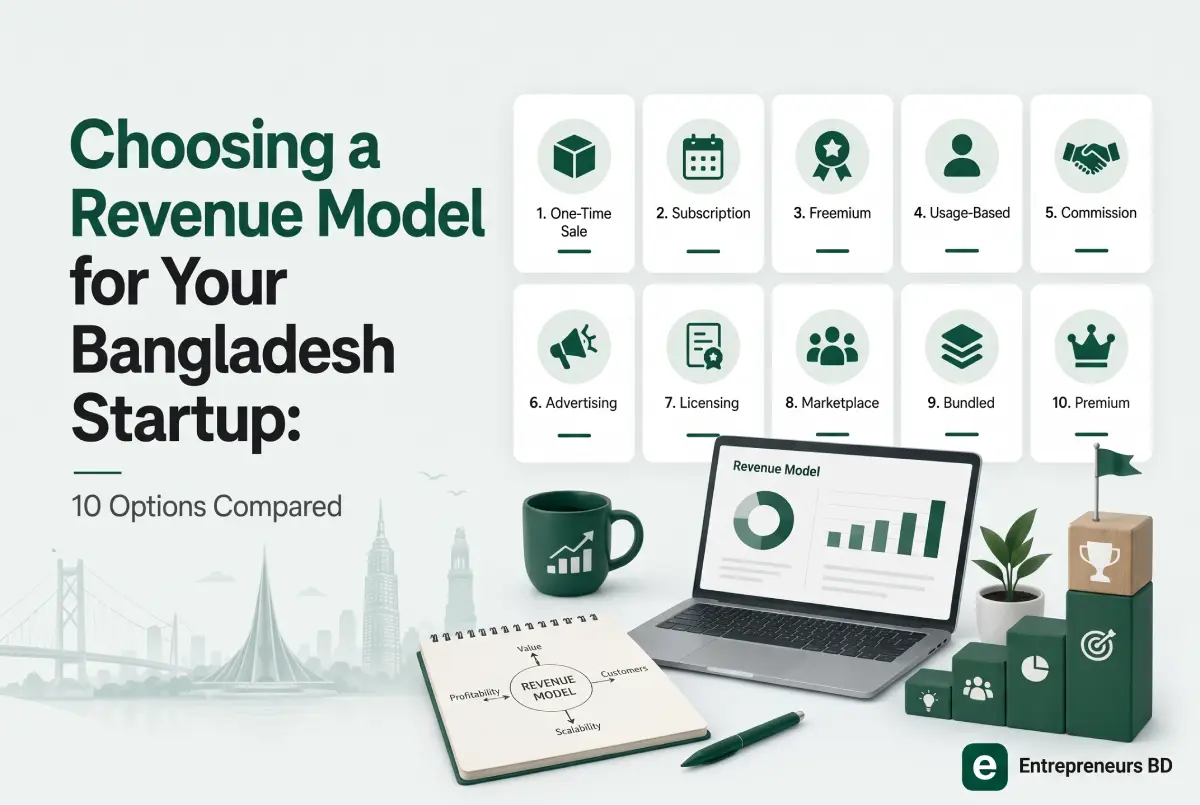
The 10 Revenue Models Compared
1. Subscription Model
Customers pay a recurring fee, usually monthly or annually, for continued access to a product or service.
This model works well for SaaS tools, streaming platforms, and edtech products where value is delivered continuously rather than in a single transaction.
In Bangladesh, subscription businesses need to plan for two local realities: irregular income patterns among many consumers, and a strong preference for MFS-based recurring payments over cards. A business model canvas exercise early on helps founders map whether recurring value actually exists before locking into this structure.
Best for: SaaS, edtech, streaming, B2B tools.
2. Freemium Model
A basic version of the product is free, and advanced features sit behind a paid tier.
Freemium works when the free tier is genuinely useful on its own, which builds a large user base that a small percentage eventually converts to paid.
The challenge in Bangladesh is scale. Freemium math only works with large numbers of free users, and internet access outside major cities still limits how fast that base can grow.
Best for: Productivity apps, design tools, niche software with a clear upgrade path.
3. Transaction or Commission-Based Model
The platform takes a percentage cut of every transaction that happens through it, rather than charging users directly.
This is arguably the dominant model in Bangladesh's digital economy. Ride-sharing, food delivery, and e-commerce marketplaces all rely on it, and it maps naturally onto how MFS platforms already process payments.
Mobile financial services processed nearly 240 million registered accounts and well over a trillion taka in monthly transaction volume as of early 2025, according to Bangladesh Bank's MFS data. That infrastructure is exactly what makes commission-based platforms viable at scale here.
Best for: Marketplaces, delivery apps, ride-sharing, booking platforms.
4. Advertising-Based Model
Revenue comes from third parties paying to reach the platform's audience, while users access the core product for free.
This model demands significant traffic before it becomes meaningful income. A content site or app needs a large, engaged audience before advertisers take real interest.
Bangladesh's internet base gives this model real long-term potential. The country had over 133 million internet subscribers as of mid-2025, based on a U.S. government digital economy assessment, though reaching a monetizable slice of that audience takes time and content investment.
Best for: News platforms, content sites, high-traffic apps.
5. Direct Sales or E-commerce Retail Model
The business sells a physical or digital product directly to customers at a fixed price, earning margin on each unit sold.
This is the most familiar model to most first-time founders because it mirrors traditional retail. The complexity in Bangladesh comes from logistics, cash-on-delivery expectations, and return rates rather than the pricing mechanics itself.
Founders testing this model should validate demand before scaling inventory. A structured MVP guide helps avoid overcommitting capital to stock that has not proven itself.
Best for: D2C brands, physical products, niche e-commerce.
6. Licensing Model
A business grants another company or individual the right to use its intellectual property, software, or brand in exchange for a fee.
This model suits founders with a defensible technology, proprietary process, or strong brand that others want to use under their own name. It is capital-light once developed but requires real IP that others cannot easily replicate.
Licensing deals in Bangladesh are less common at the startup stage, mostly because building genuinely licensable IP takes years, but it becomes viable once a product is proven.
Best for: Fintech infrastructure, proprietary software, franchisable concepts.
7. Affiliate Marketing Model
The business earns a commission by referring customers to another company's product or service, rather than selling its own.
This model has low startup cost and works well for content-driven platforms, comparison sites, or influencers with an engaged following.
It rarely stands alone as a full business model for Bangladeshi startups, but it works well as a secondary revenue stream layered onto a content or community platform.
Best for: Content platforms, comparison sites, niche communities.
8. Pay-Per-Use or Usage-Based Model
Customers pay based on actual consumption rather than a flat recurring fee, similar to a utility bill.
This model fits businesses where usage varies significantly between customers, such as cloud infrastructure, API access, or logistics services billed per delivery.
It requires accurate usage tracking and billing infrastructure, which adds technical overhead compared to a flat subscription. For early-stage founders still validating product-market fit, this complexity is often worth deferring until the core product is stable.
Best for: API businesses, cloud services, logistics, utility-style products.
9. Franchise or Reseller Model
The business licenses its operating model to independent partners who run local outlets or territories, sharing revenue or paying a fee for the rights.
This model expands geographic reach without the original business bearing the full capital cost of every new location. It works particularly well in Bangladesh's district-level markets, where a Dhaka-based team often cannot efficiently manage operations directly.
Success depends heavily on strong systems and training, since brand quality now rests partly in someone else's hands.
Best for: Retail chains, service businesses, education centers.
10. Hybrid Revenue Model
The business combines two or more of the models above, often a base subscription plus transaction fees, or freemium plus advertising.
Hybrid models are increasingly the default rather than the exception. A marketplace might charge sellers a subscription for premium placement while also taking a commission on each sale. An edtech platform might offer free content supported by ads, with a paid tier for certification.
This flexibility matters in Bangladesh, where customer segments vary widely in willingness to pay, and a single model rarely captures the full addressable market.
Best for: Most startups past their first year of operation.
How to Choose the Right Revenue Model
Start with how your customer already pays for similar things, not how you wish they would pay.
A customer used to paying cash-on-delivery for goods will resist an upfront subscription. A business owner used to paying per transaction may reject a flat monthly fee that feels like a fixed cost regardless of usage.
Match the model to your cost structure too. High customer acquisition costs generally need recurring revenue to justify the spend, while low-cost, high-volume products can work on thin transaction margins.
Test before you commit. Founders who validate a startup idea with a small paying cohort, using whichever model seems most natural, learn far more from real payment behavior than from a spreadsheet.
Revenue Models and Bangladesh's Regulatory and Payment Context
Every revenue model interacts with VAT differently, and that affects your effective pricing from day one.
The standard VAT rate on most goods and services in Bangladesh is 15 percent, though reduced rates apply to specific categories, and businesses above the registration threshold must register with the National Board of Revenue. Subscription and licensing revenue typically falls under standard service VAT treatment, while some digital and IT-enabled services qualify for reduced rates.
Payment infrastructure matters just as much as tax treatment. Recurring billing through MFS platforms is technically possible but less mature than card-based auto-debit in markets where subscriptions are the norm. Founders building subscription or usage-based models should budget extra time for payment collection friction, particularly renewal reminders and manual top-ups.
Commission-based and marketplace models benefit from the opposite dynamic. MFS rails make instant, low-friction transaction settlement genuinely easy, which is part of why this model has scaled so well across ride-sharing and delivery in Bangladesh.
Practical Steps to Test Your Revenue Model
Pick one model and price a real offer, even a rough one, within the first few weeks of building.
Talk to 10 to 15 potential customers about how they would actually pay, not whether they like the idea in theory.
Watch what they do when asked to pay something small, even a token amount, rather than only what they say.
Track early cash flow separately from vanity metrics like signups or downloads, since revenue model viability shows up in payment behavior, not interest.
Revisit the model at each growth stage. What works for the first 100 customers in Dhaka may need adjustment before it works for scaling nationally, and again before it works for outside investors evaluating the business for funding.
Frequently Asked Questions
What is the difference between a business model and a revenue model?
Which revenue model is most common among Bangladeshi startups?
Can a startup combine more than one revenue model?
How does VAT affect subscription and SaaS pricing in Bangladesh?
Is the freemium model realistic for a small Bangladeshi startup?
What revenue model works best for a marketplace or delivery app in Bangladesh?
Building a Revenue Model That Fits Bangladesh, Not Just the Textbook
Every model in this list has worked for some startup, somewhere. What matters is whether it fits your specific customer's payment habits, your cost structure, and the realities of Bangladesh's digital infrastructure.
Resist the urge to copy a model just because a well-known company uses it. A subscription model that works for a global SaaS product may fail here if your customer has never paid for software before.
Start with the smallest, most honest test you can run: a real price, offered to real customers, through a payment method they already trust. What they actually pay for tells you more than any framework ever will.
From there, expect your model to evolve. The founders who build durable revenue in Bangladesh are rarely the ones who pick perfectly on day one. They are the ones who watch closely, adjust quickly, and are willing to combine models once the data tells them to.

Specializing in SaaS product marketing, SEO strategy, Content marketing, TikTok advertising, PPC, and digital growth.
View Full Profile & ContributionsRelated Articles
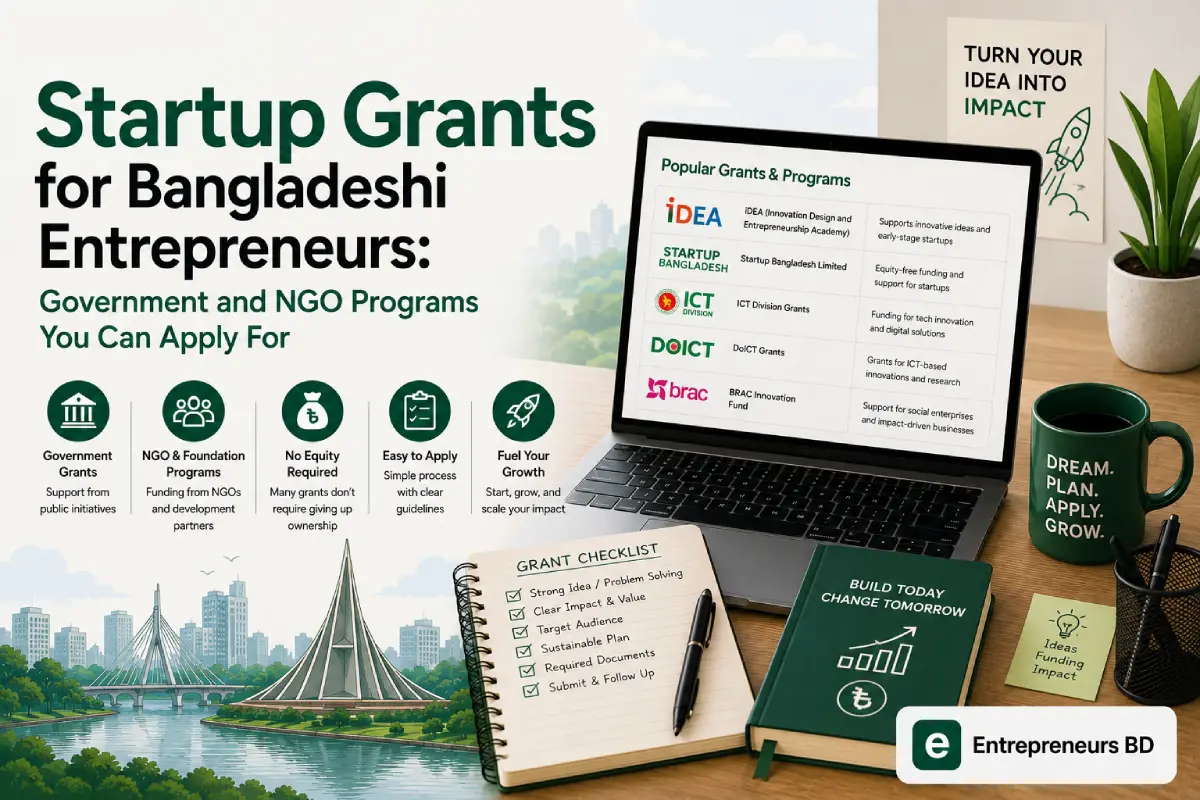
Startup Grants for Bangladeshi Entrepreneurs: Government and NGO Programs You Can Apply For
Bangladeshi entrepreneurs can apply for grants and low-cost financing through the ICT Division's iDEA project (up to BDT 10 lakh), SME Foundation's Credit Wholesaling Program, and Bangladesh Bank's refinance schemes for women and new entrepreneurs. Most require a trade license, a clear business plan, and an online application.

Fintech in Bangladesh: Key Players, Regulations, and Opportunities for Founders
For the payment and digital-finance businesses covered here, four regulated models matter most: MFS, PSP, PSO and digital banking. MFS requires a bank, financial institution or government entity to hold at least 51% of the provider and control its board. PSPs don't carry that requirement. PSOs run payment infrastructure and can't issue e-money. Digital banks are licensed under the Bank Company Act and now require Tk 300 crore in paid-up capital.

Angel Investors in Bangladesh: Who They Are and How to Reach Them
Angel investors in Bangladesh are individuals, family offices, and diaspora professionals who fund early-stage startups in exchange for equity. Most operate through organized networks like Bangladesh Angels Network (BAN) and Bangladesh Women Investors Network (BWIN), which vet founders, run pitch sessions, and syndicate deals among members.
Comments (0)
No comments yet. Be the first to share your thoughts!