Financial Planning for Bangladesh Startups: Cash Flow, Burn Rate, and Runway
Financial planning for a Bangladesh startup means tracking three numbers together: cash flow (money in versus money out), burn rate (how fast you spend cash each month), and runway (how many months of cash you have left). In 2026, with domestic startup funding down sharply and lending rates near 12 percent, founders need to calculate these figures monthly, not annually.
Key Takeaways
Cash flow, burn rate, and runway are three different metrics, and mixing them up leads to bad decisions
Bangladeshi startup funding fell 95 percent year on year in the first half of 2026, so cash discipline now matters more than growth speed
The weighted average bank lending rate stood at 11.96 percent in April 2026, making debt an expensive runway extension
A 12 to 18 month runway buffer is the realistic minimum for Bangladeshi founders given how slow local fundraising cycles have become
Government-backed refinance schemes offer working capital at far lower rates than commercial loans, if your business qualifies
Most founders in Bangladesh discover the difference between cash flow, burn rate, and runway the hard way. They watch their bank balance shrink and only then start asking why. That reactive habit is expensive, and in 2026 it can be fatal.
This guide breaks down each metric in plain terms, shows how to calculate them with real numbers, and applies them to the current Bangladeshi funding and lending environment. You will leave with a working method you can update every month, not a one-time spreadsheet you forget about.
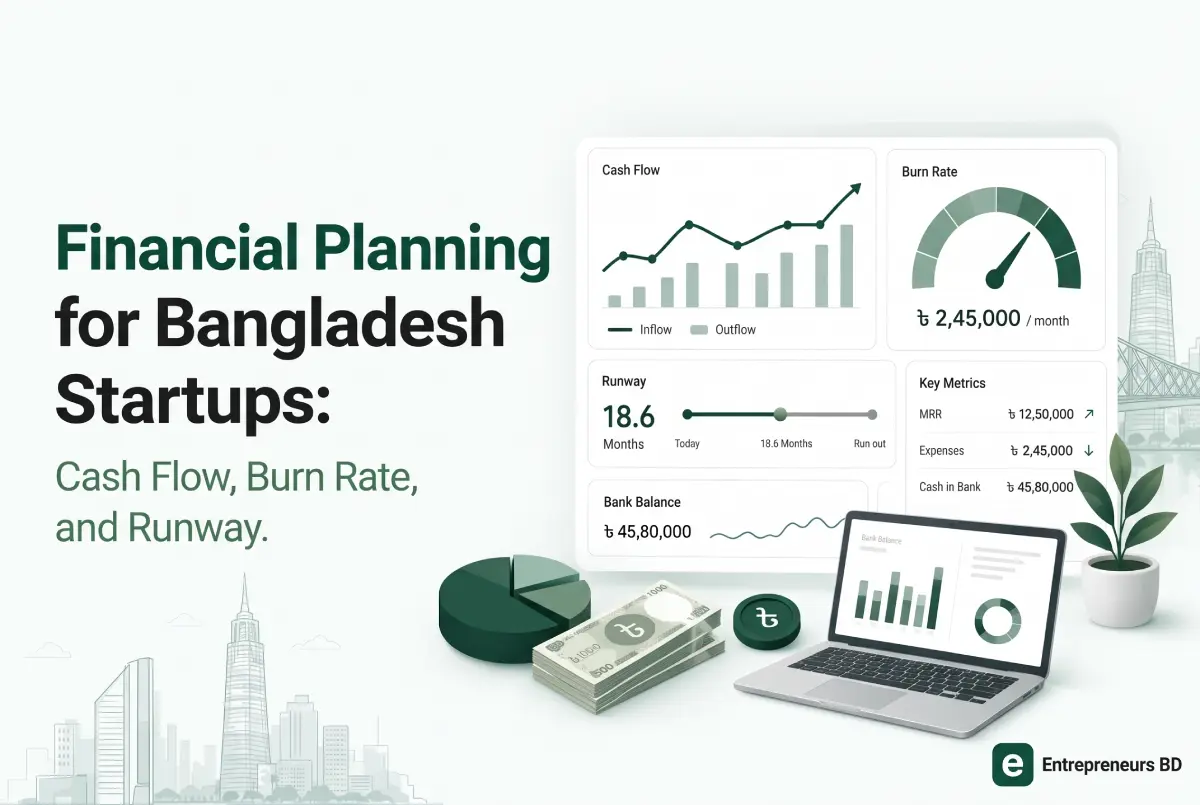
Cash Flow, Burn Rate, and Runway: What Each One Actually Means
Cash flow is the movement of money into and out of your business over a given period. It is not the same as profit, since a profitable business can still run out of cash if payments are delayed.
Burn rate is how much cash your business loses each month. Gross burn rate is your total monthly spending. Net burn rate subtracts whatever revenue you bring in, giving a truer picture of your actual cash loss.
Runway is the number of months your business can survive before it runs out of money, assuming your current burn rate stays constant. The formula is simple: cash in the bank divided by net monthly burn rate.
If a startup has 6,000,000 taka in the bank and a net burn rate of 500,000 taka a month, its runway is 12 months. That single number should drive every major decision a founder makes.
Why Founders Confuse These Three Numbers
A common mistake is treating a healthy bank balance as safety. A large balance with a high burn rate can disappear faster than a small balance with tight spending.
Another mistake is calculating burn rate once, at the start of the business, and never updating it. Costs change as a team grows, as marketing spend increases, and as business scaling in Bangladesh accelerates hiring.
The fix is a monthly cash flow review, not a quarterly or annual one. A monthly cadence catches problems while there is still time to react.
The 2026 Funding Reality Bangladeshi Founders Are Working Against
Startup financial planning cannot be separated from the funding environment a founder is raising in. That environment has shifted hard this year.
Startup funding in Bangladesh dropped 95 percent year on year, falling to just 6.0 million dollars in the first half of 2026 compared to 120 million dollars during the same period in 2025, according to a LightCastle Partners report cited by The Financial Express. Only six deals closed locally in that window.
Foreign investors supplied 100 percent of that capital, with no domestic institutional participation recorded in the first half of the year. That means founders waiting on local investors to bridge a cash gap are likely to wait much longer than they planned.
The practical takeaway is direct. If your fundraising timeline assumes a quick round, rebuild it around a slower one. Extending your runway through spending discipline is now more reliable than extending it through a fast raise, a shift also visible when you look at how startup funding in Bangladesh has evolved.
Why Debt Is an Expensive Runway Extension Right Now
Some founders try to extend runway by borrowing rather than raising equity. In the current rate environment, that option costs more than it used to.
The weighted average bank lending rate in Bangladesh stood at 11.96 percent at the end of April 2026, according to Bangladesh Bank's Monetary Policy Statement. Bangladesh Bank has held its policy rate at 10 percent since October 2024 as part of a sustained anti-inflation stance.
Inflation itself has stayed stubborn, easing only to 9.16 percent by June 2026 after months above 9 percent. That combination of high borrowing costs and high inflation compresses margins for any startup carrying debt.
There is a narrower path worth exploring before taking a standard commercial loan. Bangladesh Bank channels refinance funds to participating banks at concessional rates, and those banks are required to pass on the saving to eligible small and medium borrowers rather than charging full market rates, as outlined in Bangladesh Bank's SME credit policy. Some current CMSME refinance windows cap the customer rate at 7 to 9 percent, well below the general market rate.
Practical Cash Flow Management for Bangladeshi Startups
Start with a 13 week cash flow forecast, updated weekly. This window is short enough to stay accurate and long enough to catch problems before they become emergencies.
Separate fixed costs from variable costs. Rent, salaries, and software subscriptions are fixed. Marketing spend, freelance costs, and inventory purchases can flex month to month.
Track receivables aggressively. Late payments from customers or partners are one of the most common causes of cash crunches for early-stage Bangladeshi businesses, particularly those selling on credit terms to other businesses.
Build a cash buffer before you need one. A validated business model still needs a financial cushion, since even predictable revenue can arrive later than expected.
Review your burn rate against your actual revenue every month, not just your spending plan. This is where data analytics becomes genuinely useful for a small team, since even a simple dashboard catches drift between plan and reality faster than a manual review.
How Much Runway Is Actually Safe in 2026
The old startup advice of keeping 6 months of runway does not hold up well against a market where local funding rounds have slowed this much. A 12 to 18 month buffer is a more realistic target for Bangladeshi founders this year.
That buffer should widen further if your business depends on external capital to reach its next milestone. Waiting for a term sheet in a market where angel investment in Bangladesh has become more selective takes longer than founders expect, and a thin runway forces you to accept worse terms out of desperation.
If your current runway is under 6 months, treat it as an emergency, not a planning exercise. Cut variable costs immediately, delay non-essential hires, and open conversations with lenders or investors before the number drops further.
Six Steps to Extend Your Startup's Runway
Cut before you raise. Reducing burn rate by 20 percent extends runway more reliably and more quickly than most fundraising conversations will.
Renegotiate fixed costs. Office leases, software subscriptions, and vendor contracts often have more room to move than founders assume, especially with a track record of on-time payment.
Delay hiring until revenue confirms the need. Payroll is usually the single largest and least flexible cost on a startup's books.
Explore concessional financing before commercial loans. Government-backed refinance schemes exist specifically because commercial lending rates are high right now.
Diversify revenue streams where possible. A second income source, even a small one, reduces how much your runway depends on a single customer or channel.
Revisit your startup pitch and financial story before every fundraising conversation. Investors in this market are scrutinizing burn discipline as closely as growth numbers.
Frequently Asked Questions
What is a good burn rate for a Bangladeshi startup?
How is runway different from burn rate?
Should I use gross burn rate or net burn rate?
How often should a startup review its cash flow in Bangladesh?
Are government refinance loans available to early-stage startups?
Why did startup funding drop so sharply in Bangladesh in 2026?
Treat Your Runway as Your Most Important Metric This Year
The founders who get through 2026 in good shape will not necessarily be the ones who raised the most money. They will be the ones who knew their numbers cold and acted early.
Calculate your burn rate this week if you have not already. Then calculate your runway, and be honest about what it tells you.
If the number is uncomfortable, that discomfort is useful information. It is far better to find it in a spreadsheet today than in an empty bank account in six months.

Specializing in SaaS product marketing, SEO strategy, Content marketing, TikTok advertising, PPC, and digital growth.
View Full Profile & ContributionsRelated Articles

Startup Grants for Bangladeshi Entrepreneurs: Government and NGO Programs You Can Apply For
Bangladeshi entrepreneurs can apply for grants and low-cost financing through the ICT Division's iDEA project (up to BDT 10 lakh), SME Foundation's Credit Wholesaling Program, and Bangladesh Bank's refinance schemes for women and new entrepreneurs. Most require a trade license, a clear business plan, and an online application.

Fintech in Bangladesh: Key Players, Regulations, and Opportunities for Founders
For the payment and digital-finance businesses covered here, four regulated models matter most: MFS, PSP, PSO and digital banking. MFS requires a bank, financial institution or government entity to hold at least 51% of the provider and control its board. PSPs don't carry that requirement. PSOs run payment infrastructure and can't issue e-money. Digital banks are licensed under the Bank Company Act and now require Tk 300 crore in paid-up capital.

Angel Investors in Bangladesh: Who They Are and How to Reach Them
Angel investors in Bangladesh are individuals, family offices, and diaspora professionals who fund early-stage startups in exchange for equity. Most operate through organized networks like Bangladesh Angels Network (BAN) and Bangladesh Women Investors Network (BWIN), which vet founders, run pitch sessions, and syndicate deals among members.
Comments (0)
No comments yet. Be the first to share your thoughts!