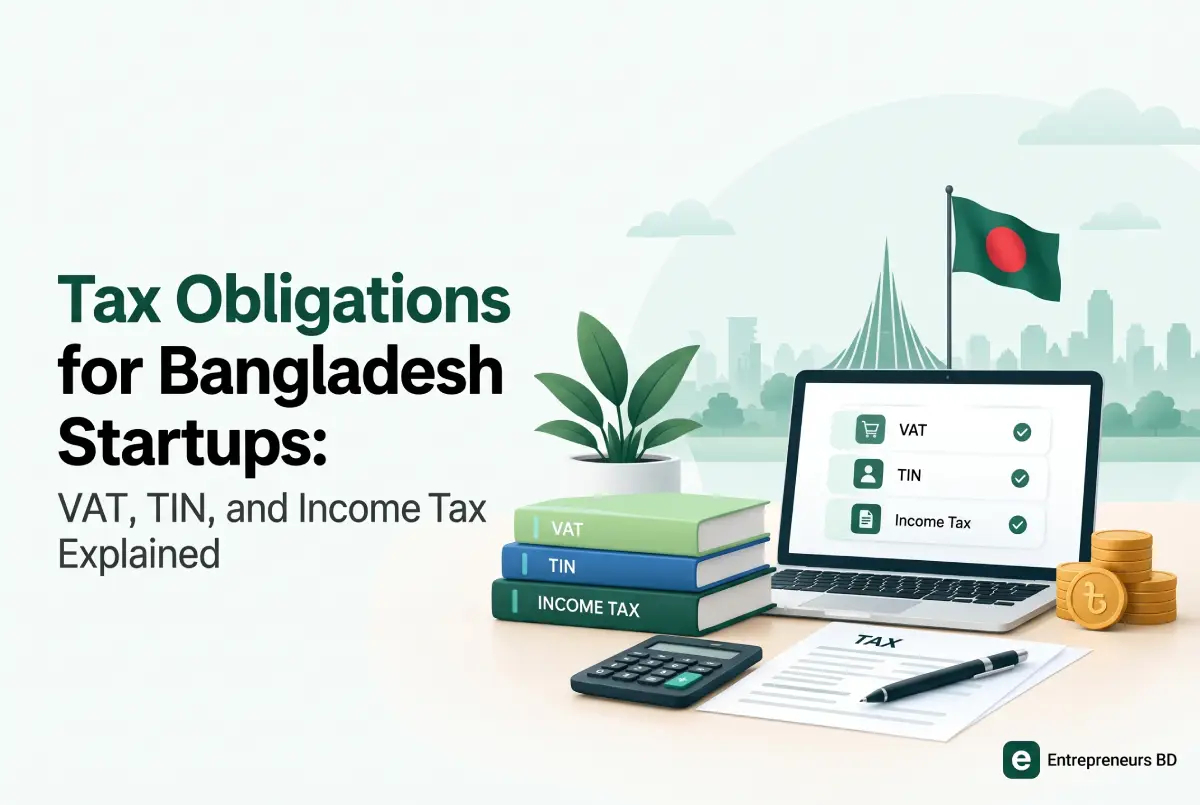
Tax Obligations for Bangladesh Startups: VAT, TIN, and Income Tax Explained
Every Bangladesh startup needs a TIN from the NBR to operate legally, and most crossing BDT 50 lakh in annual turnover must also register for VAT (BIN). Income tax then applies on top, either as personal tax for sole proprietors or corporate tax for registered companies.
Key Takeaways
A TIN is mandatory for almost every registered business activity in Bangladesh, regardless of size
VAT registration (BIN) is now required above BDT 50 lakh in annual turnover, down from the old BDT 3 crore threshold
Sole proprietors pay personal income tax on business profits, while companies pay a separate corporate tax rate
Missing VAT or income tax deadlines carries real penalties, not just paperwork delays
Getting tax structure right before your first sale saves far more time than fixing it later
Tax is usually the last thing on a founder's mind when launching a startup in Bangladesh. Product, customers, and cash flow take priority.
But tax obligations catch up fast. A missed TIN, a skipped VAT registration, or a misunderstood filing deadline can freeze a bank account or block a government tender bid.
This guide breaks down the three obligations every Bangladesh startup runs into: TIN, VAT, and income tax. It covers what each one actually requires, who needs to register, and what the current rules look like heading into the 2026 filing cycle.
TIN: The Starting Point for Every Startup
A Taxpayer Identification Number (TIN), issued through the National Board of Revenue's e-TIN system, is the foundation of tax compliance in Bangladesh.
You need a TIN to open a business bank account, apply for a trade license renewal, register a company, or file any tax return. Directors of a private limited company each need a personal TIN as well as one for the company itself.
Applying is free and done entirely online through the NBR e-TIN portal. You will need the following ready before you start:
National ID card (NID) or passport
A mobile number not already registered with the e-TIN system
Trade license, if you already have one
Certificate of Incorporation, for a registered company
Bank account details
Sole proprietors typically use their personal TIN for business filings. If you are still deciding on a legal structure, it's worth reviewing the options for sole proprietorship versus registering as a private limited company before applying.
Once issued, the certificate downloads instantly as a PDF. Keep it on file. Banks, landlords, and government offices will ask for it repeatedly.
VAT Registration: What Changed and Who Needs It
VAT is where most new founders get confused, partly because the rules shifted recently.
For years, the mandatory VAT registration threshold sat at BDT 3 crore in annual turnover. Businesses below that could often avoid formal VAT registration altogether.
That changed. The government lowered the mandatory registration threshold, a move confirmed by NBR leadership during VAT Week as part of a push to widen the tax base.
Annual Turnover | Registration Status |
|---|---|
Below BDT 50 lakh | Outside the formal VAT regime |
BDT 50 lakh to BDT 3 crore | Mandatory VAT registration (BIN) |
Above BDT 3 crore | Mandatory VAT registration (BIN), stricter reporting |
Any turnover, specific sectors | Mandatory regardless of size (importers, manufacturers, telecom, banking, digital services) |
In practice, this means far more small businesses and startups now fall inside the VAT net than a few years ago. If your revenue is approaching BDT 50 lakh, registration is no longer optional.
Registration happens through the VAT Online Portal, where you submit Mushak-2.1 with your TIN, bank details, and business documents. Approval typically takes a few working days, and there is no government fee.
Once registered, you receive a Business Identification Number (BIN) and must charge VAT, usually at the standard 15 percent rate, on taxable sales. You then file monthly returns and remit the difference between VAT collected and VAT paid on business purchases.
Even below the mandatory threshold, voluntary VAT registration is worth considering. It lets you claim input tax credit, and many corporate clients in Bangladesh will only work with VAT-registered vendors. This matters especially for anyone selling through an online store, where ecommerce regulations already require careful tax handling.
Income Tax: Personal vs Corporate
Income tax works differently depending on how your business is structured.
If you run a sole proprietorship, business profit is taxed as part of your personal income. For income year 2025-26, general taxpayers get a tax-free threshold of BDT 375,000. Women and senior citizens aged 65 and above get BDT 425,000.
Income above that threshold is taxed progressively across six slabs:
Income Slab (BDT) | Tax Rate |
|---|---|
First 375,000 | 0 percent |
Next 300,000 | 10 percent |
Next 400,000 | 15 percent |
Next 500,000 | 20 percent |
Next 2,000,000 | 25 percent |
Remaining income | 30 percent |
A minimum tax of BDT 5,000 applies once your income crosses the tax-free threshold, regardless of your calculated liability.
If you have registered a private limited company instead, the business pays corporate tax separately from your personal income, at a flat rate rather than progressive slabs.
Company Type | Corporate Tax Rate |
|---|---|
Non-listed private limited company | 27.5 percent |
Listed company, IPO conditions met | 20 percent |
This is one of the bigger decisions founders face early on, and it connects directly to the choice between a limited company structure and staying a sole proprietor. Corporate tax rates are often lower than the top personal slabs, but companies carry heavier compliance obligations, including audited financial statements.
The Income Tax Act, 2023 governs both regimes and replaced the older 1984 ordinance, so older guides referencing "the 1984 Ordinance" by name are describing an outdated legal basis.
Getting the Sequence Right in Bangladesh
Founders often try to handle these three obligations in the wrong order, or all at once, which creates avoidable friction.
The practical sequence looks like this:
Apply for a personal TIN, and a company TIN if you are registering a limited company
Complete business registration or trade licensing, tied to your business registration process
Register for VAT (BIN) once revenue nears BDT 50 lakh, or immediately if your sector requires it regardless of turnover
Set up basic bookkeeping through your business bank account from the first transaction
File income tax returns annually, and VAT returns monthly if registered
Income tax filing then becomes an annual rhythm rather than a one-time task. Many founders underestimate how much time proper bookkeeping saves here. Bank-channel transactions, kept invoices, and a simple ledger make the difference between a straightforward filing and a stressful one.
If you are still mapping out formation steps, a startup legal checklist alongside this tax sequence covers most of what a new founder needs before the first transaction.
Frequently Asked Questions
Do I need a TIN if my startup has no revenue yet?
What happens if I exceed the VAT threshold but don't register?
Can a startup register for VAT voluntarily before hitting the threshold?
Is the corporate tax rate always better than personal income tax?
How often do I need to file VAT returns once registered?
Where can I verify the latest tax rates before filing?
Building Tax Compliance Into Your Startup From Day One
Tax obligations are not a side task to handle once things get busy. They are part of the operating system of a legitimate business in Bangladesh.
Founders who treat TIN, VAT, and income tax as founding decisions, not afterthoughts, avoid the scramble that hits so many startups around their first filing deadline.
Start with the TIN application this week if you haven't already. Map out whether your projected turnover puts VAT registration on your near-term horizon. And build a simple habit of tracking income and expenses through your bank from the very first transaction.
None of this requires an accounting background. It requires starting early, staying organized, and treating the NBR's deadlines with the same seriousness you'd give a client deadline.

Specializing in SaaS product marketing, SEO strategy, Content marketing, TikTok advertising, PPC, and digital growth.
View Full Profile & ContributionsRelated Articles
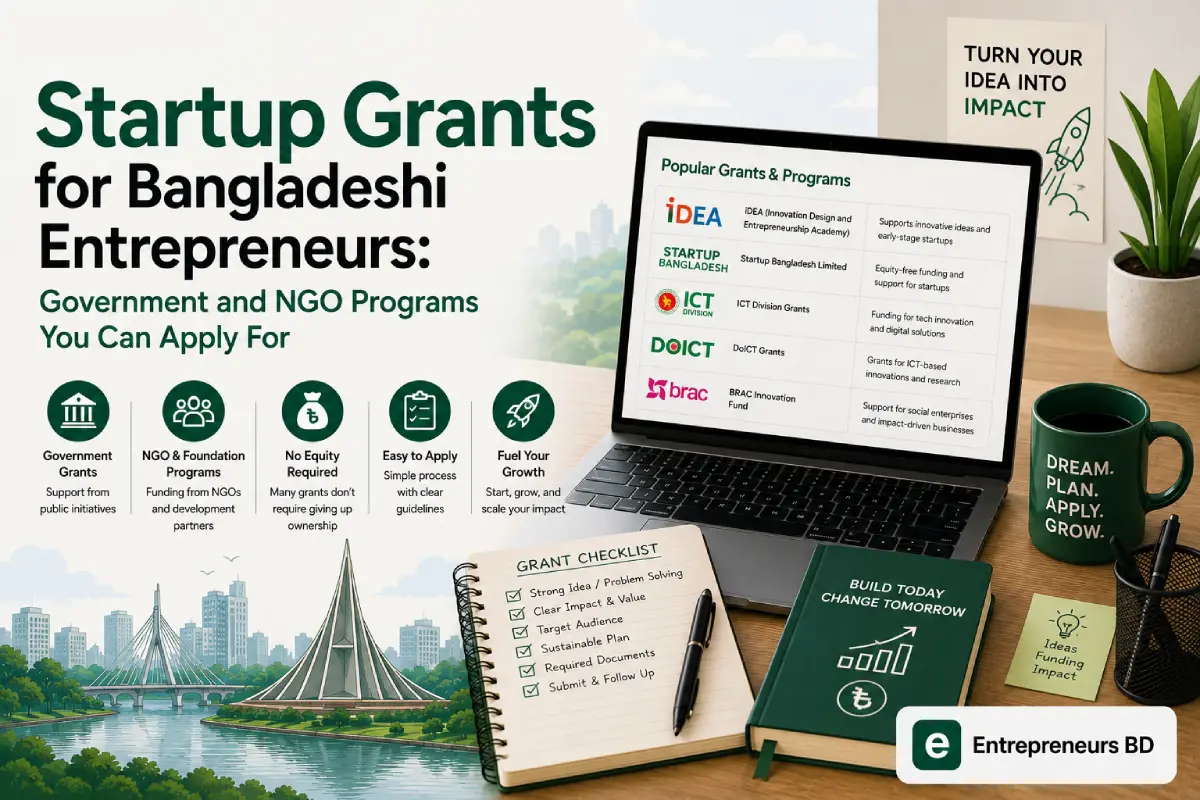
Startup Grants for Bangladeshi Entrepreneurs: Government and NGO Programs You Can Apply For
Bangladeshi entrepreneurs can apply for grants and low-cost financing through the ICT Division's iDEA project (up to BDT 10 lakh), SME Foundation's Credit Wholesaling Program, and Bangladesh Bank's refinance schemes for women and new entrepreneurs. Most require a trade license, a clear business plan, and an online application.

Fintech in Bangladesh: Key Players, Regulations, and Opportunities for Founders
For the payment and digital-finance businesses covered here, four regulated models matter most: MFS, PSP, PSO and digital banking. MFS requires a bank, financial institution or government entity to hold at least 51% of the provider and control its board. PSPs don't carry that requirement. PSOs run payment infrastructure and can't issue e-money. Digital banks are licensed under the Bank Company Act and now require Tk 300 crore in paid-up capital.

Angel Investors in Bangladesh: Who They Are and How to Reach Them
Angel investors in Bangladesh are individuals, family offices, and diaspora professionals who fund early-stage startups in exchange for equity. Most operate through organized networks like Bangladesh Angels Network (BAN) and Bangladesh Women Investors Network (BWIN), which vet founders, run pitch sessions, and syndicate deals among members.
Comments (0)
No comments yet. Be the first to share your thoughts!