How to Start a Business in Bangladesh: Complete Step-by-Step Guide
Quick Answer: To start a business in Bangladesh, choose a legal structure (sole proprietorship, partnership, or private limited company), register with RJSC or your local authority, obtain a trade license from the city corporation or union parishad, get a TIN from the NBR, and register for VAT if your turnover exceeds the threshold. The full process typically takes 2–6 weeks, depending on your business type.
Key Takeaways
Sole proprietorships are the fastest and cheapest structure to register, the right choice for solo founders testing a business idea
Private limited companies offer liability protection and are preferred by investors, essential if you plan to raise funding
A trade license is mandatory for every business operating in Bangladesh, regardless of structure
TIN registration is free, done online via the NBR portal, and required before you can open a business bank account
Most new businesses in Bangladesh can be fully legal and operational within 30 days if paperwork is prepared in advance
Starting a business in Bangladesh is more straightforward than most first-time founders expect, but only if you know the actual steps. The confusion usually comes from conflating different processes: registration, licensing, and tax enrollment are three separate things, each handled by a different authority.
Bangladesh has a growing startup ecosystem, with a significant rise in new business formations driven by eCommerce growth, a young population, and expanding digital infrastructure.
According to the Bangladesh Investment Development Authority (BIDA), the country registered a significant rise in new business formations over the past several years, driven by eCommerce growth, a young population, and expanding digital infrastructure.
This guide covers every practical step, from choosing the right legal structure to getting your business bank account open.
It is written for first-time founders in Bangladesh who want accurate, actionable information without the legal jargon. By the end, you will know exactly what to do, in what order, and what each step costs.
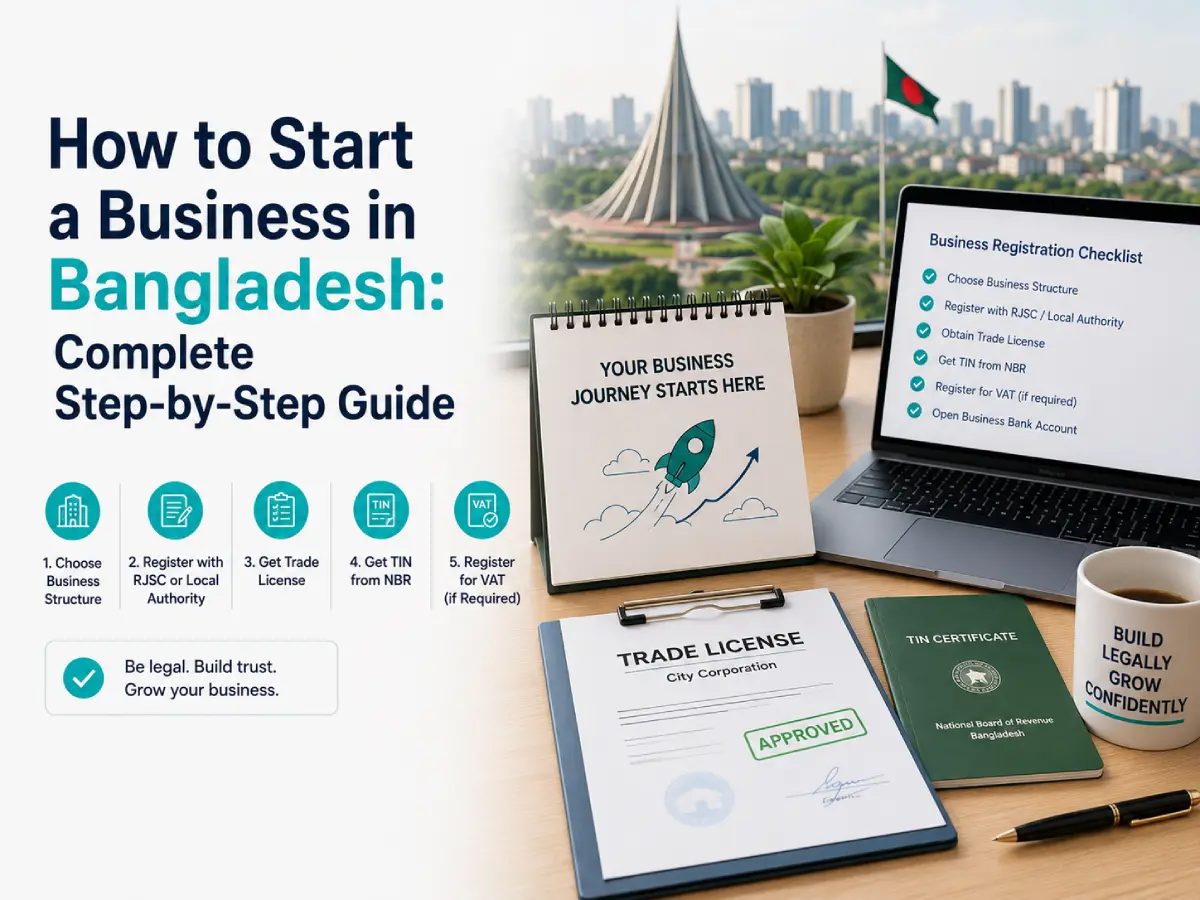
Step 1: Choose Your Legal Business Structure
The structure you choose determines your liability, tax obligations, and how easily you can bring in investors later. In Bangladesh, most small businesses fall into one of three categories.
Sole Proprietorship
The simplest structure. You are the business; there is no legal separation between you and the company. If you're considering this option, read our complete guide to sole proprietorship in Bangladesh. Registration is done at the local City Corporation or Union Parishad when you apply for your trade license.
Best for: Freelancers, small retailers, individual service providers, and anyone testing an idea with low capital.
Downside: You carry unlimited personal liability. If the business owes money, your personal assets are at risk.
Partnership
Two or more people sharing ownership. Before registering with a partner, it's worth putting a co-founder agreement in place to avoid future disputes. A partnership deed must be drafted and, while not mandatory, should be registered with the Registrar of Joint Stock Companies and Firms (RJSC) to be legally enforceable.
Best for: Two co-founders with equal contributions who want a simple structure without corporate formalities.
Downside: Partners share liability. Disputes without a proper deed get messy fast.
Private Limited Company (Ltd.)
A separate legal entity from its owners. If you're leaning toward incorporation, our detailed guide on private limited companies in Bangladesh explains the process in greater depth. Shareholders are only liable up to their share investment. This is the preferred structure for startups seeking investment or planning to scale.
Best for startups expecting to raise capital, hire a team, or scale their startup in Bangladesh over the coming years.
Requires: Minimum 2 shareholders, minimum 2 directors, a registered office address in Bangladesh, and a memorandum and articles of association.
Step 2: Register with RJSC (For Companies and Partnerships)
The Registrar of Joint Stock Companies and Firms (RJSC) handles all company and partnership registrations in Bangladesh. Sole proprietors skip this step; their registration happens via the trade license.
How to Register a Private Limited Company with RJSC
1. Name clearance: Apply for name clearance through the RJSC online portal (roc.gov.bd). Submit 3–5 name options. Clearance typically takes 1–3 working days and costs BDT 200–500.
2. Prepare your incorporation documents
Memorandum of Association (MoA)
Articles of Association (AoA)
Form I (Declaration on Registration)
Form VI (Notice of Registered Office)
Form IX (Consent of Directors)
Form X (List of Persons Consenting to be Directors)
Form XII (Particulars of Directors)
These documents must be prepared carefully. They also form an important part of your broader startup legal checklist before launching. Most founders hire a lawyer or company secretarial firm for this step; fees range from BDT 10,000 to 40,000, depending on the firm.
3. Pay stamp duty and filing fees: Stamp duty is calculated on your authorized capital. Filing fees are set by the RJSC. Pay through the designated bank (Sonali Bank is the most common payment channel for RJSC fees).
4. Submit and collect Certificate of Incorporation: Once RJSC approves your application, you will receive a Certificate of Incorporation. Processing time: 7–15 working days after complete document submission.
Total estimated cost for private limited company registration: BDT 15,000–60,000 (including professional fees, stamp duty, and government charges, depending on authorized capital).
Step 3: Obtain a Trade License
A trade license is mandatory for every business in Bangladesh, whether a sole proprietor, a partnership, or a company. It is issued by the local government authority where your business physically operates.
Issuing authorities:
Dhaka North City Corporation (DNCC) or Dhaka South City Corporation (DSCC) for businesses in Dhaka
Chittagong City Corporation for Chittagong
Other city corporations and pourashavas for divisional towns
Union Parishad for rural areas
Documents Required for Trade License
National ID (NID) of the proprietor/director
Passport-size photographs
Proof of business address (rental agreement or ownership documents)
RJSC Certificate of Incorporation (for companies)
Memorandum of Association (for companies)
Fire license (for some business categories)
TIN certificate (some authorities require this upfront)
Process and Cost
Submit your application to the relevant city corporation ward office. Trade license fees vary significantly by business category and location. In Dhaka, annual fees range from BDT 1,000 to BDT 50,000+, depending on your business type and turnover bracket.
Processing time: 3–10 working days. Trade licenses must be renewed annually.
Step 4: Register for TIN (Tax Identification Number)
TIN registration is handled by the National Board of Revenue (NBR). It is free of cost and can be done entirely online at etaxnbr.gov.bd.
You need a TIN to:
Open a business bank account
Apply for government tenders
Import or export goods
Submit income tax returns
Required for online TIN registration:
NID number
Mobile number registered to your NID
Business address
TIN is issued immediately upon successful online application. Print your TIN certificate from the portal.
Step 5: Register for VAT (If Required)
VAT registration is mandatory if your annual turnover exceeds BDT 50 lakh (5 million). If you are below this threshold, VAT registration is optional but can be beneficial in B2B contexts where clients require VAT invoices.
VAT registration is done through the NBR's VAT Online portal (vat.gov.bd). You will need your TIN, trade license, and business bank account details.
Once registered, you receive a Business Identification Number (BIN), your VAT registration number. File VAT returns monthly using Mushak forms.
Step 6: Open a Business Bank Account
A dedicated business bank account separates your personal and business finances, essential for tax compliance, investor relations, and professional credibility.
Documents typically required:
Trade license
TIN certificate
Certificate of Incorporation (for companies)
MoA and AoA (for companies)
NID of all directors/proprietors
Passport-size photographs
Board resolution authorizing account opening (for companies)
Recommended banks for SMEs and startups in Bangladesh: Dutch-Bangla Bank, BRAC Bank, Eastern Bank, and Mutual Trust Bank are known for responsive SME services. Some offer dedicated startup account types with lower minimum balance requirements.
Processing time: 3 - 7 working days after document submission.
Step 7: Sector-Specific Licenses and Permits
Depending on your business type, you may need additional approvals beyond the trade license. Common ones include:
Business Type
Additional License Required
Issuing Authority
Food & restaurant
Food safety license
BSTI / local authority
Pharmacy/medicine
Drug license
Directorate General of Drug Administration
Education/coaching
Registration/approval
Ministry of Education
Financial services
License
Bangladesh Bank / BSEC
Import/export
IRC / ERC
Office of the Chief Controller of Imports and Exports
Garments/manufacturing
Factory license
Department of Inspection for Factories
Check with the relevant regulatory authority before launching if your business falls into any regulated sector.
What Starting a Business in Bangladesh Actually Costs
Here is a realistic cost breakdown for the two most common setups:
Sole Proprietorship (Dhaka-based service business)
Trade license: BDT 2,000–8,000
TIN registration: Free
Miscellaneous (notarization, photocopies, transport): BDT 1,000–2,000
Total: BDT 3,000–10,000
Private Limited Company (Dhaka, BDT 1 crore authorized capital)
RJSC name clearance + filing fees: BDT 5,000–10,000
Stamp duty (varies by authorized capital): BDT 5,000–20,000
Professional/legal fees: BDT 10,000–30,000
Trade license: BDT 3,000–15,000
Bank account opening: Free to BDT 5,000 minimum balance
Total: BDT 23,000–75,000
Common Mistakes First-Time Founders Make in Bangladesh
Choosing the wrong structure: Many founders register a sole proprietorship because it is cheaper, then realize they cannot raise investment without re-registering as a company. Think one step ahead.
Using a residential address without checking the bylaws: Some city corporations restrict commercial trade licenses at residential addresses. Confirm before applying.
Skipping the partnership deed: Verbal agreements between co-founders collapse under pressure. A properly drafted and notarized deed is worth every taka.
Ignoring annual renewal: A trade license must be renewed every year. Operating on an expired license is a legal violation and can result in fines.
Mixing personal and business finances: Using your personal account for business transactions creates tax headaches and looks unprofessional to investors and clients.
Your First 90 Days: A Practical Checklist
Days 1–15: Legal foundation
Decide business structure
Apply for RJSC name clearance (if company)
Prepare MoA and AoA with legal help (if company)
Register with RJSC (if company or partnership)
Days 15–30: Licensing and tax
Apply for a trade license at the city corporation/union parishad
Complete TIN registration online (NBR portal)
Assess VAT registration requirement
Days 30–60: Financial setup
Open a business bank account
Set up basic bookkeeping (spreadsheet or accounting software)
Register for VAT if required
Days 60–90: Operations
Check sector-specific license requirements
Set up invoicing and payment collection
Consult a chartered accountant for your first-year tax planning
Frequently Asked Questions
How long does it take to start a business in Bangladesh?
Can a foreigner start a business in Bangladesh?
What is the minimum capital required to register a company in Bangladesh?
Do I need a lawyer to register a company in Bangladesh?
Is it possible to run a business from home in Bangladesh?
What taxes does a new business in Bangladesh have to pay?
The Honest Reality of Starting a Business in Bangladesh
The registration process in Bangladesh is manageable, but it requires preparation. Most founders who struggle do so because they underestimate the paperwork or try to cut corners on professional help for the RJSC process.
The bigger challenge comes after registration: building a customer base, managing cash flow, and staying compliant year after year. If you're just getting started, our guide on customer acquisition in Bangladesh is a good next step. Getting legal is the starting line, not the finish line.
If you are still deciding between structures, start with the end in mind. Your choice should reflect the business model you're building, not just today's costs. Where do you want this business to be in three years? If the answer involves investors, partnerships, or significant scale, register a private limited company from day one.
The extra BDT 20,000–50,000 in setup costs now will save you the far greater cost and disruption of re-registering later.
The entrepreneurs who build lasting businesses in Bangladesh are not necessarily the ones with the best ideas - they're the ones who develop the right entrepreneurial mindset and execute consistently. They are the ones who set the right foundation early and execute with discipline from there.
Get your legal structure right, keep your accounts clean, renew your licenses on time, and stay focused on delivering real value to your customers. That is the foundation everything else builds on.

Specializing in SaaS product marketing, SEO strategy, Content marketing, TikTok advertising, PPC, and digital growth.
View Full Profile & ContributionsRelated Articles
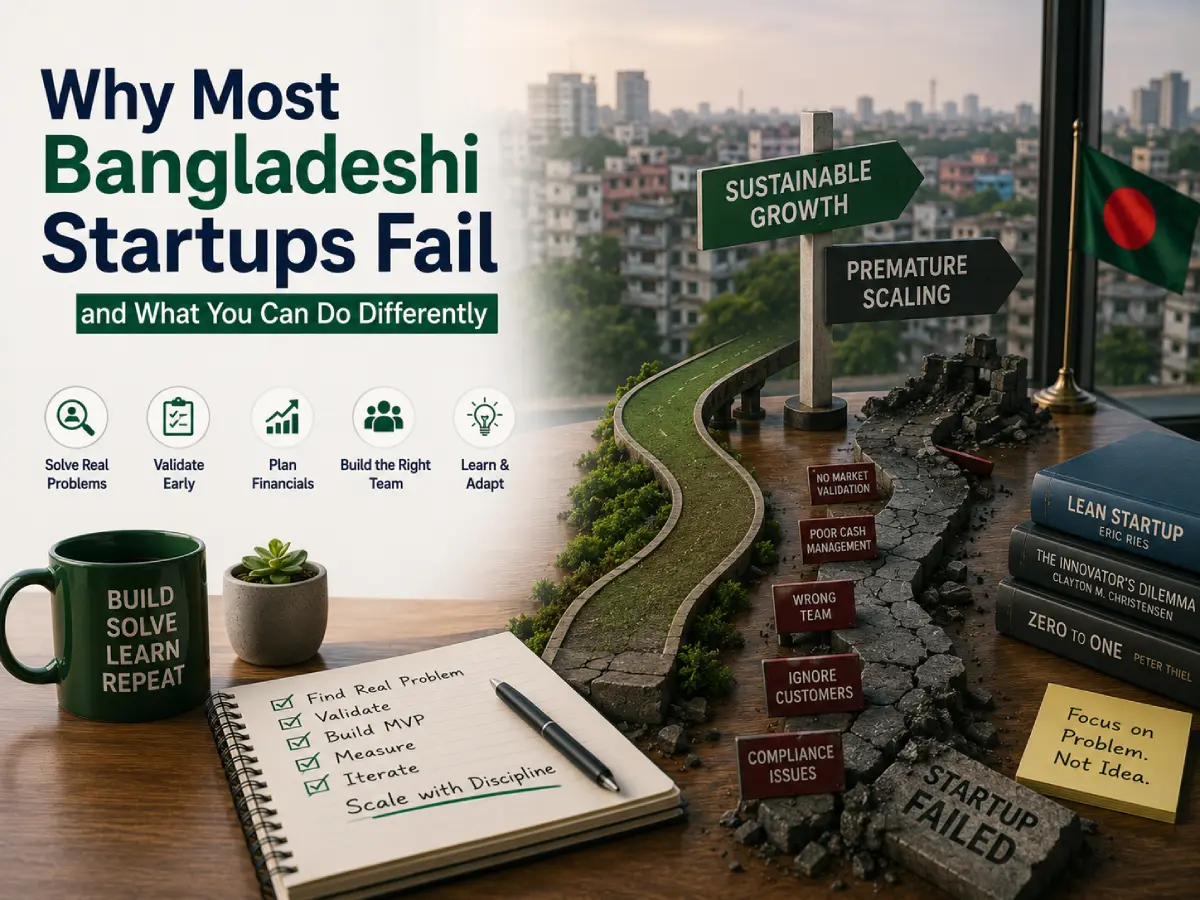
Why Most Bangladeshi Startups Fail — and What You Can Do Differently
Quick Answer: Most Bangladeshi startups fail because of poor market validation, weak financial planning, and founder-market mismatch, not lack of ideas or effort. The founders who survive focus on solving real problems, build lean, and learn from their market before scaling.
Customer Acquisition Strategies That Work for Bangladesh Startups
Quick Answer: The most effective customer acquisition strategies for Bangladesh startups combine low-cost digital channels (Facebook, WhatsApp Business, SEO), mobile financial service integration for frictionless payment, referral-driven growth, and hyperlocal targeting. Startups that blend paid acquisition with retention-focused tactics see the lowest long-term cost per customer.

Business Model Canvas Explained with Bangladesh Startup Examples
Quick Answer: The Business Model Canvas (BMC) is a one-page strategic framework with 9 building blocks: Customer Segments, Value Propositions, Channels, Customer Relationships, Revenue Streams, Key Resources, Key Activities, Key Partnerships, and Cost Structure. It helps founders map, test, and communicate their entire business model before writing a single page of a business plan.
Comments (0)
No comments yet. Be the first to share your thoughts!