What Bangladesh Startups Should Outsource and What to Keep In-House
Key Takeaways
Keep under internal control whatever customers would notice if it got worse: product knowledge, customer insight, and pricing.
Outsource work that is specialist, occasional, or easy to measure from outside, such as bookkeeping and design.
Outsourcing a task never outsources accountability; one named person inside should own every vendor.
Many company payments to resident service providers require tax deduction at source, at rates that depend on the service and the payee.
In Bangladesh, a large freelance and IT-services workforce makes outsourcing easy to start, but founder time spent managing vendors is a real cost.
As a startup grows, founders often find themselves juggling product development, bookkeeping, marketing, compliance, and operations at the same time. Hiring for every gap is rarely affordable, so startup outsourcing in Bangladesh quickly becomes a practical question rather than a theoretical one.
The risk is deciding what to hand off based on price alone. A freelance designer costs less than a salary, so design goes out. A software house quotes a fixed fee, so the whole app goes out. Over time, too much outsourcing can leave a startup dependent on vendors for knowledge and decisions it should hold itself.
If you are bootstrapping a Bangladeshi startup, the goal is to buy speed without giving up control. This guide gives you a decision framework, a function-by-function view of what to keep and what to hand off, the FY 2026-27 tax and VAT points that affect vendor payments, the contract, data protection, and security basics, and a step-by-step process for setting up vendors properly.
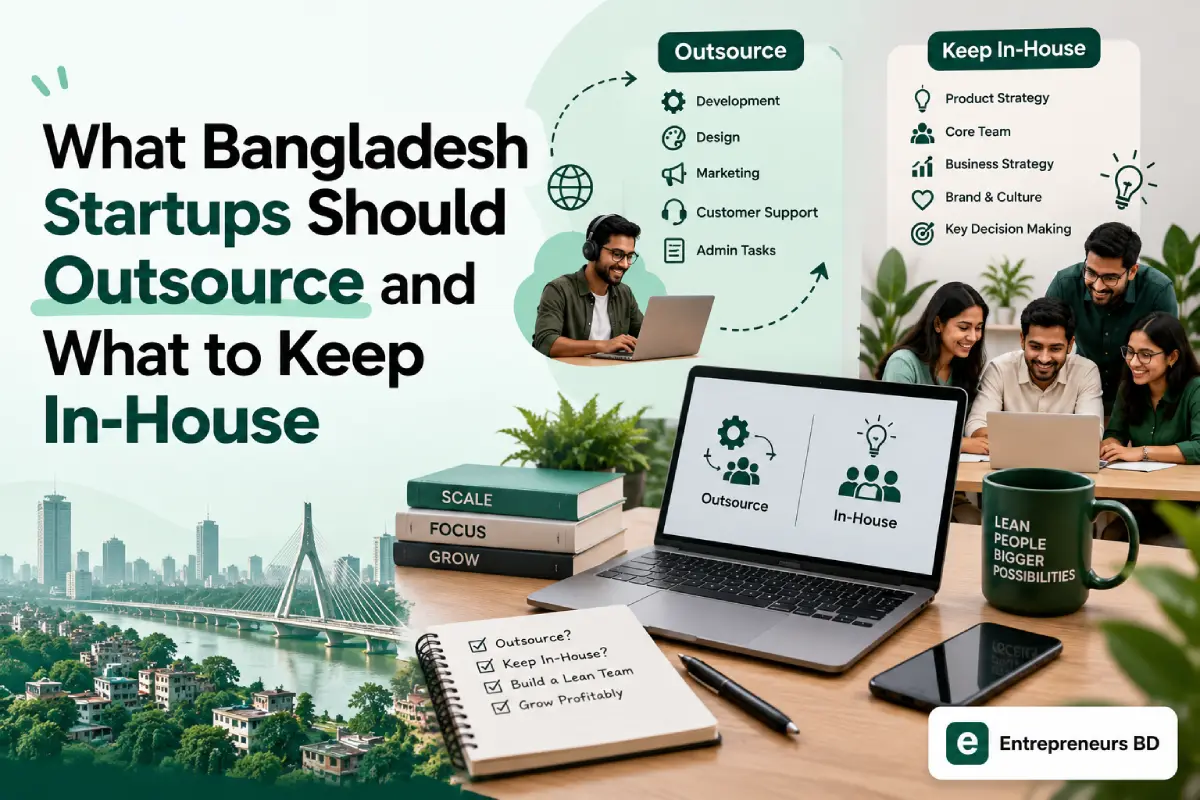
A Six-Question Framework for Startup Outsourcing in Bangladesh
Before outsourcing any function, run it through six questions. None of them decides the case alone, but together they show whether a task belongs inside or outside the company.
Is it a competitive advantage? If customers choose you because of it, keep it close.
Does it involve sensitive data or intellectual property? Customer records, payroll, source code, and credentials raise the bar for any vendor.
How often do you need it? Daily, core work often justifies a hire. Occasional or seasonal work usually does not.
Can you judge the output? If you cannot tell good work from bad, you will not notice a weak vendor until damage is done.
How hard would it be to switch vendors? Work that locks in knowledge, accounts, or code with one provider carries dependency risk.
Does it carry regulatory or operational risk? Tax filings, company records, and payment systems need tight oversight even when someone else does the work.
The first and fourth questions give a quick starting point:
Is it your edge? | Can you judge the output? | Starting point |
|---|---|---|
Yes | Yes | Keep in-house; use outside help for overflow |
Yes | No | Keep in-house and build the skill |
No | Yes | Outsource with a clear brief and regular review |
No | No | Outsource cautiously to a reputable specialist |
Then check questions two, three, five, and six before deciding. The fourth question is especially important for functions where poor quality is hard for a founder to spot, such as accounting or security.
What Founders Should Usually Keep Under Internal Control
Keep close the functions that hold your advantage, your customer trust, or your future options. What that means depends on the business, but for many startups it includes the areas below.
Core product knowledge
Your startup should retain enough internal technical knowledge to understand and control the codebase, architecture, infrastructure, and release process. Outside developers can do much of the building, but someone on your side should own the repository, review changes, and be able to brief a new vendor if the current one leaves.
The same logic applies outside tech. A food brand protects its recipes and supplier relationships. A logistics startup protects its routing logic and delivery data.
Customer insight
Early customers reveal what the product is missing faster than any report. Whoever handles support, the team should stay close to that feedback, because it is the raw material for reaching product-market fit. That can mean founders answering some tickets, reviewing support logs weekly, or calling customers directly.
Pricing and financial decisions
Bookkeeping can go to an outside firm. Decisions about price, credit terms to distributors, and how much runway to keep should stay with the founders, because they shape survival and a vendor's incentives are not the same as yours.
Final hiring decisions
Recruitment agencies and job boards can source and screen candidates. The final interview, the offer, and onboarding are where early culture is set, so founders should stay involved.
Positioning
An agency can design a logo and run campaigns. It should not decide what your company stands for. Document your positioning internally, in the language your customers use, before you brief anyone outside.
What to Outsource Without Losing Control
Work that is specialist, occasional, or easy to measure is often a good candidate for outsourcing. These functions rarely set a startup apart, and a professional may do them better than a stretched founder.
A quick note on terms. "Outsourcing" here means paying an outside person or firm to do work: a freelancer, an agency or software house, an accounting firm, a company secretary, a courier, or a manpower contractor. Each relationship can carry different tax, labour-law, and intellectual property implications. Subscribing to software such as an accounting or design tool is different: you still do the work, and the main risks are data access and lock-in.
Function | Typical vendor type | Control to keep |
|---|---|---|
Bookkeeping and tax preparation | Accounting firm or part-time accountant | Monthly statements, copies of every return and payment challan |
Company filings and legal drafting | Corporate lawyer or company secretary | Originals of filed documents and a calendar of deadlines |
Graphic and UI design | Freelancers or small studios | Editable source files and written transfer of rights |
Ad execution | Performance marketing agency | Company-owned business and ad accounts, with the agency added under a limited role |
Last-mile delivery | Third-party courier services | Weekly tracking of failed deliveries and returns |
Payroll processing | Accounting firm or HR software | Proof that tax deducted from salaries was deposited |
Hosting and IT support | Managed hosting or IT service firm | Domains and cloud accounts registered to the company, separate user logins, MFA, and recovery details the company controls |
Tax preparation and filing can be outsourced, but the company remains responsible for compliance. Keep access to every return, acknowledgement, and deadline yourself.
Company filings are another strong case for professional help. Annual returns tied to the AGM, and records such as share-transfer documentation, follow formal Companies Act and RJSC requirements, and defaults can attract penalties. Our guide to RJSC filings for startups covers what a company secretary typically handles.
Delivery is a third. Building a rider fleet only makes sense at serious order density, so many early e-commerce businesses find third-party couriers more practical. Services such as Pathao Courier are examples of delivery infrastructure a startup can evaluate before deciding.
The pattern in the right-hand column matters. Every outsourced function comes with something the company should keep in its own name: files, accounts, records, or recovery access. That approach reduces the risk of disputes over access, ownership, and handover later.
The Grey Zone: Decisions That Change With Your Stage
Some functions have no permanent answer. The right call before revenue can be the wrong call once the business scales.
Software development
At the idea stage, outsourcing a prototype to a software house can be sensible. Early prototypes often prioritise learning and speed over production-grade architecture, which is the point of a minimum viable product. As the product becomes the business, the priority shifts to retaining technical control. Many companies combine an internal technical lead with outside developers, QA, or DevOps specialists, provided the company owns the code and documentation.
Marketing
Before hiring an agency, it helps to run some campaigns yourself or study your own results closely. You need enough firsthand experience to understand your own acquisition economics, such as cost per customer and conversion rate, before you can judge an agency's numbers. After that, specialists can handle execution while strategy, budget, and messaging stay inside.
Customer support
In the early stage, the team should stay close to customer problems. Once ticket volume grows and common questions are documented, a trained outside team can often handle first-line queries. Escalations, refunds, and complaint analysis are usually worth keeping with your own staff.
Sales and distribution
For FMCG and some B2B products, outside distributors can give you reach faster than building your own network, although some companies choose direct distribution. Either way, keep key accounts, pricing approval, and sales data in your own hands, so that losing a distributor does not mean losing the market.
Tax, VAT, and Labour Rules That Affect Vendor Payments in 2026
The vendor's quote is rarely the full cost. This section is a general overview for FY 2026-27, not tax or legal advice. Rates change through finance acts and SROs, so confirm the treatment of each payment with a qualified adviser before you pay. For the wider picture, see our guide to tax for startups.
Tax deducted at source (TDS) on vendor payments
The Income Tax Act 2023 requires companies and other specified payers to deduct tax at source from many payments to resident contractors, suppliers, and service providers. Section 89 covers contracts and supplies, Section 90 covers services, and the rates sit in the withholding rules. Whether withholding applies depends on the type of payment, the payer, the payee, and any exemption.
For services startups commonly outsource, the FY 2026-27 rates summarised by PwC's Bangladesh tax summary (last reviewed 31 July 2026) are:
Service paid for | Payee is an individual | Payee is a firm or company |
|---|---|---|
Advisory, consultancy, or professional services (accountant, lawyer, consultant) | 15% | 7.5% |
Technical services or technical assistance | 15% | 10% |
Courier, event management, training management, public relations | 2% of gross bill | 2% of gross bill |
Manpower supply, creative media, cleaning, security, media agency | 10% of commission or 1% of gross bill, whichever is higher where both are stated | Same |
Internet service | 5% | 5% |
Advertising paid directly to newspapers, TV, radio, or similar media | 5% | 5% |
Any other service not covered elsewhere | 10% | 10% |
Three details catch startups out. The applicable rate rises by 50% if a resident payee does not give you proof of submission of their tax return (PSR). Some software and IT-enabled service income is tax-exempt, and payments for it can carry nil withholding, so ask such vendors for evidence of their exemption. And a freelance designer or developer may fall under different rows depending on how the work is contracted, which is why classification needs an adviser's check.
Compliance involves more than deducting a percentage:
Decide whether withholding applies and under which section.
Calculate the amount on the correct base and rate.
Deduct it when paying the vendor.
Deposit it and report it in the withholding return. PwC notes these returns are now filed quarterly, by the 25th of the month after each quarter.
Issue the required certificate to the vendor.
Keep invoices, challans, and certificates on file.
Failing to comply with withholding requirements can result in the related expenditure being disallowed for tax purposes, and can also create additional tax, interest, or penalty exposure. Agree in writing whether each quote includes or excludes withholding.
VAT deduction at source (VDS)
VAT deduction at source (VDS) does not apply to every VAT-registered business. Bangladesh's VAT law defines specific categories of "withholding entity", which include bodies such as government organisations, banks, insurers and other financial institutions, NGOs, and certain companies and educational institutions. A startup should confirm whether it falls within that definition before applying VDS. The procedures are set out in the VAT and SD Rules, now published in an official English text, and rates differ by service code.
Paying vendors outside Bangladesh
Everything above concerns resident vendors. Paying a foreign freelancer, agency, or software provider needs separate analysis: non-resident withholding rates are different and often higher (the same PwC summary lists 10% for digital marketing and advertisement making, and 20% for payments not covered elsewhere), VAT can apply to imported services, and remittances must go through banking channels under foreign exchange rules. Check with your bank and tax adviser before signing a foreign contract.
Contract workers and labour law
Outsourcing does not remove the need to check labour-law compliance. The Bangladesh Labour Act contains specific provisions on contracting agencies and the workers they supply, and a principal may carry certain statutory responsibilities depending on the circumstances. Similarly, calling someone a freelancer does not by itself settle their legal status. Where a working arrangement closely resembles employment, take legal advice rather than relying on the label in the contract.
The hidden cost: founder time
Every vendor needs briefing, feedback, and follow-up. For example, if five vendors each need two hours of management a week, that is about 10 hours of founder time every week. Include that time when comparing outsourcing with hiring.
How Bangladeshi Companies Draw the Line
Local companies show both sides of the decision.
Online grocer Chaldal keeps fulfilment close. Its customer help page states that it holds its own inventory in its warehouses and delivers with its own fleet. One reasonable reading is that when fast, reliable delivery is central to the customer promise, there is a strong case for controlling it directly.
The opposite case is a young online fashion or cosmetics brand whose edge is product selection and brand rather than logistics. For a business like that, plugging into existing courier networks can make more sense than financing a fleet.
Bangladesh also has an established software and IT-enabled services industry. BIDA's IT sector profile describes the country as a destination for offshore development and BPO work. Companies such as Brain Station 23, founded in 2006, now run delivery centres in Bangladesh and several other countries. For startups, this means access to local agencies and technical teams that serve both domestic and international clients.
Vendor capability still varies. BIDA itself notes that many smaller BPO firms lack international certifications for software process and information security. Because quality can vary, use references from other founders, paid trials, and clearly defined deliverables when selecting any vendor.
Protecting Your IP, Data, and Accounts
Ownership, data, and access are common sources of vendor disputes, so they deserve more than a single clause.
Intellectual property
For software, design, and content vendors, the written agreement should cover:
Ownership of deliverables, including source code and editable design files
Pre-existing material the vendor reuses, and the licence you receive for it
Third-party and open-source components, and their licence terms
Whether the vendor may show the work in its portfolio
Handover obligations on completion or termination, including documentation
Data protection and confidentiality
Outsourced support, payroll, accounting, marketing, and development often expose customer data, employee records, financial information, and source code. Give each vendor access only to the data it needs. Agree in writing how the data may be used and stored, how long it is kept, how it is returned or deleted at the end, and how the vendor must report a breach.
This now has a legal dimension. The 2025 data protection ordinance became the Personal Data Protection Act on 15 April 2026, Bangladesh's first comprehensive data protection law. It gives people rights over their personal data, requires consent before collection, and introduces penalties for violations. If your startup collects customer or employee data, expect to answer for how vendors handle the data you share with them, and have a lawyer confirm what the Act requires of your business.
Account ownership and access
Register domains, hosting, cloud services, social media pages, and ad accounts to the company, with company-controlled billing and recovery email and phone numbers. Keep at least two trusted internal admins. Give vendors their own user accounts with the narrowest role that lets them do the job, require multi-factor authentication (MFA), store shared credentials in a password manager, and remove access the day a contract ends.
Vendor dependency
Relying on a single vendor for a critical function creates concentration risk. Keep documentation current, identify a backup provider, set a reasonable notice period in the contract, and agree a transition plan covering data, code, and account handover.
A Five-Step Process for Your First Outsourcing Decisions
Use this sequence each time you consider handing work outside. It gives you a repeatable process and can reduce the risk of costly vendor problems later.
List your recurring tasks for one month. Note who does each one and roughly how many hours it takes. Many founders find a few tasks taking far more time than expected.
Run each task through the six questions. Mark it keep, outsource, or grey zone. Be honest about tasks you simply dislike versus tasks that are genuinely not your edge.
Name an internal owner for every outsourced task. This person writes the brief, reviews the output, approves payment, and checks tax deductions. No owner means no outsourcing.
Start with a paid trial and a written agreement. Give the vendor a small, real piece of work. Put scope, deliverables, timelines, payment terms, tax treatment, confidentiality, data handling, IP ownership, account access, and handover in writing.
Review vendors on a schedule that matches their importance. Quarterly reviews are a practical default for important ongoing vendors; security-critical ones may need closer monitoring. Compare cost, quality, and the founder time each one absorbs.
A regular review gives you evidence for deciding whether to keep outsourcing a function or hire for it. When you do switch, use the transition plan from your contract so data, code, and accounts move cleanly.
Frequently Asked Questions
Is outsourcing cheaper than hiring for a Bangladeshi startup?
Should a Bangladeshi tech startup outsource its app development?
Do I need to deduct tax when paying a freelancer or agency in Bangladesh?
What should founders usually keep under internal control?
How do I protect my startup when working with outside vendors?
When should a startup bring outsourced work back in-house?
Buy Hands, Keep the Head
Good outsourcing decisions in Bangladesh come down to one idea: you can rent skills, but you should not hand over judgment. Accountants, designers, couriers, and agencies can do excellent work, and many care about their clients' results. Their incentives, though, are never quite the same as a founder's.
So keep control of the parts of the business that decide whether it survives: product knowledge, customer insight, pricing, final hiring, and positioning. Many non-core functions can be outsourced when the startup retains appropriate oversight, access, documentation, and accountability, and when the company owns the files, accounts, code, and data.
Bangladesh gives founders useful options here. An established software-services industry, a large freelance and IT-services workforce, and expanding courier networks are all within reach. Outsourcing works best when it is run as a managed system: written agreements, correct TDS and VDS handling, careful treatment of personal data, company-controlled accounts, and regular reviews.
This week, list your recurring tasks, run them through the six questions, and pick one function to hand off properly, with an owner, a written scope, and a review date. Then check the result at that review.

Specializing in SaaS product marketing, SEO strategy, Content marketing, TikTok advertising, PPC, and digital growth.
View Full Profile & ContributionsRelated Articles

Why Most Bangladeshi Startups Fail — and What You Can Do Differently
Quick Answer: Most Bangladeshi startups fail because of poor market validation, weak financial planning, and founder-market mismatch, not lack of ideas or effort. The founders who survive focus on solving real problems, build lean, and learn from their market before scaling.

Customer Acquisition Strategies That Work for Bangladesh Startups
Quick Answer: The most effective customer acquisition strategies for Bangladesh startups combine low-cost digital channels (Facebook, WhatsApp Business, SEO), mobile financial service integration for frictionless payment, referral-driven growth, and hyperlocal targeting. Startups that blend paid acquisition with retention-focused tactics see the lowest long-term cost per customer.

How to Start an Export Business in Bangladesh: Compliance, Buyers, and Logistics
To start an export business in Bangladesh, set up your business with a trade license and tax registration, open a bank account with an authorized dealer bank, and get an ERC from CCI&E. Then confirm your HS code, BIN and product permits, check the buyer's import rules, agree payment terms, and repatriate proceeds within four months.
Comments (0)
No comments yet. Be the first to share your thoughts!