What Is an MVP? How Bangladeshi Founders Can Build One on a Budget
Quick Answer: An MVP (Minimum Viable Product) is the simplest version of your product that solves a real problem for real users. For Bangladeshi founders, building one on a budget means validating your idea with minimal investment before spending on full development. You test, learn, and iterate before committing significant resources.
Key Takeaways
An MVP is not a half-built product. It is a focused, intentional tool for testing one core assumption.
Bangladeshi founders can build a functional MVP for as little as BDT 20,000 to 80,000, depending on the type.
No-code platforms like Glide, Softr, and Carrd let you launch without hiring a developer.
Defining your riskiest assumption before building is the single most important step most founders skip.
Government support through Startup Bangladesh offers grants and mentorship for early-stage founders willing to validate first.
Most Bangladeshi founders are told to "start lean." Very few are told what that actually means in practice.
The idea of an MVP gets thrown around constantly in startup circles, but it gets misunderstood just as often.
Founders either build too much, too early, spending months and hundreds of thousands of taka on something users never asked for, or they build so little that the "MVP" cannot actually test anything meaningful.
This article cuts through the noise. You will learn exactly what an MVP is, why the concept matters more in a budget-constrained market like Bangladesh, and how to build one that actually works without draining your savings before you have a single paying customer.
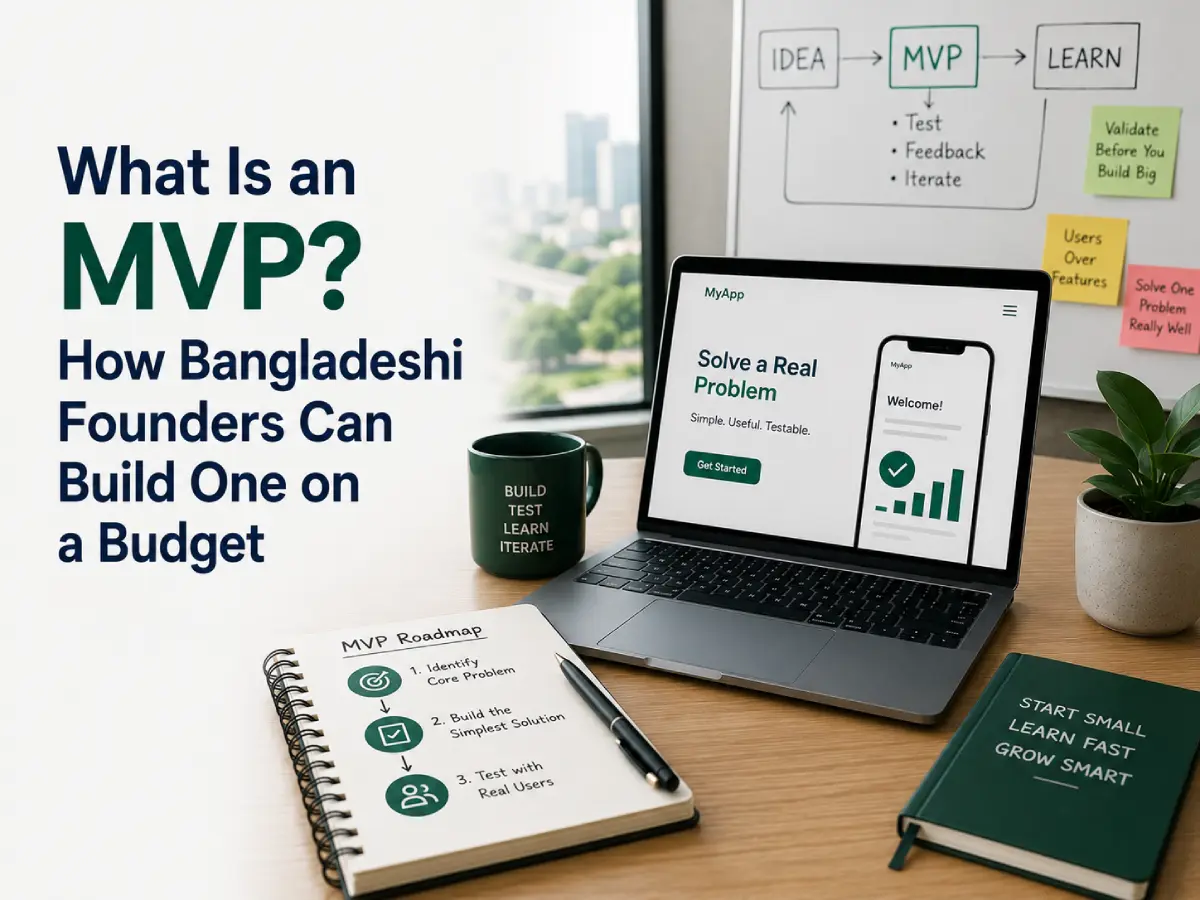
What an MVP Actually Is (and What It Is Not)
The term "Minimum Viable Product" was popularized by Eric Ries in his book The Lean Startup, but it is widely misquoted. An MVP is not a cheap version of your final product. It is not a prototype. It is not a beta launch with bugs you plan to fix later.
An MVP is the smallest possible product that lets you test your most critical business assumption with real users.
That one sentence changes everything. Notice the emphasis: not "smallest product you can build," but the smallest product that tests something specific.
If you are building a food delivery app in Dhaka, your riskiest assumption might not be "can we build the app?" It might be "will restaurants actually onboard?" or "will customers pay a delivery fee on top of food prices?"
Your MVP should test that assumption directly, and nothing else.
A common mistake among Dhaka-based early founders is confusing "building the whole product slowly" with building an MVP. If you spent six months building, you did not build an MVP. You built version one of your product and called it an MVP after the fact.
Why MVP Development Is Especially Important in Bangladesh
Bangladesh has a rapidly expanding startup ecosystem. The country has produced notable success stories across fintech, e-commerce, logistics, and agritech. But most founders here face constraints that their counterparts in Singapore or Bangalore do not.
Capital is limited. Angel investors are cautious. Consumer behaviour in Tier 2 and Tier 3 cities is still unpredictable. Payment infrastructure, while improving, still requires workarounds. These realities make early validation not just good practice but a financial necessity.
Spending BDT 5 lakh building a product nobody uses is painful anywhere. In Bangladesh, where early-stage funding is harder to raise and personal savings are often the primary source, that mistake can end a startup before it begins.
Building an MVP forces you to answer the hard questions early, before the costs compound.
The Bangladesh Investment Development Authority (BIDA) provides facilitation services for startups, including market entry support. Even BIDA's framework emphasizes validation and market readiness before scale. That framing exists for good reason.
The Four Types of MVP (and Which Works Best on a Budget)
Not every MVP requires code. Understanding your options changes what "building on a budget" actually looks like.
The Concierge MVP
You do the service manually, pretending the automation exists. A founder testing a home cleaning platform in Dhaka might personally coordinate cleaners via WhatsApp before building any booking system. You are selling the outcome, not the product. Cost: near zero.
The Landing Page MVP
A single-page website explains your product and collects email signups or pre-orders. Tools like Carrd or Webflow let you build this in a day. You are testing whether demand exists, not whether you can build the product. Cost: under BDT 3,000 per month.
The Wizard of Oz MVP
Users think they are using a real product. Behind the scenes, a human is doing the work. An AI-powered CV screening tool might actually have a human reviewer reading applications for the first 30 clients. You are testing willingness to pay and workflow fit. Cost: your time.
The No-Code MVP
You build a real, functional product using no-code tools. Glide or Adalo for mobile apps. Softr or Bubble for web apps. Airtable as your backend. This is the right choice when the product needs to actually function for users to give meaningful feedback. Cost: BDT 5,000 to 20,000 per month, depending on tools.
For most Bangladeshi founders, a combination of the Concierge approach first, followed by a No-Code MVP, is the most cost-effective path.
How to Build an MVP on a Budget: A Practical Framework
Step 1: Write Down Your Riskiest Assumption
Before touching any tool, write this sentence: "This business only works if _____."
Fill in the blank honestly. That blank is your MVP's job to test.
If you are building a B2B SaaS for garment factories, your riskiest assumption might be "factory owners will pay for a digital inventory system." Everything you build should test that one claim first.
Step 2: Define the Smallest Proof
What is the minimum evidence that would convince you the assumption is true? Ten users who pay BDT 500? Fifty email signups? Three factories that agree to a paid pilot?
Set the number before you start building. This prevents scope creep disguised as "just adding one more feature."
Step 3: Choose Your Build Method
Match your build method to your assumption:
Assumption is about demand: use a Landing Page MVP
Assumption is about willingness to pay: use a Concierge or Wizard of Oz MVP
Assumption is about usability or workflow: use a No-Code MVP
Resist the temptation to jump straight to hiring a developer. BASIS, Bangladesh's ICT industry trade body, lists hundreds of software firms in Bangladesh, but hiring one before validating is how founders burn money on the wrong product.
Step 4: Set a Time Limit
Two to four weeks is the right window for most MVPs. If it takes longer than four weeks to test your core assumption, you are building too much.
Give yourself a hard deadline. When the deadline arrives, go talk to users, even if the product feels unfinished.
Step 5: Talk to Users Before, During, and After
MVP feedback is not a survey you send out after launch. It is a conversation. Sit with your first ten users. Watch them use the product. Ask what confused them. Ask what they almost closed the tab over.
In Bangladesh, in-person user interviews are still underrated. The insight you get from a 20-minute chai conversation with a small shopkeeper in Mirpur or a garment buyer in Gazipur will outperform any Google Form you send.
Low-Cost Tools Bangladeshi Founders Can Use Right Now
Building an MVP does not require a big budget if you choose the right stack:
For landing pages and pre-launch validation: Carrd (free tier available), Notion with a public page, or a simple WordPress site on Hostinger Bangladesh hosting.
For no-code apps: Glide for mobile apps using Google Sheets as the backend. Bubble for more complex web apps. Softr for client portals and directories.
For payments: Integrate bKash or Nagad directly for local transactions. SSLCommerz supports multiple local and international payment methods and has a sandbox environment for testing before going live.
For communication and operations: WhatsApp Business for customer support. Trello or Notion for internal task tracking. Google Forms for collecting feedback.
For analytics: Google Analytics 4 is free. Microsoft Clarity gives you heatmaps and session recordings at no cost.
The ICT Division of Bangladesh has also established infrastructure, including incubators and co-working support, that early-stage founders can access to reduce overhead costs while building.
What Bangladeshi Startups Can Learn from Local MVP Stories
Chaldal, now Bangladesh's largest online grocery platform, started by manually taking orders and packing groceries themselves. There was no sophisticated logistics engine in the beginning. They tested whether Dhaka customers would buy groceries online before building the fulfilment infrastructure.
Pathao began with a small bike-sharing experiment in Dhaka before expanding into ride-hailing, food, and logistics. The earliest version was not the platform you see today. It was a test.
ShopUp, which supports small merchants with financing and supply chain tools, spent significant time understanding how small shop owners actually manage inventory before building their product stack.
Each of these companies validated something specific before scaling. The "build it and they will come" approach does not work in any market. In Bangladesh, it is particularly costly.
Frequently Asked Questions
How much does it cost to build an MVP in Bangladesh?
Do I need a developer to build an MVP?
How long should it take to build an MVP?
What is the difference between an MVP and a prototype?
How do I know if my MVP is working?
Is there funding available for MVP-stage startups in Bangladesh?
Yes. Startup Bangladesh Limited, a government-backed initiative under the ICT Division, offers seed funding and mentorship for early-stage tech startups. Bangladesh Angels Network (BAN) and several impact investors also fund pre-revenue startups, but most require some form of validated traction, which is exactly what your MVP is designed to generate. Building a solid MVP is often the prerequisite for accessing that first check.
Start Small, Learn Fast, Build What Actually Works
An MVP is not a compromise. It is a commitment to learning before spending. For Bangladeshi founders operating in a market where every taka counts, this approach is not just a smart strategy; it is the difference between a startup that pivots intelligently and one that runs out of runway chasing the wrong idea.
The tools are accessible. The methodology is proven. The examples are local.
Your next step is simple: write down the one assumption your business cannot survive without. Then figure out the cheapest, fastest way to test it. That is your MVP. Start there, and build the rest only after the market tells you it is worth building.

Specializing in SaaS product marketing, SEO strategy, Content marketing, TikTok advertising, PPC, and digital growth.
View Full Profile & ContributionsRelated Articles
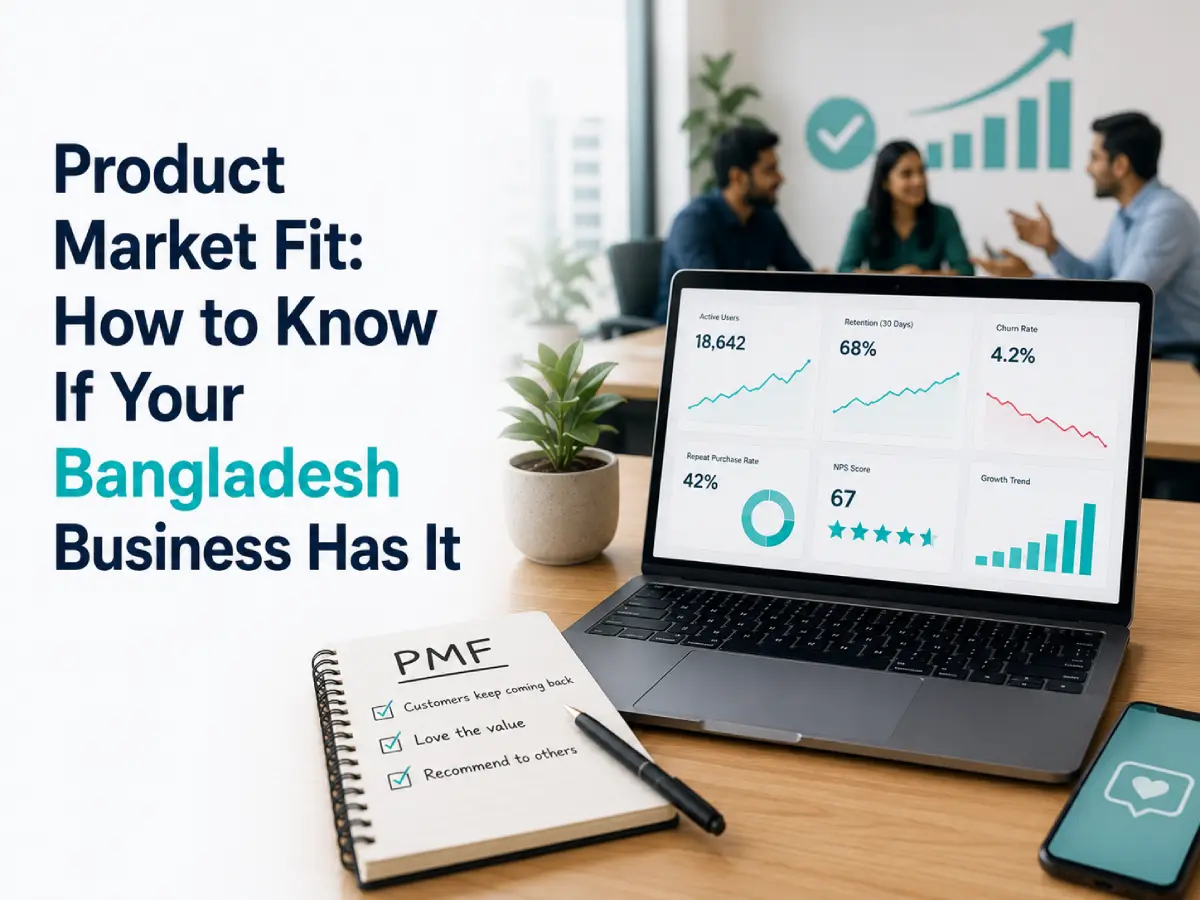
Business Registration in Bangladesh: All Legal Structures Explained
Quick Answer: Business registration in Bangladesh depends on your chosen legal structure. A sole proprietorship is registered via a trade license at your local city corporation. Partnerships and private limited companies are registered through the Registrar of Joint Stock Companies and Firms (RJSC). Each structure has different liability, tax, and compliance implications.
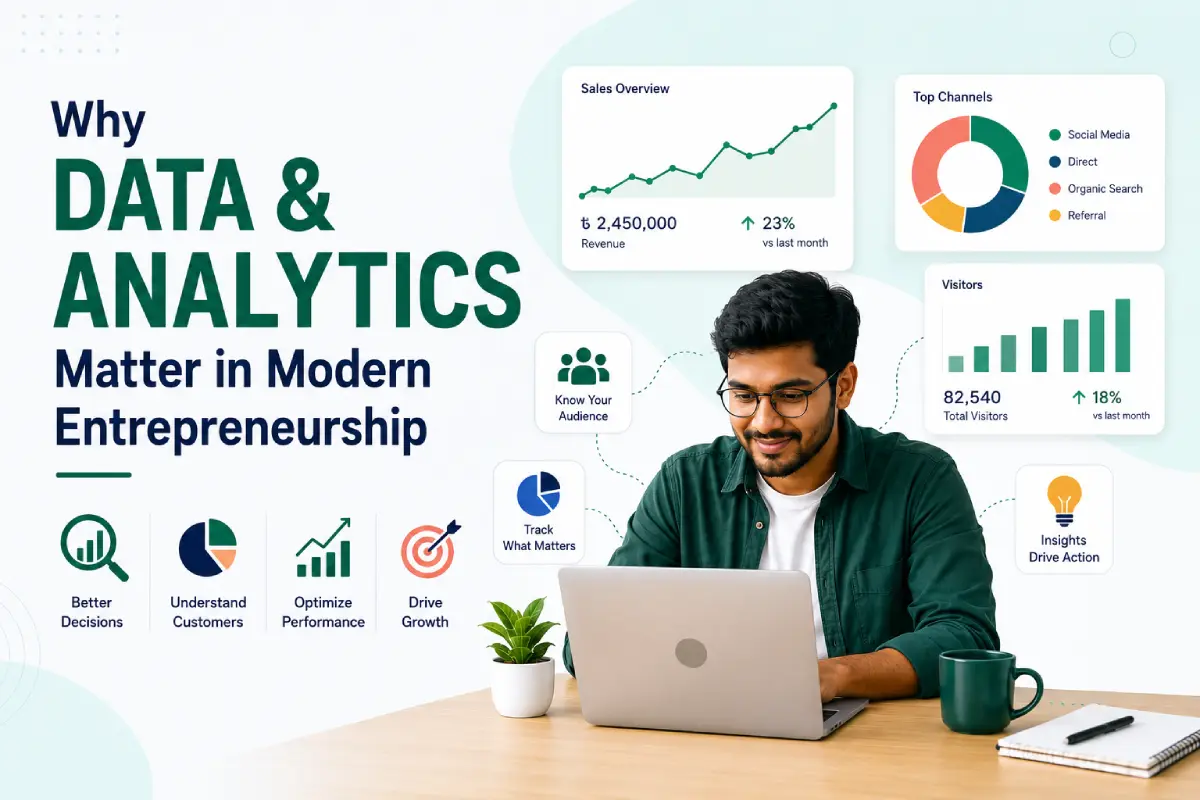
Why Data and Analytics Matter in Modern Entrepreneurship
Quick Answer: Data and analytics help entrepreneurs replace guesswork with evidence. Instead of relying on instinct alone, you use real numbers — from sales figures to customer behaviour — to make decisions that are faster, cheaper, and far more likely to succeed. In 2026, it is not a competitive advantage; it is a baseline requirement.
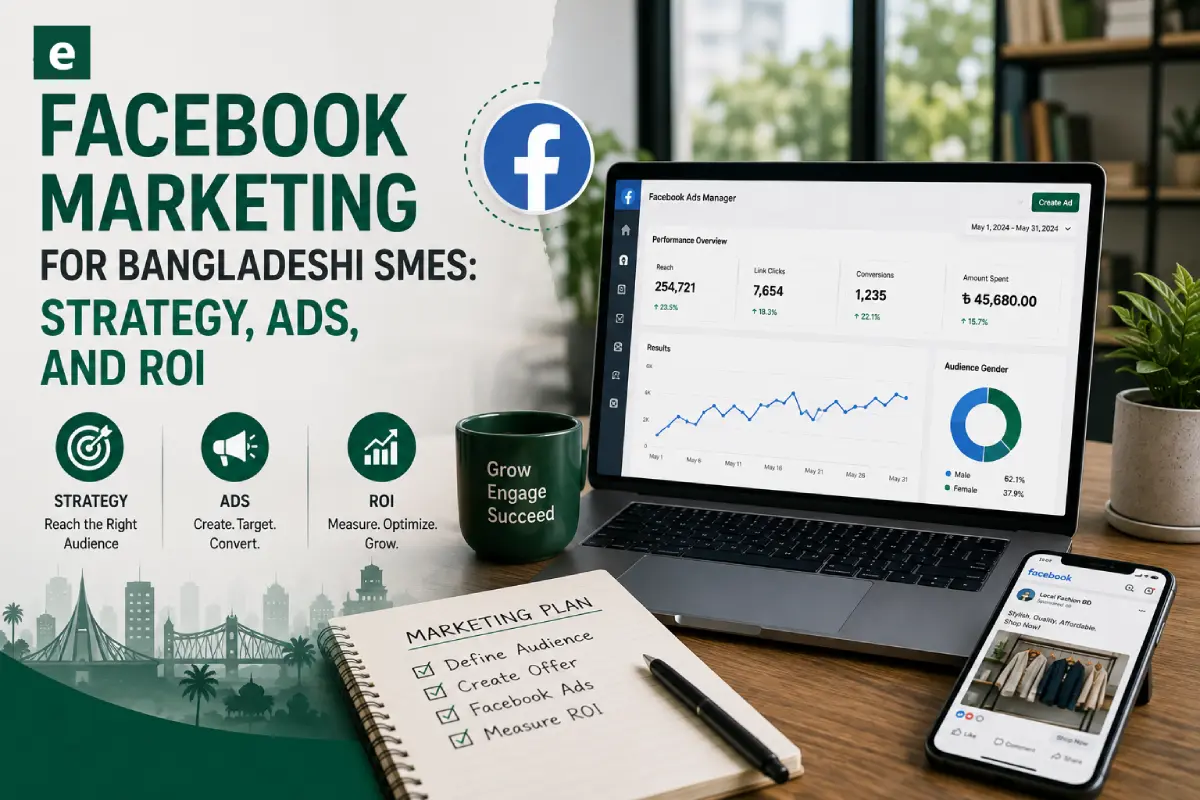
Facebook Marketing for Bangladeshi SMEs: Strategy, Ads, and ROI
Quick Answer: Facebook marketing for Bangladeshi SMEs involves building an optimized Business Page, posting consistently for organic reach, and running targeted paid ads using Meta Ads Manager. With over 50 million Facebook users in Bangladesh and low ad costs compared to Western markets, SMEs can generate strong ROI even on modest budgets of BDT 5,000–20,000 per month.
Comments (0)
No comments yet. Be the first to share your thoughts!