Lean Startup Methodology: How to Apply It in the Bangladesh Market
Quick Answer: The Lean Startup methodology is a framework for building businesses through rapid experimentation, validated learning, and iterative product development. In Bangladesh, it works especially well because it reduces wasted capital, lets founders test ideas with minimal resources, and adapts to the fast-changing preferences of local consumers.
Key Takeaways
Lean Startup is built on three core loops: Build, Measure, and Learn, not on lengthy business plans
An MVP (Minimum Viable Product) lets you test real demand before committing serious money
Bangladesh's resource-constrained startup environment makes lean thinking a natural fit
Local customer discovery requires offline methods alongside digital ones
Pivoting is not failure; it is the methodology working as intended
Bangladeshi entrepreneurs often make the same costly mistake: they spend months (sometimes years) building a product nobody asked for.
A fully developed app, a complete product line, a polished brand, launched into a market that turns out to be indifferent.
The Lean Startup methodology, developed by Eric Ries and popularized through his 2011 book of the same name, was designed to fix exactly this problem.
The core idea is simple but counterintuitive: instead of planning everything up front and executing, you treat your business idea as a hypothesis.
You build the smallest possible version of it, put it in front of real users, measure what happens, and use that data to decide what to do next. This cycle, Build, Measure, Learn, replaces assumption with evidence.
For founders operating in Bangladesh, where capital is scarce, investor networks are still developing, and market behavior does not always mirror global trends, the lean approach offers a practical framework that fits the reality on the ground.
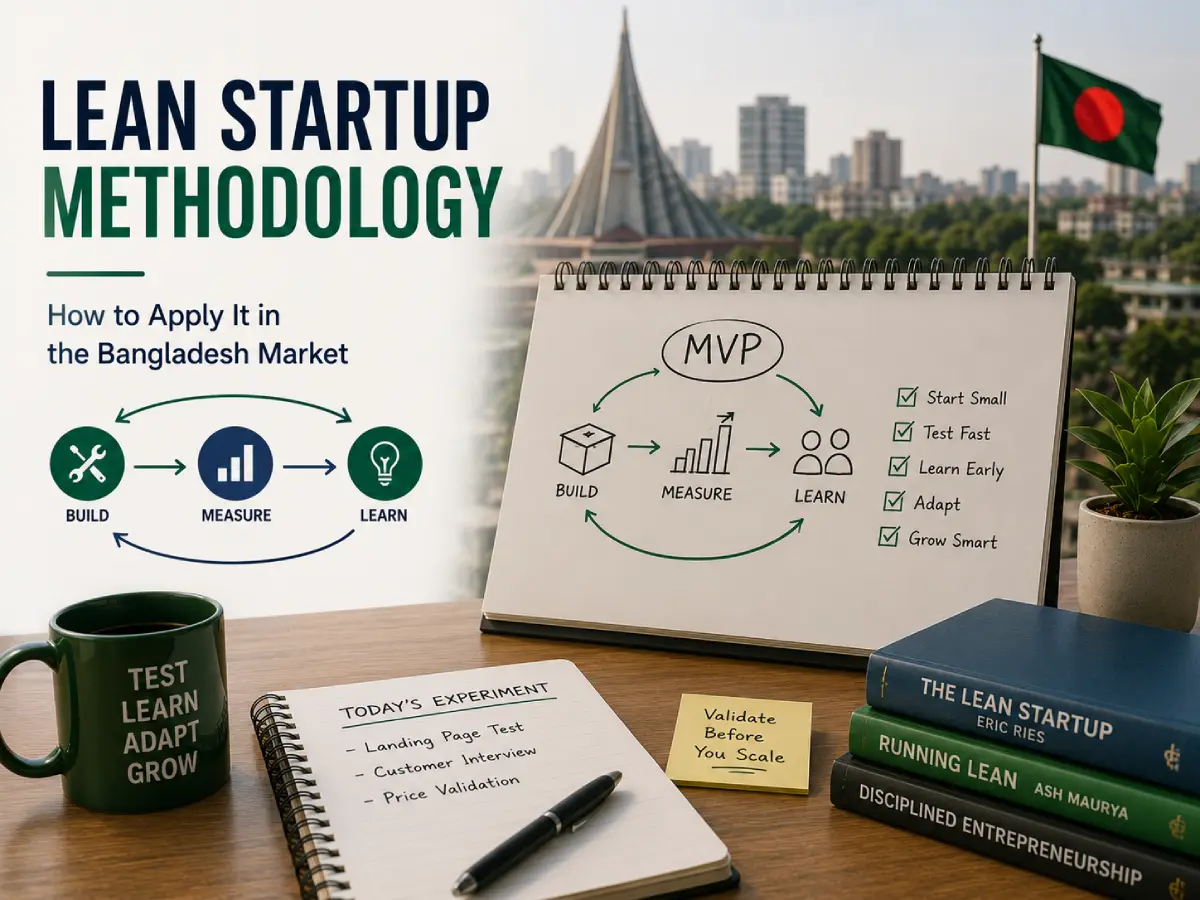
What the Build-Measure-Learn Loop Actually Means
The Build-Measure-Learn loop sounds simple enough, but each stage requires specific thinking.
Build does not mean build the whole product. It means build the minimum thing that lets you test a specific assumption. If you believe Dhaka's middle-class households will pay for a weekly grocery subscription, you do not need a fully automated platform to test that.
A WhatsApp group, a Google Form, and manual deliveries can validate whether people will actually pay before you write a single line of code.
Measure means defining your metrics before you build. What does success look like? How many people signed up? How many completed a second purchase? How long did they stay? In Bangladesh, digital analytics tools like Google Analytics are accessible and free, but offline feedback channels, phone calls, in-person follow-ups, and community group responses often give richer data than click-through rates alone.
Learning is where most founders get stuck. Learning means being willing to act on what the data tells you, even when it contradicts what you hoped to hear. If three out of five pilot customers found your pricing too high, that is not noise. That is a signal.
The World Bank's data on Bangladesh's private sector development consistently points to access to finance and market uncertainty as the top barriers for small businesses.
The lean approach directly addresses market uncertainty by making it something you resolve through iteration, not guesswork.
Understanding the MVP in the Bangladesh Context
The Minimum Viable Product (MVP) is the most misunderstood concept in the lean framework. It is not a rough draft of your product. It is the smallest experiment that generates meaningful learning about your most critical assumption.
In Bangladesh, MVPs often work best in three forms:
Concierge MVP: You manually do what your product is supposed to automate. A logistics startup in Chattogram might manually coordinate deliveries between small suppliers and retailers before building a routing algorithm. The goal is to learn whether the service model works, not whether the software works.
Landing Page MVP: You describe your product or service in detail, set up a simple website or Facebook page, and measure how many people express interest or register. BIDA's One Stop Service portal allows founders to register businesses quickly once they have validated their idea, which means you can stay in MVP mode longer without being legally exposed.
Wizard of Oz MVP: The customer believes they are interacting with a working product or automated system, but behind the scenes, a human is doing the work. This is particularly useful for testing AI-driven or platform-based ideas before the technology is built.
One practical note: in Bangladesh, where trust is built through personal relationships and word-of-mouth, your MVP audience matters.
Starting with a community you already have access to, a neighborhood, an industry group, or a university network tends to produce more honest feedback than cold outreach.
Why Lean Startup Fits Bangladesh Especially Well
Bangladesh's startup ecosystem has grown substantially. Platforms like Shohoz, Chaldal, and Shajgoj all went through versions of iterative product development before reaching scale. But for every success story, there are hundreds of founders who burned through savings building something the market never validated.
Several structural realities make lean thinking a natural fit here:
Capital constraints: Venture funding is more accessible than it was a decade ago, but most early-stage founders in Bangladesh are bootstrapping or relying on personal savings and family support.
The lean method is fundamentally about doing more with less. Every taka you spend before validating an assumption is a taka at risk.
Market heterogeneity: Bangladesh is not a monolithic market. Consumer behavior in Sylhet differs from Khulna. The urban middle class in Dhaka has different spending patterns than the aspirational lower-middle segment in secondary cities.
A lean approach lets you start narrow, one city, one customer segment, one use case, and expand only when you have proof that the model works.
Mobile-first behavior: With over 180 million mobile connections and smartphone penetration rising rapidly, Bangladeshi consumers interact with products primarily through mobile.
This makes it relatively low-cost to run digital experiments, measure engagement, and iterate on messaging or features using tools that are already in your users' hands.
BASIS, Bangladesh's national organization for the software and IT-enabled services industry, notes that local tech startups increasingly focus on solving domestic problems, agri-tech, fintech, and health-tech, which require deep local market understanding. Lean methodology is purpose-built for building that understanding systematically.
How to Apply Lean Startup in Your Business: A Practical Roadmap
Here is how to move from the theory to something you can start this week.
Step 1: Write down your riskiest assumption. Not your business plan, your single biggest assumption. "I believe small garment factory owners in Narayanganj will pay for a digital inventory tool." That's specific. That's testable.
Step 2: Design the smallest possible test. What is the cheapest, fastest way to get evidence? Build a paper prototype, make 20 phone calls, post in a relevant Facebook group, or set up a simple form. Keep the cost under a few thousand taka if possible.
Step 3: Define your success metric before you run the test. If 7 out of 10 people say they would pay, does that count as validation? What response rate would make you confident? Decide this before you gather data.
Step 4: Run the test and gather real data. Do not count compliments. Count commitments. Someone saying "this sounds like a great idea" is not the same as someone paying a deposit or signing up with their phone number.
Step 5: Decide: persevere or pivot? If the data supports your assumption, keep going and run the next experiment. If it does not, change the assumption and test again. A pivot is not a failure. It is the methodology working correctly.
Step 6: Register and formalize only after validation. Use RJSC's business registration process to formalize your structure once you have validated enough to commit. Formalizing too early adds compliance overhead to an idea that is still being tested.
Frequently Asked Questions
What is the Lean Startup methodology in simple terms?
Is lean startup only for tech companies?
How is an MVP different from a prototype?
Can lean startup work for traditional businesses in Bangladesh, not just startups?
How long should a lean experiment take?
What is a pivot, and when should a Bangladeshi founder pivot?
Start Small, Learn Fast, Build What Bangladesh Actually Needs
The lean startup methodology is not a shortcut. It is a discipline. It demands honesty about what you do not yet know, the patience to test instead of assume, and the courage to change direction when evidence points that way.
Bangladesh's entrepreneurial landscape in 2026 rewards this approach more than ever. Competition across sectors is sharpening, customer expectations are rising, and the founders who survive are the ones who build genuine insight into their markets rather than spending their way to a launch.
Whether you are launching a digital product from Dhaka or a service business in Rajshahi, the lean framework gives you a repeatable system for reducing risk and finding product-market fit before your resources run out.
Start with one assumption. Build the simplest test. Measure honestly. Everything else follows from that.

Specializing in SaaS product marketing, SEO strategy, Content marketing, TikTok advertising, PPC, and digital growth.
View Full Profile & ContributionsRelated Articles
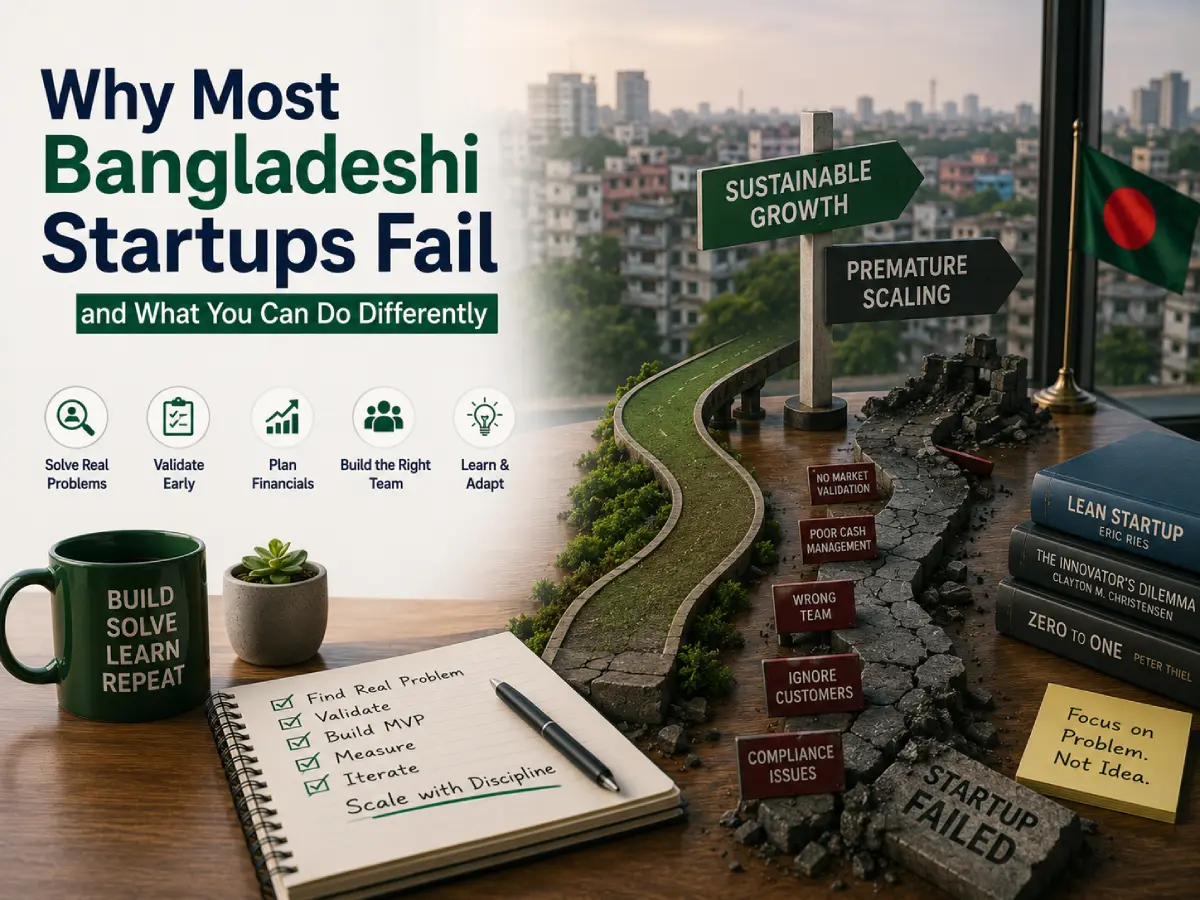
Why Most Bangladeshi Startups Fail — and What You Can Do Differently
Quick Answer: Most Bangladeshi startups fail because of poor market validation, weak financial planning, and founder-market mismatch, not lack of ideas or effort. The founders who survive focus on solving real problems, build lean, and learn from their market before scaling.
Customer Acquisition Strategies That Work for Bangladesh Startups
Customer Acquisition Strategies That Work for Bangladesh Startups
Quick Answer: The most effective customer acquisition strategies for Bangladesh startups combine low-cost digital channels (Facebook, WhatsApp Business, SEO), mobile financial service integration for frictionless payment, referral-driven growth, and hyperlocal targeting. Startups that blend paid acquisition with retention-focused tactics see the lowest long-term cost per customer.
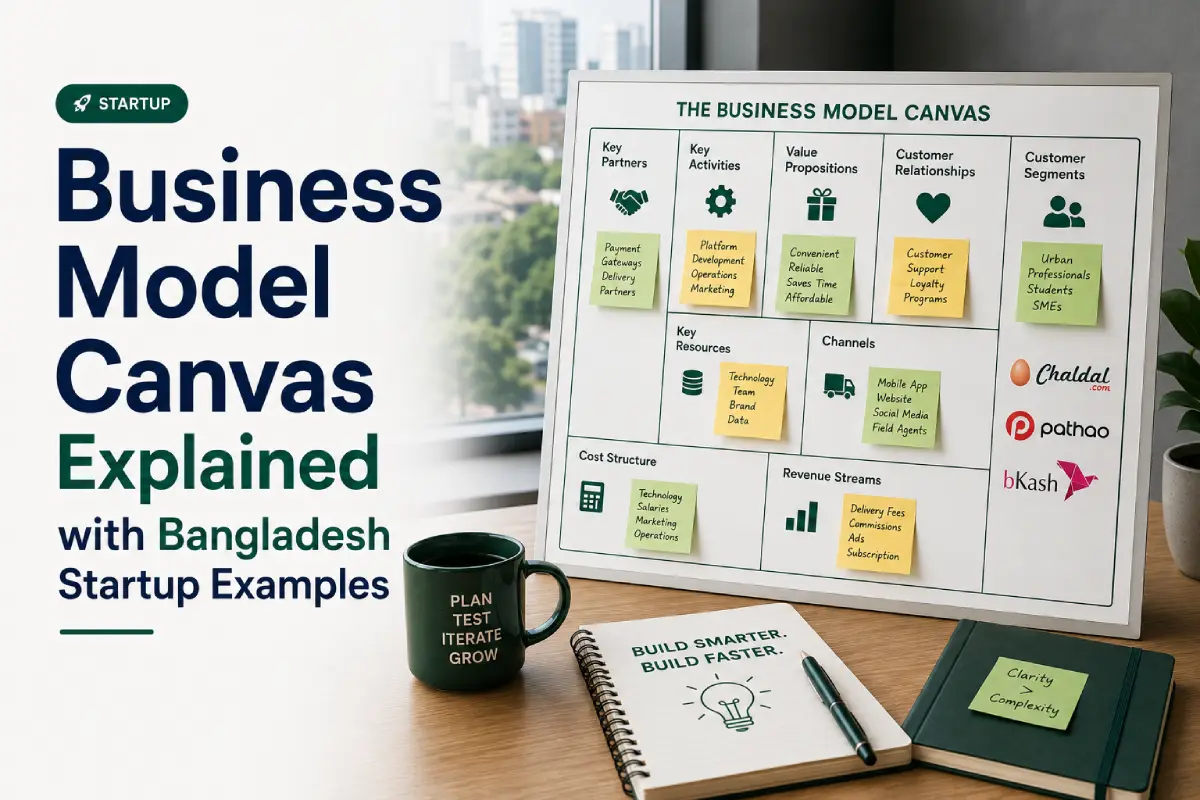
Business Model Canvas Explained with Bangladesh Startup Examples
Quick Answer: The Business Model Canvas (BMC) is a one-page strategic framework with 9 building blocks: Customer Segments, Value Propositions, Channels, Customer Relationships, Revenue Streams, Key Resources, Key Activities, Key Partnerships, and Cost Structure. It helps founders map, test, and communicate their entire business model before writing a single page of a business plan.
Comments (0)
No comments yet. Be the first to share your thoughts!