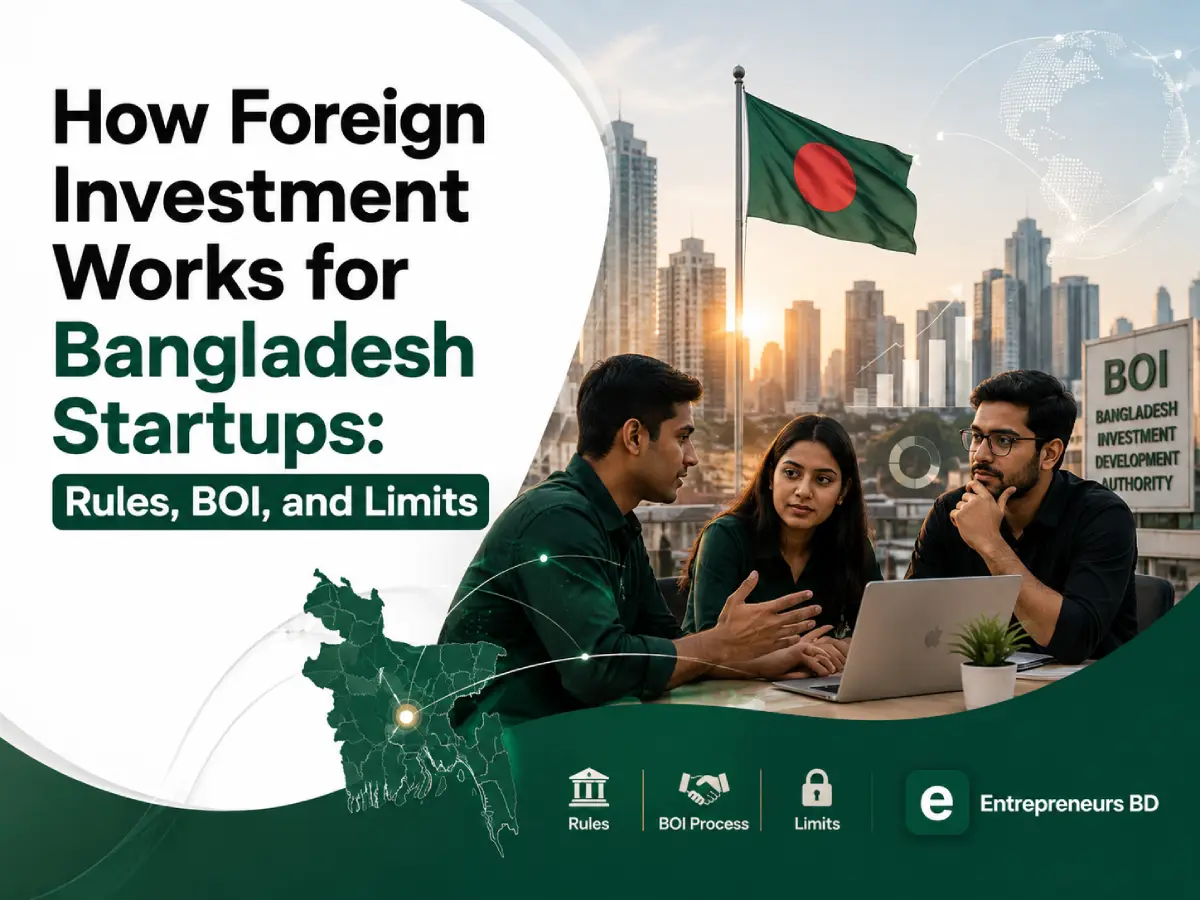
How Foreign Investment Works for Bangladesh Startups: Rules, BOI, and Limits
Foreign investors can own up to 100% of most Bangladeshi startups without needing prior Bangladesh Bank approval, as long as the investment moves through proper banking channels. A handful of sectors are reserved or controlled, and share sale proceeds up to Tk 100 crore can now be repatriated directly through an authorized dealer bank.
Key Takeaways
Most sectors allow 100% foreign ownership in Bangladeshi startups, with no Bangladesh Bank approval needed if the money enters through a bank.
Only four sectors are fully reserved for government, and a short list of "controlled" sectors need a No Objection Certificate first.
BIDA registration isn't mandatory for every foreign-funded startup, but it unlocks work permits, tax incentives, and easier import approvals.
A March 2026 Bangladesh Bank circular raised the repatriation threshold banks can process directly, from Tk 10 crore to Tk 100 crore.
Share issuances to foreign investors must be reported to Bangladesh Bank within 14 days, backed by an encashment certificate.
Bangladesh has become one of South Asia's more approachable places for a founder to bring in outside money. The rules weren't written with app-based startups in mind, but they apply to them all the same.
Most people still call the country's investment authority BOI. That name officially disappeared in 2016, when the old Board of Investment merged into BIDA, the Bangladesh Investment Development Authority.
If you're raising from a foreign angel, a regional VC fund, or a diaspora backer, three institutions matter most: BIDA, Bangladesh Bank, and the National Board of Revenue. Each one handles a different part of the process.
This guide covers what foreign investors can actually own, which sectors are off limits, how BIDA registration works, and what changed in 2026 for repatriating profits. It's written for founders who want the legal picture before the term sheet is signed.
How BIDA Registration Actually Works
BIDA is the single agency most foreign investors deal with first. It was created in 2016 when the government merged the old Board of Investment and the Privatization Commission into one body.
Registering with BIDA is not legally required just to accept foreign money. A startup can bring in foreign equity through its bank without BIDA's involvement, as long as the funds arrive through proper banking channels.
Most startups register anyway. BIDA registration is what unlocks work permits for foreign staff, tax incentives, industrial plot access, and smoother import approvals for equipment, and it typically takes 7 to 10 working days once the paperwork is complete.
Applications go through BIDA's online One Stop Service portal, which now links services from dozens of government agencies and banks into a single system. You'll need your certificate of incorporation, memorandum and articles of association, and details of the foreign shareholding structure.
Founders working through their business registration in Bangladesh should treat BIDA registration as a separate, later step. Get the company incorporated with the Registrar of Joint Stock Companies and Firms first, then apply to BIDA once the foreign investment is confirmed.
How Much of Your Startup a Foreign Investor Can Own
For most sectors, the answer is simple: up to 100%. Bangladesh doesn't require a local co-founder or a Bangladeshi majority shareholder for the vast majority of industries a startup would operate in.
Four sectors are reserved entirely for government investment, under the guidelines that govern foreign investment in Bangladesh. These are arms and ammunition, mechanized extraction in reserved forests, nuclear energy, and security printing like currency notes.
A second group of sectors is "controlled" rather than reserved. According to BIDA's own guidance, this list covers banking, telecommunications, aviation, large infrastructure, and a shorter set of trade categories like freight forwarding, shipping agents, courier services, buying houses, indenting agents, and for-profit education institutions.
Each of these needs a No Objection Certificate from the relevant ministry before BIDA registration can proceed.
Telecommunications carries its own ceiling on top of that, with foreign ownership capped below 100% and a slightly higher limit for tower-sharing companies specifically.
If your startup is a SaaS product, an e-commerce platform, or a fintech tool that isn't itself a bank, none of the reserved or controlled categories are likely to apply. The startup legal checklist for Bangladesh is worth reviewing early, since sector classification affects which licenses you'll need before you can legally take foreign money at all.
What This Looks Like for a Dhaka-Based Startup Raising a Round
Picture a Dhaka-based SaaS company closing a $150,000 seed round from a Singapore-based angel. The money is wired into the company's bank account through a local authorized dealer bank, never as cash.
The bank has 14 days from the share issuance to report the transaction to Bangladesh Bank. An encashment certificate confirming the foreign currency was converted to taka becomes the paperwork that matters most later, especially at the exit.
BIDA registration isn't required to close this round. Many founders register anyway, mainly to sort out work authorization for a foreign co-founder or technical hire.
Three years later, the Singapore investor sells their shares to a new backer for the equivalent of Tk 40 crore. That deal falls comfortably under the new Tk 100 crore repatriation threshold, so the authorized dealer bank can process the transfer directly using an independent valuation report, without a separate Bangladesh Bank approval.
This is a meaningfully faster exit than what founders dealt with before March 2026. Startup funding in Bangladesh has generally been harder to close on the exit side than the entry side, and this reform addresses that directly.
Practical Steps for Bringing In Foreign Investment
Decide on the entity structure first. A private limited company is the standard vehicle for outside equity, since a sole proprietorship generally isn't set up to hold foreign shareholding.
Have the investor wire funds through the banking channel, never informally. This one step is what makes every later step, including repatriation, straightforward.
Report the share issuance to Bangladesh Bank within 14 days through your authorized dealer bank. Ask for the encashment certificate at the same time, since it will be needed for any future exit.
Register with BIDA through the One Stop Service portal if you want work permits, tax incentives, or easier equipment imports. This step is optional but rarely skipped by founders planning to hire foreign staff.
Keep a paper trail from day one. Cap tables, valuation reports, and board resolutions around any share transfer will all be requested again when it's time to repatriate proceeds.
If you're taking money from an angel investor in Bangladesh based overseas rather than an institutional fund, the same reporting rules apply. Bangladesh Bank doesn't distinguish between a VC fund and an individual angel for these purposes.
Founders setting up a new entity for this purpose should also look at the difference between a private limited company and other structures, since the entity type decided at incorporation is hard to change once foreign shareholders are already on the cap table.
Frequently Asked Questions
Do foreign investors need Bangladesh Bank's approval before investing in a startup?
Can a foreign national or company own 100% of a Bangladeshi startup?
Which sectors are closed to foreign investors in Bangladesh?
How much can be repatriated from Bangladesh without prior approval?
Is BIDA registration mandatory for a startup with foreign funding?
Do foreign investors pay tax on profits earned in Bangladesh?
Turning These Rules Into a Fundraising Advantage
Foreign investment rules in Bangladesh are more open than most founders assume going in. The default is full foreign ownership, not a joint-venture requirement, and that surprises people who haven't looked closely.
The paperwork trail matters more than the approval process itself. Getting the encashment certificate, the Bangladesh Bank reporting, and the valuation documentation right at the time of investment saves real time and cost at the exit, which is when both investors and founders tend to feel the friction.
The March 2026 repatriation reform is a genuine signal of where policy is heading. Bangladesh Bank has been working directly with BIDA to close the gap between how easy it is to bring money in and how hard it has historically been to take money out.
If you're preparing a term sheet with a foreign investor, get your authorized dealer bank involved before the money moves, not after. It's the one relationship in this process that touches every step, from the first wire transfer to the eventual exit.

Specializing in SaaS product marketing, SEO strategy, Content marketing, TikTok advertising, PPC, and digital growth.
View Full Profile & ContributionsRelated Articles

Why Most Bangladeshi Startups Fail — and What You Can Do Differently
Quick Answer: Most Bangladeshi startups fail because of poor market validation, weak financial planning, and founder-market mismatch, not lack of ideas or effort. The founders who survive focus on solving real problems, build lean, and learn from their market before scaling.

Customer Acquisition Strategies That Work for Bangladesh Startups
Quick Answer: The most effective customer acquisition strategies for Bangladesh startups combine low-cost digital channels (Facebook, WhatsApp Business, SEO), mobile financial service integration for frictionless payment, referral-driven growth, and hyperlocal targeting. Startups that blend paid acquisition with retention-focused tactics see the lowest long-term cost per customer.

Business Model Canvas Explained with Bangladesh Startup Examples
Quick Answer: The Business Model Canvas (BMC) is a one-page strategic framework with 9 building blocks: Customer Segments, Value Propositions, Channels, Customer Relationships, Revenue Streams, Key Resources, Key Activities, Key Partnerships, and Cost Structure. It helps founders map, test, and communicate their entire business model before writing a single page of a business plan.
Comments (0)
No comments yet. Be the first to share your thoughts!