SME Loans in Bangladesh: Banks, Terms, and What Gets You Approved
SME loans in Bangladesh come from private banks, state banks, and NBFIs, with rates typically running 13.75% to 16% for standard loans and as low as 5% to 9% under Bangladesh Bank refinance schemes. Approval depends on trade license validity, a clean CIB credit report, and consistent cash flow documentation rather than collateral alone.
Key Takeaways
Private banks like BRAC Bank, City Bank, and Eastern Bank lead SME lending, with rates roughly 13.75% to 16%
Bangladesh Bank's Credit Guarantee Scheme lets qualifying borrowers skip collateral entirely
A clean Credit Information Bureau (CIB) report is often the single biggest factor in approval
Refinance schemes can bring effective rates down to 5% to 9% for priority groups
Women entrepreneurs qualify for dedicated windows with rates as low as 5%
Getting an SME loan approved in Bangladesh has less to do with luck and more to do with preparation. Banks are not short on funds to lend. What they are short on is applicants who show up with a complete, credible paper trail.
This guide covers who counts as an SME, which banks offer the most competitive terms, current interest rates, and the documents that make or break an application. Every section reflects how lending actually works here, not textbook theory.
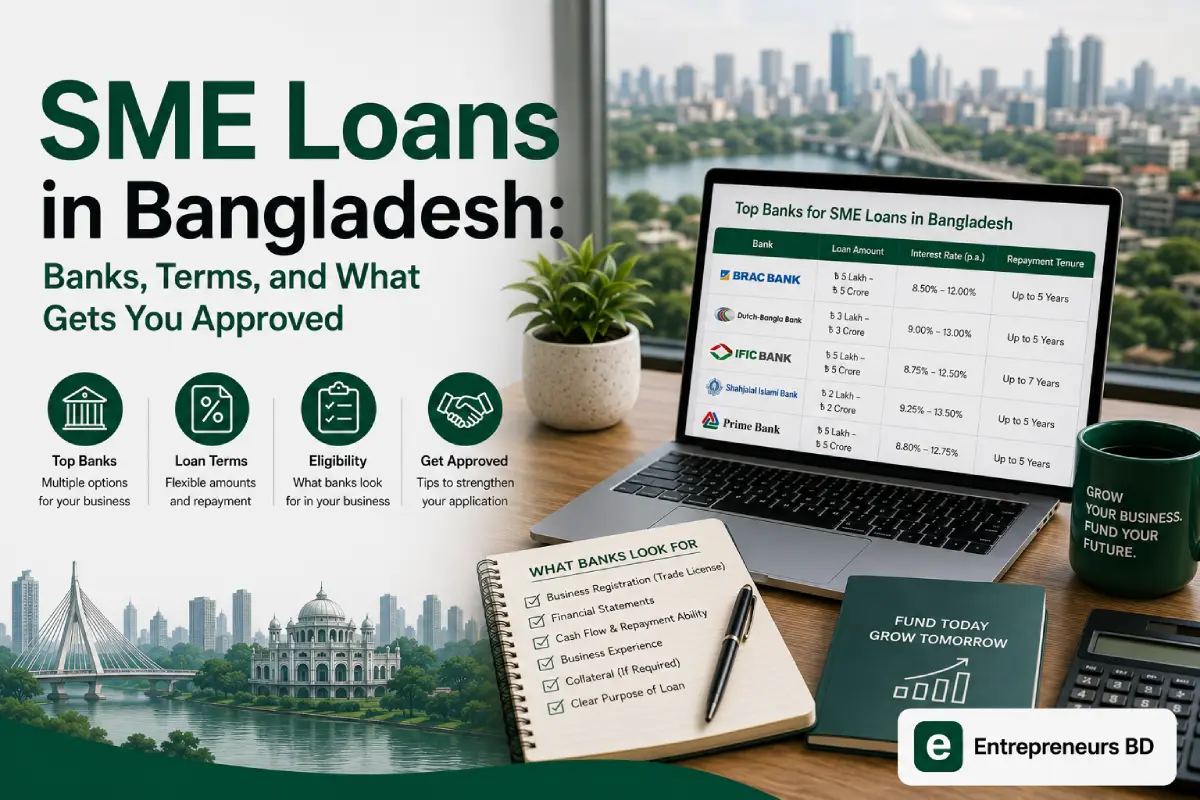
Who Qualifies as an SME in Bangladesh
Bangladesh Bank classifies enterprises by fixed asset value and number of employees, not revenue. Your tier determines your loan ceiling.
Category | Fixed Assets (excluding land) | Employees | Typical Loan Access |
|---|---|---|---|
Informal / Marginal | Under BDT 5 lakh | Up to 10 | Up to BDT 5 lakh |
Cottage | Under BDT 10 lakh | Up to 15 | Ceiling set by bank policy |
Small | Higher threshold, sector specific | Sector specific | Mid-range ceiling |
Medium | Highest threshold among CMSMEs | Sector specific | Largest CMSME ceiling |
Exact thresholds vary between manufacturing, service, and trading businesses, so confirm your tier with your bank before applying. Business structure matters too. Many first time borrowers register as a sole proprietorship since it is faster to set up, though unsecured limits can run lower than for a registered company.
Which Banks Offer the Most Competitive Terms
Private commercial banks dominate SME lending. Indicative rates below reflect published figures through mid-2026.
Bank Type | Indicative Rate Range | Notes |
|---|---|---|
BRAC Bank | 13.75% to 14% | Pioneer of unsecured CMSME lending in Bangladesh |
Eastern Bank, City Bank | Up to 14% | Strong SME desk network |
Prime Bank, Pubali Bank, UCB | Up to 15% | Broad branch coverage |
State owned banks (Sonali, Rupali) | Often lower headline rates | Slower processing, priority sector focus |
Islamic banks | Profit sharing, not interest | Shariah compliant structure |
A regulatory shift is reshaping this table. Bangladesh Bank has moved to cap the lending spread at 4 percentage points above the policy rate, which will push several banks to adjust SME pricing downward.
Interest Rates, Ceilings, and Repayment Terms
Two rate tracks exist side by side in the market:
Standard commercial loans: 13.75% to 16%, unsecured or lightly secured
Refinanced loans: 5% to 9%, funded through Bangladesh Bank windows for priority sectors and women entrepreneurs
Repayment terms also vary by loan type:
Refinance backed loans: up to 5 years including a 3 to 6 month grace period
Working capital facilities: typically 12 months, renewed annually
Term loans for fixed assets: matched to asset life, often 3 to 5 years
If you are exploring financing beyond bank debt, compare terms against startup funding options in Bangladesh before committing to a fixed repayment structure.
Collateral Free Options Through the Credit Guarantee Scheme
Lack of collateral is the single biggest reason creditworthy small businesses get turned away. Bangladesh Bank's Credit Guarantee Scheme addresses this by sharing credit risk with participating banks on a fixed ratio.
Key points to know:
Not every bank participates, and participating institutions need at least three years of CMSME lending experience
Ask your bank directly whether they offer CGS backed loans, since it is rarely volunteered upfront
Women entrepreneurs can access up to BDT 25 lakh on personal guarantee alone, with no collateral required
Loans routed through the scheme still require a clean CIB report and valid trade documentation
What Actually Gets Your Loan Approved
Loan officers weigh a fairly consistent set of factors. Understanding them changes how you prepare.
Valid trade license and TIN certificate: Expired documents stall applications before underwriting even starts, so confirm your business registration is current
Clean CIB report: A single default anywhere disqualifies you outright, regardless of current business strength
Six to twelve months of bank statements: Consistent transaction volume matters more than a strong annual revenue figure on paper
A written business plan: Structuring it around a clear business model gives the loan officer something concrete to underwrite
Command of your own numbers: Entrepreneurs who can answer cost and cash flow questions on the spot get faster approvals
Bangladesh Context: Where the Market Is Heading
CMSMEs make up about 18% of total bank lending in Bangladesh, and the government has set a target of 27% by 2029. That target is pushing banks to compete for SME clients rather than treat the segment as an afterthought.
Digital disbursement is becoming standard too. Several banks now route SME loan disbursement and installment collection through mobile financial services like bKash and Nagad, cutting down on branch visits for borrowers outside major cities.
This matters directly for entrepreneurs in the SME sector outside Dhaka and Chattogram, where branch density is lower but mobile money coverage is nearly universal.
Practical Steps Before You Apply
Confirm which classification tier your business falls into, since that sets your loan ceiling
Pull your CIB report early through your primary bank to flag any discrepancy before it derails an application
Prepare a standing document set: trade license, TIN certificate, twelve months of bank statements, and a one page cash flow summary
Ask specifically about Credit Guarantee Scheme eligibility if you lack collateral
Compare at least three banks before committing, since rates and processing speed vary more than most first time borrowers expect
Frequently Asked Questions
What is the minimum SME loan amount available in Bangladesh?
Can I get an SME loan without any collateral?
What is the current interest rate range for SME loans?
Which documents do banks require for SME applications?
How long does SME loan approval typically take?
Are there special loan schemes for women entrepreneurs?
Building a Loan Ready Business Before the Application Stage
The banks are not the bottleneck most entrepreneurs assume. Documentation readiness is.
Businesses that keep their trade license current, maintain clean bank statements, and monitor their own CIB standing rarely struggle to find a willing lender. The financing exists, and it is expanding as the government pushes toward its 27% lending target.
Treat the six months before you apply as preparation time, not an afterthought. Clean records and an honest read of your own cash flow will do more for your approval odds than any single bank relationship ever will.

Specializing in SaaS product marketing, SEO strategy, Content marketing, TikTok advertising, PPC, and digital growth.
View Full Profile & ContributionsRelated Articles
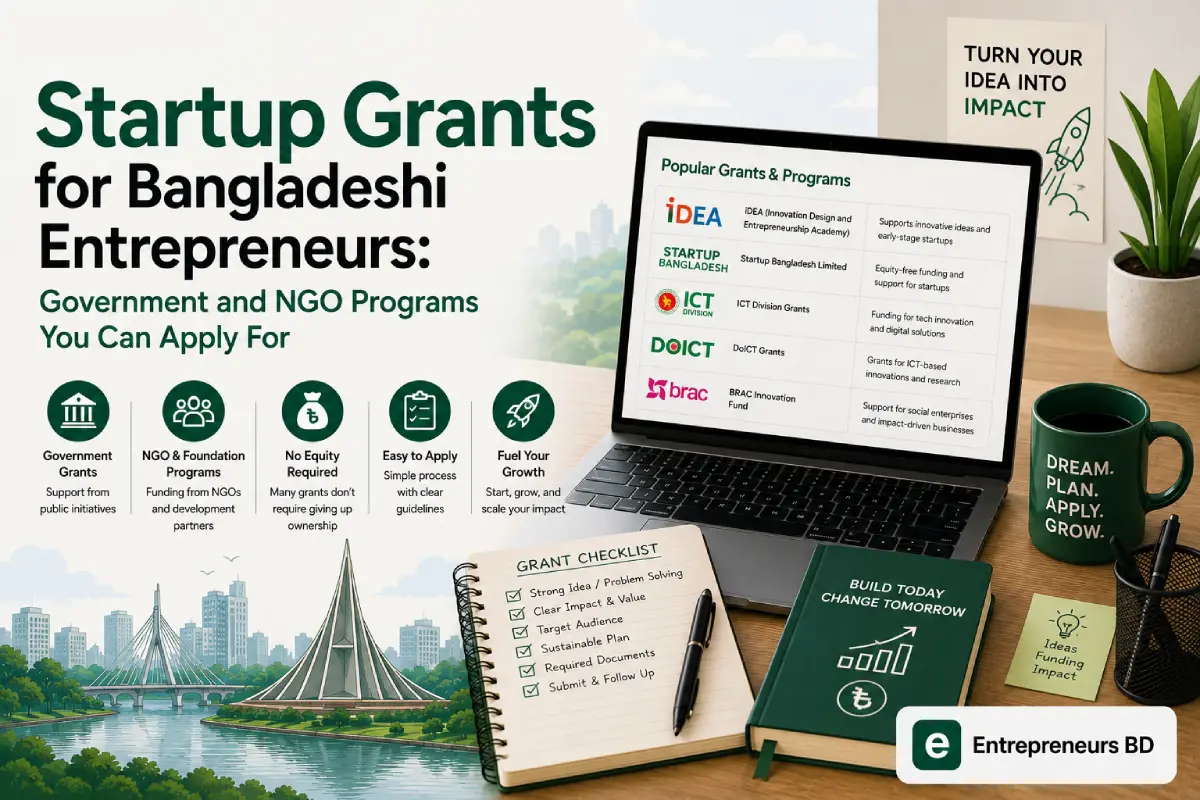
Startup Grants for Bangladeshi Entrepreneurs: Government and NGO Programs You Can Apply For
Bangladeshi entrepreneurs can apply for grants and low-cost financing through the ICT Division's iDEA project (up to BDT 10 lakh), SME Foundation's Credit Wholesaling Program, and Bangladesh Bank's refinance schemes for women and new entrepreneurs. Most require a trade license, a clear business plan, and an online application.
Fintech in Bangladesh: Key Players, Regulations, and Opportunities for Founders
For the payment and digital-finance businesses covered here, four regulated models matter most: MFS, PSP, PSO and digital banking. MFS requires a bank, financial institution or government entity to hold at least 51% of the provider and control its board. PSPs don't carry that requirement. PSOs run payment infrastructure and can't issue e-money. Digital banks are licensed under the Bank Company Act and now require Tk 300 crore in paid-up capital.
Angel Investors in Bangladesh: Who They Are and How to Reach Them
Angel investors in Bangladesh are individuals, family offices, and diaspora professionals who fund early-stage startups in exchange for equity. Most operate through organized networks like Bangladesh Angels Network (BAN) and Bangladesh Women Investors Network (BWIN), which vet founders, run pitch sessions, and syndicate deals among members.
Comments (0)
No comments yet. Be the first to share your thoughts!