How to Build a Startup Pitch Deck That Works for Bangladesh Investors
Quick Answer: A pitch deck for Bangladesh investors should include 10 to 13 slides covering the problem, solution, market size, business model, traction, team, and funding ask. Unlike Western decks, Bangladesh investors prioritize founder credibility, local market validation, and realistic revenue projections over global scalability claims.
Key Takeaways
Bangladesh investors evaluate founder credibility as heavily as the business idea itself
Local market validation matters more than global comparable benchmarks
Your financial projections must reflect BDT-denominated realities, not USD-inflated assumptions
Traction, even early-stage, dramatically increases your chances of getting a second meeting
The pitch deck is the door opener; the conversation behind it is where deals are made
Most Bangladeshi founders approach pitch decks the wrong way. They copy Silicon Valley templates from Y Combinator or Sequoia, drop in a few local figures, and wonder why investors aren't responding. The disconnect is real, and it costs founders funding.
Bangladesh's startup investment ecosystem has grown significantly. BIDA has been working to create better channels for foreign and local capital into startups, and angels, micro-VCs, and accelerators like Startup Bangladesh Limited are increasingly active.
But the investors writing checks here think differently from their counterparts in San Francisco or Singapore.
This guide covers exactly what a pitch deck for Bangladesh investors should contain, how to structure it, what to never include, and how to tailor each slide to the expectations of local capital.
Whether you are approaching angel investors, Startup Bangladesh, or regional VCs with Bangladesh exposure, this breakdown applies.
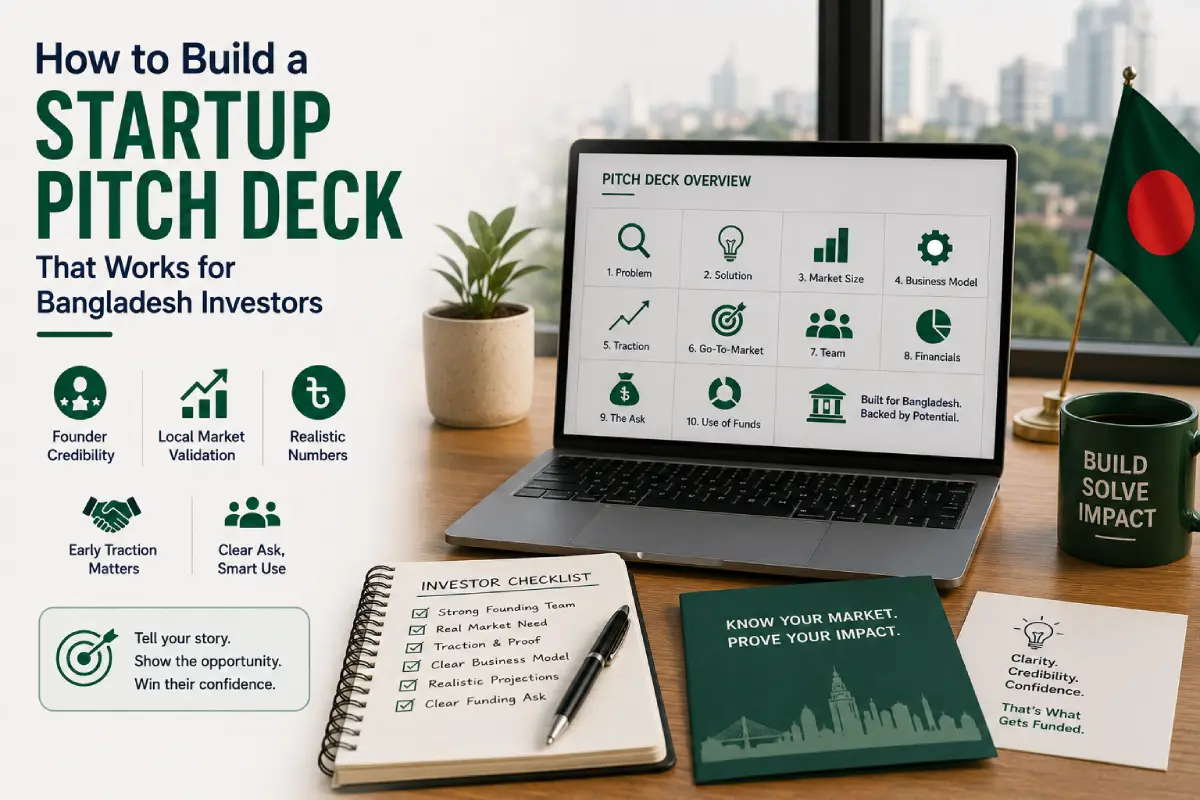
What Bangladesh Investors Actually Want to See
Before touching a single slide, understand the evaluation lens.
Most Bangladesh-based investors, especially angels and early-stage funds, are asking three core questions within the first five minutes of seeing your deck:
Can this founder execute in the Bangladesh market?
They are not betting on a global idea in the abstract. They are betting on whether you specifically can make something work inside the constraints of Bangladesh's infrastructure, regulatory environment, payment ecosystem, and consumer behavior.
Is the market real, and is it local?
Citing India or Southeast Asia TAM (total addressable market) numbers without local data reads as homework avoidance. Investors who operate here know what the numbers actually look like. They want to see you know them, too.
What does the money do, specifically?
Vague fundraising slides ("to scale operations") are a red flag. Bangladesh investors, especially those writing smaller tickets between BDT 20 lakh and BDT 2 crore, want to know exactly what milestones their capital unlocks.
Answering these three questions clearly is the backbone of any pitch that works here.
The Slide-by-Slide Structure That Works
A pitch deck for Bangladesh investors should run 10 to 13 slides. Longer decks signal that you cannot prioritize information, which is itself a red flag.
Slide 1: The Problem
Open with a problem that is real in Bangladesh, not a translated version of a Western pain point. Use local data where possible. If you are solving a logistics inefficiency, cite the actual delivery failure rates in Dhaka or Chattogram. If you are in fintech, reference the proportion of adults without formal banking access according to Bangladesh Bank's Financial Inclusion data.
Make the problem feel costly and urgent. Investors should feel the pain before they hear the solution.
Slide 2: Your Solution
One clear sentence describing what you do, followed by how it directly addresses the problem. Avoid technical jargon unless your investor audience is technical. If you are pitching a non-technical angel, plain Bangla or clear English descriptions outperform buzzword-heavy summaries every time.
Show a product screenshot, mockup, or demo flow if you have one. Tangibility builds confidence.
Slide 3: Market Size (Bangladesh-Anchored)
This is where many founders lose investors by going too global. Yes, include TAM (Total Addressable Market), SAM (Serviceable Addressable Market), and SOM (Serviceable Obtainable Market), but root them in Bangladesh data.
Use sources like the Bangladesh Bureau of Statistics for economic sector data, or sector-specific reports from organizations like BASIS for tech industry figures. If you are in e-commerce, reference actual Bangladesh e-commerce transaction volumes. Credibility lives in specificity.
Slide 4: Business Model
How do you make money? Keep this simple. Revenue model, pricing structure, and unit economics in BDT if your business operates primarily in Bangladesh. If you have any early revenue, show it here or on the traction slide.
Avoid complicated multi-stream revenue models at the seed stage. Investors want to see one working model, not five theoretical ones.
Slide 5: Traction
This slide can make or break a Bangladesh pitch. Local investors are more conservative than their counterparts in more mature ecosystems. They want proof before conviction.
Traction does not have to mean millions in revenue. It can mean: paying pilot customers, active users with strong retention, letters of intent from enterprise clients, or a successful small-scale test of your core assumption. Whatever you have, show it with numbers and dates. A growth chart, even a small one, is worth a thousand words.
Slide 6: Competition and Your Edge
Acknowledge competitors directly. Pretending you have no competition tells investors you have not done your research. Map out 3 to 5 alternatives (including manual or informal alternatives, which dominate many Bangladesh sectors) and clearly show where you sit differently.
Your differentiation should be specific: lower cost, deeper distribution, better local language support, faster turnaround in Dhaka's traffic-constrained logistics environment. Generic claims like "better technology" do not hold up.
Slide 7: Go-to-Market Strategy
How are you going to get customers in Bangladesh, specifically? Paid digital? Field sales in secondary cities? Partnerships with mobile network operators? Microfinance institution distribution channels?
This slide tells investors whether you understand the market or just the product. Many Bangladeshi founders underestimate the importance of offline and hybrid distribution, especially outside Dhaka. If your go-to-market is Dhaka-only in the first phase, own that decision and explain why.
Slide 8: The Team
In Bangladesh's early-stage investment ecosystem, the team slide carries disproportionate weight. Investors often back founders more than ideas at the pre-seed and seed stage.
Include relevant experience, past ventures (even unsuccessful ones, if you learned from them), and any domain expertise that directly applies to the problem you are solving. If you have advisors with credibility in the local ecosystem, include them with a one-line description of their relevance.
Do not pad this slide with irrelevant credentials. A founder who ran a successful small business in Sylhet for three years is more credible to a local investor than one who lists a remote internship at a foreign company.
Slide 9: Financial Projections (3 Years)
Your numbers need to be realistic and explainable. Bangladesh investors have seen enough inflated hockey-stick projections to be immediately skeptical of anything that assumes hypergrowth without a clear driver.
Show revenue, gross margin, and burn rate in BDT. Include the key assumptions behind your projections so investors can stress-test them. If your model depends on a specific customer acquisition cost or conversion rate, state it. Honesty about assumptions builds more trust than polished optimism.
Slide 10: The Ask
State the amount you are raising, the instrument (equity, convertible note, SAFE), the valuation or valuation cap, and what the capital will be used for across specific categories: product development, hiring, marketing, and working capital.
Tie the use of funds to concrete milestones. "This funding gets us to BDT X in monthly revenue by Month 12" is far stronger than a generic budget breakdown.
Common Mistakes Bangladesh Founders Make in Pitch Decks
Overclaiming the market by using global or regional figures without Bangladesh-specific validation is the most frequent error. Close behind it: ignoring regulatory considerations.
If your business operates in fintech, healthcare, or education, investors will ask about compliance. Referencing relevant frameworks from agencies like BSEC or sector regulators shows you have thought beyond the product.
Another common mistake is burying the ask. Do not wait until the last slide to tell investors what you need. Sophisticated investors want to calibrate their interest early. If the ask is misaligned with what they write, you have both saved time.
Finally, do not design a deck that only works as a presentation. Many investors read decks alone, without you in the room. Every slide should be self-explanatory.
Frequently Asked Questions
How many slides should a pitch deck have for Bangladesh investors?
Do Bangladesh investors prefer pitches in English or Bangla?
What valuation should I expect as a pre-seed startup in Bangladesh?
Should I include a product demo in my pitch deck?
What funding sources exist for startups in Bangladesh in 2026?
Is a pitch deck enough to get funding in Bangladesh?
Build the Deck, Then Build the Relationship
A pitch deck for Bangladesh investors is a communication tool, not a magic document. The strongest decks are clear, honest, and rooted in local reality. They show investors a founder who understands the market they are operating in, respects the investor's time with tight thinking, and can defend every number on the page.
Start with the problem slide and work backward. If you cannot articulate the problem in two sentences, the rest of the deck is not ready either.
Once the deck is solid, the real work begins: getting it in front of the right people through warm introductions, industry events, and programs like Startup Bangladesh's funding initiatives.
The Bangladesh startup ecosystem is still early relative to regional peers. That means less institutional infrastructure but also more access to investors who are genuinely looking for founders to back. A well-built deck that speaks their language is your fastest path to that conversation.

Specializing in SaaS product marketing, SEO strategy, Content marketing, TikTok advertising, PPC, and digital growth.
View Full Profile & ContributionsRelated Articles
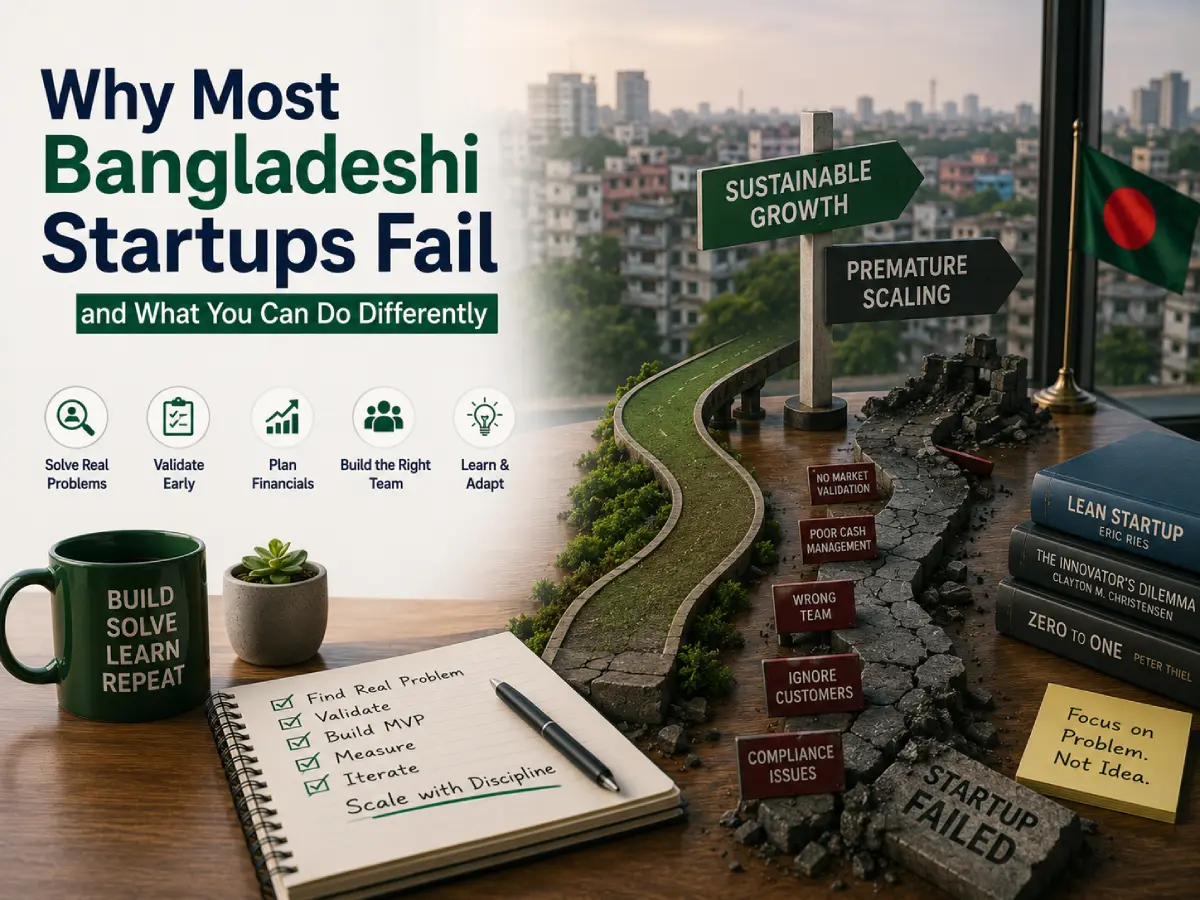
Why Most Bangladeshi Startups Fail — and What You Can Do Differently
Quick Answer: Most Bangladeshi startups fail because of poor market validation, weak financial planning, and founder-market mismatch, not lack of ideas or effort. The founders who survive focus on solving real problems, build lean, and learn from their market before scaling.
Customer Acquisition Strategies That Work for Bangladesh Startups
Quick Answer: The most effective customer acquisition strategies for Bangladesh startups combine low-cost digital channels (Facebook, WhatsApp Business, SEO), mobile financial service integration for frictionless payment, referral-driven growth, and hyperlocal targeting. Startups that blend paid acquisition with retention-focused tactics see the lowest long-term cost per customer.

Business Model Canvas Explained with Bangladesh Startup Examples
Quick Answer: The Business Model Canvas (BMC) is a one-page strategic framework with 9 building blocks: Customer Segments, Value Propositions, Channels, Customer Relationships, Revenue Streams, Key Resources, Key Activities, Key Partnerships, and Cost Structure. It helps founders map, test, and communicate their entire business model before writing a single page of a business plan.
Comments (0)
No comments yet. Be the first to share your thoughts!