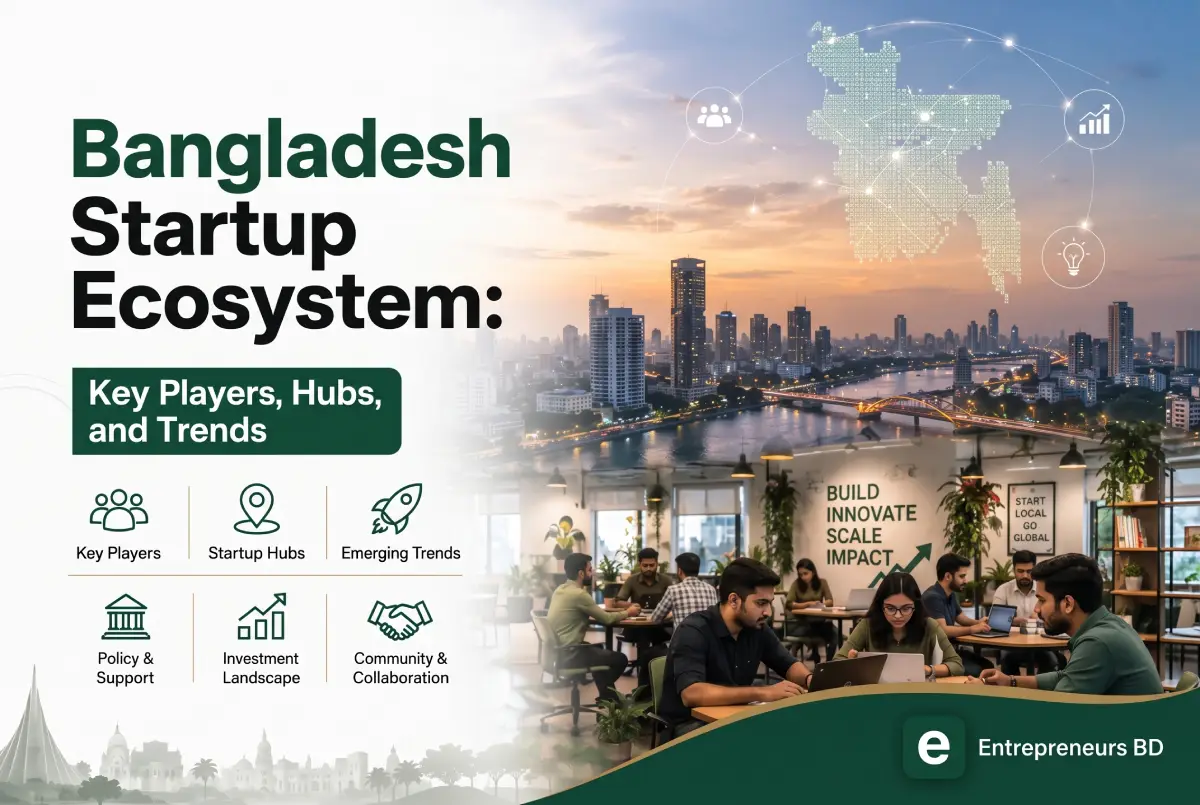
Bangladesh Startup Ecosystem: Key Players, Hubs, and Trends in 2026
Bangladesh's startup ecosystem now counts more than 1,200 active ventures, two fintech unicorns in bKash and Nagad, and over 900 million dollars raised since 2010. Dhaka remains the core hub, though Chittagong, Sylhet, and Jessore host growing hi-tech parks. In 2026, fresh government funding and a friendlier national budget are reshaping how founders raise capital and register new companies.
Key Takeaways
Bangladesh has two confirmed unicorns, bKash and Nagad, though Nagad's banking licence remains under central bank review.
Dhaka still dominates the ecosystem, but hi-tech parks in Chittagong, Sylhet, Jessore, and Rajshahi are widening regional access.
The government launched the Bangladesh Startup Investment Company and a Tk400 crore Fund of Funds in 2026 to deepen local capital.
The FY2026-27 national budget introduced zero turnover tax and VAT relief for registered startups through 2035.
Fintech infrastructure, logistics, and agritech are outperforming pure consumer apps this year.
Bangladesh's startup ecosystem has moved past its early hype phase.
In 2026, the market is separating founders who can build durable, cash generating businesses from those who grew mainly on funding headlines.
Two companies, bKash and Nagad, have already reached unicorn status. Behind them sits a wider base of more than 1,200 active startups, according to LightCastle Partners, working across fintech, e-commerce, logistics, healthtech, and agritech.
Dhaka still anchors most of this activity. But hi-tech parks in Chittagong, Sylhet, Jessore, and Rajshahi are slowly pulling founders and mentors outside the capital.
2026 has also brought real policy movement. A new government backed investment company, a fund of funds, and a startup friendly national budget are changing how founders raise money and register their companies.
This guide walks through the key players shaping Bangladesh's startup ecosystem right now, where the country's startup hubs are growing, and the trends worth watching for the rest of 2026.
Who Is Leading Bangladesh's Startup Ecosystem
Bangladesh has produced two unicorns so far.
bKash got there first. In November 2021, a 250 million dollar Series C round led by SoftBank Vision Fund valued the mobile financial service at 2 billion dollars.
Nagad followed in 2023. Its path has been rockier: Bangladesh Bank suspended Nagad Digital Bank's licence in August 2024 over ownership concerns, and the entity now operates under direct government administration while the central bank reviews its status.
Below the two unicorns sits a wider layer of established companies. Pathao, founded in 2015 by Hussain M Elius, now runs ride-hailing, courier, food delivery, and fintech services across 64 districts in Bangladesh and 22 cities in Nepal.
ShopUp built its name connecting small retailers to suppliers and credit. In 2025 it merged with Saudi Arabia's Sary to form SILQ Group, one of the clearest signs yet that a Bangladeshi startup can scale as a regional player rather than stay confined to one market.
Other familiar names round out the leading pack. Paperfly and Chaldal work in logistics and grocery delivery, Shohoz covers ticketing and ride-hailing, 10 Minute School leads in edtech, iFarmer focuses on agritech, and Sheba.xyz and Praava Health serve home services and healthtech.
Capital behind these companies comes from a mix of sources. Startup Bangladesh Limited, the government's own venture fund under the ICT Division, has backed names like 10 Minute School and ShareTrip since 2020.
Private investors are active too. Anchorless Bangladesh, founded by Rahat Ahmed, writes seed checks of 200,000 to 1 million dollars into fintech, logistics, and AI focused startups, while BD Venture and SBK Tech Ventures back healthtech, agritech, and rural digital services.
Founders exploring outside capital should also look at the angel investor networks now active in Dhaka, alongside corporate platforms like Robi Axiata's r-ventures.
Nagad's founder, Tanvir A Mishuk, has since moved on to build AI and regtech ventures internationally, a path we cover in our profile of his career.
Where Bangladesh's Startup Hubs Are Growing
Dhaka remains the country's clear startup capital. Most incubators, venture funds, and corporate partners are based there, and most founders still relocate to the city to raise their first round.
That said, the Bangladesh Hi-Tech Park Authority has been pushing incubation beyond the capital for years. More than 100 startups have received a year of free office space and utilities through its parks nationwide.
Chittagong is the clearest second hub. The Chittagong University of Engineering and Technology hosts the country's first comprehensive university based business incubator, a ten floor building that pairs startups with academic and industry mentors.
Sylhet is close behind. The Bangabandhu Sheikh Mujib Hi-Tech Park there covers 171 acres and has already allocated land to a mix of established companies and startups, with tens of thousands of jobs expected once it is fully built out.
Jessore, Khulna, and Rajshahi round out the next tier. BHTPA's regional Startup Idea Pitching Program has connected more than 2,000 founders across these five regions, with 143 startups receiving free space and mentoring so far.
The gap is real, though. BHTPA's own research found that mentoring and incubation support barely exist outside Dhaka and Chittagong, and high office and utility costs remain the two most common complaints from founders nationwide.
For founders building outside the capital, this points to a specific opportunity. Sectors tied to rural and regional growth, like agritech and last mile logistics, tend to face less competition and lower operating costs than a Dhaka based consumer app.
Local founder communities are filling some of this gap on their own. University innovation hubs, district level IT training centers, and informal founder networking groups now exist in most divisional cities, even where formal VC offices do not.
Bangladesh's Policy and Funding Push in 2026
2026 has been the busiest policy year Bangladesh's startup sector has seen. Three moves stand out.
First, the Bangladesh Investment Development Authority continues to serve as the main gateway for company registration, licensing, and investor facilitation, working alongside sector regulators as the government streamlines approval timelines.
Second, Bangladesh Bank's SME and Special Programmes Department issued a Startup Finance Master Circular in July 2025 that raised loan ceilings to as much as Tk8 crore, up from roughly Tk1 to 2 crore before, depending on a startup's operational stage. It also capped startup lending rates at 4 percent and set up a bank funded venture capital company, while a companion Share Swap Circular now lets founders restructure into offshore holding companies without moving capital out of Bangladesh first.
Third, the Bangladesh Startup Investment Company launched in May 2026 to provide professionally governed domestic equity capital at the late seed and Series A stage. Startup Bangladesh Limited followed in August 2026 with a Tk400 crore Fund of Funds, which invests through local and international venture capital managers rather than directly into startups, on the condition that each manager matches the government's commitment one for one.
The FY2026-27 national budget added fiscal support on top of all this. Registered startups now qualify for a zero percent turnover tax and full VAT exemption through 2035, alongside a dedicated Tk500 crore Startup Fund worth roughly 40 million dollars and higher tax free turnover thresholds for women led enterprises.
Together, these measures mark a shift from scattered tax breaks toward a coordinated funding framework built around debt, equity, and tax relief working in tandem. Execution will decide whether the shift holds, since similar announcements in past years have moved slower than promised.
The Trends Shaping 2026
The clearest trend this year is a shift from emergence to sorting. Bangladesh no longer struggles to produce new startups; it is starting to separate operators with real revenue from those that grew mainly on narrative.
Estimates of the ecosystem's size vary by methodology. StartupBlink's 2026 Global Startup Ecosystem Index tracks 677 companies and ranks Bangladesh 77th worldwide and fourth in South Asia, while LightCastle Partners counts more than 1,200 active ventures and a UN ESCAP assessment puts the figure above 2,500 once informal and early stage businesses are included.
Whichever count you use, the funding pattern is consistent. LightCastle reports roughly 400 completed deals and 151 unique funded startups since 2010, worth more than 900 million dollars combined.
Cross border ambition is rising too. The ShopUp and Sary merger into SILQ Group shows Bangladeshi founders increasingly building for regional distribution and procurement scale, not just the domestic market.
Infrastructure heavy sectors are also proving sturdier than consumer hype cycles. Merchant credit rails, logistics networks, agritech services, and fintech plumbing tend to keep growing even when broader funding slows, because they solve a recurring operational problem rather than chase a trend.
Local capital formation is the other structural shift worth watching. New vehicles like the Bangladesh Startup Investment Company, the Fund of Funds, and privately raised pools such as the reported 35 million dollar Onkur Bangladesh Fund 1 are reducing the sector's dependence on foreign VC cycles, even as late stage capital remains scarce.
What This Means for Founders and Investors
If you are building a startup in Bangladesh in 2026, a few practical points follow from all of the above.
Start with a narrow, visible problem in payments, logistics, healthcare access, or SME operations rather than a broad market entry plan. Bangladesh consistently rewards founders who fix daily friction over founders chasing a trend.
Check your eligibility against Bangladesh Bank's Startup Finance Circular before assuming you need foreign venture capital. Registered companies under 12 years old that meet its innovation criteria can now access concessional loans and equity routes that did not exist two years ago.
Get your legal and registration basics sorted early, since BIDA, RJSC, and NBR filings all move faster when a company's structure is clean from day one. This matters even more if you plan to raise from international investors, given how recently the offshore holding rules changed.
If you are based outside Dhaka, look at BHTPA's regional incubation programs before assuming you need to relocate. Free office space and mentoring access have expanded meaningfully in Chittagong, Sylhet, and Jessore over the past two years.
Finally, prepare to sell your traction, not just your idea. With capital sorting into companies that show real revenue and unit economics, investors in 2026 have far more patience for proof than for polished pitch decks alone.
Frequently Asked Questions
What counts as a startup under Bangladesh's official financing rules?
How many active startups does Bangladesh have in 2026?
Which Bangladeshi startups have reached unicorn status?
Where are Bangladesh's main startup hubs outside Dhaka?
What new funding programs support startups in 2026?
What sectors are attracting the most startup investment in Bangladesh?
Building for Bangladesh's Next Growth Phase
Bangladesh's startup ecosystem is no longer defined by a handful of headline companies. It is a market with two unicorns, a widening base of funded startups, and a government finally moving policy in the same direction as founders.
The opportunities in 2026 sit less in chasing the next big consumer app and more in solving the operational problems still holding back small businesses across the country. Payments, logistics, farm data, and SME digitization all remain underserved outside Dhaka.
None of this makes building easier. Capital is still concentrated at the seed stage, mentoring support outside Dhaka and Chittagong remains thin, and policy execution has a history of moving slower than announcements suggest.
But the direction is clear enough. If you are building here in 2026, treat the new financing circulars, the regional hi-tech parks, and the coordinated tax relief as tools to use now, not promises to wait out.

Specializing in SaaS product marketing, SEO strategy, Content marketing, TikTok advertising, PPC, and digital growth.
View Full Profile & ContributionsRelated Articles
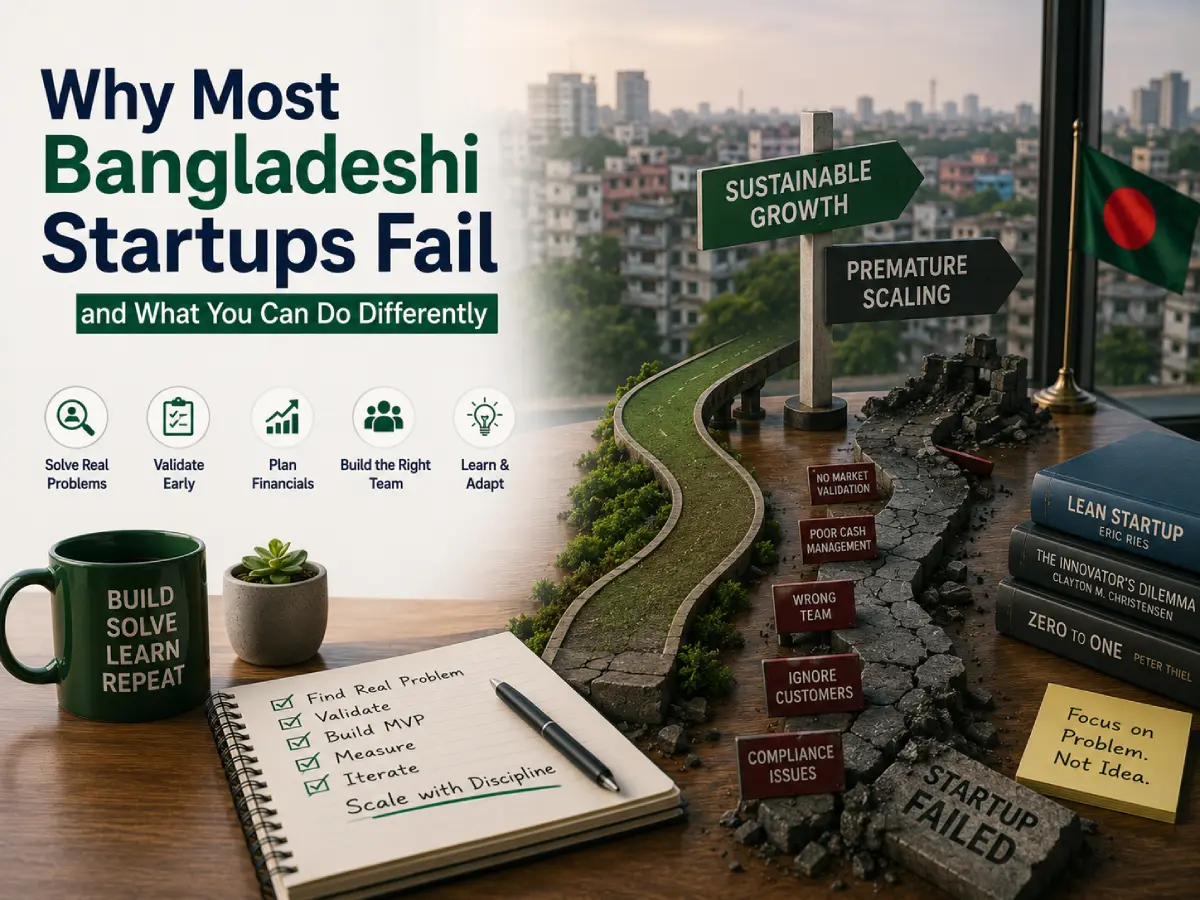
Why Most Bangladeshi Startups Fail — and What You Can Do Differently
Quick Answer: Most Bangladeshi startups fail because of poor market validation, weak financial planning, and founder-market mismatch, not lack of ideas or effort. The founders who survive focus on solving real problems, build lean, and learn from their market before scaling.
Customer Acquisition Strategies That Work for Bangladesh Startups
Quick Answer: The most effective customer acquisition strategies for Bangladesh startups combine low-cost digital channels (Facebook, WhatsApp Business, SEO), mobile financial service integration for frictionless payment, referral-driven growth, and hyperlocal targeting. Startups that blend paid acquisition with retention-focused tactics see the lowest long-term cost per customer.

Business Model Canvas Explained with Bangladesh Startup Examples
Quick Answer: The Business Model Canvas (BMC) is a one-page strategic framework with 9 building blocks: Customer Segments, Value Propositions, Channels, Customer Relationships, Revenue Streams, Key Resources, Key Activities, Key Partnerships, and Cost Structure. It helps founders map, test, and communicate their entire business model before writing a single page of a business plan.
Comments (0)
No comments yet. Be the first to share your thoughts!