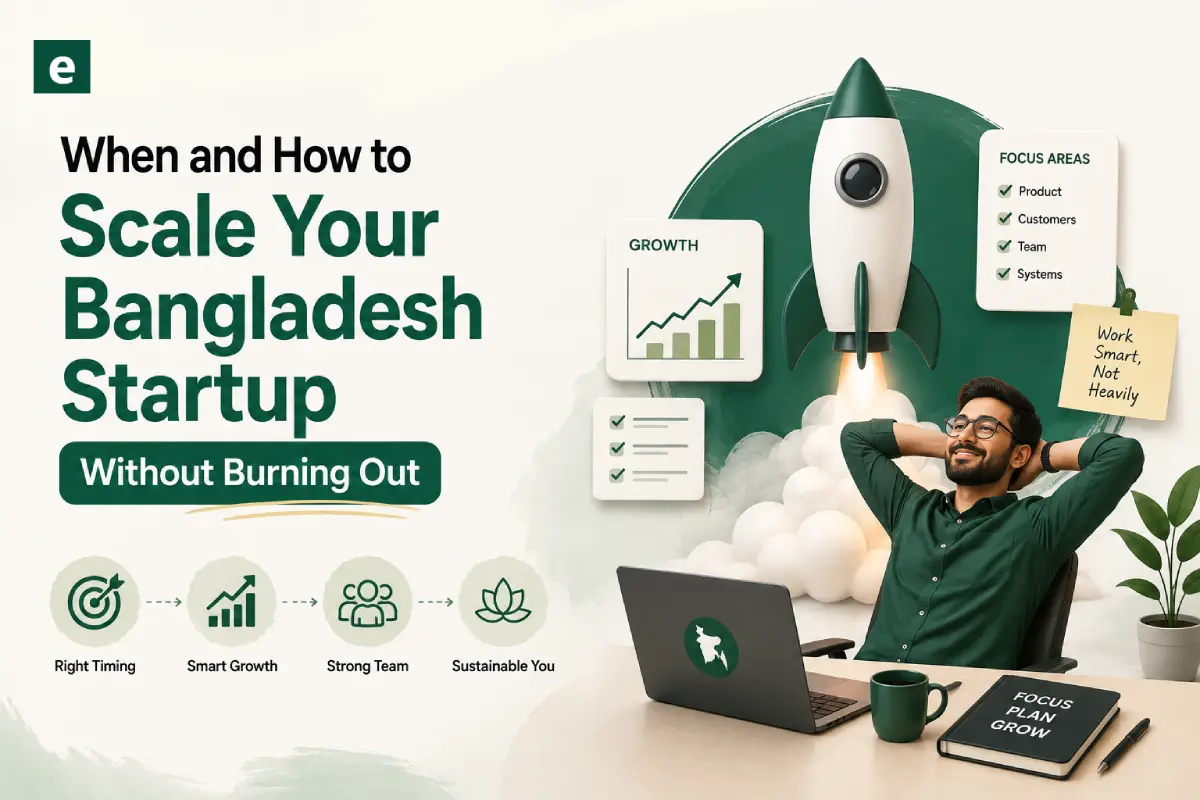
When and How to Scale Your Bangladesh Startup Without Burning Out
Quick Answer: Scale your Bangladesh startup when you have consistent revenue, a repeatable sales process, and a team that can run operations without you. Avoid burnout by delegating systematically, setting growth targets tied to capacity, not pressure, and separating founder energy from business momentum.
Key Takeaways
Scaling too early is one of the most common reasons Bangladeshi startups collapse in their second year
Revenue consistency matters more than revenue size before you scale
Burnout is a systems failure, not a personal weakness. Fix the structure, not yourself
Bangladesh's talent market, funding landscape, and operational costs create specific scaling conditions unlike India or Southeast Asia
The right time to scale is when the business pulls you forward, not when pressure pushes you
Starting a business in Bangladesh is hard. Keeping it alive past 18 months is harder. Scaling it without destroying your health, your team, and your original vision? That is where most founders quietly fail.
The problem is not ambition. Bangladesh has no shortage of hungry founders, from the Dhaka tech scene to apparel startups in Chattogram to agri-tech ventures in Sylhet.
The problem is a culture that celebrates hustle as strategy, treats exhaustion as proof of commitment, and treats scaling as something you do when you feel ready rather than when the business signals it is ready.
This article is a practical guide for founders who want to grow without breaking. It covers how to read the real signals that your startup is ready to scale, what sustainable scaling actually looks like in the Bangladesh context, and how to build systems that protect both your business and yourself.
What Scaling Actually Means (And What It Does Not)
Scaling is not the same as growing. Growth means you add resources in proportion to revenue, hire one more person, serve 10 more clients, or open one more location.
Scaling means your revenue grows faster than your costs. The unit economics improve as volume increases.
A Dhaka-based SaaS startup serving SMEs can scale: once the product is built, adding the 500th customer costs a fraction of what the first 50 cost.
A service business that sells consulting hours cannot scale the same way without fundamentally changing its model. Understanding which type of business you are running is the first step.
Many Bangladeshi founders conflate scaling with expansion, adding branches, hiring aggressively, or entering new cities.
These moves can be part of a scale strategy, but they are not scaling on their own. Expansion without systems is just complexity with higher overhead.
Signs Your Bangladesh Startup Is Ready to Scale
The decision to scale should come from data, not from investor pressure or the anxiety of watching competitors move fast.
Consistent, not just high, revenue:
If your last six months show stable or growing revenue with manageable variation, your business model has proved itself.
If you are still experiencing wild swings, great months followed by near-zero months, you have a demand problem, not a capacity problem. Scaling will amplify both.
A repeatable sales or acquisition process:
Can someone other than you close a deal or acquire a customer? If yes, you have a process.
If every new customer requires your personal involvement, you have a founder dependency, and scaling will stretch you across too many conversations at once.
Operational baseline:
Are your core operations documented, delegated, or automated to a degree that they run without your daily intervention?
If you went offline for a week, would the business survive? This baseline is a prerequisite for adding scale on top.
Positive unit economics:
In Bangladesh's competitive market, many founders chase growth while their cost per acquisition still exceeds customer lifetime value.
Before scaling, verify that each new customer, order, or contract is genuinely profitable at current pricing.
If you can confirm all four of these, your startup is signaling readiness. If you can confirm two or three, you are close; spend 60 to 90 days closing the gaps before committing.
Why Bangladeshi Founders Burn Out Faster Than They Should
Burnout in Bangladesh's startup ecosystem is systematically underreported. Founders talk about stress in private but project resilience in public because the culture treats struggle as proof of dedication. This creates a loop where founders normalize deterioration until it becomes a crisis.
Several local factors accelerate burnout in ways that are specific to the Bangladesh context.
Founder-as-everything culture:
Many early-stage Bangladeshi startups rely on the founder for sales, operations, hiring, product decisions, and investor relations simultaneously.
This is common in bootstrapped businesses and sometimes unavoidable at the seed stage, but founders who do not deliberately shed roles as the business grows will hit a wall.
Capital inefficiency pressure:
With access to institutional venture capital still limited compared to India or Indonesia, many Bangladeshi founders self-fund or rely on family capital, which creates intense personal financial pressure alongside operational pressure.
The Bangladesh Investment Development Authority has made strides in creating a more investor-friendly environment, but early-stage capital remains concentrated in Dhaka and largely relationship-dependent.
Talent gaps in middle management:
One of the most common complaints among scaling founders in Bangladesh is that they cannot find competent managers to delegate to.
Hiring a capable operations lead or head of growth is genuinely harder here than in more mature ecosystems, which means founders end up managing individual contributors rather than building leadership layers.
Lack of structured support:
While organizations like the Bangladesh Hi-Tech Park Authority and BASIS provide ecosystem support, many founders outside Dhaka operate in relative isolation without peer networks, mentors, or accountability structures that could catch early burnout warning signs.
A Sustainable Scaling Framework for Bangladesh Startups
Sustainable scaling is not about going slowly. It is about building capacity ahead of demand so growth does not require heroics every quarter.
Build before you need it:
The biggest mistake is waiting until you are overwhelmed to hire, document, or delegate.
By that point, every new employee is a drain rather than a multiplier because the founder is too stretched to onboard them properly. Hire your first key team member, operations, sales, or product, depending on your bottleneck, two to three months before you technically need them.
Document everything that repeats:
If a task happens more than twice a month, it needs a process document. This does not have to be elaborate.
A simple Google Doc or Notion page that captures how the task is done, who owns it, and what the quality bar looks like is enough to begin delegating. This is how you convert founder knowledge into business infrastructure.
Set capacity-based targets, not pressure-based targets:
Many founders set growth targets based on what investors expect or what competition appears to be doing.
Capacity-based targets ask instead: given our current team, systems, and cash position, what growth can we absorb without degrading quality or burning people out? Scale to that number, then build capacity for the next level.
Protect recovery time:
This is not a lifestyle suggestion; it is a performance variable. Founders who work seven-day workweeks for extended periods make worse decisions, communicate less clearly, and retain employees at lower rates.
Building genuine recovery time into your schedule is a business investment. Bangladesh's regulatory calendar, with public holidays and cultural moments like Eid and Pahela Baishakh, actually creates natural pause points; use them rather than resenting them.
Funding Scaling in Bangladesh: What Your Options Actually Are
Scaling requires capital. Understanding the realistic landscape in Bangladesh prevents founders from either waiting indefinitely for funding that may not come or taking the wrong type of capital at the wrong stage.
The Bangladesh Bank's SME and Special Programmes Department administers refinancing schemes for small and medium enterprises, with loan facilities available through commercial banks. These are practical options for established businesses with documented revenue, but are not designed for pre-revenue startups.
For tech startups, venture capital activity in Bangladesh has grown modestly but remains early-stage.
Most active investors prefer companies with proven product-market fit and some revenue history before committing.
Grants and equity-free funding through programs linked to the ICT Division of Bangladesh have supported early-stage digital ventures and are worth tracking.
Revenue-based financing, where repayment scales with revenue rather than fixed monthly installments, is increasingly used by e-commerce and D2C brands as an alternative to dilutive equity. Several regional fintech players now offer this instrument to Bangladeshi businesses.
The honest advice: bootstrap to first revenue, grow to a defensible unit economics baseline, then raise capital specifically to accelerate what is already working, not to figure out what works.
Frequently Asked Questions
How do you know if you are scaling too early?
What is the minimum team size needed to scale a Bangladesh startup?
Can a solo founder scale without burning out?
What are the most common scaling mistakes Bangladeshi startups make?
The most common mistakes are hiring for presence rather than output, entering new markets before the existing market is fully captured, and scaling marketing spend before the conversion funnel is optimized. Many founders also underestimate the time and cost of compliance as they grow. RJSC filings, VAT obligations through the NBR's VAT online portal, and labour law requirements all become more complex as headcount increases.
How should a founder handle team burnout during a scaling phase?
Is it better to scale vertically (deeper in one market) or horizontally (multiple markets)?
Horizontal expansion to new cities or customer segments requires duplicated management overhead and often dilutes focus at a stage when focus is your most valuable asset. Expand horizontally only after your vertical position is genuinely strong.
Scale the Business, Not Just the Pressure
The goal of scaling is a business that grows in a way that does not require you to sacrifice everything else. That sounds obvious, but the startup culture in Bangladesh, and globally, often celebrates the opposite.
Scaling sustainably means building systems, not grinding harder. It means hiring ahead of need, delegating below your ceiling, and setting targets your team can meet without burning out in the process.
It means knowing the difference between a business that is ready to grow and a founder who is just ready to escape the anxiety of staying small.
Bangladesh's startup ecosystem is maturing. There are more experienced operators, more institutional investors, and more sector-specific infrastructure than there was five years ago.
Founders who build with discipline now, rather than chasing growth at any cost, will be the ones still standing when the market rewards durability.
The best scaling decision you can make is the one that keeps you in the game for the next decade, not just the next quarter.

Specializing in SaaS product marketing, SEO strategy, Content marketing, TikTok advertising, PPC, and digital growth.
View Full Profile & ContributionsRelated Articles
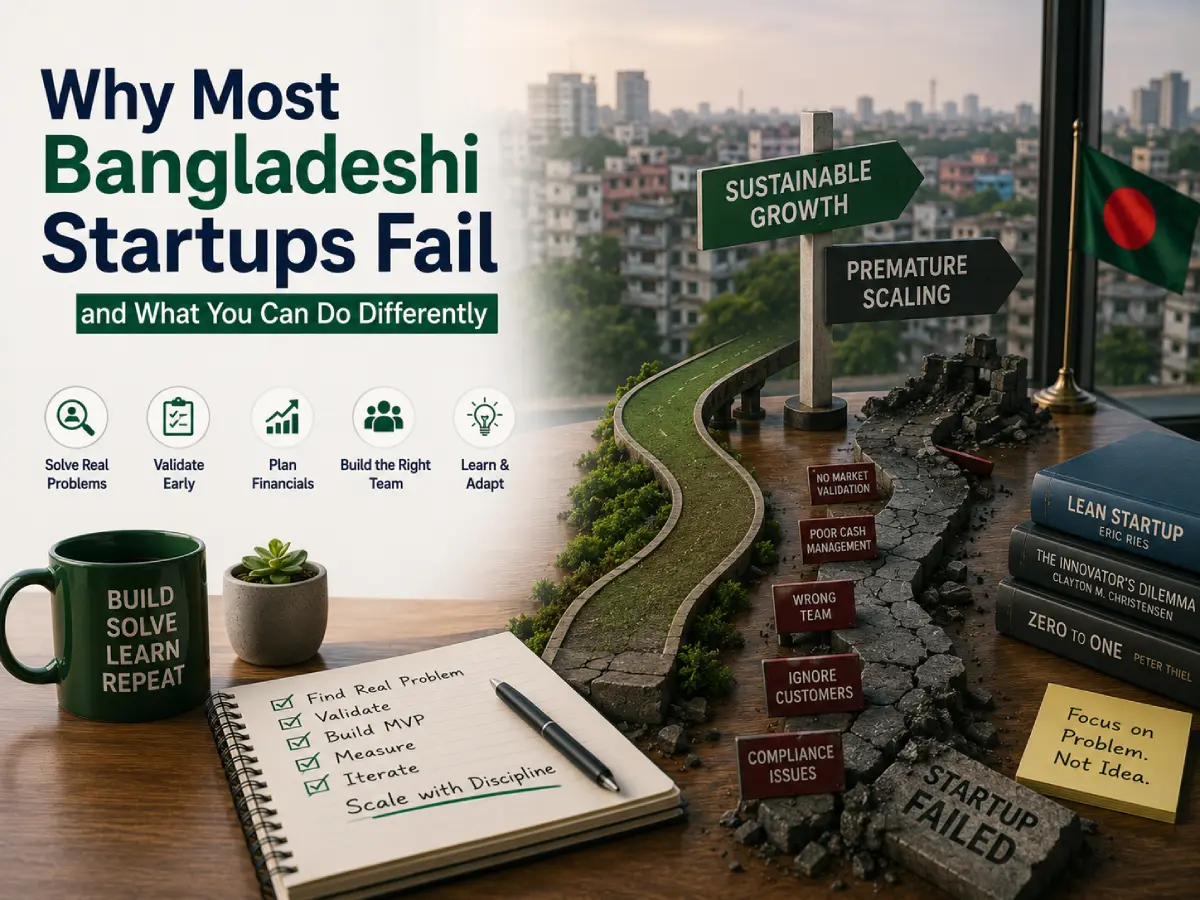
Why Most Bangladeshi Startups Fail — and What You Can Do Differently
Quick Answer: Most Bangladeshi startups fail because of poor market validation, weak financial planning, and founder-market mismatch, not lack of ideas or effort. The founders who survive focus on solving real problems, build lean, and learn from their market before scaling.
Customer Acquisition Strategies That Work for Bangladesh Startups
Quick Answer: The most effective customer acquisition strategies for Bangladesh startups combine low-cost digital channels (Facebook, WhatsApp Business, SEO), mobile financial service integration for frictionless payment, referral-driven growth, and hyperlocal targeting. Startups that blend paid acquisition with retention-focused tactics see the lowest long-term cost per customer.
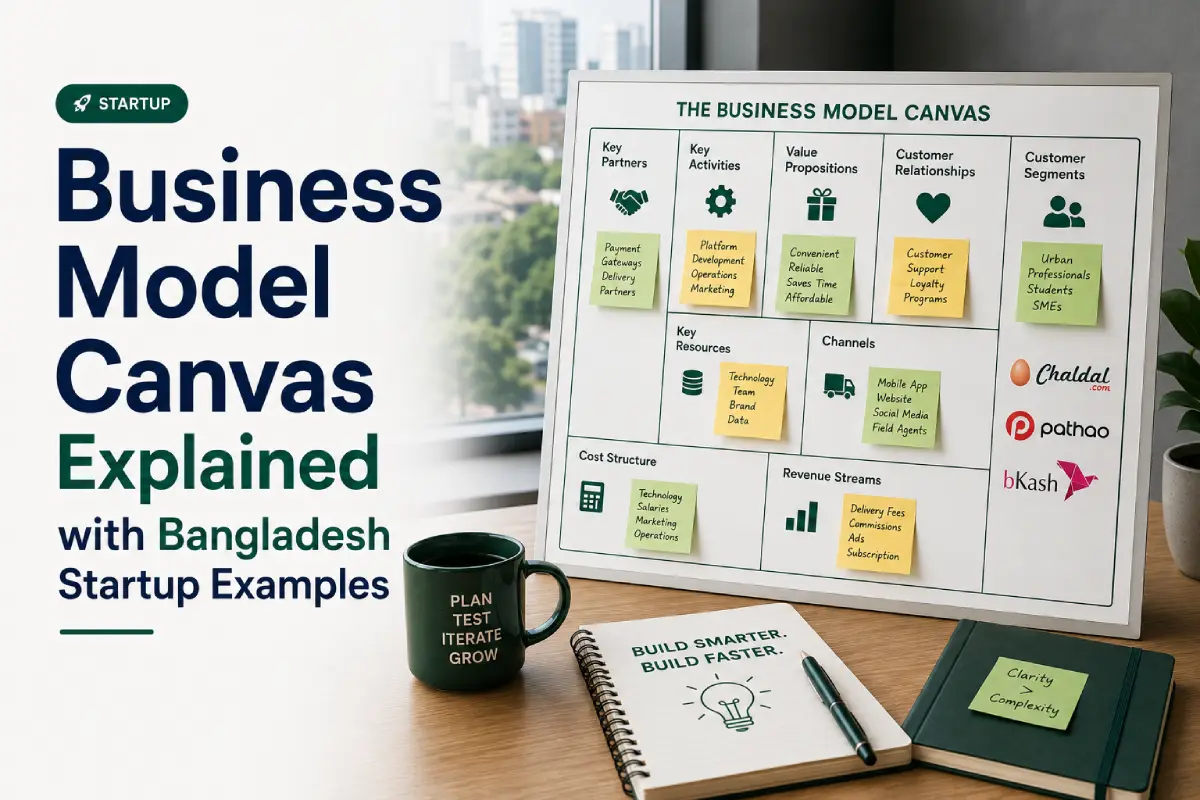
Business Model Canvas Explained with Bangladesh Startup Examples
Quick Answer: The Business Model Canvas (BMC) is a one-page strategic framework with 9 building blocks: Customer Segments, Value Propositions, Channels, Customer Relationships, Revenue Streams, Key Resources, Key Activities, Key Partnerships, and Cost Structure. It helps founders map, test, and communicate their entire business model before writing a single page of a business plan.
Comments (0)
No comments yet. Be the first to share your thoughts!