Why Data and Analytics Matter in Modern Entrepreneurship
Quick Answer: Data and analytics help entrepreneurs replace guesswork with evidence. Instead of relying on instinct alone, you use real numbers — from sales figures to customer behaviour — to make decisions that are faster, cheaper, and far more likely to succeed. In 2026, it is not a competitive advantage; it is a baseline requirement.
Key Takeaways
Global spending on big data and analytics is projected to exceed $420 billion by 2027, showing how central it has become to business strategy.
By 2026, 90% of analytics content consumers can generate their own reports using AI-powered tools — data is no longer only for specialists.
Retailers that adopt analytics-driven approaches see 5 to 6% higher sales and profit growth than those that ignore it.
For Bangladeshi entrepreneurs, analytics is most immediately useful in three areas: customer behaviour, marketing spend, and inventory or stock decisions.
You do not need expensive software to start — free tools like Google Analytics 4, Meta Business Suite, and Google Search Console cover most early-stage needs.
Every entrepreneur makes decisions constantly. What product to launch next? Which market to enter? How much to spend on Facebook Ads? Whether to hire a second person or hold off. For most new business owners in Bangladesh, these decisions come down to gut feeling, advice from friends, or copying what a competitor appears to be doing.
That approach works — until it does not. When it fails, the cost is real: wasted money, missed timing, a product nobody wanted. Data and analytics exist to reduce that cost.
This is not about becoming a data scientist or installing complex software. It is about learning to ask your business better questions, and then finding the numbers that actually answer them. In 2026, the tools to do this are more accessible than they have ever been — many of them free, most of them designed for non-technical users.
This guide explains what data and analytics mean for working entrepreneurs, why they matter more now than before, and how to start using them in a Bangladeshi business context without overcomplicating the process.
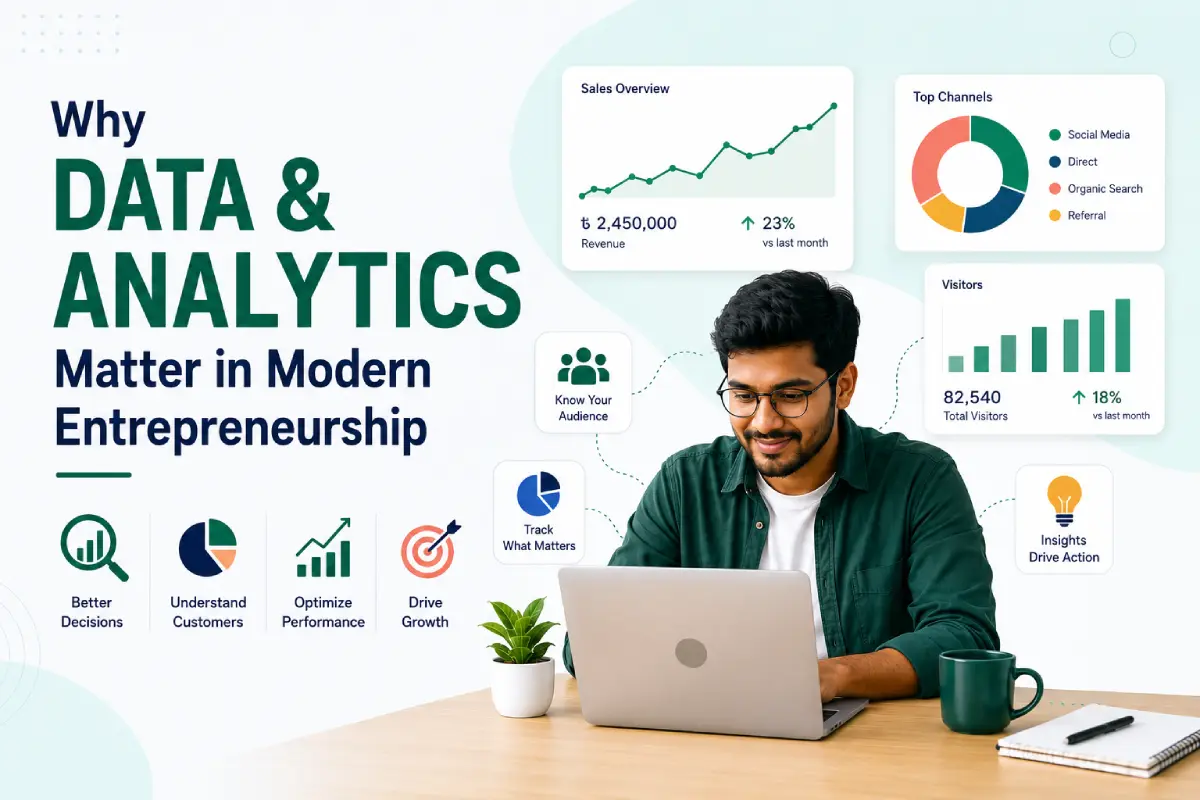
What Data and Analytics Actually Mean for a Small Business
People hear "data analytics" and imagine a team of engineers staring at code. For a small business or startup, it is far simpler than that.
Data is any piece of recorded information about your business: how many people visited your website, how many orders you received, which product sold fastest last month, and what your average customer spends per transaction.
Analytics is the act of examining data to find patterns and draw conclusions. It answers questions like: Why did sales drop in March? Which Facebook post drove the most purchases? Which product has the highest return rate?
You do not need complex tools for this at the start. A well-maintained spreadsheet, your Facebook page insights, and Google Analytics can give a new entrepreneur enough information to make significantly better decisions from day one.
The Business Case: What the Numbers Say in 2026
The scale of investment in data globally reflects how seriously businesses take it. According to projections cited by Refonte Learning's 2026 Business Analytics report, global spending on big data and business analytics is on track to exceed $420 billion by 2027, roughly doubling from $193 billion in 2019.
This is not just large corporation behaviour. Research published by Statista and cited by Coherent Solutions shows that retailers using AI and machine learning-powered analytics report 5 to 6% higher sales and profit growth than those that do not.
For a business doing BDT 10 lakh per month in revenue, a 5% improvement is BDT 50,000 in additional profit — from better information, not more work.
From Guesswork to Evidence: How Analytics Changes Decision-Making
The most immediate value of data is this: it removes assumptions from decisions that are too expensive to get wrong.
Without Data
A clothing entrepreneur in Dhaka launches three new designs based on what she personally likes. One sells well. Two sit in inventory for four months. She cannot tell which posts on her Facebook page actually drove orders versus which ones just got likes.
With Data
She checks her Meta Business Suite to see which posts generated link clicks, not just engagement. She tracks which product variants sold out first. She notices 70% of her buyers are from Chattogram, not Dhaka — so she runs a geo-targeted ad campaign in Chattogram for the next launch.
Same entrepreneur, same budget. Different results because she asked her business better questions and used the numbers to answer them.
The 4 Types of Analytics Every Entrepreneur Should Know
Not all analytics work the same way. Understanding the four types helps you pick the right approach for each question.
Type | What It Does | Example |
|---|---|---|
Descriptive | Tells you what happened | "Sales were down 15% in April" |
Diagnostic | Explains why it happened | "April sales dropped because traffic from Facebook fell by 40%" |
Predictive | Forecasts what might happen | "Based on last year, sales will spike in Ramadan" |
Prescriptive | Recommends what to do | "Increase ad spend in March to capture Ramadan demand early" |
New entrepreneurs should start with descriptive analytics — understanding what has already happened. As your data matures, the other three become more accessible and more valuable.
What Metrics Actually Matter for a Bangladeshi Startup
Tracking everything is as unhelpful as tracking nothing. Focus on the numbers that connect directly to business health.
For an Ecommerce or F-Commerce Business
Conversion Rate: What percentage of people who see your product actually buy it?
Average Order Value (AOV): How much does a typical customer spend per transaction?
Customer Acquisition Cost (CAC): How much do you spend to get one paying customer?
Return Rate: How often do customers return products, and which products trigger returns most?
Repeat Purchase Rate: Are customers coming back, or is every sale a one-time event?
For a Service Business
Lead-to-Client Rate: Of every 10 people who enquire, how many become clients?
Average Revenue Per Client: What does each client relationship earn over time?
Churn Rate: What percentage of clients stop using your service each month?
Pick three to five metrics that match your business model. Track them consistently, not just when something goes wrong.
Free Analytics Tools That Work for Early-Stage Entrepreneurs
You do not need a budget to start. These tools are free and sufficient for most businesses at the startup stage.
Google Analytics 4 (GA4): Tracks who visits your website — where they came from, how long they stayed, which pages they read, and whether they completed a purchase or enquiry. Set it up within a day; it costs nothing.
Google Search Console: Shows which keywords bring people to your site through Google Search, and flags technical errors that prevent your pages from ranking. Essential for anyone doing SEO.
Meta Business Suite: Provides detailed data on your Facebook and Instagram posts and ads — reach, engagement, link clicks, conversions, and audience demographics. Every Bangladeshi entrepreneur with a Facebook business page has access to this.
Google Sheets: For businesses that are not yet running a website, a structured spreadsheet tracking daily sales, product performance, and customer sources is a powerful starting point. Simple, free, and controllable.
Google Keyword Planner: Shows how many people search for specific terms in Bangladesh, which helps with content decisions and paid ad targeting.
Data Analytics in the Bangladesh Market: Why Local Context Matters
Applying global analytics frameworks to a Bangladeshi business without considering local behaviour leads to wrong conclusions. A few realities shape how data reads here.
Mobile dominates everything. According to BTRC data from January 2026, 114 million of Bangladesh's internet users access the web on mobile. If your website analytics show high bounce rates, the first question is not "is the content bad?" — it is "does the page load fast enough on a 4G mobile connection?"
Facebook is a primary business channel, not secondary. Over 300,000 sellers use Facebook pages as their primary storefront in Bangladesh. For these businesses, Meta Business Suite insights are the equivalent of a full analytics dashboard. Treat them seriously.
Payment behaviour is still evolving. Bangladesh Bank data shows digital transaction volume growing rapidly, with bKash processing over $30 billion annually. If your cart abandonment rate is high, payment friction — not product appeal — is often the real cause. Analytics can reveal this pattern.
Tier-2 and Tier-3 cities are underserved and underanalyzed. Many entrepreneurs assume their customers are in Dhaka. Analytics frequently show otherwise. A geo-breakdown of your Meta Ads or GA4 audience might reveal strong demand in Sylhet, Khulna, or Rajshahi — cities where competition and ad costs are lower.
How to Build a Simple Analytics Habit (Without Hiring Anyone)
Consistency matters more than complexity. A 30-minute weekly review of your key metrics will outperform a monthly deep dive that never actually happens.
A Simple Weekly Routine
Check sales figures for the past 7 days against the previous 7 days.
Open Meta Business Suite — which content drove the most link clicks?
Open GA4 — where did your website traffic come from?
Note one thing that performed better than expected and one that underperformed.
Make one small change based on what you found.
That is it. Five steps, 30 minutes, done once a week. Over three months, you will know more about your business than most of your competitors know about theirs.
Common Analytics Mistakes Entrepreneurs Make
Knowing what not to do saves as much time as knowing what to do.
Tracking vanity metrics. Likes, follower counts, and post reach feel good but rarely connect to revenue. Focus on metrics that link to money: clicks, conversions, revenue per customer.
Collecting data but never acting on it. Data without a decision is just storage. Every review session should end with at least one change based on what the numbers showed.
Comparing to the wrong benchmarks. Comparing your email open rate to a US industry average is not useful when your audience is in Dhaka. Build your own historical baseline and compare against that.
Waiting until you have "enough" data. There is no such thing as enough data before you start. Begin tracking from your first sale, your first website visitor, your first Facebook post.
Ignoring qualitative input. Numbers tell you what is happening. Conversations with customers tell you why. The best entrepreneurs combine both.
When to Invest in Paid Analytics Tools
Free tools cover most early-stage needs. Paid tools make sense when you outgrow them — specifically when you need to:
Track customer journeys across multiple channels (website, email, paid ads) in one place
Automate reporting that currently takes several hours per week
Run A/B tests at a scale that free tools do not support
Build custom dashboards for a growing team
Platforms like Hotjar (user behaviour recording), Klaviyo (email analytics), and Semrush (SEO analytics) all offer meaningful free tiers before requiring payment. Explore free tiers thoroughly before committing to a monthly subscription.
The Entrepreneur Who Counts Wins
Bangladesh's business environment is getting more competitive, not less. E-commerce crossed $3 billion in annual transactions in 2025 and is growing at 25 to 30% annually, according to Bangladesh digital market data from Agent Wise X. More entrepreneurs are entering the market every month. The ones who survive long term are rarely the ones with the best instincts. They are the ones who learn fastest.
Data and analytics are the fastest learning loop available to any entrepreneur. Every sale, every customer visit, every ad click is a piece of feedback your business is already generating. The only question is whether you are reading it.
Start with three metrics. Track them weekly. Make one decision per week based on what you find. In six months, that habit will have changed how you run your business — not because analytics is magic, but because consistent evidence beats consistent guessing every time.
Your business is already producing data. It is time to use it.
Frequently Asked Questions
Do I need technical skills to use data analytics as an entrepreneur?
Which single metric should a new entrepreneur in Bangladesh track first?
How is data analytics different from market research?
Can a small F-Commerce business in Bangladesh benefit from analytics?
How do I know if my analytics data is reliable?

Specializing in SaaS product marketing, SEO strategy, Content marketing, TikTok advertising, PPC, and digital growth.
View Full Profile & ContributionsRelated Articles

Business Registration in Bangladesh: All Legal Structures Explained
Quick Answer: Business registration in Bangladesh depends on your chosen legal structure. A sole proprietorship is registered via a trade license at your local city corporation. Partnerships and private limited companies are registered through the Registrar of Joint Stock Companies and Firms (RJSC). Each structure has different liability, tax, and compliance implications.
Facebook Marketing for Bangladeshi SMEs: Strategy, Ads, and ROI
Quick Answer: Facebook marketing for Bangladeshi SMEs involves building an optimized Business Page, posting consistently for organic reach, and running targeted paid ads using Meta Ads Manager. With over 50 million Facebook users in Bangladesh and low ad costs compared to Western markets, SMEs can generate strong ROI even on modest budgets of BDT 5,000–20,000 per month.

What Is an MVP? How Bangladeshi Founders Can Build One on a Budget
Quick Answer: An MVP (Minimum Viable Product) is the simplest version of your product that solves a real problem for real users. For Bangladeshi founders, building one on a budget means validating your idea with minimal investment before spending on full development. You test, learn, and iterate before committing significant resources.
Comments (0)
No comments yet. Be the first to share your thoughts!