How to Write a Business Plan in Bangladesh: Template, Tips, and Mistakes to Avoid
To write a business plan in Bangladesh, explain what you sell, how you earn money, who buys, how you operate, and who runs the business. Then add milestones, BDT financial projections, a funding request, and key risks. Requirements vary by bank, investor, and program, so always check what your specific reader asks for.
Key Takeaways
A business plan is a decision tool first and a funding document second
Document requirements differ by bank, loan product, and program, so check them before writing
The SME Foundation publishes a free business plan template in English and Bangla
Break-even tells you the sales needed to cover costs, while runway tells you how long your cash lasts
2026 tax changes, including startup VAT and turnover tax relief, can reshape your projections
Many business plans lose their reader early. The key numbers sit buried under pages of general market statistics, and the document never clearly explains how the business will earn enough cash to cover its costs and repay any financing.
Knowing how to write a business plan in Bangladesh means writing for local readers, local costs, and local risks. A plan for a Mirpur garments workshop and a plan for a Dhaka software startup can share a structure, but their assumptions and risks differ.
If you have already sketched your idea on a Business Model Canvas, you have useful raw material. The business plan expands that one-page map into a written case with evidence, timelines, and taka figures.
This guide gives you a section-by-section template with fill-in formats, shows how to build financial projections, explains how bank and investor plans differ, and covers common mistakes in first drafts.
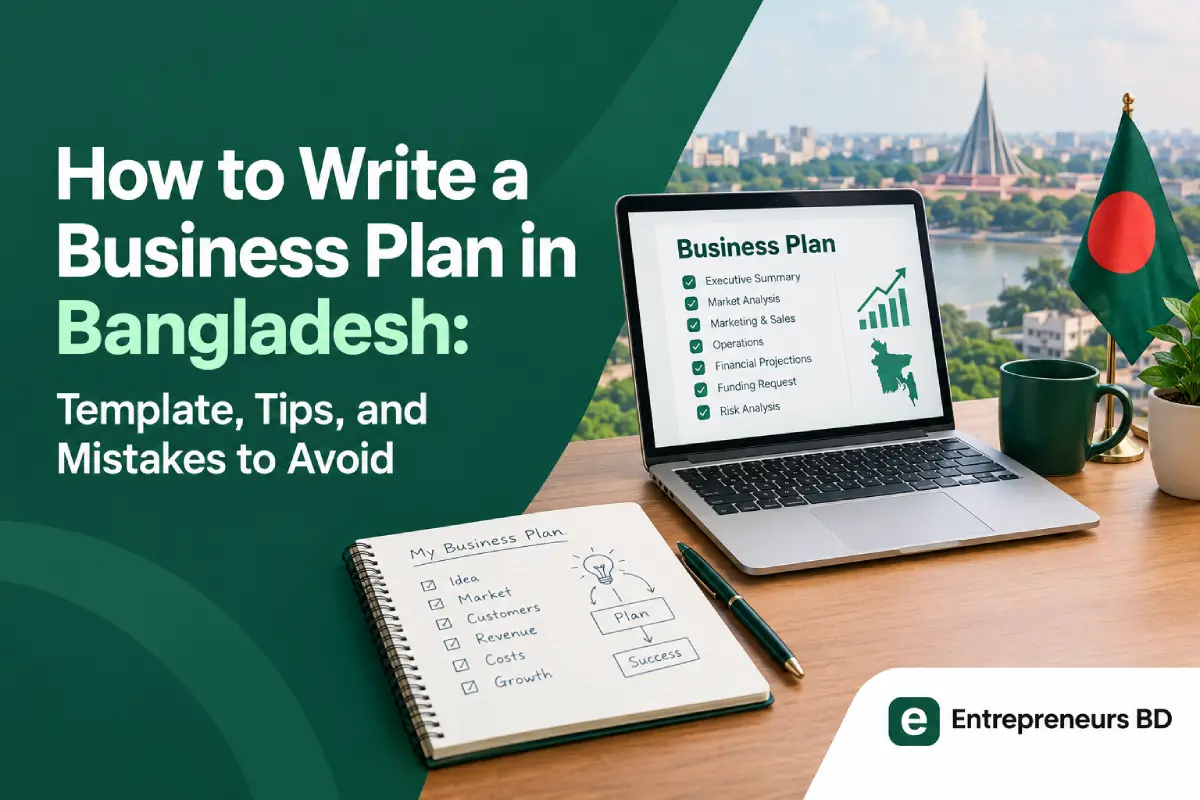
What a Business Plan Does in Bangladesh
A business plan is a written document that explains what your business sells, who buys it, how it operates, and how it will earn money and repay any financing. It serves three readers: you, as a decision tool; lenders, who assess repayment capacity; and investors, who assess growth potential.
Lenders are where many Bangladeshi founders first need the document. Bangladesh Bank's SME loan FAQ lists a realistic business plan, based on the enterprise's actual income, expenses, and loan requirements, among the steps in loan processing. Individual banks set their own document lists, though, and these differ by loan product, business type, and borrower.
For that reason, get the lender's current checklist before you write. Our guide to SME loans in Bangladesh covers the documents banks commonly request alongside a plan or cash flow projection.
The Bangladesh Bank Startup Fund in 2026
Startups have a dedicated credit channel, set out in a master circular Bangladesh Bank issued on July 9, 2025. Under it, Bangladeshi citizens aged 21 and above can apply for startup loans through banks and financial institutions at an interest rate capped at 4%. The central bank's circulars are published on its SMESPD circulars page.
The scheme works through refinancing. As BSS reported, banks and financial institutions draw refinancing support from a Tk 500 crore Startup Fund to distribute these loans. Operating startups remain eligible if they are no more than 12 years old from registration. The maximum loan ranges from Tk 2 crore to Tk 8 crore, depending on the startup's development stage.
The circular also added an equity route. Each bank's own Startup Fund now provides equity investment only. The Bangladesh Startup Investment Company (BSIC), launched in May 2026, provides equity for companies at the late-seed and Series A stages. The participating bank still makes the credit decision on any loan, so your plan must stand up to that bank's own review.
Business Plan Template for Bangladesh: Section by Section
You do not need to invent a structure. The SME Foundation's business plan template is a useful local reference. It is designed to fit any type of business and includes marketing, operations, organization and management, and financial plan sections. The template was uploaded in 2021 in English and Bangla versions, so pair it with current lender requirements.
The template below expands on that structure. Each section includes what to write and, where helpful, a fill-in format.
1. Executive Summary
Write this section last and keep it to about one page. It should let a reader understand the whole proposal without reading further.
Use this fill-in structure:
Business name: [name]
Legal form: [sole proprietorship / partnership / private limited]
Location: [city, area]
Product or service: [what you sell, in one sentence]
Target customer: [who buys, specifically]
Current status: [idea / pilot / operating since (year), monthly sales of BDT (amount)]
Funding required: BDT [amount], as [loan / equity / grant]
Use of funds: [main categories]
Owner contribution: BDT [amount]
Repayment or return source: [how the money comes back]
Key milestone for the next 12 months: [one measurable goal]
2. Business Description and Legal Structure
State the business name, founding date, location, and legal form. Include the status of your trade license, TIN, BIN, and any sector permits your business needs.
Explain why the location suits the business. A wholesale shop in Chawkbazar and a cloud kitchen in Gulshan have very different rent, footfall, and delivery logic.
3. Products, Services, and Business Model
Describe each product or service, its price, and the customer problem it solves. Then explain how the business makes money.
Cover the revenue model (one-time sales, subscriptions, commissions, contracts), your pricing logic, gross margin per product line, and whether revenue repeats. A reader should finish this section knowing exactly where each taka of revenue comes from.
4. Market Analysis
Define your target customer narrowly. "Middle-class families in Dhaka" is too broad. "Working parents in Mohammadpur and Dhanmondi who order groceries weekly" gives you something you can measure.
Back your claims with primary evidence: customer conversations, pre-orders, pilot sales, or a small paid advertising test. The SME Foundation's business start-up guide suggests testing an idea with 20 to 50 potential customers or a small Facebook ad, which is a practical starting range. If you have not tested demand yet, work through validating a startup idea first.
Name your real competitors, including informal ones such as neighborhood shops, and explain why customers would switch to you.
5. Marketing and Sales Plan
List each sales channel with its expected cost and result: Facebook ads, f-commerce pages, dealer networks, marketplace listings, or direct corporate sales.
Model payment behavior honestly. If orders arrive as cash on delivery, include courier charges, return rates, and the delay before collected cash reaches your account. If you sell to distributors, retailers, or corporate buyers on credit, use the actual payment terms in your cash flow rather than assuming cash arrives when you record the sale.
6. Operations Plan
Cover suppliers, production or sourcing, inventory, delivery, staffing, and technology. Importers should include LC processes and shipment lead times. Manufacturers should include capacity limits and power backup.
Operations choices can shape the entire cost structure. Chaldal, for example, holds its own inventory in its warehouses and delivers with its own fleet, choices that affect its costs, delivery reliability, and stock control. Your operations section should explain choices like these and what they cost.
7. Management and Organization
List the founders and key hires, their relevant experience, and who is responsible for finance, sales, and operations. Name the skill gaps openly and explain how you plan to fill them.
Address continuity too. The SME Foundation template asks who will manage the business when the proprietor is absent, which is worth answering in any plan.
8. Milestones and Implementation Timeline
A plan needs dated, measurable goals, not just intentions. This table format works for most businesses:
Milestone | Target date | Cost (BDT) | Owner | Evidence of completion |
|---|---|---|---|---|
Equipment purchased and installed | [month, year] | [amount] | [name] | Invoices, installation report |
Launch of first product line | [month, year] | [amount] | [name] | First sales recorded |
First 100 paying customers | [month, year] | [amount] | [name] | Sales records |
First month with positive operating cash flow | [month, year] | n/a | [name] | Monthly cash flow statement |
Second hire or expansion step | [month, year] | [amount] | [name] | Appointment letter or lease |
9. Financial Plan
This section contains your start-up cost breakdown, sales forecast, profit and loss projection, cash flow statement, break-even analysis, and runway. The next H2 explains how to build these. For budgeting and cash management beyond the plan itself, see our guide to startup financial planning.
10. Funding Request and Use of Funds
State exactly what you are asking for and where each taka goes. Use this format:
Total funding required: BDT [amount]
Type of financing: [term loan / working capital / equity / grant]
Owner contribution: BDT [amount] ([percentage]% of total project cost)
Proposed repayment period or investment horizon: [months or years]
Repayment or return source: [cash flow from operations, specific contracts, etc.]
Use of funds | Amount (BDT) | Share of total |
|---|---|---|
Equipment and machinery | [amount] | [%] |
Inventory and raw materials | [amount] | [%] |
Rent advance and fit-out | [amount] | [%] |
Marketing and launch | [amount] | [%] |
Working capital reserve | [amount] | [%] |
For an equity request, add the valuation, the ownership share on offer, and what the investment should achieve before the next round.
11. Risks
List the main risks with a response to each. Examples include taka depreciation for import-dependent businesses, dependence on a single supplier or buyer, regulatory and tax changes, and delivery disruptions.
Appendix
Attach supporting documents: trade license, TIN certificate, supplier quotations, rental agreement, historical financial statements if the business is already operating, and any letters of intent from buyers. Include whatever your specific lender or program lists as required.
How to Build Business Plan Financial Projections
Start with the business's underlying sales and cost drivers, not a revenue target picked in advance. For a retailer, the drivers might be footfall and average basket size. For a manufacturer, production capacity and machine hours. For a consultancy, billable days and day rates. For an online store, traffic, conversion rate, and order value.
The Core Financial Statements
Statement | Typical detail | What it shows |
|---|---|---|
Start-up costs | One-time list | Everything needed before the first sale, including deposits and licenses |
Sales forecast | Monthly for the first year | Expected volumes and revenue, built from your drivers |
Profit and loss | Annual, for your planning horizon | Whether the business is profitable after all costs |
Cash flow statement | Monthly for the first year | Whether cash covers expenses and repayments month by month |
Break-even analysis | Single calculation | Sales volume or revenue needed to cover total costs |
Runway | Single calculation | How many months your cash lasts before operations sustain themselves |
A three-year projection is a common planning horizon, but no single horizon applies to every reader. Check what your lender, investor, or program requests, and break the first year into monthly figures where detailed cash planning matters.
Break-Even vs Runway
These are different calculations, and plans often confuse them.
Break-even tells you the sales volume at which the business covers all its costs. The basic formula is fixed costs divided by contribution per unit (price minus variable cost). If your monthly fixed costs are Tk 3,00,000, you sell a product for Tk 500, and each unit costs Tk 300 in materials and delivery, you need to sell 1,500 units a month to break even.
Runway tells you how long your cash lasts. Divide the cash you have by your net monthly cash outflow. With Tk 12,00,000 in the bank and a net monthly outflow of Tk 2,00,000, your runway is six months. A strong plan shows break-even arriving before the runway ends.
Costs Specific to Bangladesh
Check your cost list against these items, which plans frequently leave out:
Rent advances, which some commercial landlords require upfront
VAT or turnover tax, depending on your business's turnover, supplies, and eligibility for relief
Merchant and cash-out fees on bKash, Nagad, and card payments
Courier charges and return costs on cash-on-delivery orders
Trade license renewal, fire license, and sector-specific permits
Accounting, audit, and legal fees, especially for private limited companies
Generator or IPS costs where power interruptions affect operations
VAT and Tax Assumptions for 2026
NBR's VAT registration guide states that every business needs a Business Identification Number (BIN) and that applying for VAT registration is free. The standard VAT rate is 15%, but whether you charge VAT, pay turnover tax, or qualify for relief depends on your turnover, the nature of your supplies, and your eligibility for exemptions.
Tax rules shifted in 2026, so do not rely on older figures. The Finance Act 2026, in force from July 1, 2026, revised several VAT provisions, and some of NBR's online guidance pages have not yet been updated to match. The FY2026-27 budget also introduced zero turnover tax and VAT relief until 2035 for startups that qualify under Bangladesh Bank's startup circular. If your business might qualify, the difference can materially change your projected costs, so confirm your position with NBR or a qualified VAT consultant before finalizing the numbers.
For tax planning, make sure your projections reflect Bangladesh's applicable income-year rules. For reporting, follow your own accounting period and any format your lender requests.
Base, Downside, and Upside Cases
Prepare three scenarios and state the assumptions behind each:
Base case: your most realistic estimate of sales, costs, and timing
Downside case: lower sales, slower collections, or higher costs than expected
Upside case: faster growth, used mainly for investor discussions
Showing the downside case helps readers see whether the business can still meet its obligations when conditions turn against it.
Bank vs Investor Business Plans in Bangladesh
The same business needs a different emphasis depending on who reads the plan.
Area | Bank-focused plan | Investor-focused plan |
|---|---|---|
Central question | Can the business repay on schedule? | Can the business grow into something much larger? |
Financial focus | Monthly cash flow, existing debt, repayment capacity | Growth rate, unit economics, gross margin, burn rate |
Track record | Historical financials and repayment history, where available | Traction: users, revenue growth, retention |
Security | Collateral or guarantor, if the loan product requires it | Not usually relevant |
Owner commitment | Owner contribution to the project | Founder commitment and team strength |
Use of money | Specific assets or working capital needs | Milestones the investment will reach before the next round |
Ownership terms | Loan amount, tenure, and repayment schedule | Valuation, equity offered, and exit or liquidity considerations |
For a bank, lead with cash flow, existing borrowing, repayment history, and any collateral or guarantor requirements the lender specifies. Keep growth language modest.
For an investor, lead with the market opportunity, traction, and team. Investors usually see a short deck first, so pair the full plan with a startup pitch deck that summarizes it.
For a grant or government program, emphasize whatever the program's criteria reward, such as job creation, women's participation, district-level reach, or technology adoption.
Common Business Plan Mistakes to Avoid
Using a Template Without Localizing It
Templates designed for other countries often assume different tax rules, payment methods, and regulatory steps. Adjust the assumptions, costs, taxes, payment channels, and market data to Bangladeshi conditions.
Sizing the Market From the Top Down
"If we capture 1% of the country's population" is not a market analysis. Build from the bottom up: customers you can realistically reach, multiplied by a realistic conversion rate, multiplied by the average order value.
Confusing Profit With Cash
A business can show a profit and still run out of cash while waiting for customers to pay. Your cash flow statement should reflect when money actually arrives, not when you record the sale.
Leaving Out Compliance Costs
Founders often budget for equipment and forget license renewals, VAT compliance, accounting, audit, and legal costs. These add up, particularly for private limited companies.
Using Outdated Tax Figures
Tax and VAT rules changed with the Finance Act 2026. Projections built on older thresholds or rates can misstate your costs, so check the current rules before you finalize the numbers.
Ignoring What the Reader Asked For
A detailed plan in the wrong format can slow an application. Follow the lender's or program's required structure and document list before adding anything extra.
Treating the Plan as a One-Time Document
A plan written for one application and never revisited drifts from reality quickly. Compare actual results with your projections regularly and update the assumptions that turn out wrong.
Practical Steps to Write Your First Draft
A focused two-week schedule works well as a starting point, though complex businesses may need longer.
In the first few days, gather evidence: speak with potential customers, collect supplier quotations, and confirm the document requirements of your target lender or program. Next, build the financial model, because the numbers usually force changes to other sections.
Then write the business description, products and business model, market, marketing, operations, management, milestones, and risk sections. Finish with the funding request, executive summary, and appendix.
Before submitting, ask someone with relevant experience to review it: an accountant, a banker, or a founder who has raised funding. Their questions will show you what is missing or unclear.
Frequently Asked Questions
Is a business plan required to register a company in Bangladesh?
How long should a business plan be?
Can I write my business plan in Bangla?
Should I hire a consultant to write my business plan?
How many years of financial projections do I need?
What is the difference between a business plan and a business model canvas?
Keep Your Business Plan in Step With Reality
A business plan in Bangladesh works best as a working document rather than a one-time formality. It captures your thinking before real money is at risk, and it becomes a useful benchmark once the business is operating.
Start with the SME Foundation template or your lender's required format. Build your projections from real sales and cost drivers, include the costs specific to operating in Bangladesh, and check them against the 2026 tax rules. Then shape the emphasis around your reader, whether that is a bank, an investor, or a grant program.
Once the business is running, compare projected results with actual results each month. Update your assumptions when rent, courier rates, supplier prices, tax rules, or customer demand change.
Set a date one month after finishing the plan to review your actual numbers against it. That review will show you which assumptions held, which did not, and what to adjust next.

Specializing in SaaS product marketing, SEO strategy, Content marketing, TikTok advertising, PPC, and digital growth.
View Full Profile & ContributionsRelated Articles
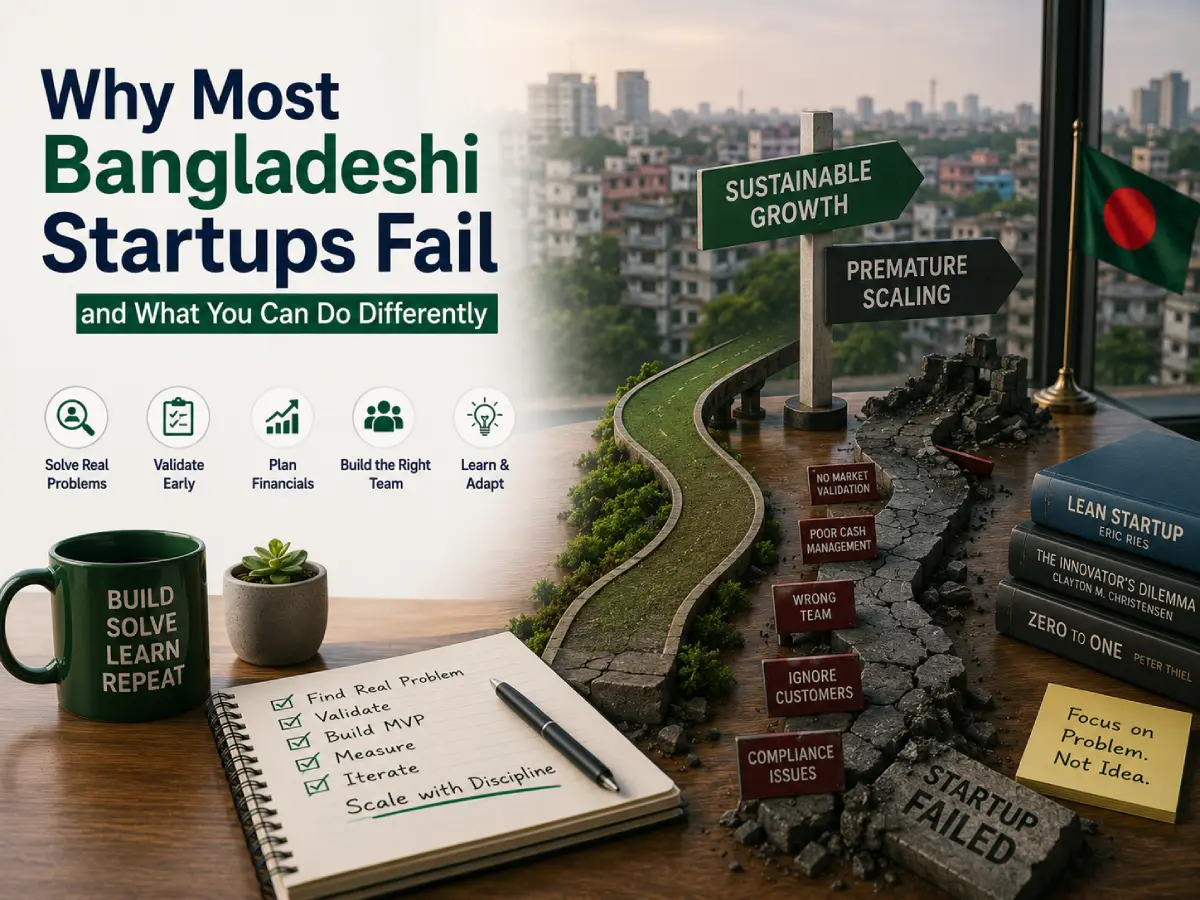
Why Most Bangladeshi Startups Fail — and What You Can Do Differently
Quick Answer: Most Bangladeshi startups fail because of poor market validation, weak financial planning, and founder-market mismatch, not lack of ideas or effort. The founders who survive focus on solving real problems, build lean, and learn from their market before scaling.
Customer Acquisition Strategies That Work for Bangladesh Startups
Quick Answer: The most effective customer acquisition strategies for Bangladesh startups combine low-cost digital channels (Facebook, WhatsApp Business, SEO), mobile financial service integration for frictionless payment, referral-driven growth, and hyperlocal targeting. Startups that blend paid acquisition with retention-focused tactics see the lowest long-term cost per customer.
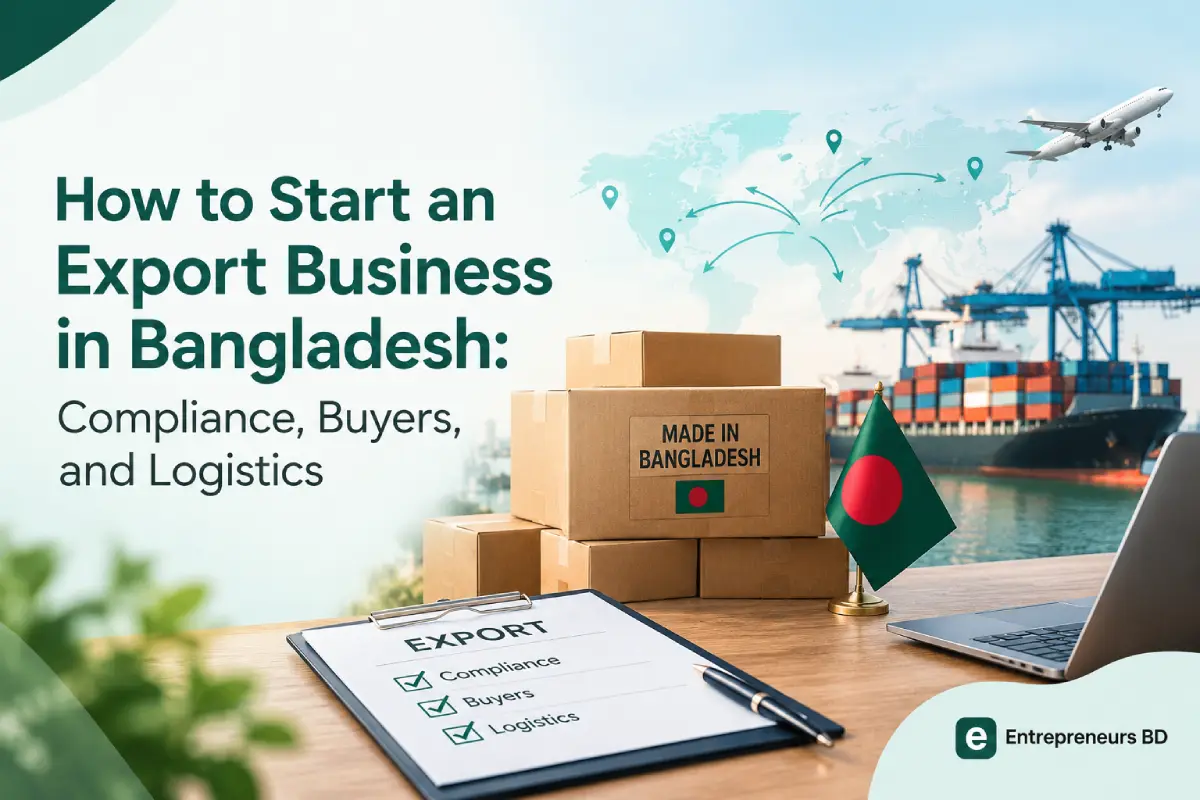
How to Start an Export Business in Bangladesh: Compliance, Buyers, and Logistics
To start an export business in Bangladesh, set up your business with a trade license and tax registration, open a bank account with an authorized dealer bank, and get an ERC from CCI&E. Then confirm your HS code, BIN and product permits, check the buyer's import rules, agree payment terms, and repatriate proceeds within four months.
Comments (0)
No comments yet. Be the first to share your thoughts!