Microfinance for Bangladesh Entrepreneurs: Which MFIs Support Business Growth
In Bangladesh, MRA-licensed microfinance institutions such as BRAC, ASA, BURO Bangladesh, and TMSS offer the largest microenterprise (ME) loans for growing a small business. PKSF also channels wholesale funds to smaller partner organizations. Compare loan size, interest rate, and collateral rules before choosing, since ME loans differ sharply from basic microcredit.
Key Takeaways
BRAC and ASA together hold more than half of all microenterprise loan outstanding among Bangladesh's top 20 MFIs.
Microenterprise (ME) loans are larger and more business focused than standard microcredit.
PKSF acts as the main wholesale funder for smaller MFIs through its Agrosor program.
Bangladesh Bank refinances CMSME loans through banks and finance companies, not directly to entrepreneurs.
Dhaka and Chattogram divisions carry the largest share of MFI branches and loan outstanding.
Bangladesh built one of the world's most extensive microfinance sectors. It now serves tens of millions of borrowers.
For most small business owners, microfinance is not just about survival level credit. A growing number of institutions now offer microenterprise, or ME, loans built for people scaling an existing business.
This article breaks down which microfinance institutions actually support business growth, not just subsistence lending. It uses the role SMEs play in the economy as a starting point, then moves into the specific institutions, loan sizes, and government-backed schemes an entrepreneur can realistically access.
You will see where BRAC and ASA fit, what PKSF does behind the scenes, and how Bangladesh Bank's refinance schemes connect to the loan you might get from your local branch.
How Microfinance Works for Business Growth in Bangladesh
Bangladesh's microfinance sector runs through several parallel channels. Understanding the difference matters before you apply anywhere.
The Microcredit Regulatory Authority, or MRA, licenses and supervises NGO-run microfinance institutions. 693 MRA-licensed MFIs were operating through 27,113 branches nationwide.
These MFIs served 43.98 million members and 33.68 million active borrowers. Grameen Bank, government departments, and scheduled banks run separate microfinance windows outside MRA's direct supervision.
Within this landscape, two loan categories matter most for a business owner. Microcredit is the smaller, subsistence style loan most people associate with the sector.
Microenterprise, or ME, loans are different. They are sized for someone who already has a small business and needs working capital or expansion funds.
In FY2024-25, ME loans made up about 40 percent of combined ME and microcredit disbursement among MFIs. That share has been rising steadily each year.
This shift matters if you are running a shop, workshop, or small farm operation and want a loan proportional to your revenue. Understanding the wider funding landscape helps you see where ME loans sit relative to bank credit or equity.
Top MFIs Offering Microenterprise Loans in Bangladesh
Not every MFI is set up for business scale lending. A small number of large institutions dominate ME lending nationally.
As of June 2025, the top 20 MFIs served 4.14 million ME borrowers combined. Their ME loan outstanding totaled BDT 570.96 billion, against BDT 810.67 billion disbursed.
BRAC leads by a wide margin. Its ME loan outstanding stood at BDT 213.31 billion, which is 37.36 percent of the entire top 20 group's ME portfolio.
ME loans also make up nearly half of BRAC's own book. They account for 49.62 percent of its total loan outstanding of BDT 429.93 billion.
ASA ranks second. Its ME loan outstanding was BDT 87.50 billion, or 15.33 percent of the top 20 group's total.
Combined, BRAC and ASA hold over 53 percent of all ME loan outstanding among the top 20 institutions. That concentration is worth knowing before you shop around.
Below the top two, a second tier of MFIs still runs meaningful ME programs.
MFI | ME Loan Outstanding (million BDT) | Total Loan Outstanding (million BDT) |
|---|---|---|
BRAC | 213,308 | 429,926 |
ASA | 87,500 | 273,575 |
Jagorani Chakra Foundation | 43,527 | 54,754 |
TMSS | 30,932 | 64,446 |
BURO Bangladesh | 20,724 | 114,617 |
Sajida Foundation | 22,698 | 36,027 |
Jagorani Chakra Foundation stands out here. Its ME loans make up nearly 80 percent of its total loan book, suggesting a deliberate focus on business lending rather than broad microcredit.
BURO Bangladesh takes a different approach. It carries a large total loan portfolio but a comparatively smaller ME share, spreading risk across product types.
If your business needs a bigger loan, BRAC or ASA branches are the most likely to have the product and processing experience. If you want a lender specialized in enterprise credit, Jagorani Chakra Foundation or Sajida Foundation are worth a direct inquiry.
Bangladesh Context: PKSF and Government Backed Refinance
Behind many smaller MFIs sits a single wholesale funder most borrowers never deal with directly. Palli Karma Sahayak Foundation, or PKSF, was established by the government in 1990 for exactly this purpose.
PKSF does not lend to entrepreneurs itself. It channels funds through PKSF's partner organizations, which then lend to individual borrowers.
As of June 2025, PKSF's total loan outstanding at the partner organization level was BDT 141.05 billion. Of that, BDT 66.59 billion, or 47.21 percent, sat in its Agrosor microenterprise program.
Under Agrosor, an individual entrepreneur can access up to BDT 1 million. That ceiling makes it one of the larger structured microenterprise products available through smaller, community based MFIs.
PKSF's reach extends across all 64 districts through its Agrosor microenterprise lending program, covering areas some large MFIs do not prioritize. This matters if you operate outside Dhaka or Chattogram.
Bangladesh Bank runs a separate but complementary layer of support. In June 2026, it launched a Tk 5,000 crore revolving refinance fund for cottage, micro, small, and medium enterprises to ease working capital shortages.
Under that scheme, Bangladesh Bank refinances participating banks at 4 percent. Those banks can then charge borrowers up to 9 percent, well below typical market rates for unsecured small business credit.
This refinance flows through commercial banks and finance companies, not through MRA-licensed MFIs. You access it by applying at a participating bank branch, not at Bangladesh Bank itself.
Bangladesh Bank's SME refinance framework also includes cluster financing and dedicated funds for women entrepreneurs. Several private banks signed new participation agreements under these schemes during 2026.
Regional coverage still shapes what is realistically available to you. Dhaka division holds 26.52 percent of all MFI branches and 28.89 percent of loan outstanding nationally.
Chattogram division follows with 19.67 percent of branches and a slightly higher 22.56 percent share of loan outstanding, suggesting larger average loan sizes there. If you operate in Sylhet or Barishal, branch density and loan availability will be noticeably thinner.
Practical Steps for Choosing the Right MFI
Picking a lender should follow your business stage, not just brand recognition. A few concrete steps make the process faster.
First, confirm your business is formally set up before you approach any lender. Completing business registration early makes loan applications smoother across every institution type.
Second, match the loan type to your need. If you need under BDT 100,000 for working capital, a standard microcredit product may process faster than an ME loan.
Third, compare ME loan ceilings directly. PKSF partner organizations cap Agrosor loans near BDT 1 million, while BRAC and ASA can extend larger amounts to established borrowers with strong repayment history.
Fourth, ask about interest rates and any linked compulsory savings requirements. MRA rules require some MFIs to hold compulsory savings, which affects your effective cost of borrowing.
Fifth, check whether your bank participates in a Bangladesh Bank refinance scheme before assuming you only qualify for NGO-run microcredit. Rates under these schemes are often lower than standalone MFI products.
Sixth, build a short repayment track record with a smaller loan first. MFIs and PKSF partner organizations typically increase loan ceilings for borrowers who repay on schedule.
If you are still validating your business model rather than scaling an existing one, look at the basics of starting a business in Bangladesh before taking on debt. Loan capital works best once you already have paying customers.
For businesses further along, understanding scaling strategies helps you decide whether an ME loan, a bank facility, or outside investment fits your growth stage better.
Frequently Asked Questions
What is a microenterprise loan in Bangladesh?
Which MFI has the largest microenterprise loan portfolio?
How is microfinance different from a bank loan for a growing business?
Can a small business borrower apply directly to Bangladesh Bank?
What is PKSF and why does it matter to entrepreneurs?
Are MFI loans risky for a first time business borrower?
Building a Financing Path That Matches Your Growth Stage
Microfinance in Bangladesh is no longer just a poverty reduction tool. It has become a genuine, if segmented, financing layer for small business growth.
The right choice depends on where your business actually stands. A newly registered shop with limited history may fit better with a PKSF partner organization's Agrosor product.
An established business with two or three years of steady revenue may qualify for a larger BRAC or ASA ME loan, or a bank facility under Bangladesh Bank's refinance schemes. Neither path is universally better.
Start by matching loan size to real need, not maximum eligibility. Borrowing beyond what your revenue supports is the fastest way to end up in the classified loan category MRA tracks every year.
Talk to more than one institution before committing. Loan ceilings, documentation requirements, and compulsory savings rules vary enough between BRAC, ASA, and smaller MFIs that a single quote rarely tells the full story.

Specializing in SaaS product marketing, SEO strategy, Content marketing, TikTok advertising, PPC, and digital growth.
View Full Profile & ContributionsRelated Articles
Startup Grants for Bangladeshi Entrepreneurs: Government and NGO Programs You Can Apply For
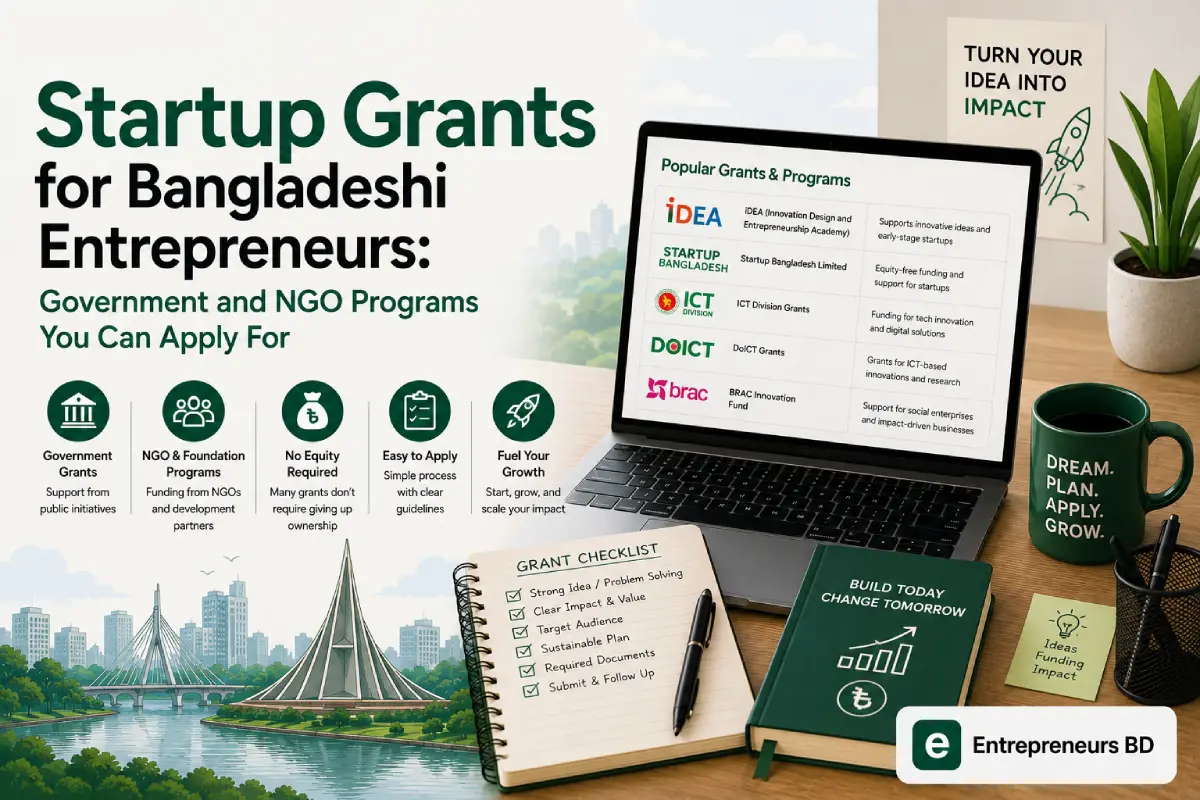
Bangladeshi entrepreneurs can apply for grants and low-cost financing through the ICT Division's iDEA project (up to BDT 10 lakh), SME Foundation's Credit Wholesaling Program, and Bangladesh Bank's refinance schemes for women and new entrepreneurs. Most require a trade license, a clear business plan, and an online application.
Fintech in Bangladesh: Key Players, Regulations, and Opportunities for Founders
For the payment and digital-finance businesses covered here, four regulated models matter most: MFS, PSP, PSO and digital banking. MFS requires a bank, financial institution or government entity to hold at least 51% of the provider and control its board. PSPs don't carry that requirement. PSOs run payment infrastructure and can't issue e-money. Digital banks are licensed under the Bank Company Act and now require Tk 300 crore in paid-up capital.

Angel Investors in Bangladesh: Who They Are and How to Reach Them
Angel investors in Bangladesh are individuals, family offices, and diaspora professionals who fund early-stage startups in exchange for equity. Most operate through organized networks like Bangladesh Angels Network (BAN) and Bangladesh Women Investors Network (BWIN), which vet founders, run pitch sessions, and syndicate deals among members.
Comments (0)
No comments yet. Be the first to share your thoughts!