How to Open a Business Bank Account in Bangladesh: Requirements and Best Banks
To open a business bank account in Bangladesh, you need a valid trade license, a TIN certificate, and NID or passport of the owner or directors. Private limited companies also need their RJSC incorporation certificate, MOA and AOA, and a board resolution. Sole proprietors can usually open an account in three to five working days. Companies take one to two weeks due to director and beneficial owner checks.
Key Takeaways
A trade license, TIN certificate, and owner identification are the baseline documents for every business account.
Private limited companies need extra paperwork: RJSC incorporation certificate, MOA and AOA, Form XII, and a board resolution.
BRAC Bank is the most established name for SME business banking. Dutch-Bangla Bank offers the widest branch and ATM network.
Bangladesh Bank's anti-money laundering rules require banks to verify beneficial owners and source of funds before an account goes live.
New companies raising foreign capital before RJSC registration usually need a temporary account first.
Opening a business bank account in Bangladesh is one of the first practical steps after you register your business. It's also one of the steps entrepreneurs underestimate most.
Banks here are far stricter with business accounts than personal ones. This is mainly because of anti-money laundering checks on directors, shareholders, and the source of business funds.
What you need depends heavily on your business structure. A sole proprietor with a trade license faces a much shorter process than a private limited company with multiple directors and foreign shareholders.
This guide walks through the documents each business type needs, the step-by-step opening process, the local compliance rules that catch people off guard, and how the leading banks in Bangladesh compare in 2026.
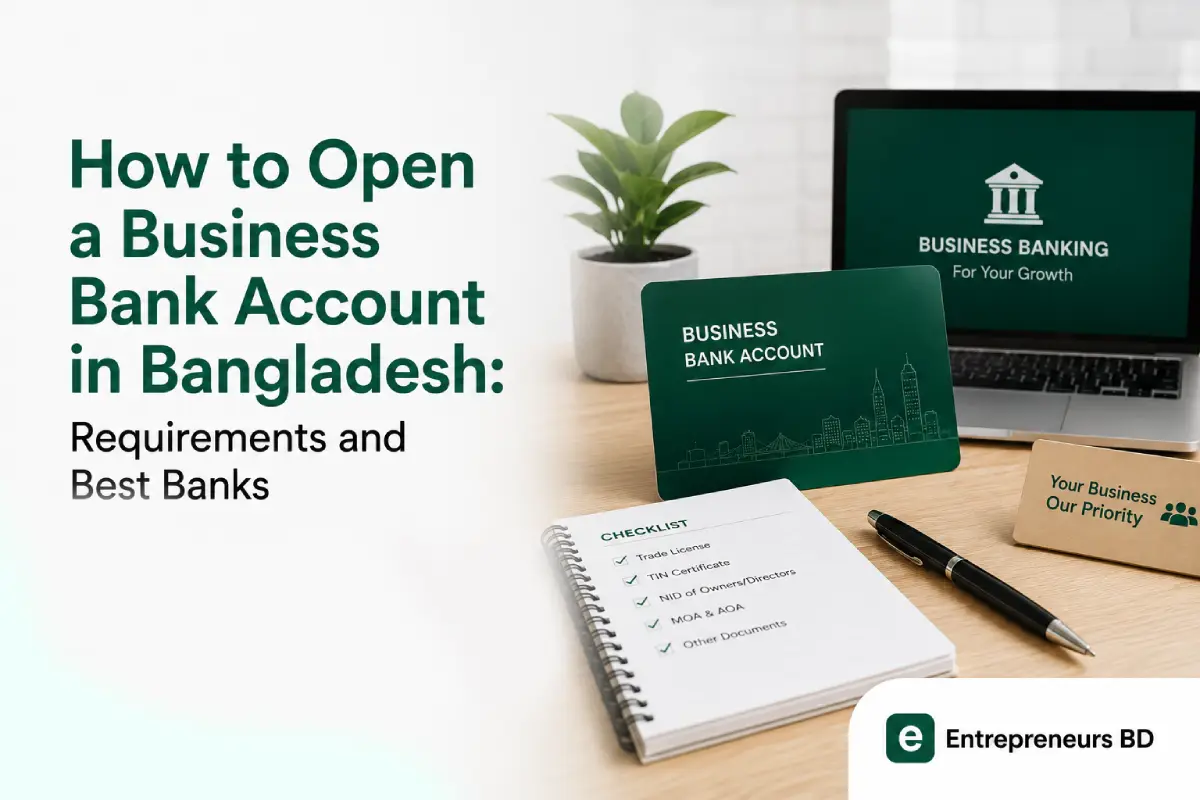
Documents You Need to Open a Business Bank Account
The exact checklist depends on whether you're a sole proprietor, a partnership, or a registered company. Banks in Bangladesh treat these as three separate risk categories.
Sole Proprietorship
For a sole proprietorship, you'll need a valid trade license from your local City Corporation, Paurashava, or Union Parishad. You'll also need your personal TIN certificate and National ID card.
Add two passport-size photographs and a specimen signature card, completed in front of bank staff.
Most banks also ask for an introducer, someone who already holds an account at that branch and can vouch for you. If you're still getting your paperwork in order, our guide on sole proprietorship registration in Bangladesh covers the trade license process in more detail.
Partnership Firms
Partnership firms need everything a sole proprietorship needs, plus a certified copy of the partnership deed. You'll also need a partnership resolution authorizing specific partners to operate the account.
Each partner named on the account typically needs their own NID or passport and TIN certificate.
Private Limited Companies
Companies face the longest document list. You'll need the RJSC Certificate of Incorporation, the Memorandum and Articles of Association, Form XII listing your directors, and a board resolution naming who can operate the account.
The Registrar of Joint Stock Companies and Firms only issues the certificate of incorporation once name clearance, the MOA and AOA, and the prescribed forms have all been approved. This step needs to be complete before you approach a bank for a permanent business account.
Every director and authorized signatory also needs their own NID or passport, TIN certificate, and photographs. If your company plans to bring in foreign capital, our piece on business registration in Bangladesh explains how the temporary account and encashment certificate process fits into incorporation.
Step-by-Step Process to Open the Account
Step 1: Choose the right bank and account type. Most businesses need a current account rather than a savings account, since current accounts allow unlimited transactions.
Step 2: Gather your documents. Prepare originals and photocopies of everything listed above, attested where the bank requires it.
Step 3: Submit the account opening form. Fill it out in person. Most business accounts still require in-branch verification rather than fully digital onboarding.
Step 4: Complete KYC verification. The bank verifies your identity, your business's legitimacy, and for companies, every director and beneficial owner.
Step 5: Make the minimum opening deposit. The amount varies by bank and account tier. Confirm the figure with your branch before you go in.
Step 6: Wait for approval and activation. Sole proprietors are often approved within a few working days. Companies usually take longer.
Bangladesh-Specific Rules You Should Know
Bangladesh Bank's Financial Intelligence Unit, known as BFIU, sets the anti-money laundering rules every scheduled bank must follow. For business accounts, this means identifying the beneficial owners behind the company, not just the person filling out the form.
Bangladesh Bank's electronic KYC guideline sets out the applicant identification data and verification steps reporting institutions must collect. This is why company accounts take longer: every director on Form XII typically needs individual verification.
If you're a foreign national or a non-resident Bangladeshi, expect to submit a valid visa or work permit, your passport, and often a letter tied to your business registration or BIDA approval.
If your company is raising capital from abroad, banks generally open a temporary account first. The share capital gets remitted there and an encashment certificate is issued. The account converts to permanent status once RJSC registration is complete.
Businesses that cross the VAT registration threshold also need a Business Identification Number from the National Board of Revenue. Some banks ask to see this once your account is active.
NBR's VAT registration guide confirms that businesses need to register for VAT and receive a BIN to continue normal operations, including tenders, banking, and import or export. For more on staying compliant from day one, see our startup legal checklist for Bangladesh.
Best Banks for Business Accounts in Bangladesh in 2026
Bangladesh has more than 60 scheduled banks, but a handful stand out for business and SME banking specifically.
BRAC Bank is the most recognized name in SME banking in Bangladesh. It was built around small business lending from the start, and its digital platform makes day-to-day account management straightforward.
Dutch-Bangla Bank (DBBL) runs the largest ATM and electronic banking network in the country. That matters if your business needs cash access outside Dhaka or Chattogram.
The City Bank positions itself as a digital-first bank with a strong SME focus, built around its Citytouch platform. It suits owners who want online banking maturity alongside branch service.
Eastern Bank (EBL) is known for responsive customer service and its Skybanking platform. It tends to appeal to professionals and growing businesses.
Mutual Trust Bank (MTB) has built a reputation around its digital banking app. It's frequently cited among the more innovative private banks for account opening speed.
Islami Bank Bangladesh (IBBL) is the largest Shariah-compliant bank in the country. It's the natural choice if you need a business account structured around Islamic banking principles.
If your business is tied to government contracts, agricultural supply chains, or operates mainly outside major cities, the state-owned banks such as Sonali Bank, Janata Bank, and Agrani Bank still offer the widest rural branch presence. Their digital tools lag behind the private banks above, though.
Costs and Practical Tips
Minimum opening deposits and balance requirements differ from bank to bank, and even between branches. Always confirm the exact figure before your appointment.
Account maintenance fees, cheque book charges, and online banking fees also vary. Premium business accounts often waive some of these in exchange for a higher minimum balance.
Bring more documents than you think you need. Banks frequently request an extra attested photocopy or a specific board resolution format that isn't obvious until you're at the branch.
If your business will handle export or import payments, ask about foreign currency accounts at the same time. Setting these up later as a separate application takes additional time.
For entrepreneurs still deciding on a business structure, our guide on limited company registration in Bangladesh walks through how the entity type you choose affects how long your account approval takes.
Frequently Asked Questions
Can I open a business bank account in Bangladesh without a trade license?
How long does it take to open a business account for a private limited company?
Do I need a separate account before my company is registered with RJSC?
Which bank is best for a small business just starting out?
Can foreigners open a business bank account in Bangladesh?
Do I need a BIN or VAT registration to open a business bank account?
Getting Your Business Banking Right From Day One
The businesses that move fastest through account opening treat documentation as seriously as the bank does. Sort your trade license, TIN, and identity documents before you walk in.
If you're incorporating a company, don't wait until the last minute to prepare your board resolution and Form XII.
Choosing a bank isn't just about which branch is closest. Think about whether you need nationwide ATM access, strong digital tools, or a lender that understands SME cash flow.
Once your account is active, keep your compliance documents current. Banks in Bangladesh do periodically request updated KYC information, and an inactive account can quietly become a liability when you need financing later.
For more on what to line up before this stage, see our guide on how to start a business in Bangladesh.

Specializing in SaaS product marketing, SEO strategy, Content marketing, TikTok advertising, PPC, and digital growth.
View Full Profile & ContributionsRelated Articles
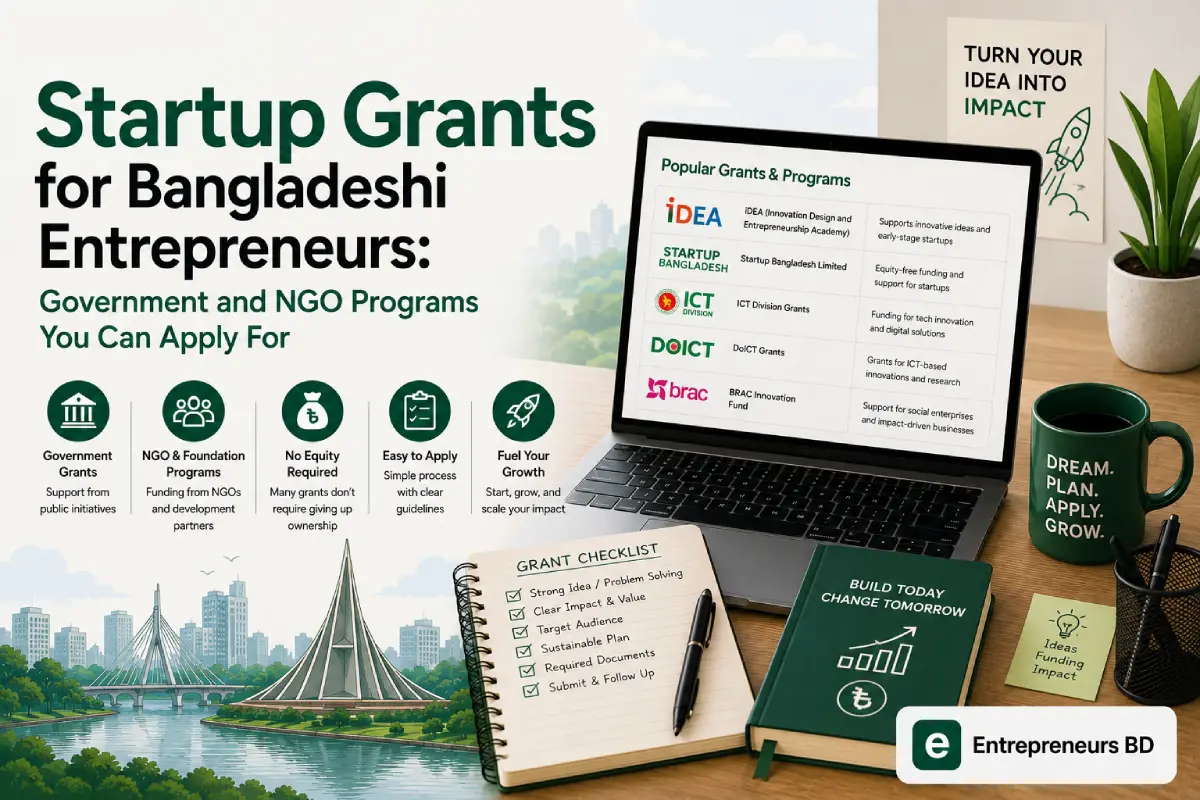
Startup Grants for Bangladeshi Entrepreneurs: Government and NGO Programs You Can Apply For
Bangladeshi entrepreneurs can apply for grants and low-cost financing through the ICT Division's iDEA project (up to BDT 10 lakh), SME Foundation's Credit Wholesaling Program, and Bangladesh Bank's refinance schemes for women and new entrepreneurs. Most require a trade license, a clear business plan, and an online application.

Fintech in Bangladesh: Key Players, Regulations, and Opportunities for Founders
For the payment and digital-finance businesses covered here, four regulated models matter most: MFS, PSP, PSO and digital banking. MFS requires a bank, financial institution or government entity to hold at least 51% of the provider and control its board. PSPs don't carry that requirement. PSOs run payment infrastructure and can't issue e-money. Digital banks are licensed under the Bank Company Act and now require Tk 300 crore in paid-up capital.

Angel Investors in Bangladesh: Who They Are and How to Reach Them
Angel investors in Bangladesh are individuals, family offices, and diaspora professionals who fund early-stage startups in exchange for equity. Most operate through organized networks like Bangladesh Angels Network (BAN) and Bangladesh Women Investors Network (BWIN), which vet founders, run pitch sessions, and syndicate deals among members.
Comments (0)
No comments yet. Be the first to share your thoughts!