Women Entrepreneurs in Bangladesh: Challenges, Support Programs, and Success Stories
Women lead roughly 2.8 million SMEs in Bangladesh, about a quarter of the sector, yet they receive only 7.28% of CMSME bank credit as of March 2026. Programs like Bangladesh Bank's women entrepreneurs refinance scheme, the SME Foundation's SheTrades Hub, and the Joyeeta Foundation are working to close that gap.
Key Takeaways
Women own about 7.2% of registered businesses in Bangladesh, but lead close to a quarter of all SMEs.
Female entrepreneurs still receive far less than their mandated 15% share of CMSME bank credit.
Bangladesh Bank, the SME Foundation, and the Joyeeta Foundation each run dedicated support schemes.
Access to collateral-free credit remains the single biggest obstacle to growth.
Women like Rubana Huq and Sonia Bashir Kabir show what scaling past that obstacle looks like.
Women entrepreneurs are no longer a footnote in Bangladesh's economy. They lead an estimated 2.8 million small and medium enterprises today.
That is close to a quarter of all SMEs in the country. Yet the path from starting a business to scaling one remains steep for most of them.
This piece looks at where women entrepreneurs actually stand right now. It covers the barriers that still hold many of them back, the government and institutional programs built to help, and a few real success stories worth learning from.
If you are a woman running or planning a business in Bangladesh, or you support someone who is, this is meant as a practical starting point rather than a motivational pep talk.
Where Women Entrepreneurs Stand in Bangladesh Today
The numbers tell a mixed story. On one hand, women now lead around 2.8 million SMEs, close to 25% of the total, employing an estimated 8.4 million people. Women's labor force participation has also climbed to 42.7%.
On the other hand, women still own only about 7.2% of all registered businesses in the country, a figure that traces back to the 2013 Economic Census and remains widely cited today.
Most women-led enterprises fall under the small and medium enterprise umbrella rather than large, formally registered companies. Many operate as sole proprietorships in food, fashion, handicrafts, beauty, or increasingly, IT and e-commerce.
Credit access is where the gap shows up most clearly. As of March 2026, female entrepreneurs held just 7.28% of total outstanding CMSME loans, well short of the central bank's 15% mandatory target.
That is a 7.72 percentage point shortfall, even as CMSMEs contribute close to 30% of GDP and account for 85% of industrial employment nationwide.
The Real Challenges Women Entrepreneurs Face
Talk to any woman running a small business in Bangladesh and collateral comes up almost immediately. Most commercial loans require land or building as security.
Because property ownership still skews heavily toward men, many women simply cannot meet this requirement, regardless of how solid their business plan is.
Paperwork adds another layer. Banks often ask for audited financial statements, multi-year trade licenses, and formal tax records, documentation that newer or informal businesses rarely have ready.
Loan officers, facing rising non-performing loans across the sector, also tend to prioritize large, asset-backed corporate accounts over smaller, cash-flow-based loans. Women-led micro and small businesses fall on the wrong side of that preference.
There is also a structural problem beyond financing. Bangladesh has gotten reasonably good at helping women start businesses through microcredit and small grants.
What it has not solved is the funding gap that shows up once a business tries to grow past the survival stage. Researchers call this the "missing middle," and it is becoming a bigger constraint as climate pressures reshape entire sectors.
Regulatory friction compounds all of this. A 2025 policy dialogue in Dhaka found women entrepreneurs across leather, IT, handicrafts, and e-commerce all citing the same complaints: complex licensing, inconsistent service across government agencies, and thin access to market information.
Government and Institutional Support Programs
The good news is that Bangladesh has not ignored the problem. Several institutions now run programs built specifically around women-led businesses.
Bangladesh Bank's refinancing scheme is the most direct financial lever. In 2023, the central bank renamed its Small Enterprise Refinance Scheme as the Small Enterprise Refinance Scheme for Women Entrepreneurs and doubled the fund to Tk 3,000 crore.
Under this scheme, women entrepreneurs can borrow at a maximum 5% interest rate, compared to 7% for men. Banks are also required to run dedicated Women Entrepreneurs Development Units and service desks.
The SME Foundation, the government's apex SME body, takes a different angle. Its SheTrades Bangladesh Hub, launched in 2023 with the International Trade Centre, has already brought over 200 women-led businesses into a network offering export training, trade fair access, and digital skills coaching.
The Joyeeta Foundation works closer to the grassroots. Established in 2011 under the Ministry of Women and Children Affairs, it supports women entrepreneurs with display space, soft loans, and market access, particularly for those coming from rural and low-income backgrounds.
Trade bodies matter too. The Bangladesh Women Chamber of Commerce and Industry, the country's first women-only chamber, has grown from 24 founding members in 2001 to more than 5,000 today, giving women a collective voice in policy discussions that used to exclude them entirely.
For anyone just getting started, business registration is easier than it was a few years ago, thanks to a growing digital One Stop Service platform that connects multiple government agencies under a single portal.
Success Stories: Women Who Are Rewriting the Rules
Numbers and schemes only tell part of the story. The individuals who pushed through the system are worth knowing about too.
Selima Ahmad built something that did not exist before her. In 2001, frustrated that women's voices were sidelined in mainstream trade bodies, she founded the Bangladesh Women Chamber of Commerce and Industry, the country's first chamber built exclusively for women in business.
Rubana Huq broke into a space that had never had a woman at the top. In 2019, the Mohammadi Group leader became the first woman elected president of BGMEA, the country's largest garment trade body, ending four decades of exclusively male leadership.
Sonia Bashir Kabir represents where a lot of the momentum is headed now. After leading Microsoft's Bangladesh operations, she founded SBK Tech Ventures, one of the few fully women-led venture capital funds actively investing in South Asian startups, alongside a foundation that has built tech hubs across dozens of rural districts.
None of these women had it easy. What they share is a pattern: build something new when the existing system will not make room for you.
Practical Steps for Aspiring Women Entrepreneurs
Start with the paperwork, even if it feels tedious. Registering through the One Stop Service platform now takes less time than it used to, and having your business formally registered opens the door to almost every support scheme mentioned above.
Once registered, walk into your bank's Women Entrepreneurs Development desk and ask directly about the 5% refinance scheme. Many women simply do not know this option exists.
Join a network before you think you need one. Whether it is BWCCI, the SheTrades Hub, or a local trade association, peer networks consistently open doors that cold applications do not.
If you are looking to scale rather than just survive, look beyond bank loans. Angel investors and impact-focused funds are increasingly active in Bangladesh, and several are actively seeking women-led businesses to back.
Keep your financial records clean from day one. The single biggest reason women get turned away from institutional credit is missing documentation, not a weak business idea.
Frequently Asked Questions
What percentage of businesses in Bangladesh are owned by women?
What is Bangladesh Bank's refinance scheme for women entrepreneurs?
How can a woman entrepreneur access institutional credit in Bangladesh?
What does the SME Foundation's SheTrades Hub do?
What is the Joyeeta Foundation?
What is the biggest barrier to scaling a women-led business in Bangladesh?
Closing the Gap Between Starting and Scaling
Bangladesh has made real progress on getting women into business. Where it still falls short is helping them grow once they are in.
The 7.28% credit share is not a reflection of ambition or ability. It is a reflection of collateral rules, documentation demands, and a banking system still calibrated for a different kind of borrower.
The programs covered here, from Bangladesh Bank's refinance scheme to the SheTrades Hub to the Joyeeta Foundation, exist precisely to chip away at that mismatch. None of them are perfect, and none of them work if women entrepreneurs do not know they exist.
That is the practical takeaway. If you are running a business, walk into your bank and ask about the women entrepreneurs desk this week. If you know someone who is, send them this list of programs today.
The next Rubana Huq or Sonia Bashir Kabir is likely already running a business somewhere in Bangladesh right now. The job ahead is making sure the system does not make her fight harder than she has to.
Specializing in SaaS product marketing, SEO strategy, Content marketing, TikTok advertising, PPC, and digital growth.
View Full Profile & ContributionsRelated Articles
The Innovation of Tanvir A. Mishuk: From Fintech Pioneer to AI Entrepreneur
Tanvir A. Mishuk is a fintech entrepreneur recognised for advancing digital financial inclusion in Bangladesh through innovations like e-KYC and USSD based banking access. He has since founded App AI Pty Ltd, an artificial intelligence company based in Australia, applying lessons from financial technology to a new generation of AI driven solutions.
HealthTech in Bangladesh: Opportunities, Regulations, and Early-Stage Players
HealthTech in Bangladesh covers telemedicine, e-pharmacy, diagnostics logistics, and digital health records serving a population with limited doctor access outside major cities. No single unified health-tech law exists yet; founders answer to DGDA, BMDC, and DGHS depending on the product. Early movers like Praava Health and Arogga built durable models around trust and last-mile delivery, not app polish.
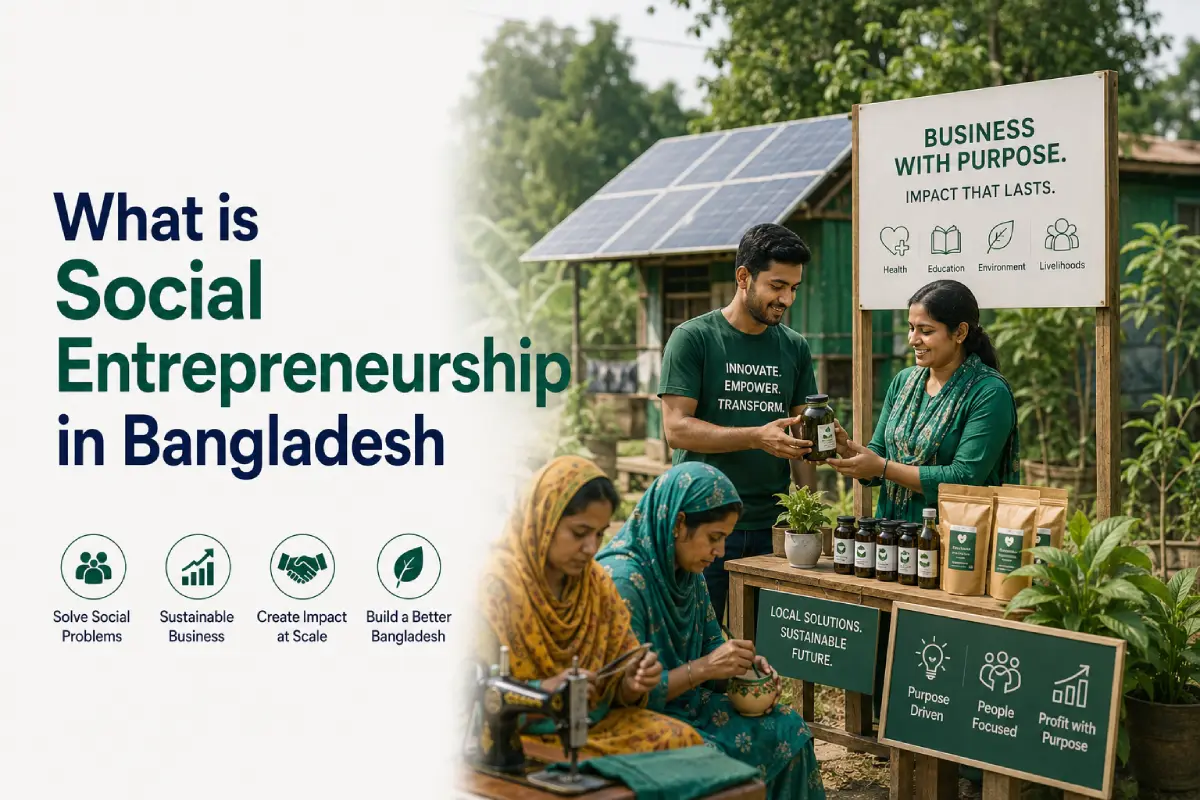
What is Social Entrepreneurship in Bangladesh 2026
Quick Answer: Social entrepreneurship in Bangladesh means building a self-sustaining business that solves a social problem, whether poverty, illiteracy, healthcare access, or climate vulnerability, without relying on charity. Bangladesh pioneered this model globally through Grameen Bank and BRAC, and the approach continues to grow across health, agriculture, and clean energy in 2026.
Comments (0)
No comments yet. Be the first to share your thoughts!