What Is Runway in Startups? How to Calculate How Long Your Money Lasts
Startup runway is the number of months a company can keep operating before its cash runs out. The quick formula is available cash divided by monthly net burn: Tk 48 lakh of cash with a net burn of Tk 4 lakh gives 12 months. A month-by-month forecast turns that number into a real cash-zero date.
Key Takeaways
Runway is a date on the calendar, not just a number of months
The quick formula is a starting point; a monthly forecast and three scenarios show the real range
Only count cash in the bank, never money an investor has promised but not yet sent
Work out how much runway you need backward: milestone time, plus fundraising time, plus a buffer
Bangladeshi startup funding hit a five-year first-half low in 2026, so plan for slower rounds and rising taka costs
Every founder eventually asks the same question late at night: how long can we keep going? The answer is your startup runway, the number of months your company can operate before the cash runs out. It sits at the top of a founder's dashboard because almost every other decision, from hiring to pricing to when to call investors, depends on it.
The trouble is that most founders calculate runway once, get a comfortable number, and stop looking. Runway is built on burn, so if you have not yet worked out your monthly cash spending, start with our guide to what burn rate means. This article picks up where that one ends.
Below, you will learn the three ways to calculate runway, the mistakes that make the number look better than it is, how much runway Bangladeshi startups realistically need in 2026, how to size a raise from it, and exactly how many months each common lever can add.
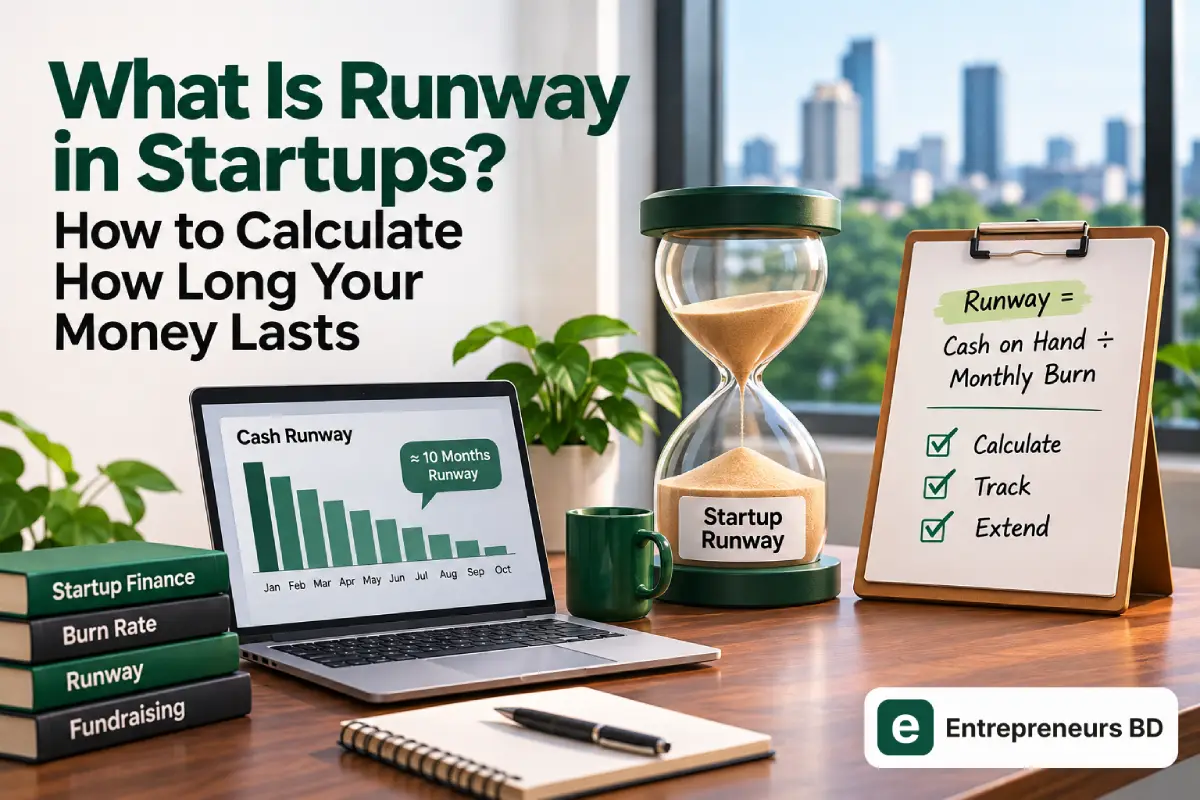
What Is Runway in Startups?
Runway in startups is the length of time a company can keep paying its bills with the cash it has today, assuming nothing changes. It is measured in months, and it is the clearest single answer to "how long does our money last?"
The term comes from aviation. A plane needs enough runway to reach take-off speed. A startup needs enough cash to reach its next milestone, such as break-even, a funding round or a product that customers pay for reliably. Run out of runway first and the business stops, however good the idea.
Founders use three related terms, and it helps to keep them apart:
Cash runway: months until the bank balance reaches zero
Fundraising runway: months left before you must start raising, which is your cash runway minus the time a round takes to close
Cash-zero date: the calendar month when the money runs out
"We have 12 months" sounds safe. "We run out of cash in November 2027" makes a team act. Always translate runway into a date.
How to Calculate Startup Runway: Three Methods
Each method answers a slightly different question. Use all three, in this order.
Method 1: The quick formula
Runway (months) = Available cash ÷ Monthly net burn
Net burn is what you spend in a month minus the cash customers actually paid you. Available cash is your bank balance minus money that is already spoken for, such as VAT due, next month's salaries and unpaid supplier bills.
Take a Chattogram-based skincare brand that sells online. It has Tk 48 lakh of available cash, spends Tk 7 lakh a month and collects Tk 3 lakh from customers. Net burn is Tk 4 lakh, so runway is 48 ÷ 4 = 12 months.
That sum takes thirty seconds and works well as a weekly check. To test different numbers quickly, our free startup runway calculator does the arithmetic and shows the month your cash ends.
Method 2: The month-by-month forecast
The quick formula assumes every future month looks exactly like this one. That never happens. Revenue grows or dips, costs creep up, and new hires start. A forecast models each month separately and finds the real cash-zero date.
Here is the same skincare brand with three realistic assumptions: revenue grows 6 percent a month, costs rise about 0.67 percent a month (roughly the pace of 8.34 percent annual inflation), and one new hire costing Tk 1 lakh a month joins in month 4.
Month | Cash collected (Tk) | Cash spent (Tk) | Net burn (Tk) | Closing cash (Tk) |
|---|---|---|---|---|
1 | 3,00,000 | 7,00,000 | 4,00,000 | 44,00,000 |
3 | 3,37,080 | 7,09,411 | 3,72,331 | 36,40,979 |
4 | 3,57,305 | 8,14,164 | 4,56,860 | 31,84,119 |
6 | 4,01,468 | 8,23,766 | 4,22,299 | 23,21,614 |
9 | 4,78,154 | 8,38,412 | 3,60,257 | 11,75,889 |
12 | 5,69,490 | 8,53,353 | 2,83,864 | 2,44,424 |
13 | 6,03,659 | 8,58,401 | 2,54,742 | Minus 10,318 |
The quick formula said 12 months, and the forecast says the cash runs out during month 13. The two agree this time, but only because sales growth offsets the new hire. Look at month 4: the hire pushes net burn up, and the company survives only if sales keep climbing. The simple formula hides that dependency completely.
Build your forecast in a spreadsheet with one row per month for the next 12 to 18 months: opening cash, cash in, cash out and closing cash. Each month, replace the estimate with actual figures and add a new month at the end.
Method 3: Scenario runway
A single forecast still bets on one version of the future. Scenario runway runs the same model three times so you can see the range of outcomes.
Scenario | Assumption | Result |
|---|---|---|
Downside | Revenue stays flat at Tk 3 lakh | Cash runs out in month 10 |
Base | Revenue grows 6% a month | Cash runs out in month 13 |
Upside | Revenue grows 10% a month | Break-even in month 12, with about Tk 16 lakh left |
Same company, same starting cash, and the outcome ranges from under ten months to never running out. Make commitments you cannot easily reverse, such as permanent hires and long leases, only if the downside case still leaves you room to react.
The upside case is what investors call "default alive": the company reaches break-even before the money ends. If only your most optimistic scenario gets there, you are depending on a raise, and you should plan for that now.
Mistakes That Make Runway Look Longer Than It Is
Counting promised money. A term sheet, a verbal commitment or an "approved" loan is not cash. Add it to runway only when it reaches your account
Using last month's burn when burn is rising. If net burn grew from Tk 3 lakh to Tk 4 lakh over a quarter, use your forward plan, not the trailing figure
Leaving out founder salaries. Founders working unpaid are a hidden subsidy that ends the day you pay yourselves or hire a replacement
Forgetting the hiring plan. Recalculate runway when a role is approved, not when the first salary is paid
Ignoring seasonality. Many Bangladeshi consumer brands earn a big share of yearly sales around Eid. Check runway in the slow months that follow your best one
Treating the bank balance as one pot. Customer advances, refundable deposits, and VAT you collected for the government sit in the same account, but they are not yours to spend
How Much Runway Does a Startup Need in 2026?
Instead of picking a round number, work backward:
Required runway = Time to next milestone + Time to raise + Safety buffer
Time to raise is the part founders underestimate most. Carta's data on US startups shows the median gap between a seed round and a Series A was 1.9 years in Q4 2025, although that gap had started shrinking back toward the traditional 18 to 24 months. That is the deepest venture market in the world.
Bangladesh is slower. According to the LightCastle H1 2026 report, Bangladeshi startups raised USD 6 million in the first half of the year, the lowest first-half total in five years, and every dollar came from foreign investors. New local money is coming, but gradually: the bank-backed Bangladesh Startup Investment Company expects to complete its first three investments by the end of 2026.
Practical targets for Bangladeshi founders this year:
Right after a raise: 18 to 24 months of runway
Bootstrapped or pre-seed with some revenue: at least 12 months in your downside scenario
When to start raising: when runway equals your expected fundraising time plus a three-month buffer, which for most local founders in 2026 means 12 to 15 months out
How to size a raise from your runway
Runway also tells you how much to ask for. Multiply the average monthly net burn you plan after the raise by the months you need, then add a buffer.
Say the skincare brand plans to expand at a net burn of Tk 8 lakh a month and wants 24 months of runway plus a three-month buffer. That is 27 × Tk 8 lakh = Tk 2.16 crore. At the Bangladesh Bank exchange rate of Tk 124.35 per US dollar on 3 November 2026, that is roughly USD 174,000.
Put that number, and the milestone it buys, on the funding slide of your startup pitch deck. Investors trust an ask that is tied to months and milestones far more than a round figure.
Runway in Bangladesh: Local Factors to Build In
Taka cost creep. Point-to-point inflation was 8.34 percent in September 2026, according to BBS data. If your costs rise at that pace, Tk 7 lakh of monthly spending becomes about Tk 7.58 lakh within a year without a single new hire. Build a monthly cost increase into your forecast rather than holding costs flat.
Currency mismatch. Many startups raise in dollars, spend mostly in taka and pay for cloud, software and ads in dollars. If you hold dollars and the taka weakens, your runway in taka gets longer. If you hold taka and pay dollar-billed tools, the same move shortens it. Check the rate monthly and run your forecast at a slightly weaker taka than today.
Rounds that close short. The Daily Star reported in April 2026 that Chaldal had planned to raise Tk 100 crore in 2025 but secured only about half, and that staff at one office protested over wages unpaid for up to four months.
Chaldal's founder Waseem Alim told the paper the company had never had trouble paying salaries before August 2025. The lesson for every founder: model a scenario where your round closes at half its target, and decide in advance which costs you would cut first.
Small rounds still close. Early-stage money has not disappeared. The same LightCastle data shows iFarmer closing a seed round plus grant funding in the first half of 2026. Startups with credible runway plans and real traction are the ones winning these scarce deals.
How to Extend Runway: What Each Lever Buys You
Here is what common moves do to the skincare brand's quick-formula runway (Tk 48 lakh cash, Tk 4 lakh net burn, 12 months):
Lever | Change | New runway | Months gained |
|---|---|---|---|
Cut costs | Tk 50,000 less spending a month | 13.7 months | +1.7 |
Collect advances | Tk 6 lakh paid upfront by wholesale buyers | 13.5 months | +1.5 |
Raise prices | 5% on Tk 3 lakh of sales, volume holds | 12.5 months | +0.5 |
Bridge funding | Tk 20 lakh from existing investors | 17 months | +5 |
A few patterns stand out. Cost cuts help every month you keep them, so start with variable costs and tools nobody uses. Price rises are weak when revenue is small and powerful once it grows, so test them, but do not count on them to rescue a short runway.
Bridge funding buys the most time, but only if you ask early. Existing investors are far more open at nine months of runway than at three. Debt can also cover a gap, but repayments add to future burn; compare the cheaper options in our startup financial planning guide before you borrow.
Finally, write your trigger points down now, while nothing is urgent. For example: start fundraising at 15 months, freeze hiring at 9, and cut all non-essential spending at 6. Decisions made in advance are faster and calmer than decisions made in a crisis.
Frequently Asked Questions
Is six months of runway enough for a startup?
Does money an investor has promised count toward runway?
What is personal runway, and why does it matter for founders?
How do you calculate runway when revenue changes every month?
What should a founder do when runway drops below six months?
How do investors check the runway figure in a pitch?
Turn Your Runway Into a Date and a Plan
Runway is not a number you calculate for an investor and then forget. It is the clock your whole company runs on, and in a year when Bangladeshi startup funding is scarce, the founders who read that clock early have the most choices.
Here is what you can do this week. Work out your available cash and net burn, and run the quick formula. Then build a twelve-month forecast with cost increases, planned hires and realistic sales growth, and find your cash-zero date. Run it again with flat revenue to see your downside.
Write that date somewhere your co-founders will see it. Next to it, write the three trigger points: when you start raising, when you freeze hiring and when you cut hard. If the downside date arrives before your next milestone, you already know it is time to change something, and you have months to do it instead of weeks.

Specializing in SaaS product marketing, SEO strategy, Content marketing, TikTok advertising, PPC, and digital growth.
View Full Profile & ContributionsRelated Articles

Why Most Bangladeshi Startups Fail — and What You Can Do Differently
Quick Answer: Most Bangladeshi startups fail because of poor market validation, weak financial planning, and founder-market mismatch, not lack of ideas or effort. The founders who survive focus on solving real problems, build lean, and learn from their market before scaling.

Customer Acquisition Strategies That Work for Bangladesh Startups
Quick Answer: The most effective customer acquisition strategies for Bangladesh startups combine low-cost digital channels (Facebook, WhatsApp Business, SEO), mobile financial service integration for frictionless payment, referral-driven growth, and hyperlocal targeting. Startups that blend paid acquisition with retention-focused tactics see the lowest long-term cost per customer.

How to Start an Export Business in Bangladesh: Compliance, Buyers, and Logistics
To start an export business in Bangladesh, set up your business with a trade license and tax registration, open a bank account with an authorized dealer bank, and get an ERC from CCI&E. Then confirm your HS code, BIN and product permits, check the buyer's import rules, agree payment terms, and repatriate proceeds within four months.
Comments (0)
No comments yet. Be the first to share your thoughts!