What Is a Pivot in a Startup? When to Change Direction and How to Do It
A pivot in a startup is a deliberate change to one core part of the business, such as the customer, the problem, the product, or the revenue model, while keeping what has already been proven to work. Founders pivot when evidence shows the current path will not reach a sustainable business before the money runs out.
Key Takeaways
A pivot changes one fundamental assumption of the business, not everything at once
Flat retention, rising acquisition costs, and customers using the "wrong" feature are the clearest signals
Every good pivot keeps something proven: a customer base, a capability, or a distribution channel
Test the new direction with a small experiment before committing the whole team and budget
In Bangladesh, changing what a limited company legally does can require amending the objects clause of the Memorandum of Association
Most founders hear the word "pivot" long before they need it, usually in a story about a famous company that changed course and won. The reality is less glamorous. A pivot in a startup is what happens when the data stops agreeing with your plan and you have to decide, with limited cash and a tired team, which part of the plan was wrong.
Done well, a pivot is a focused correction. You keep the knowledge, customers, and capabilities you have earned, and you aim them at a better opportunity. Done badly, it becomes a panicked restart that burns the last of your runway. The difference usually comes down to whether you understood why your current model failed to reach product-market fit in the first place.
This guide explains what a pivot actually is, the warning signs that tell you it is time, the main types of pivots, and a practical process for changing direction. It also covers two well-known Bangladeshi pivots and the legal steps local founders often overlook when their company starts doing something new.
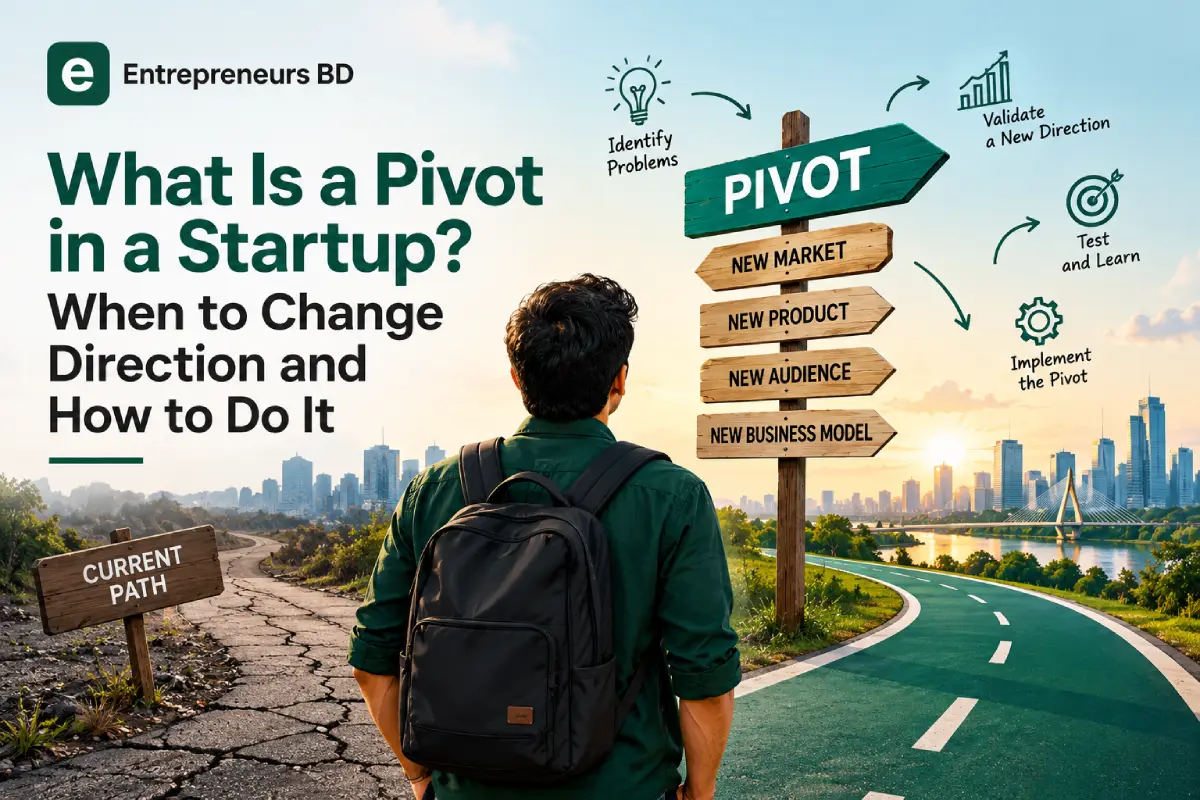
What a Pivot in a Startup Really Means
A startup pivot is a structured course correction designed to test a new fundamental hypothesis about the product, the strategy, or the engine of growth. The term was popularised by the lean startup movement, which treats a young company as an experiment rather than a scaled-down corporation.
Steve Blank, one of the architects of that movement, describes a startup as a temporary organisation searching for a repeatable and scalable business model. His lean startup method frames every early plan as a set of untested guesses. A pivot is simply what you do when one of those guesses is proven wrong.
What a pivot is not
A pivot is not a feature tweak, a new logo, or a price change of a few hundred taka. Those are iterations. A pivot changes something the whole business depends on, such as who you sell to or how you make money.
A pivot is also not starting over. If you throw away your customers, your team's skills, and everything you learned, you have not pivoted. You have launched a second startup with less money.
When to Pivot: The Warning Signs
There is rarely a single moment that announces a pivot. Instead, several signals accumulate until the pattern is hard to ignore. Many of the common reasons startups fail in Bangladesh are really pivots that came too late.
Growth that only comes from spending
If every new customer arrives because you paid for a Facebook ad or a discount, and they leave when the incentive ends, you do not have demand. You have rented attention. When customer acquisition cost keeps climbing while lifetime value stays flat, the model is telling you something.
Retention that never flattens
Healthy products lose some users early, then the curve levels off with a loyal core. If your retention curve keeps sliding toward zero month after month, no amount of marketing will save the current version.
Customers love the side feature
Sometimes users ignore your main product and get excited about something you built as an afterthought. That enthusiasm is valuable evidence. Several successful companies began by noticing exactly this.
The market or rules shift under you
Regulation, a new competitor with deep pockets, or a change in consumer behaviour can make a sound plan obsolete. In Bangladesh, policy changes in sectors like fintech, ride-sharing, and e-commerce have forced founders to rethink their models with little warning.
Your runway is shorter than your path
Do the arithmetic honestly. If reaching profitability on the current path needs 24 months and you have nine months of cash, persevering is a hope, not a strategy.
Pivot, Persevere, or Shut Down
Every few months, founders should formally ask which of three decisions fits the evidence. Persevere if the core metrics are improving, even slowly. Pivot if one part of the model is clearly broken but you have real assets worth redirecting. Shut down if there is nothing proven left to build on and continuing would only spend other people's money.
The hardest part is separating emotion from evidence. Set the review criteria in advance, for example a retention or revenue threshold, so the decision is made against numbers you agreed on when you were calm.
8 Types of Startup Pivots
Pivots come in recognisable forms. Naming the type forces you to be specific about what is changing and what is staying.
Customer segment pivot. Same core capability, different buyer. Many Bangladeshi B2C ideas find stronger, more reliable demand once they sell to businesses instead.
Customer need pivot. You stay with the same customers but solve a different, more urgent problem you discovered while serving them.
Zoom-in pivot. One feature of the product becomes the entire product.
Zoom-out pivot. The opposite: your product becomes one feature of a larger offering because it was too thin to stand alone.
Revenue model pivot. You change how you capture value, for example moving from one-time sales to subscriptions, or from commissions to software fees.
Channel pivot. The product stays, but you reach customers differently, such as moving from a retail website to a sales team, or from apps to agents.
Platform pivot. An application becomes a platform others build on, or a platform narrows into a single application.
Technology pivot. You deliver the same value with a cheaper or better technology, which often unlocks a new price point for the local market.
Bangladesh Context: Two Local Pivots Worth Studying
Two of the country's best-known companies changed direction early, and both kept something valuable when they did.
ShopUp is the clearer example of a customer segment pivot. Launched in 2016, ShopUp started as a social commerce and marketing company enabling small f-commerce companies to streamline their promotion, order management, and delivery. Working with those sellers revealed a bigger opportunity: the millions of neighbourhood shops struggling to source stock. In December 2019, the company officially launched Mokam, its B2B commerce platform, designed as a wholesale marketplace to simplify the inventory procurement process for neighborhood stores.
What ShopUp kept matters as much as what it changed. Its understanding of small merchants, its logistics capability, and its credit experience all carried over into the new model.
Pathao made two shifts in quick succession. According to The Daily Star, Pathao started as a delivery service in 2015 when the e-commerce industry was just taking off. The company first served consumers with on-demand delivery and then moved its focus to e-commerce in October 2015. In 2016 it entered ride-hailing with Pathao Rides, using the same fleet to carry passengers during peak office hours while keeping e-commerce delivery running off-peak.
Pathao's story shows a pivot built on an existing asset. The motorbike fleet and rider network already existed. The company found a more valuable use for it.
The lesson for local founders is consistent. Neither company abandoned its foundation. Each identified a proven strength and pointed it at a larger, more urgent problem.
How to Pivot Your Startup: A Practical Process
Knowing that you need to change direction is half the work. The other half is changing it without breaking the company.
Step 1: Diagnose with evidence, not frustration
Write down which assumption failed. Was it the customer, the problem, the willingness to pay, or the channel? Pull the numbers and run structured customer feedback sessions with both active and lost users. Lost customers often explain the failure more honestly than happy ones.
Step 2: List what is working
Make an inventory of proven assets: a loyal customer group, a supplier network, a technical capability, a trusted brand in one district, or a team skill. Your next direction should use at least one of them.
Step 3: Form one clear hypothesis
State the new direction as a testable sentence: "Pharmacy owners in Chattogram will pay a monthly fee for inventory alerts." One hypothesis keeps the team focused and makes success or failure measurable.
Step 4: Test small before committing
Build the smallest test that can prove or disprove the hypothesis. A landing page, a manual service, or a stripped-down minimum viable product is usually enough. Give it a fixed time window and a success threshold agreed in advance.
Step 5: Recalculate runway and costs
A new direction usually means new costs and a different revenue timeline. Rebuild your cash forecast and decide which current expenses to cut. Solid startup financial planning at this stage prevents the pivot from consuming the money it needs to succeed.
Step 6: Bring co-founders, team, and investors along
Explain what failed, what you are keeping, and how you will measure the new path. Investors generally respect a data-backed pivot far more than silence followed by bad news. If co-founders disagree about the direction, resolve it now, using your shareholder agreement as the reference point.
Step 7: Update your legal and regulatory paperwork
This step is easy to forget in Bangladesh. A private limited company can only lawfully carry on the business described in the objects clause of its Memorandum of Association. If your new direction falls outside it, the Companies Act, 1994 allows the memorandum to be altered under Section 12, but the special resolution must be confirmed by the High Court Division before the amended document is registered with RJSC.
Court records show how routine this is. A 2025 High Court Division order confirmed one company's new objects sub-clauses under Section 13 and directed it to file the altered memorandum with RJSC. Budget time and legal fees for this process. You may also need to update your trade licence category and tax or VAT registration details so they match the new business.
Step 8: Communicate clearly with existing customers
If current customers will lose a product or service, tell them early, explain the change, and offer a fair transition. How you treat them during a pivot shapes your reputation in a market where word of mouth travels fast.
Frequently Asked Questions
What is the simple meaning of pivot in business?
How do I know if my startup should pivot or keep going?
How many times can a startup pivot?
Is pivoting a sign of failure?
Do I need legal approval to change my company's business in Bangladesh?
How long should I test a new direction before deciding?
Change Direction Without Losing Your Footing
A pivot is not an admission that you were foolish. It is proof that you ran an experiment, read the results, and had the discipline to act on them. The founders who handle it best treat their original plan as a hypothesis from day one, so changing it feels like progress rather than defeat.
For Bangladeshi founders, the stakes are concrete. Capital is scarce, runways are short, and paperwork can lag behind strategy. That makes it doubly important to decide early, keep your strongest asset, test cheaply, and get your company documents in order before the new business grows.
Start this week with one exercise. Write down the single assumption your business depends on most, then list the evidence for and against it. If the evidence against is stronger, you already know where your next conversation with your co-founders needs to begin.

Specializing in SaaS product marketing, SEO strategy, Content marketing, TikTok advertising, PPC, and digital growth.
View Full Profile & ContributionsRelated Articles

Why Most Bangladeshi Startups Fail — and What You Can Do Differently
Quick Answer: Most Bangladeshi startups fail because of poor market validation, weak financial planning, and founder-market mismatch, not lack of ideas or effort. The founders who survive focus on solving real problems, build lean, and learn from their market before scaling.

Customer Acquisition Strategies That Work for Bangladesh Startups
Quick Answer: The most effective customer acquisition strategies for Bangladesh startups combine low-cost digital channels (Facebook, WhatsApp Business, SEO), mobile financial service integration for frictionless payment, referral-driven growth, and hyperlocal targeting. Startups that blend paid acquisition with retention-focused tactics see the lowest long-term cost per customer.

How to Start an Export Business in Bangladesh: Compliance, Buyers, and Logistics
To start an export business in Bangladesh, set up your business with a trade license and tax registration, open a bank account with an authorized dealer bank, and get an ERC from CCI&E. Then confirm your HS code, BIN and product permits, check the buyer's import rules, agree payment terms, and repatriate proceeds within four months.
Comments (0)
No comments yet. Be the first to share your thoughts!