What Is a Unicorn Startup? Definition and Examples
A unicorn startup is a privately held startup with an implied valuation of at least $1 billion. That valuation usually comes from a funding round or another private share transaction, not from revenue or profit, so a unicorn can lose money and still qualify. bKash is Bangladesh's first and only widely recognised unicorn.
Key Takeaways
A unicorn is a private startup with an implied equity valuation of $1 billion or more.
That valuation is a negotiated price for one slice of shares, not an audited sale value.
A down round only ends unicorn status if the new valuation falls below $1 billion.
A billion-dollar valuation does not mean founders can sell their shares for that much.
bKash became Bangladesh's first unicorn in 2021, and no second company has been confirmed since.
A unicorn startup is one of the most quoted ideas in startup media and one of the least understood. Founders hear the word at pitch events, read it in funding news, and sometimes adopt it as a goal before they have a single paying customer.
The label rests on one number: the price investors put on a private company. That number is far less precise than it looks. It comes from negotiated deals, special share rights, and occasional transactions rather than a daily market price, which is why it helps to understand startup valuation in Bangladesh before judging any company by its unicorn status.
This guide explains where the term came from, how a private valuation is actually calculated, how companies gain and lose the title, and where Bangladesh stands in 2026. It closes with what the label means for founders deciding whether to chase it at all.
What Is a Unicorn Startup? The Definition Explained
A unicorn startup is a privately held company, not listed on a stock exchange, whose implied equity valuation has reached at least $1 billion. Most trackers also limit the term to relatively young, venture-backed companies rather than old family conglomerates.
Venture capitalist Aileen Lee popularised the term in a 2013 TechCrunch essay on unicorns. Her study was narrow: US-based software companies founded since 2003 and valued above $1 billion. She found 39, roughly 0.07% of the software startups funded in that decade, and chose the mythical animal because such outcomes seemed that rare.
The group has grown enormously since. Different research firms count it differently. The Hurun Research Institute's Global Unicorn Index 2026, which only counts unlisted companies founded after 2000, recorded 1,603 unicorns as of its 1 January 2026 cut-off. Other trackers use different rules and report different totals, so any single count is an estimate, not a census.
Other informal valuation terms
You will also see a few related labels. None is an official financial classification:
Decacorn: a private company valued at $10 billion or more. Widely used.
Hectocorn: a private company valued at $100 billion or more. Used less consistently.
Soonicorn and zombiecorn: informal media terms for startups expected to become unicorns, and for unicorns struggling to justify their old valuation.
How Startup Valuation Is Calculated
No regulator grants unicorn status. A company becomes one when a credible transaction implies its equity is worth $1 billion or more.
Pre-money vs post-money valuation
The most common reference point is a primary funding round, where the company sells new shares. Suppose an investor puts $100 million into a startup and receives 10% of the company after the investment. That implies:
Post-money valuation: $100 million divided by 10% = $1 billion
Pre-money valuation: $1 billion minus the new $100 million = $900 million
Post-money includes the fresh cash. Pre-money is the implied value just before it arrived. If the 10% referred to ownership before the investment, the maths would change, which is why term sheets spell out the basis carefully.
Other sources of a valuation
Funding rounds are not the only evidence. A reported valuation can also come from secondary sales, where existing shareholders sell to new buyers, from employee tender offers, from investors marking their holdings up or down, or from data providers estimating value. Unlike a listed share price, these figures can stay unchanged for years between transactions.
Why the headline number can mislead
Investors in late rounds usually buy preferred shares with extra rights, while founders and employees hold ordinary shares. The headline valuation applies the preferred share price to every share, even though the classes are not economically equal.
Liquidation preferences are the clearest example. They do not raise the headline valuation; they decide who gets paid first if the company is sold or wound up. A 1x non-participating preference lets an investor take back its money or convert to ordinary shares, whichever pays more. Participating preferences, multiples above 1x, and seniority rules can push more of the proceeds to investors. Two companies with the same headline valuation can therefore leave their founders and staff with very different outcomes.
How a Company Stops Being a Unicorn
A company leaves the active private-unicorn category in three main ways.
It goes public. After an IPO, the market sets its value daily, so trackers remove it. Its business value does not disappear.
It is acquired. It is no longer an independent private startup, whatever price it fetched.
Its valuation falls below $1 billion. This can happen through a down round, or through investors marking down their holdings without any new round.
A down round on its own does not end unicorn status. A company that falls from a $3 billion valuation to $1.5 billion is still above the line.
Famous Unicorn Examples Around the World
Uber, Airbnb, and Facebook each reached billion-dollar private valuations before their public listings, though they took very different funding paths to get there. ByteDance and SpaceX have spent years among the most valuable private companies in the world.
India shows both sides of the story. It produced a long list of unicorns, including Flipkart, Paytm, and Zomato. It also produced Byju's, a cautionary tale. The edtech company reached a reported $22 billion valuation in 2022, then faced cash-flow problems, investor disputes, governance concerns, and insolvency proceedings. Its largest investor, Prosus, had already cut its valuation sharply within a year. A high private valuation offered no protection against weak fundamentals.
Unicorn Startups in Bangladesh
Bangladesh's only widely recognised unicorn is bKash, the mobile financial service founded by Kamal Quadir and majority-owned by BRAC Bank. In November 2021, SoftBank Vision Fund II agreed to invest $250 million, and BRAC Bank's chairman said the deal would lift bKash's valuation to about $2 billion.
That figure needs careful handling. It was a transaction-related valuation from 2021. bKash remains privately held, but its current valuation has not been publicly confirmed, so the 2021 number should not be presented as a verified 2026 value.
Population alone did not earn that price. Bangladesh has a large potential market, but investors were paying for bKash's actual position: a nationwide agent and merchant network, tens of millions of active customers, high transaction frequency, and a leading role in mobile financial services. Those are measurable advantages a large population only makes possible.
What about ShopUp and other contenders?
ShopUp, the B2B commerce company serving neighbourhood shops, raised some of the largest rounds in Bangladesh's history. In April 2025 it merged with Saudi Arabia's Sary to form SILQ Group, backed by $110 million in new funding that included both equity and a financing facility. A funding amount is not a valuation, and the combined group's valuation has not been publicly confirmed at the unicorn threshold.
As of November 2026, The Business Standard's analysis of Bangladesh's single unicorn still identifies bKash as the only one, compared with 131 created in India over a similar period. No other local startup's valuation above $1 billion could be confirmed from public sources.
Why Bangladesh Has So Few Unicorns
The funding data explains much of the gap. According to the 2025 Startup Investment Report from Startup Bangladesh and LightCastle Partners, startups raised $124 million across 12 deals in 2025. That headline is misleading: the SILQ transaction alone accounted for about $110 million, and global investors supplied roughly 99% of all capital.
The first half of 2026 was weaker still. LightCastle's H1 2026 investment report recorded about $6 million across six deals, a 95% drop year on year, and noted that most capital since 2013 has gone to a handful of late-stage companies.
Several structural factors sit behind those numbers:
Thin local capital. Almost all growth funding comes from abroad, so local startups depend on foreign investor sentiment toward Bangladesh. Initiatives like Startup Bangladesh Limited, a government-owned venture capital company, and a bank-backed fund launched in 2026 aim to help, but they are small relative to need.
Few exits. Investors want a path to returns through an IPO, a trade sale, or secondary share sales. Bangladesh has had few of any kind, which makes large late-stage cheques harder to justify.
Spending power varies by segment. Low average incomes constrain some consumer models, but the effect depends on the business. A fintech with frequent small transactions faces different economics from a subscription app.
Trust and policy shocks. Industry leaders interviewed by TBS pointed to e-commerce scams that damaged consumer trust, discount-driven cash burn, and tax changes that squeezed low-margin firms.
Fahim Ahmed of Pathao has framed the challenge as needing abundant demand, capital, and talent at the same time, while noting that a country does not need all three to compete. Our guide to venture capital in Bangladesh covers who is writing cheques locally today.
What It Takes to Build a Unicorn
There is no formula, but billion-dollar private companies tend to share a few traits.
A large market, or a credible path to one
Investors work backward from market size. A startup needs either a large addressable market or a believable plan to expand into one, through new countries or adjacent products. Size alone is not enough: investors also judge how much of that market the company can realistically capture and monetise.
Evidence of demand
Strong retention and organic growth make fundraising far easier, which is why reaching real product-market fit matters so much in consumer and software businesses. How much proof investors expect varies by sector. Deep tech and infrastructure companies sometimes raise large sums before demand is fully proven.
Economics that improve with scale
The key question is whether revenue and contribution margins can grow faster than costs over time. Software and platforms often have this advantage. Capital-intensive companies in logistics, hardware, or energy can still reach unicorn valuations when their technology, margins, and market justify it.
Network effects, where they are real
A network effect exists when a product becomes more valuable as more people use it. bKash is a local example: each new agent and merchant made the service more useful to every customer. Not every platform has a genuine network effect, and investors increasingly ask for evidence rather than claims.
Access to capital and sound governance
Most venture-backed unicorns raise several rounds, though it is not a strict requirement. Clean accounts, a functioning board, and transparent reporting matter at each stage. Weak governance is one of several factors, alongside slower growth, poor unit economics, and market conditions, that can pull a valuation down.
Should Bangladeshi Founders Aim to Be a Unicorn?
For most founders, not as a starting goal. A company generating a few crore taka in annual net profit can give its owners more freedom and security than a heavily funded startup chasing a headline number.
It also helps to separate three things that often get blurred:
Dilution vs control. Selling equity reduces your ownership, but control depends on board seats, voting rights, share classes, and investor veto rights. Founders can keep significant control after dilution, or lose it while still owning a large stake.
Paper wealth vs realised wealth. A $1 billion valuation does not mean founders can sell shares at that price. Private shares often carry transfer restrictions, lock-ups, and few willing buyers.
Valuation vs business health. Revenue, profit, and cash flow tell you whether a company can survive. A valuation tells you what one investor paid at one moment.
Build a business that solves a real problem well. If the market is large and growth comes naturally, the valuation can follow. If it does not, you still own a healthy company.
Frequently Asked Questions
Why is it called a unicorn startup?
Does a unicorn have to be profitable?
Is bKash still a unicorn?
What is the difference between a unicorn and a decacorn?
How long does it take to become a unicorn?
Can a small business become a unicorn?
Building Value Before Chasing the Billion
The unicorn label is a snapshot of investor confidence at a specific moment. It does not measure revenue, profit, or resilience, and it does not tell you what founders or employees will ever receive in cash.
For Bangladeshi founders, bKash remains useful precisely because the valuation came last. It solved a daily problem for millions of people, built distribution competitors struggled to copy, and only then attracted capital at a billion-dollar price. With startup funding at multi-year lows in 2026, that lesson matters more than ever: investors who return will back businesses with proven demand and sound economics.
If you want to build something that could one day reach that scale, start with a large problem, prove people will pay to solve it, and keep your unit economics honest. When you are ready to raise money, map out your options in our guide to startup funding in Bangladesh. This week, pick one metric that shows real customer demand and start tracking it.

Specializing in SaaS product marketing, SEO strategy, Content marketing, TikTok advertising, PPC, and digital growth.
View Full Profile & ContributionsRelated Articles
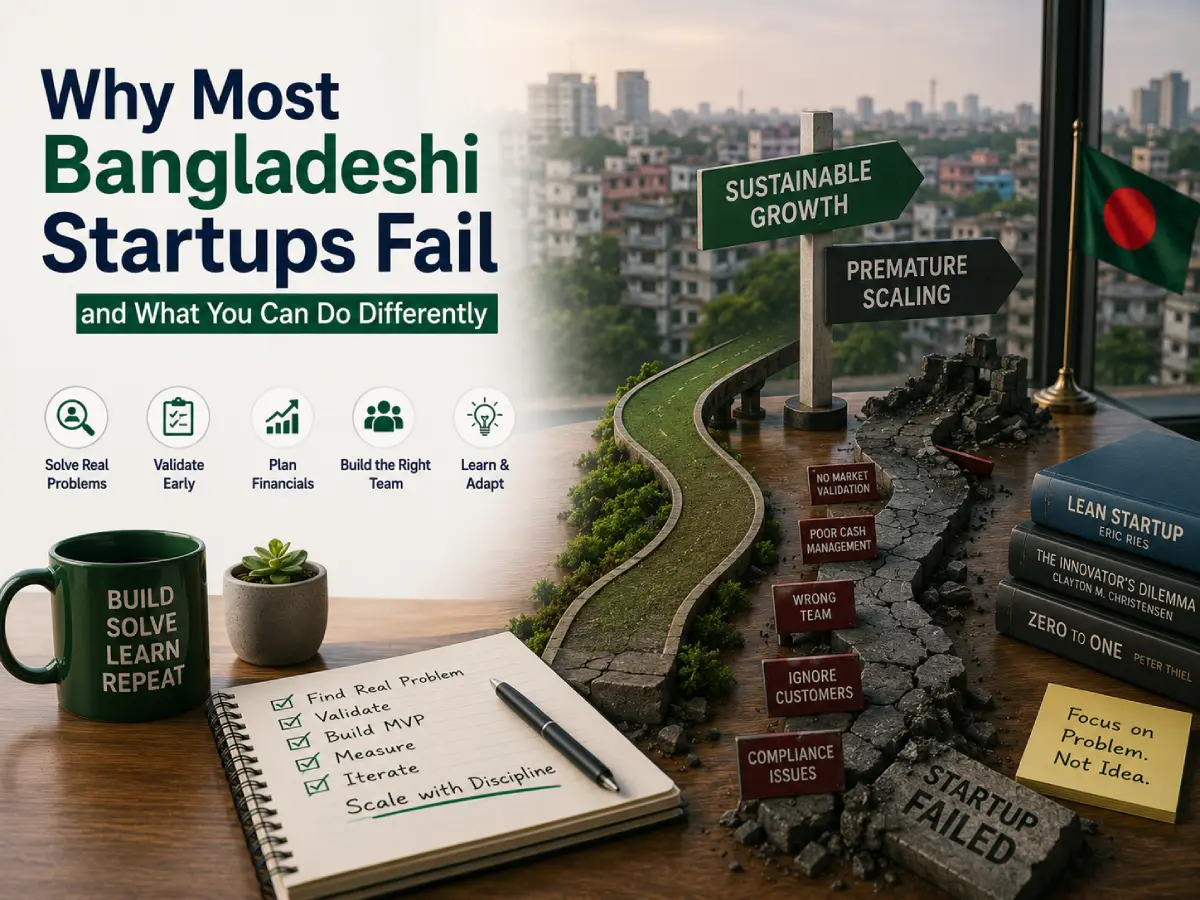
Why Most Bangladeshi Startups Fail — and What You Can Do Differently
Quick Answer: Most Bangladeshi startups fail because of poor market validation, weak financial planning, and founder-market mismatch, not lack of ideas or effort. The founders who survive focus on solving real problems, build lean, and learn from their market before scaling.

Customer Acquisition Strategies That Work for Bangladesh Startups
Quick Answer: The most effective customer acquisition strategies for Bangladesh startups combine low-cost digital channels (Facebook, WhatsApp Business, SEO), mobile financial service integration for frictionless payment, referral-driven growth, and hyperlocal targeting. Startups that blend paid acquisition with retention-focused tactics see the lowest long-term cost per customer.
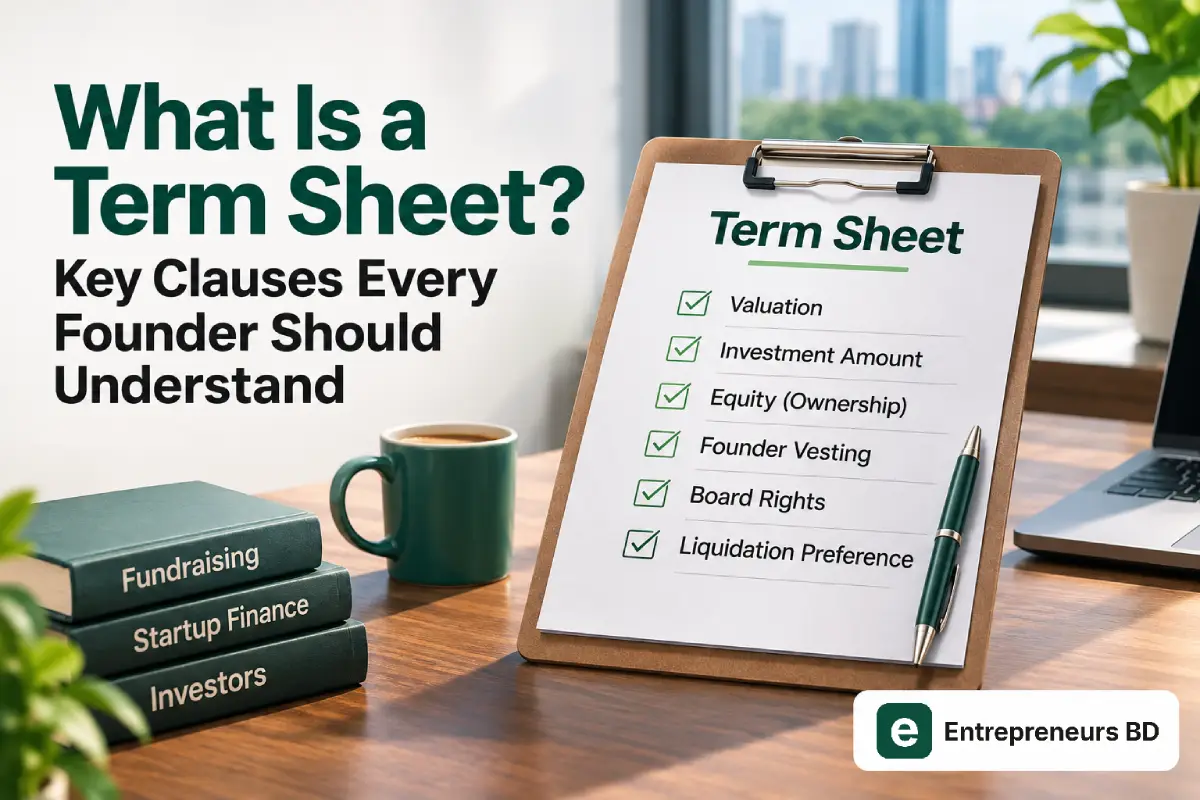
What Is a Term Sheet? Key Clauses Every Founder Should Understand
A term sheet is a short, mostly non-binding document that sets out the main terms of an investment before lawyers draft the final agreements. It covers how much the investor pays, how much equity they receive, and the rights attached to that equity, such as liquidation preference, board seats, anti-dilution protection, and founder vesting.
Comments (0)
No comments yet. Be the first to share your thoughts!