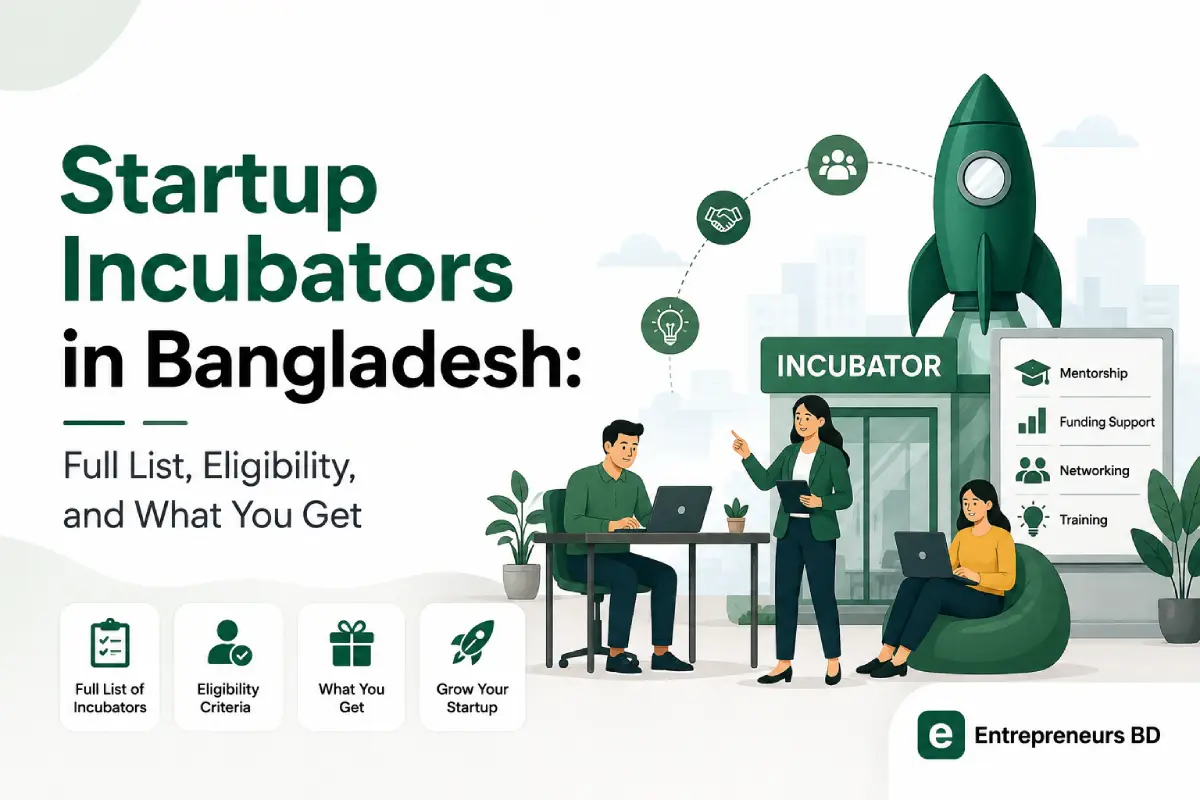
Startup Incubators in Bangladesh: Full List, Eligibility, and What You Get
Bangladesh's most active startup incubation programs in 2026 are the iDEA Project, Startup Bangladesh Limited, the Hi-Tech Park Authority's Sheikh Kamal IT Business Incubators, the Grameenphone Accelerator, NSU Startups Next, the Daffodil Business Incubator, and the private Startup Dhaka Incubator. Each targets a different startup stage and offers a different mix of funding, space, and mentorship.
Key Takeaways
iDEA offers up to BDT 10 lakh in non-equity, non-repayable grants for ICT-based startups.
Startup Bangladesh Limited invests for equity, unlike the grant-only government programs.
Sheikh Kamal IT Business Incubators give free or subsidized office space across a dozen-plus districts.
Grameenphone Accelerator and Startup Dhaka run structured, cohort-based programs with real investor access.
Most government programs still favor ICT businesses, so non-tech founders usually fit better with SME grants or university incubators.
Startup incubators in Bangladesh have grown from a single government pilot into a genuine mix of ministries, telecom-backed accelerators, and university programs. If you are building a startup here in 2026, you no longer have to choose between one or two options.
You can pick from grant-based government schemes, equity-taking venture funds, physical incubation centers with free office space, and private paid accelerators.
Each works differently. Some hand out non-repayable cash. Others invest for equity.
A few just give you a desk and a mentor. This guide breaks down seven of the most active programs operating in the country right now. For each one, you will find who can apply, what you actually get, and how the application process works. Whether you have a raw idea, a working MVP, or a startup already scaling inside Bangladesh's growing startup ecosystem, one of these programs likely fits your stage.
Incubator, Accelerator, or Grant: What You Are Actually Applying To
Not every program on this list works the same way. Knowing the type first helps you apply to the right one.
Grant programs give you cash. You do not repay it and you do not give up equity.
Venture capital programs like Startup Bangladesh Limited invest money in exchange for equity or a convertible instrument.
Physical incubators mainly give you space. Think free or subsidized office space, internet, and sometimes lab equipment.
Accelerators run structured, time-boxed programs. They mix mentorship and training with a pitch event at the end, sometimes in exchange for a small equity stake or a flat fee.
Knowing which bucket a program falls into tells you exactly what you are signing up for before you fill out an application.
7 Startup Incubators and Accelerators in Bangladesh
Bangladesh's incubation landscape splits into government grants, a government venture fund, a nationwide physical network, one major corporate accelerator, two university programs, and one private paid incubator. Here is what each one actually offers.
iDEA Project (ICT Division)
The Innovation Design and Entrepreneurship Academy, known as iDEA, is Bangladesh's flagship government incubation program.
It runs under the ICT Division's Bangladesh Computer Council and has operated since 2016.
Eligibility: Bangladeshi entrepreneurs, teams, or early-stage startups with an innovative, scalable ICT-based idea in any sector can apply for the iDEA Startup Grant.
What you get: a non-equity, non-repayable grant of up to BDT 10 lakh, plus mentorship and networking support.
A separate SME Grant of BDT 50,000 is available for ICT-based small and medium entrepreneurs who hold a valid NID, an active trade license, and at least one year of financial activity.
iDEA also runs a free coworking space program for up to six months, plus an iDEA Lab for hardware prototyping at no cost beyond raw materials.
You cannot reapply if you have already received either grant. Approval typically takes two to three months after you submit your pitch deck and documents online.
Startup Bangladesh Limited (SBL)
Startup Bangladesh Limited is the country's first government-sponsored venture capital company, founded in March 2020 under the ICT Division.
Unlike iDEA, SBL is not a grant program. It makes equity or quasi-equity investments in seed and growth-stage startups.
Eligibility: your company must be registered in Bangladesh, have a working MVP, and show a track record of growing revenue or customer base.
The application asks for detailed business, team, and financial information, including your pitch deck, revenue, and any existing investors.
In 2026, SBL also launched a BDT 400 crore Fund of Funds that channels capital through partner venture capital firms rather than investing directly in individual startups.
If you are chasing a startup's first outside funding round, SBL's direct investment arm is the one to approach, not the Fund of Funds.
Bangladesh Hi-Tech Park Authority (Sheikh Kamal IT Business Incubators)
BHTPA is the government body responsible for Bangladesh's network of hi-tech parks and IT training and incubation centers.
It has built incubation centers named after Sheikh Kamal in districts including Cumilla, Chattogram, Sylhet, Rangpur, Natore, Netrokona, Barishal, and Magura, alongside university-based centers at institutions like CUET and KUET.
Eligibility varies by location but generally targets IT and ITES entrepreneurs, freelancers, and university graduates from that district.
What you get: subsidized or free office space, high-speed internet, and training access, without the strict ICT-only sector rule some other government programs apply.
The CUET-based center, one of the oldest, occupies a ten-story, 50,000-square-foot building and hosts dozens of resident startups.
Because each center runs somewhat independently, you apply directly through the specific park or center nearest you rather than one central portal.
Grameenphone Accelerator (GP Accelerator)
Launched in 2014, GP Accelerator was Bangladesh's first structured accelerator program and remains one of the most recognized.
It is run by Grameenphone, the country's largest telecom operator, as a corporate-backed initiative.
Eligibility: early-stage tech startups with a scalable product, selected through a competitive cohort application.
What you get: an intensive multi-month bootcamp at GP House in Dhaka, mentorship from industry experts, seed funding, and direct investor access at a closing Demo Day.
Its 2025 to 2026 expansion, run jointly with Startup Bangladesh Limited, pushed bootcamps into more than 30 district-level hubs outside Dhaka.
Cohorts stay small and selective, so a working product with early traction beats a raw idea here.
NSU Startups Next
North South University runs one of Bangladesh's most established university incubators, launched in 2020.
Eligibility: at least one founder must be an NSU student, alum, or faculty member.
NSU Startups Next runs two tracks. The Founders' Lab Program is a 16-week pre-incubation track for idea-stage founders.
The Flagship Incubation Program runs about 3.5 months for startups that already have an MVP and are approaching investors.
What you get: weekly mentorship, office hours, investor meetings, pitch coaching, and two extra months of post-graduation support to help close funding rounds.
There is no cost to join if you meet the NSU affiliation requirement.
Daffodil Business Incubator
Daffodil International University runs its own incubation and entrepreneurship support system through its Department of Innovation and Entrepreneurship.
Unlike NSU's program, the Daffodil Business Incubator is open to both DIU students and local youth entrepreneurs outside the university.
What you get: office space and official support services, plus access to DIU's Entrepreneurial Development Fund, which offers interest-free loans for business development.
DIU also runs the Daffodil Startup Market, a recurring event where incubated founders showcase and sell products directly to the public.
This makes it one of the more accessible university-linked options if you have no private university affiliation of your own.
Bangladesh Context: Why Sector and Location Still Decide Your Options
Most government-backed programs, including iDEA and the Sheikh Kamal centers, still favor ICT and ICT-adjacent businesses.
If your startup sits outside tech, a general business idea in agriculture or retail may fit better with SME-focused grants than with iDEA's core Startup Grant.
Location matters too. Dhaka concentrates most investor activity, corporate accelerators, and demo days.
But the Hi-Tech Park Authority's district-level centers and GP Accelerator's regional hub expansion exist specifically to reach founders outside the capital.
If you are based in Chattogram, Sylhet, Rajshahi, or another divisional city, check the nearest Hi-Tech Park or Sheikh Kamal center before assuming you need to relocate.
A formally registered company also opens more doors. Programs like Startup Bangladesh Limited expect an actual registration, not just an idea on paper.
How to Pick the Right Program and Apply
Start by matching your stage to the program type, not the other way around.
If you only have an idea, look at NSU's Founders' Lab Program or a coworking slot through iDEA.
If you already have an MVP and some traction, Startup Bangladesh Limited, NSU's Flagship program, or GP Accelerator suit you better.
If you need office space more than money, the Sheikh Kamal IT Business Incubators or the Daffodil Business Incubator solve that directly.
Before you apply anywhere, prepare your documents: a clear pitch deck, your trade license or registration proof, and basic financial records.
Most government programs ask for the same core paperwork: NID, trade license, and bank or MFS statements.
Apply to more than one program at a time. Eligibility rules rarely overlap enough to disqualify you from applying elsewhere.
Frequently Asked Questions
What is the biggest startup incubator in Bangladesh?
Do Bangladesh incubators take equity in your startup?
Can a non-ICT startup join Bangladesh's incubation programs?
How much funding can a startup get from the iDEA Project?
Is business registration required to apply for an incubator?
How long does it take to get accepted into a Bangladeshi incubator or accelerator?
Your Next Application Should Match Your Stage
Bangladesh's incubator landscape in 2026 is wider than it was even two years ago.
You have government grants that ask for nothing in return, a state-backed venture fund willing to invest real equity, a nationwide network of physical incubation space, a corporate accelerator with genuine investor access, two active university programs, and a private paid option with no equity strings attached.
The mistake most founders make is applying to whichever program is best known, rather than the one that fits their actual stage.
An idea-stage founder chasing Startup Bangladesh Limited will get rejected for lacking an MVP. A founder with real traction who only applies to a free coworking space is leaving funding on the table.
Map your current stage against the seven programs above, shortlist two or three that fit, and prepare your documents once so you can apply to all of them without repeating the work.
The support exists in Bangladesh now. The application is the only real barrier left.

Specializing in SaaS product marketing, SEO strategy, Content marketing, TikTok advertising, PPC, and digital growth.
View Full Profile & ContributionsRelated Articles
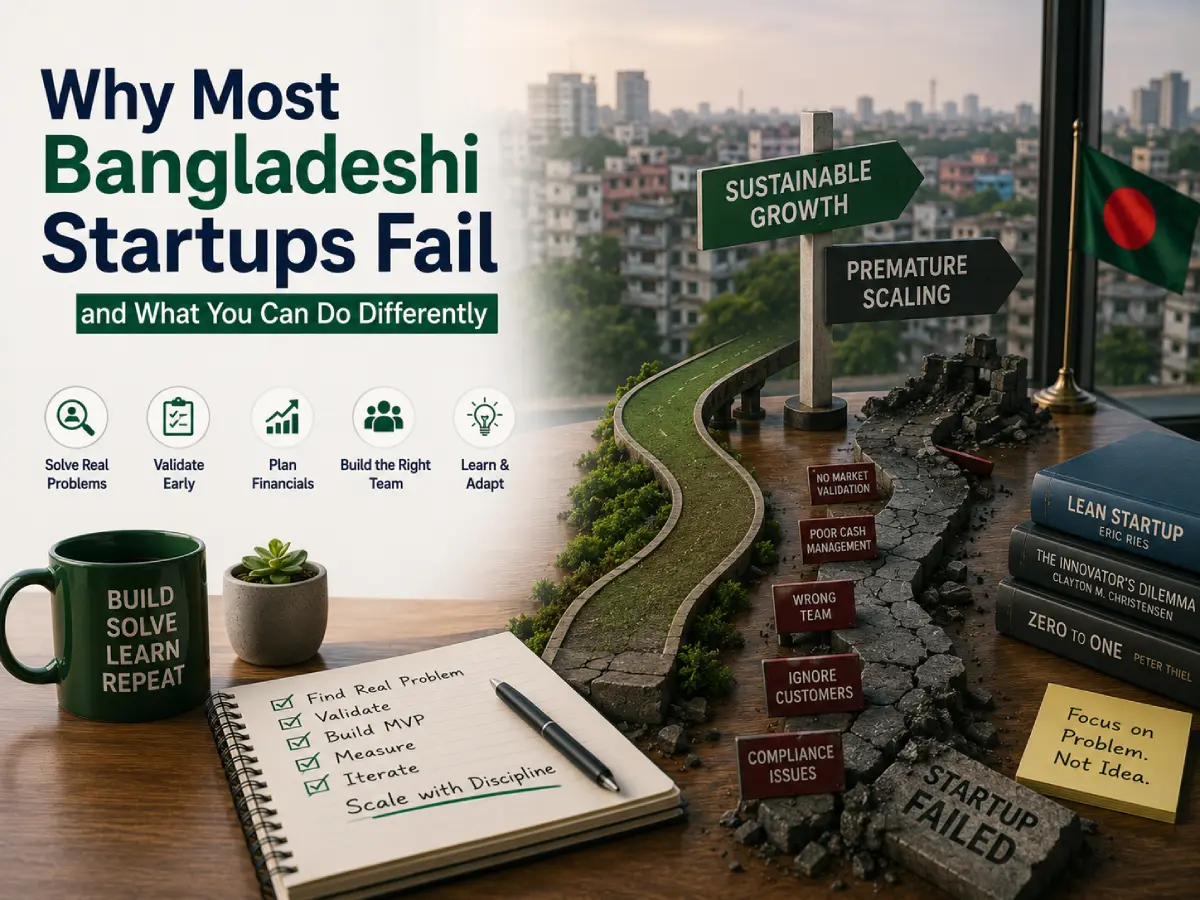
Why Most Bangladeshi Startups Fail — and What You Can Do Differently
Quick Answer: Most Bangladeshi startups fail because of poor market validation, weak financial planning, and founder-market mismatch, not lack of ideas or effort. The founders who survive focus on solving real problems, build lean, and learn from their market before scaling.
Customer Acquisition Strategies That Work for Bangladesh Startups
Quick Answer: The most effective customer acquisition strategies for Bangladesh startups combine low-cost digital channels (Facebook, WhatsApp Business, SEO), mobile financial service integration for frictionless payment, referral-driven growth, and hyperlocal targeting. Startups that blend paid acquisition with retention-focused tactics see the lowest long-term cost per customer.
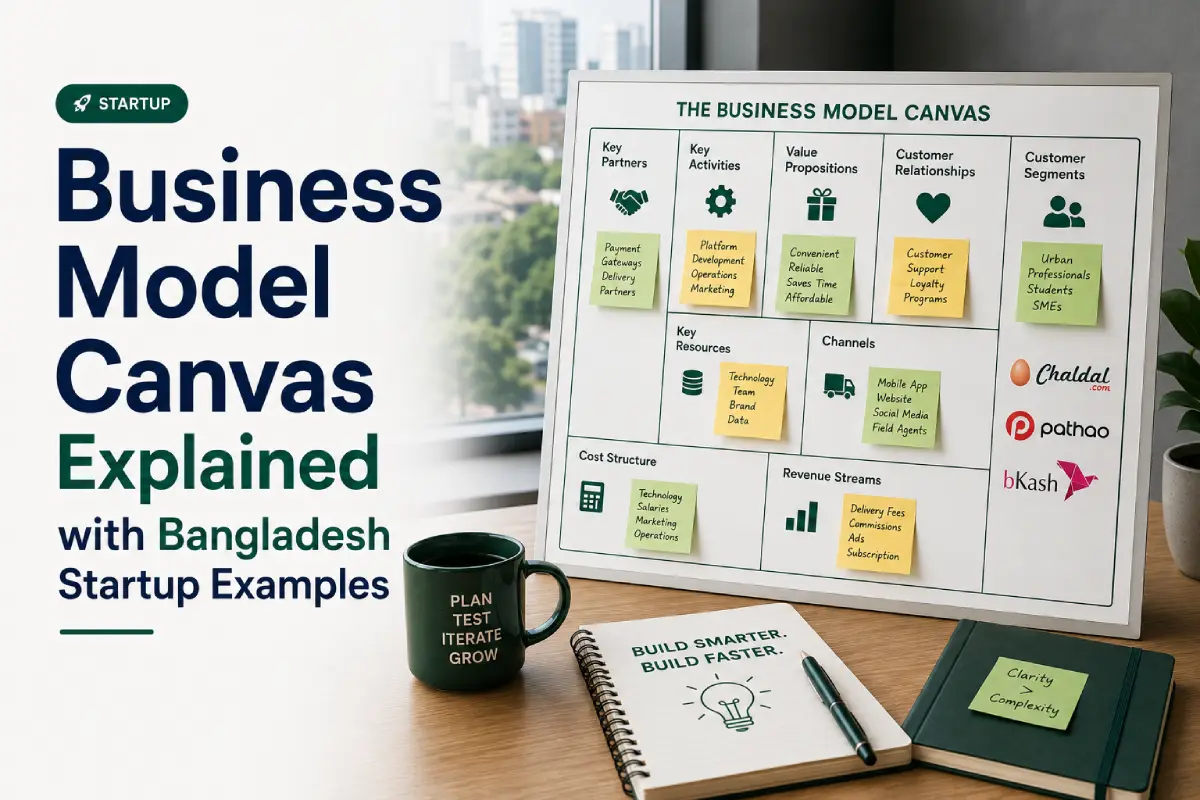
Business Model Canvas Explained with Bangladesh Startup Examples
Quick Answer: The Business Model Canvas (BMC) is a one-page strategic framework with 9 building blocks: Customer Segments, Value Propositions, Channels, Customer Relationships, Revenue Streams, Key Resources, Key Activities, Key Partnerships, and Cost Structure. It helps founders map, test, and communicate their entire business model before writing a single page of a business plan.
Comments (0)
No comments yet. Be the first to share your thoughts!