Beyond RMG: What New Industries Bangladeshi Entrepreneurs Are Building
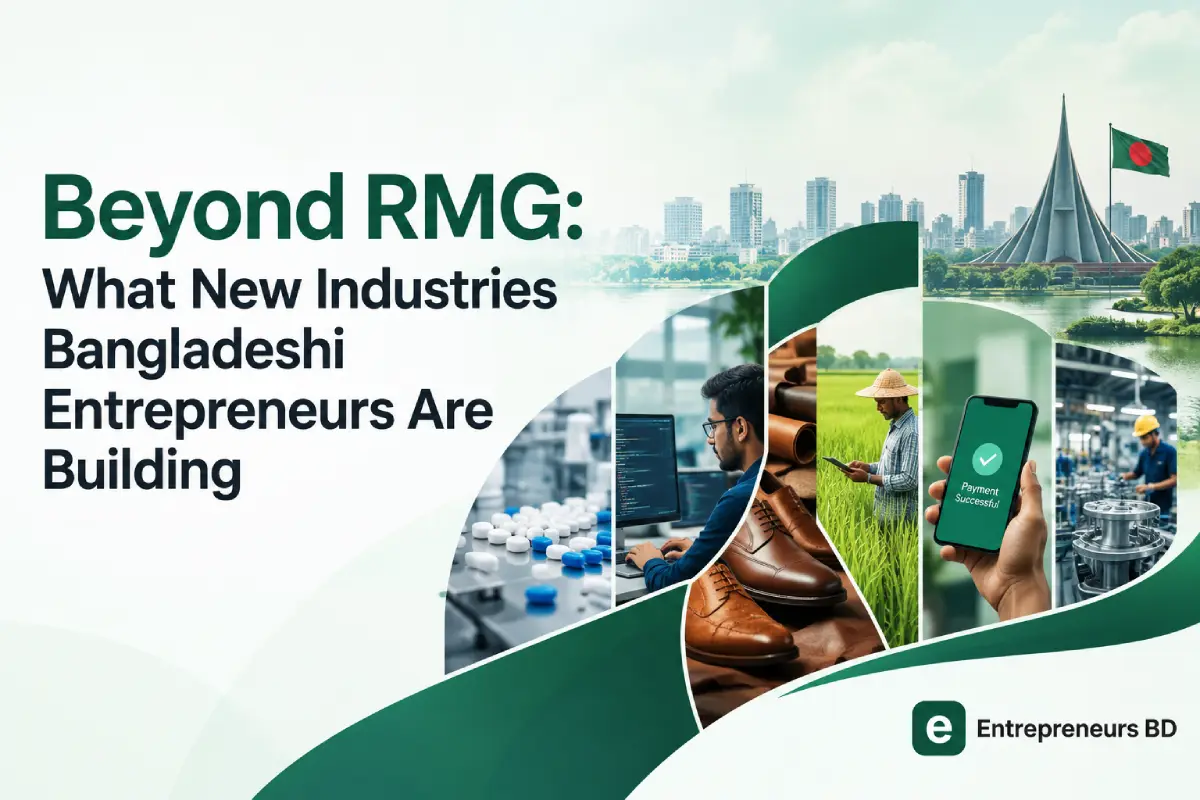
Bangladeshi entrepreneurs are diversifying beyond RMG into pharmaceuticals, IT services, leather and footwear, light engineering, fintech and agritech. None of these sectors approaches RMG's export scale yet, but several have official priority status and measurable growth, and non-RMG export sectors grew roughly 83 percent annually between 2016 and 2023 in targeted firms.
Key Takeaways
RMG accounts for about 82 percent of Bangladesh's exports, a concentration the World Bank flags as a structural risk
Vietnam and Cambodia are no longer minor competitors. Vietnam nearly matched Bangladesh's apparel exports in 2025 and Cambodia is gaining share fast
Pharmaceuticals, leather, light engineering and plastics are the government and World Bank's named non-RMG priority sectors
IT service exports reached $724.6 million in FY2024-25, well short of official targets but growing
Investment promotion just got simpler. BIDA, BEZA and PPPA merged into a single agency, Invest Bangladesh, in August 2026
Ready-made garments transformed Bangladesh's export economy. They created millions of jobs and helped drive decades of industrialization.
But an economy this concentrated in one sector carries real risk. The business trends in Bangladesh over the past few years show entrepreneurs actively building alternatives, rather than waiting to find out what happens if that risk materializes.
This piece maps where that building is happening, checked against the latest available data.
Why Bangladesh Can't Stay a One-Industry Economy
RMG accounts for roughly 82 percent of Bangladesh's merchandise exports, according to the World Bank's export diversification program. That concentration was manageable when Bangladesh's main rivals were smaller.
It no longer is.
Vietnam earned $37.51 billion from apparel exports in 2025. That's within roughly $1.3 billion of Bangladesh's $38.82 billion, down from a $4.7 billion gap just two years earlier.
Cambodia's global market share crossed 2 percent for the first time in the same period. Bangladesh's own market share slipped from 7.0 percent to 6.76 percent year over year.
On top of that, Bangladesh is scheduled to graduate from Least Developed Country status on 24 November 2026. Bangladesh has formally requested an extension, and the relevant UN committee has recommended that request be favorably considered, so the exact timeline is still unsettled.
Even where graduation proceeds, trade preferences don't vanish overnight. The EU has confirmed that 2026 graduates like Bangladesh keep duty-free EBA access for a three-year transition period, running to the end of 2029.
None of this means RMG is going away. It means a country this dependent on one sector, under growing competitive pressure, needs other sectors growing alongside it.
The Sectors Actually Positioned to Diversify
Bangladesh's National Industrial Policy and the World Bank both name a fairly specific list of non-RMG priority sectors. That list includes pharmaceuticals, leather and footwear, light engineering, plastics, agro-processing and ICT/software.
None of them is close to RMG's scale. Each has different strengths.
Sector | Current Export Base | Capital Intensity | Regulatory Burden | Main Opportunity |
|---|---|---|---|---|
Pharmaceuticals | Established, 150+ export markets | High | High (DGDA licensing) | Generic and specialty drugs, API manufacturing |
IT and software services | Small but growing | Low to medium | Medium | Software, ITES, outsourcing |
Leather and footwear | Established, expanding | Medium | Medium (compliance-heavy) | Higher-value footwear for regulated markets |
Light engineering | Large domestic base | High | Medium | Machinery and industrial components |
Plastics | Emerging | Medium | Low to medium | Packaging, industrial goods |
Fintech and MFS | Domestic-scale, pre-export | Low to medium | High (Bangladesh Bank licensing) | Payments, micro-lending, insurance |
Agritech and agro-processing | Emerging | Medium | Low to medium | Farm financing, processed food exports |
Pharmaceuticals: Mature, But Still Small Next to RMG
Pharma is genuinely one of Bangladesh's most established non-RMG manufacturing sectors. Local firms meet about 98 percent of domestic medicinal demand.
They export to more than 150 countries, according to Invest Bangladesh's pharmaceutical profile. In the first ten months of FY2024-25, pharma exports reached $177.42 million.
That's real growth, but it's worth being honest about scale. RMG exports run around $40 billion a year.
Pharma isn't RMG's replacement. It's one of several sectors chipping away at RMG's share, constrained mainly by heavy reliance on imported active pharmaceutical ingredients.
That's exactly why a newer wave of entrepreneurs is moving into domestic API manufacturing rather than finished drugs.
IT and Software Services: Real Growth, Overstated Numbers
Official ICT service exports (telecommunications, computer and information services) reached $724.6 million in FY2024-25. That's a 7.7 percent increase from the year before, according to Export Promotion Bureau data.
That's well short of the government's own $5 billion target. It also lags regional competitors like Pakistan, whose ICT exports grew 18 percent to $3.8 billion the same year.
Industry groups argue the real figure is higher. Freelance earnings brought in through informal channels aren't fully captured in official statistics, and some estimates put the broader IT/ITES economy above $1 billion.
That's a real distinction worth holding onto. Official exports and industry-estimated exports are two different numbers, and conflating them overstates the sector.
What still makes IT attractive to new founders is low capital entry. A small team with laptops and a client abroad can start exporting the same month, something that's harder to say about pharma or light engineering.
Leather, Footwear and Plastics: The Sectors Often Left Out
These three don't get the attention pharma and fintech do. But the World Bank specifically names leather goods, footwear, light engineering and plastics as the core targets of its non-RMG export diversification work in Bangladesh.
Firms in these targeted sectors grew export volumes by nearly 83 percent annually between 2016 and 2023. The program created close to 180,000 jobs, more than triple its original target.
One footwear exporter that received support, Apex Footwear, restarted post-pandemic operations and created over 9,600 jobs, 38 percent of them held by women.
Fintech, Agritech and Healthtech: Domestic-First, Export-Later
These sectors work differently from pharma or IT. They're solving a domestic problem before there's any real export ambition.
Fintech and mobile financial services. Bangladesh Bank data put total registered MFS accounts near 240 million by early 2025, spread across services like bKash and Nagad.
That's a headline figure, not a user count. Registered accounts include duplicates and dormant accounts, so the real active user base is smaller.
It's also worth separating categories. bKash and Nagad are mobile financial service providers regulated directly by Bangladesh Bank, while payment infrastructure companies like ShurjoPay hold a separate payment system operator license from the same regulator.
Nagad itself is currently operating under an administrator appointed by Bangladesh Bank, rather than a standard commercial license. That's worth knowing if you're studying the sector, not a detail to gloss over.
Agritech. iFarmer is a useful example of how this sector actually works. It connects smallholder farmers to retail investors, institutional buyers and financing providers.
That combination of capital access and market access is something traditional agricultural lending in Bangladesh has historically struggled to do at scale.
Healthtech. Praava Health built a modern primary care and diagnostics model. It's aimed at a country where quality healthcare has been concentrated in a handful of cities.
This is a domestic-access problem first, with no meaningful export component yet.
Edtech. 10 Minute School, Shikho and Ostad occupy a similar position. They've built large domestic user bases around tutoring and skills gaps in a young population.
International expansion is still an early-stage ambition for these companies, not a current revenue driver.
Bangladesh Context: Who Is Actually Building This
It isn't only founders driving this shift. Government industrial policy, established manufacturers, and programs like the World Bank's Export Readiness Fund are doing a lot of the underlying work. That fund has already supported 570 firms.
The institutional landscape itself just changed too. In August 2026, the government merged BIDA, the Bangladesh Economic Zones Authority, and the Public-Private Partnership Authority into a single body called Invest Bangladesh, operating under the Prime Minister's Office. For founders, this means registration, sector incentives and economic zone access are meant to run through one agency going forward instead of three.
What entrepreneurs are doing is building the customer-facing layer on top of all this. Think platforms, financing products and direct-to-market channels that didn't exist before.
Fahim Mashroor, president of BASIS, Bangladesh's software and IT services trade body, has spent years pushing for better export data and stronger advocacy for the sector. That kind of institution-building tends to matter more than any single company.
As technology reaches rural Bangladesh, agritech and fintech founders are reaching customers who were previously unreachable. It's worth noting, though, that IT and fintech company headquarters remain heavily concentrated in Dhaka and Chattogram even as their customer bases spread.
The country's large freelance and outsourcing workforce is increasingly where these companies hire their first technical staff.
Practical Steps for Entrepreneurs Entering These Sectors
Start with a domestic problem you understand personally, not an export narrative you read about
Check current incentives and export support for the specific sector through Invest Bangladesh, since eligibility and benefits vary and aren't automatic just because a sector has priority status
Talk to people already licensed or operating in the sector before writing a business plan, especially in pharma, fintech and healthcare where the regulator matters as much as the product
Decide export timing by sector: software can be export-first from day one, while agritech, healthtech and pharma generally need a working domestic model before export makes sense
Budget realistic timelines for regulatory approval. Pharma licensing runs through the Directorate General of Drug Administration, MFS and payment products through Bangladesh Bank, both of which typically take longer than software or e-commerce registration
Frequently Asked Questions
What industries is Bangladesh diversifying into besides garments?
Is Bangladesh's economy too dependent on RMG?
Which new sector has the most export potential after RMG?
Do these new industries require more capital than starting a garment business?
How long does regulatory approval typically take in these sectors?
Is Bangladesh actually going to lose its LDC trade benefits soon?
What Bangladesh's Diversification Could Look Like Next
RMG built modern Bangladesh. But it's now facing real competitive pressure from Vietnam and Cambodia at the same time the country approaches a trade-status transition.
Neither pharma, IT, leather, nor fintech is close to replacing RMG's scale. None of them will be for a long time.
What's changed is that these sectors now have measurable traction: real export data, real World Bank-backed programs, and a newly consolidated investment agency meant to make registration less of a bottleneck than it used to be.
For founders deciding where to build, the useful takeaway isn't a ranked list of winners. It's picking the domestic problem you understand best, being realistic about the regulatory path for that specific sector, and building the export case only once the local model actually works.

Specializing in SaaS product marketing, SEO strategy, Content marketing, TikTok advertising, PPC, and digital growth.
View Full Profile & ContributionsRelated Articles
The Innovation of Tanvir A. Mishuk: From Fintech Pioneer to AI Entrepreneur
Tanvir A. Mishuk is a fintech entrepreneur recognised for advancing digital financial inclusion in Bangladesh through innovations like e-KYC and USSD based banking access. He has since founded App AI Pty Ltd, an artificial intelligence company based in Australia, applying lessons from financial technology to a new generation of AI driven solutions.
HealthTech in Bangladesh: Opportunities, Regulations, and Early-Stage Players
HealthTech in Bangladesh covers telemedicine, e-pharmacy, diagnostics logistics, and digital health records serving a population with limited doctor access outside major cities. No single unified health-tech law exists yet; founders answer to DGDA, BMDC, and DGHS depending on the product. Early movers like Praava Health and Arogga built durable models around trust and last-mile delivery, not app polish.
What is Social Entrepreneurship in Bangladesh 2026
Quick Answer: Social entrepreneurship in Bangladesh means building a self-sustaining business that solves a social problem, whether poverty, illiteracy, healthcare access, or climate vulnerability, without relying on charity. Bangladesh pioneered this model globally through Grameen Bank and BRAC, and the approach continues to grow across health, agriculture, and clean energy in 2026.
Comments (0)
No comments yet. Be the first to share your thoughts!