Business Trends in Bangladesh Every Entrepreneur Should Know in 2026
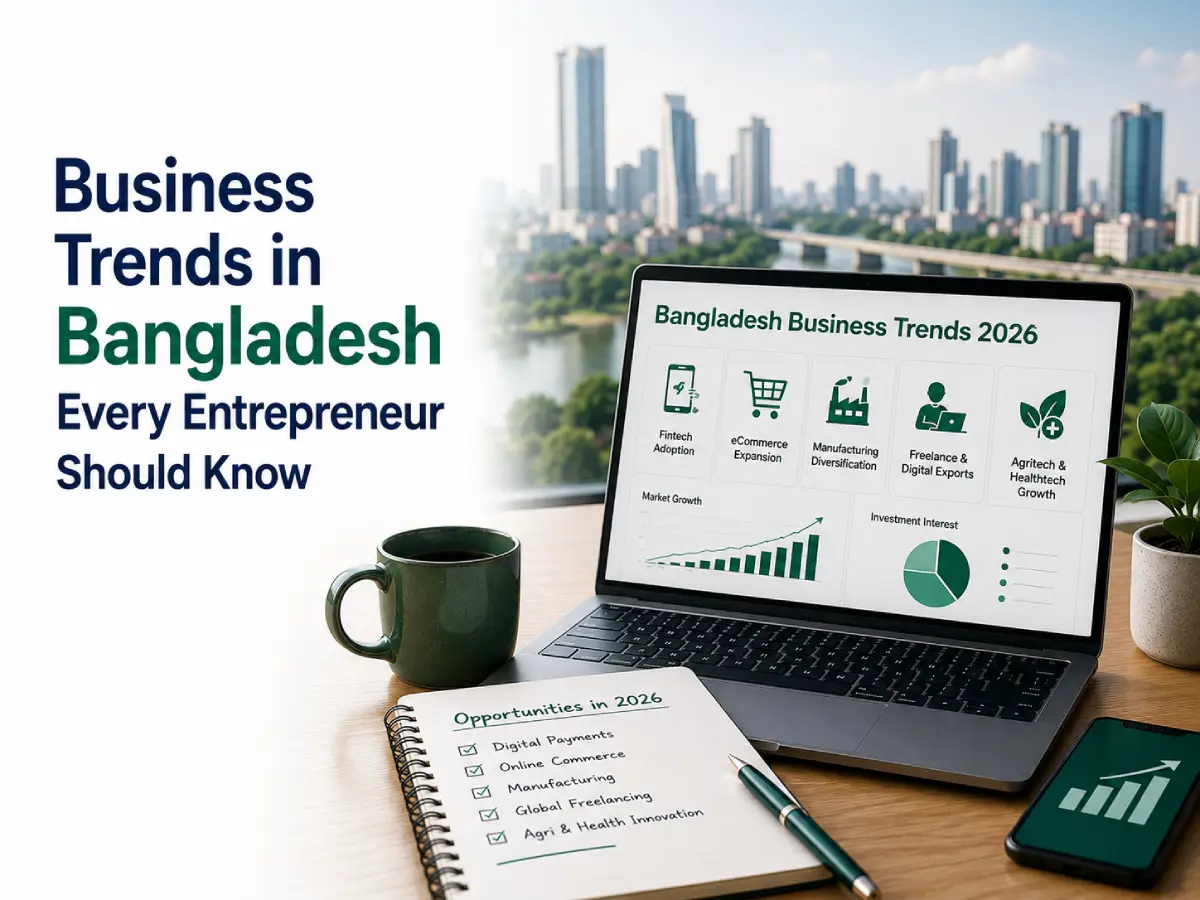
Quick Answer: The dominant business trends in Bangladesh right now include rapid fintech adoption, eCommerce market expansion, growth in light manufacturing beyond garments, a surge in freelance and digital service exports, and increasing investor interest in agritech and healthtech. These shifts are creating new entry points for founders across multiple sectors.
Key Takeaways
Mobile financial services have crossed 200 million registered accounts, fundamentally changing how businesses collect payments and manage cash
eCommerce in Bangladesh is growing faster than physical retail, with rural demand rising as smartphone penetration deepens
Garments still dominate exports, but electronics assembly, leather goods, and pharmaceuticals are gaining measurable ground
Freelancing has become a legitimate business sector, with Bangladesh ranked among the top five freelance-exporting countries globally
Investor capital is flowing into agritech, edtech, and healthtech as founders address real infrastructure gaps in those sectors
Bangladesh's economy has been on a sustained growth trajectory for over a decade, and the business landscape that exists today looks fundamentally different from what it did five years ago.
GDP growth has averaged around 6 percent annually over the past several years, and the structural shifts driving that growth are visible at the business level, not just in macroeconomic headlines.
For founders and entrepreneurs, these shifts matter because they reveal where demand is forming, where capital is moving, and which sectors will reward early entry over the next three to five years.
This article covers the most consequential business trends currently shaping Bangladesh, with a specific focus on what each one means for entrepreneurs looking to build or grow a business in this environment. Data is drawn from official sources and sector-specific reports throughout.
Fintech and Mobile Finance Are Reshaping How Business Gets Done
The transformation of financial services in Bangladesh is not a future story. It is happening right now, and it is changing the operating conditions for every type of business.
bKash, Nagad, Rocket, and Upay collectively serve hundreds of millions of accounts across the country. According to the Daily Star, Mobile Financial Services (MFS) transactions reached Tk 17.37 trillion, a figure that reflects how deeply these platforms have integrated into daily commerce.
For entrepreneurs, this shift has two major implications. First, the payment infrastructure barrier that once prevented small businesses from collecting money digitally has largely disappeared. A street vendor in Bogura and a boutique owner in Gulshan can now both accept digital payment with no point-of-sale hardware.
Second, transaction data generated through MFS platforms is beginning to fuel alternative credit scoring, which means businesses with consistent digital revenue records are gaining access to financing that would have been unavailable to them through traditional banking.
The next layer of fintech opportunity sits in B2B payments, payroll digitization for small businesses, and SME lending products built on transaction history rather than collateral. Founders who understand the MFS infrastructure well are positioned to build on top of it rather than competing with it.
eCommerce Is Growing Beyond Dhaka
For several years, Bangladesh's eCommerce market was essentially a Dhaka-centric phenomenon. That geographic concentration is now breaking open as smartphone ownership and mobile internet access extend into secondary cities and rural areas.
The eCommerce sector has grown to over 2,000 active eCommerce businesses, with transaction volume expanding significantly outside the capital.
Platforms like Chaldal, Shajgoj, and Shikho built their early bases in Dhaka but are actively expanding, and a new wave of category-specific and regional eCommerce businesses is emerging to serve demand that national platforms do not address at the local level.
The specific opportunity here is not in building another general marketplace. That window is largely closed for new entrants without significant capital. The opportunity is in vertical eCommerce, meaning platforms or services that serve a specific product category, geography, or customer segment with depth that generalist platforms cannot match.
Agricultural inputs for smallholder farmers, healthcare products for rural clinics, and educational materials for students outside major cities are all examples of segments with real demand and limited current supply.
Logistics remains the primary constraint. Last-mile delivery outside Dhaka is expensive, unreliable, and fragmented. Founders who solve part of that problem, either directly or by building products that work within current logistics constraints, will be positioned well.
Manufacturing Diversification Beyond Garments
The ready-made garments (RMG) sector generates approximately 84 percent of Bangladesh's export earnings according to the Export Promotion Bureau's annual export statistics, making the country's external revenue position highly concentrated in a single industry. That concentration has been a recognized vulnerability for years, and the diversification that economists and policymakers have called for is beginning to materialize.
Electronics assembly is the most prominent emerging export category. Several global brands have begun shifting or adding assembly operations to Bangladesh, attracted by competitive labor costs, improving infrastructure in export processing zones, and the government's active promotion through the Bangladesh Economic Zones Authority.
The BEZA website lists over 100 economic zones at various stages of development, several of which are specifically targeting electronics and light manufacturing tenants.
Leather and leather goods, pharmaceuticals, and processed food are also growing as export categories. Each of these creates upstream and downstream business opportunities: input supply, quality testing, packaging, logistics, and the services that manufacturing operations require.
For entrepreneurs, the most accessible entry point into this trend is not manufacturing itself, which requires significant capital, but the service businesses that manufacturing expansion creates.
Recruitment and staffing, compliance consulting, logistics coordination, and technology services for factory operations are all areas where demand is growing faster than supply.
The Freelance Economy Has Become a Real Business Sector
Bangladesh consistently ranks among the top countries globally for freelance export earnings. According to the ICT Division and the Bangladesh Freelancer Development Society estimates over 650,000 active freelancers in the country, with annual foreign currency earnings from the sector reaching hundreds of millions of dollars.
What is new is not the existence of freelancing but its formalization. Freelancing is increasingly being treated as a business, not just a side income. Individuals are forming agencies, building teams, specializing in service and client geography, and generating revenue at a scale that rivals small manufacturing operations.
The government has responded. The ICT Division's Learning and Earning Development Project has trained hundreds of thousands of young Bangladeshis in digital skills, and policies around foreign currency remittance for freelancers have been progressively clarified to make it easier to receive and retain international earnings.
For entrepreneurs, the opportunity here is twofold. Those with existing skills can formalize and scale their individual practice into a service business. And those who do not freelance themselves can build tools, platforms, training programs, or support services specifically for Bangladesh's large and underserved freelance community.
Agritech Is Attracting Serious Investor Attention
Agriculture employs around 40 percent of Bangladesh's workforce. Despite that scale, the sector operates with significant inefficiency: fragmented landholdings, poor cold chain infrastructure, price opacity between farmers and buyers, and limited access to inputs like quality seeds and fertilizer at fair prices.
These inefficiencies are exactly the kind of structural problems that technology-enabled businesses can address. Startups working on digital marketplaces connecting farmers directly to buyers, soil testing services, crop advisory platforms, and agricultural input financing have all attracted funding from both local and international investors over the past two years.
The Startup Bangladesh Limited, a government-backed fund under the ICT Division, has publicly disclosed investments in several agritech companies, signaling that public capital is moving into the sector alongside private funding.
The challenge in agritech is distribution and trust. Reaching farmers with a digital product requires local agents, partnerships with NGOs or cooperatives, or physical presence at a level that app-only models cannot achieve. Founders who account for this from the start build more defensible businesses than those who assume digital adoption will happen on its own.
Health Services and Healthtech Are Filling Infrastructure Gaps
Bangladesh's public health infrastructure is under significant strain. Doctor-to-patient ratios in rural areas are well below WHO recommendations, and the cost of private healthcare is prohibitive for a large portion of the population. These gaps have created a market for digital health services that has been growing steadily and accelerated notably after 2020.
Telemedicine platforms, pharmacy delivery services, diagnostic booking apps, and health insurance products designed for lower-income households are all active areas. Several Bangladesh-founded healthtech companies have raised funding from regional and international investors, reflecting growing confidence in the sector's viability.
The regulatory environment is an important variable. The Directorate General of Health Services (DGHS) is the primary regulatory body for health businesses in Bangladesh, and licensing requirements for digital health services are still evolving. Founders in this sector benefit from engaging with regulatory processes early rather than treating compliance as a post-launch problem.
Green Business and Sustainability Are Moving From Niche to Requirement
Bangladesh is among the countries most affected by climate change, and that physical reality is beginning to shape business conditions in concrete ways. International buyers, particularly in the garments sector, are increasingly requiring suppliers to demonstrate environmental compliance as a condition of doing business.
The Bangladesh Garment Manufacturers and Exporters Association (BGMEA) reports that Bangladesh has more LEED-certified green garment factories than any other country. That leadership in green manufacturing is now creating a reputational and commercial advantage that extends beyond compliance.
Beyond garments, solar energy adoption among SMEs is accelerating as electricity costs rise and reliability remains a challenge. Waste management, sustainable packaging, and water treatment are emerging as commercially viable service businesses serving industrial clients who need to meet their own environmental commitments.
For entrepreneurs, the practical implication is that sustainability is shifting from a cost center to a business requirement in export-oriented sectors. Building that capability early, or building products and services that help other businesses meet green standards, is a genuine commercial opportunity.
Frequently Asked Questions
What is the fastest-growing business sector in Bangladesh right now?
Is Bangladesh a good country for starting a business in 2026?
How is digital payment adoption affecting small businesses in Bangladesh?
Which industries are receiving the most startup investment in Bangladesh?
How is the garment industry changing, and what does it mean for entrepreneurs?
What government programs support entrepreneurs and startups in Bangladesh?
What These Trends Mean for Your Next Move
Trends create timing advantages, but only for founders who act on them before the window closes. Knowing that agritech is receiving investor attention matters less than knowing specifically which agritech problem you are positioned to solve.
Knowing that eCommerce is growing outside Dhaka matters less than understanding which specific product category or geography you could serve with real depth.
The most useful way to engage with these trends is not to pick the hottest sector and build toward it. It is to look at the intersection of what is genuinely growing and where your existing knowledge, relationships, or location gives you a real advantage.
A founder with deep knowledge of the pharmaceutical supply chain has a more credible path in healthtech than someone who simply noticed the sector is growing. A founder based in Sylhet who understands local agricultural patterns is better positioned to build agritech in that region than a Dhaka-based team targeting the same geography remotely.
The business environment in Bangladesh in 2026 has more entry points than it did five years ago, across more sectors and more geographies. The constraint is not opportunity. The constraint is clarity about where you specifically can create something real. Start there.

Specializing in SaaS product marketing, SEO strategy, Content marketing, TikTok advertising, PPC, and digital growth.
View Full Profile & ContributionsRelated Articles

Business Registration in Bangladesh: All Legal Structures Explained
Quick Answer: Business registration in Bangladesh depends on your chosen legal structure. A sole proprietorship is registered via a trade license at your local city corporation. Partnerships and private limited companies are registered through the Registrar of Joint Stock Companies and Firms (RJSC). Each structure has different liability, tax, and compliance implications.
Why Data and Analytics Matter in Modern Entrepreneurship
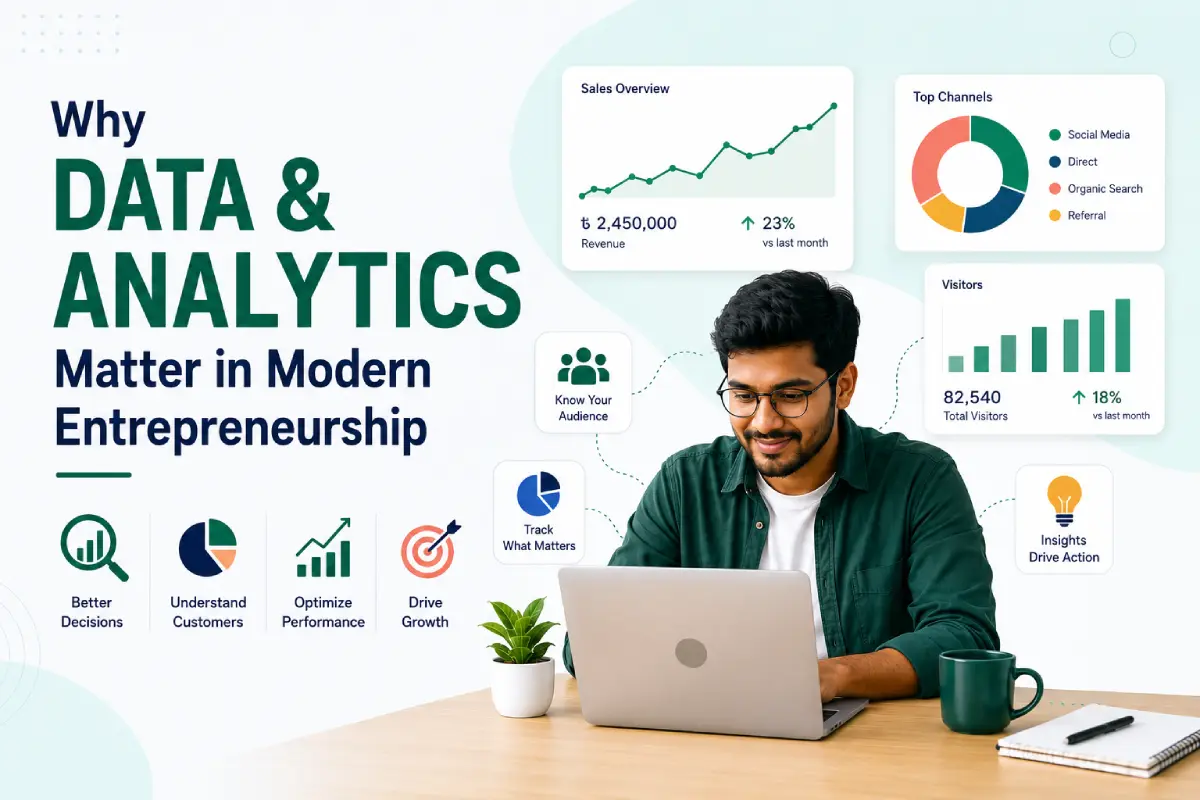
Quick Answer: Data and analytics help entrepreneurs replace guesswork with evidence. Instead of relying on instinct alone, you use real numbers — from sales figures to customer behaviour — to make decisions that are faster, cheaper, and far more likely to succeed. In 2026, it is not a competitive advantage; it is a baseline requirement.

Facebook Marketing for Bangladeshi SMEs: Strategy, Ads, and ROI
Quick Answer: Facebook marketing for Bangladeshi SMEs involves building an optimized Business Page, posting consistently for organic reach, and running targeted paid ads using Meta Ads Manager. With over 50 million Facebook users in Bangladesh and low ad costs compared to Western markets, SMEs can generate strong ROI even on modest budgets of BDT 5,000–20,000 per month.
Comments (0)
No comments yet. Be the first to share your thoughts!