One Person Company (OPC) in Bangladesh: Rules & Registration
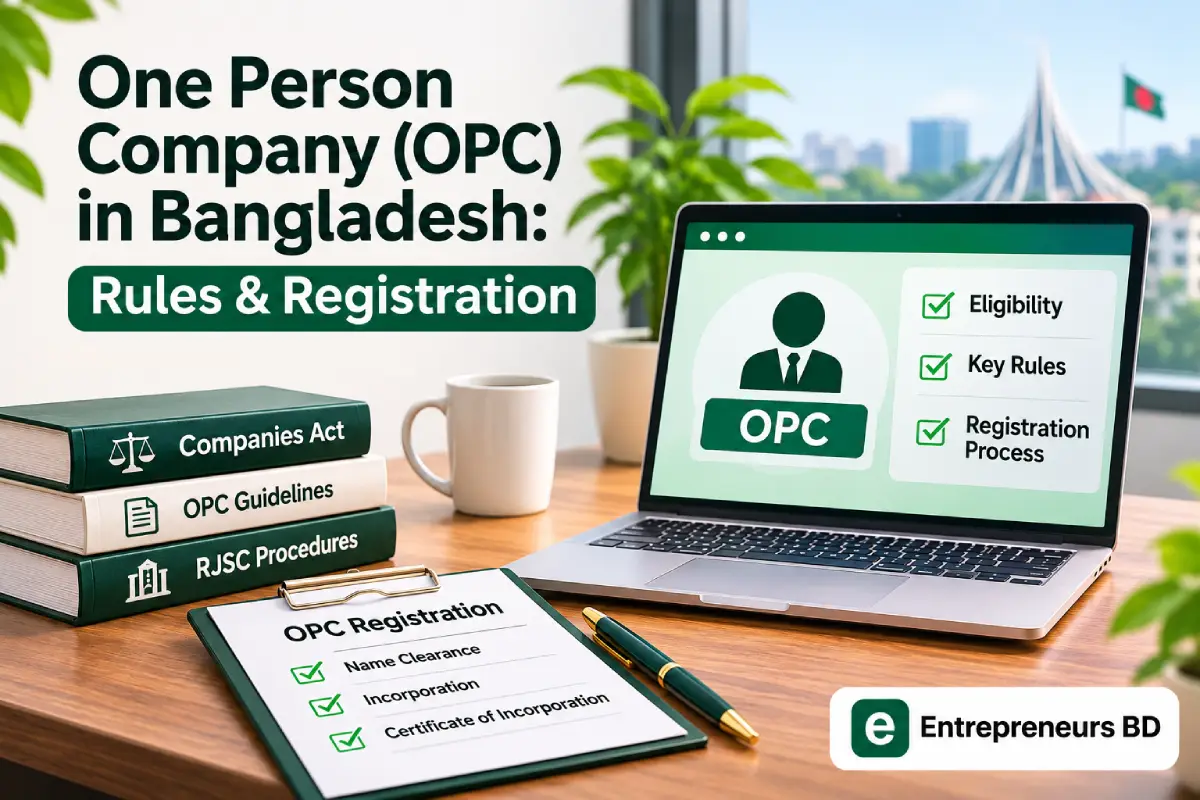
A one person company (OPC) is a limited company with a single individual as its only shareholder. You register it with RJSC through the eBRS portal. The law requires Tk 25 lakh to Tk 5 crore in paid-up capital and a named nominee. Government registration fees start at about Tk 17,200.
Key Takeaways
An OPC gives one founder limited liability without a second shareholder
The Act sets paid-up capital at Tk 25 lakh to Tk 5 crore and a turnover band of Tk 1 crore to Tk 50 crore
Every OPC must name a nominee who becomes the shareholder if the owner dies or becomes incapable
Applications go through RJSC's eBRS portal, live since 12 November 2026
A draft 2026 amendment would lower the capital minimum, but it is not law yet
A one person company in Bangladesh lets a single founder own a company outright while keeping the business legally separate from their personal finances. Before 2020, a solo founder could either run a sole proprietorship in Bangladesh with unlimited personal liability, or find a second shareholder to meet the minimum for a private company.
The Companies (Second Amendment) Act 2020 added a third option, and registrations are rising fast from a small base: RJSC figures show 818 OPCs registered in FY26, up 235% on the year before, and 376 in the first quarter of FY27.
This guide covers the rules in plain language, including the two limits that matter most (capital and turnover), then OPC registration in Bangladesh on eBRS, the fees and your yearly duties.
What Is a One Person Company?
An OPC is a private company limited by shares with exactly one shareholder, who must be an individual, not a company or firm. Its rules sit in Sections 392A to 392L of the Companies Act 1994. Unlike a sole proprietorship, an OPC:
Is a separate legal person. It signs contracts, owns assets and borrows in its own name.
Limits your liability. Your liability is generally limited to any amount unpaid on your shares. The protection does not extend to personal guarantees you sign, your own unlawful conduct or other liabilities the law places on you personally.
Continues if you die. The nominee becomes the shareholder.
The Core OPC Rules
One owner, one OPC per person
Under Section 392B of the Act, any natural person can form an OPC for a lawful purpose, but each person can form only one.
The eBRS manual offers a foreign individual option for the shareholder, but portal acceptance does not replace other rules. Foreign founders should separately check investment, banking, foreign-exchange and sector requirements.
The nominee
The Memorandum must name a nominee who has given written consent. If you die, become unable to manage the company or become of unsound mind, the nominee becomes the shareholder. The nominee can withdraw consent, and you can replace them at any time, or appoint a new one if they die first, with the new person's consent. Notify RJSC of any change.
Becoming the shareholder is not the same as being appointed to run the business, so choose someone willing to take on ownership if needed.
Capital: Tk 25 lakh to Tk 5 crore
Section 392C sets paid-up share capital at Tk 25 lakh to Tk 5 crore, and the eBRS portal separately requires authorized capital in the same range. Paid-up capital is not a fee: it is money you commit to the company, which it can use for its business. A multi-member private company has no statutory minimum.
Turnover: Tk 1 crore to Tk 50 crore
Section 392C also requires turnover in the immediately preceding financial year of Tk 1 crore to Tk 50 crore. A new company has no previous year, and the Act does not say how the condition applies at first registration or what happens if a running OPC falls below Tk 1 crore. Ask RJSC or a company lawyer how it is currently applied before you apply, and once trading, have your accountant track turnover against the band.
Conversion
Section 392C(2) allows an OPC to convert into a private or public limited company when both paid-up capital and turnover exceed the upper limits, subject to the required conditions. It is not automatic. Because an OPC can never have two shareholders, confirm the restructuring route with RJSC and a lawyer before bringing in a co-founder or investor.
Name, director and meetings
Name: must end with "OPC". Follow the naming format eBRS shows during the name search
Director: the sole shareholder is the director. You can appoint a manager, company secretary and other staff
Meetings: under Section 392F, at least one directors' meeting in each half of the calendar year
Share transfer: shares can only be transferred to another natural person
OPC vs Sole Proprietorship vs Private Company
If you are unsure what kind of business you are building, our explainer on startup, SME and solopreneur paths helps frame the choice.
Point | Sole proprietorship | One person company | Private limited company |
|---|---|---|---|
Owners | 1 | Exactly 1 | 2 to 50 |
Liability | Unlimited | Limited | Limited |
Minimum capital | None | Tk 25 lakh paid-up | None set by law |
RJSC registration | Not required | Required | Required |
Statutory audit under Companies Act | No | Yes | Yes |
Can add investors | No | Not as an OPC | Yes |
An OPC suits a founder who works alone, can commit Tk 25 lakh, and needs an incorporated company for clients, tenders or larger contracts. If you are still testing an idea, a proprietorship is cheaper. With a genuine co-founder, a limited company in Bangladesh has no capital minimum.
OPC Registration Requirements and Steps on eBRS
New applications have gone through the eBRS portal (ebrs.rjsc.gov.bd) since 12 November 2026. Guides pointing to roc.gov.bd are out of date.
What you need
For a Bangladeshi shareholder, the eBRS manual asks for:
NID and date of birth, plus a mobile number registered under that NID
TIN and scanned proof of submission of your latest tax return (PSR)
Photo, scanned signature, email and addresses
A foreign shareholder gives passport details, a scanned passport, photo, signature and addresses; PSR is optional.
For the nominee, you enter their identity and contact details and they consent through the system; check the live form for exact fields. You also need a registered office address in Bangladesh. If you have never filed a tax return and have no PSR, ask NBR or a tax adviser how to meet the requirement first.
Step 1: Clear the name
Sign up on eBRS with your NID, choose One Person Company, search your name and pay Tk 575. Our guide to RJSC name clearance explains the naming rules and common rejections.
Step 2: Complete the application
Enter your name clearance details, then the registered address, authorized capital, shareholder, company signatory and nominee. For the Memorandum and Articles, choose Model (generated from your details), Custom, or Pre-Approved, which is for banks, financial institutions and insurers.
Step 3: Consents, payment and approval
Complete the online consents and pay through the challan system. According to RJSC's launch statement, applications using the model documents can be registered automatically once information, payment, identity checks and OTP consent are complete, while custom documents get detailed review by officials. Once approved, download your certificate and certified copies from eBRS.
OPC Registration Fees in 2026
OPCs pay the same fees as private companies on the eBRS fee schedule, but start in a higher capital band.
Fee | Tk 25 lakh authorized capital | Tk 50 lakh authorized capital |
|---|---|---|
Name clearance | Tk 575 | Tk 575 |
Filing fee | Tk 1,380 | Tk 1,380 |
Capital-based fee | Tk 1,200 | Tk 3,200 |
Stamp duty on MoA and AoA | Tk 12,000 | Tk 32,000 |
Certified copies | Tk 2,048 | Tk 2,048 |
Total | Tk 17,203 | Tk 39,203 |
The schedule does not say whether 15% VAT applies to the capital-based fee, so your invoice may be up to Tk 480 higher. Stamp duty jumps by Tk 20,000 once authorized capital passes Tk 40 lakh, so keep it at Tk 40 lakh or less unless you need more room. Our full breakdown of company registration cost explains each band.
After Registration
Most new OPCs then need:
A company TIN for income tax
A BIN or turnover tax enlistment. The Finance Act 2026 made one mandatory for running a business current or STD bank account, taking a bank loan and renewing a trade licence, so you need it even if no VAT is payable
A company bank account in the company's name
A trade licence from your city corporation or local authority. See our trade licence guide
Any sector licence your activity needs
Yearly Compliance Checklist
Financial statements within 180 days. Under Section 392I, file them with RJSC within 180 days after each financial year ends, signed by you. This differs from the AGM-based deadlines in our guide to RJSC annual return filing
Audit. Section 392J applies the normal auditor rules, so appoint a chartered accountant firm every year
Two directors' meetings. At least one in each half of the calendar year, with signed minutes and resolutions
Borrowing. Section 392K applies the Act's borrowing and repayment rules when an OPC deals with a bank or financial institution, so check the approvals and filings before taking a loan
Changes. Notify RJSC of changes to the nominee, registered office, Memorandum or Articles, and any share transfer
The OPC also files its own income tax return, separate from yours. PwC's tax summary lists no separate OPC rate. Non-listed companies pay 27.5% for AY 2026-27 to AY 2030-31, reduced to 25% only if the company meets the bank-transfer condition. Have your adviser confirm the rate and filing date, and see our overview of tax for startups.
The Proposed 2026 Amendment
A draft Companies (Third Amendment) Act 2026 would, according to the Financial Express, lower the OPC minimum paid-up capital to about Tk 5 lakh, raise the ceiling and remove the fixed turnover band. Reported conversion thresholds vary, so treat the details as unsettled. Until an amending Act is passed and in force, the current rules apply, and there is no date to plan around.
Frequently Asked Questions
What is the minimum capital for a one person company in Bangladesh?
Can a foreigner open a one person company in Bangladesh?
Who can be a nominee in an OPC?
How long does OPC registration take?
How much does OPC registration cost?
Can I convert my sole proprietorship into an OPC?
Is an OPC Right for You?
The main hurdle is the Tk 25 lakh paid-up capital commitment and the turnover band. On top of that, budget for an annual audit, accounting, two minuted meetings a year, tax filings and RJSC returns.
Start by writing down how much capital you can genuinely commit. If it is Tk 25 lakh or more, confirm the turnover question with RJSC, gather your TIN and PSR and your nominee's details, and run your name through the eBRS search. If not, a proprietorship, or a private company with a genuine co-founder, may fit better for now.
Specializing in SaaS product marketing, SEO strategy, Content marketing, TikTok advertising, PPC, and digital growth.
View Full Profile & ContributionsRelated Articles

The Innovation of Tanvir A. Mishuk: From Fintech Pioneer to AI Entrepreneur
Tanvir A. Mishuk is a fintech entrepreneur recognised for advancing digital financial inclusion in Bangladesh through innovations like e-KYC and USSD based banking access. He has since founded App AI Pty Ltd, an artificial intelligence company based in Australia, applying lessons from financial technology to a new generation of AI driven solutions.

HealthTech in Bangladesh: Opportunities, Regulations, and Early-Stage Players
HealthTech in Bangladesh covers telemedicine, e-pharmacy, diagnostics logistics, and digital health records serving a population with limited doctor access outside major cities. No single unified health-tech law exists yet; founders answer to DGDA, BMDC, and DGHS depending on the product. Early movers like Praava Health and Arogga built durable models around trust and last-mile delivery, not app polish.

What is Social Entrepreneurship in Bangladesh 2026
Quick Answer: Social entrepreneurship in Bangladesh means building a self-sustaining business that solves a social problem, whether poverty, illiteracy, healthcare access, or climate vulnerability, without relying on charity. Bangladesh pioneered this model globally through Grameen Bank and BRAC, and the approach continues to grow across health, agriculture, and clean energy in 2026.
Comments (0)
No comments yet. Be the first to share your thoughts!