RJSC Name Clearance: Step-by-Step Guide
RJSC name clearance is the approval you need before registering most entities with RJSC. Since 12 November 2026 you apply on the eBRS portal: sign up with your NID, search the name, pay by A-Challan (Tk 575 per name for companies, Tk 2,300 for a society) and download the clearance letter once RJSC approves it.
Key Takeaways
Name clearance now runs on eBRS (ebrs.rjsc.gov.bd), not the old app.roc.gov.bd portal
Fees depend on entity type: Tk 575 with VAT for companies and firms, Tk 2,300 for societies
The portal blocks restricted words, reserved words, reordered names, and close variants of existing names
An available name is held for two days while you pay; the approved letter has its own validity dates
Bangladeshi founders now need NID-linked phones, e-TINs, and tax return proof ready for the registration that follows
RJSC name clearance is the first official step in RJSC company registration, and in November 2026 the process changed. The Registrar of Joint Stock Companies and Firms (RJSC) moved name clearance and registration to a new Electronic Business Registration System, called eBRS. Guides that send you to app.roc.gov.bd or a bank counter are now out of date.
The new route is fully online. You create an account with your NID, run an RJSC name search, pay through A-Challan, and wait for an RJSC official to review the name. What has not changed is that the name itself decides how smoothly this goes.
This guide covers one task: getting your company name cleared on eBRS. It walks through who needs clearance, current fees by entity type, the exact application steps, the naming checks the portal applies, and what to do once your letter arrives.
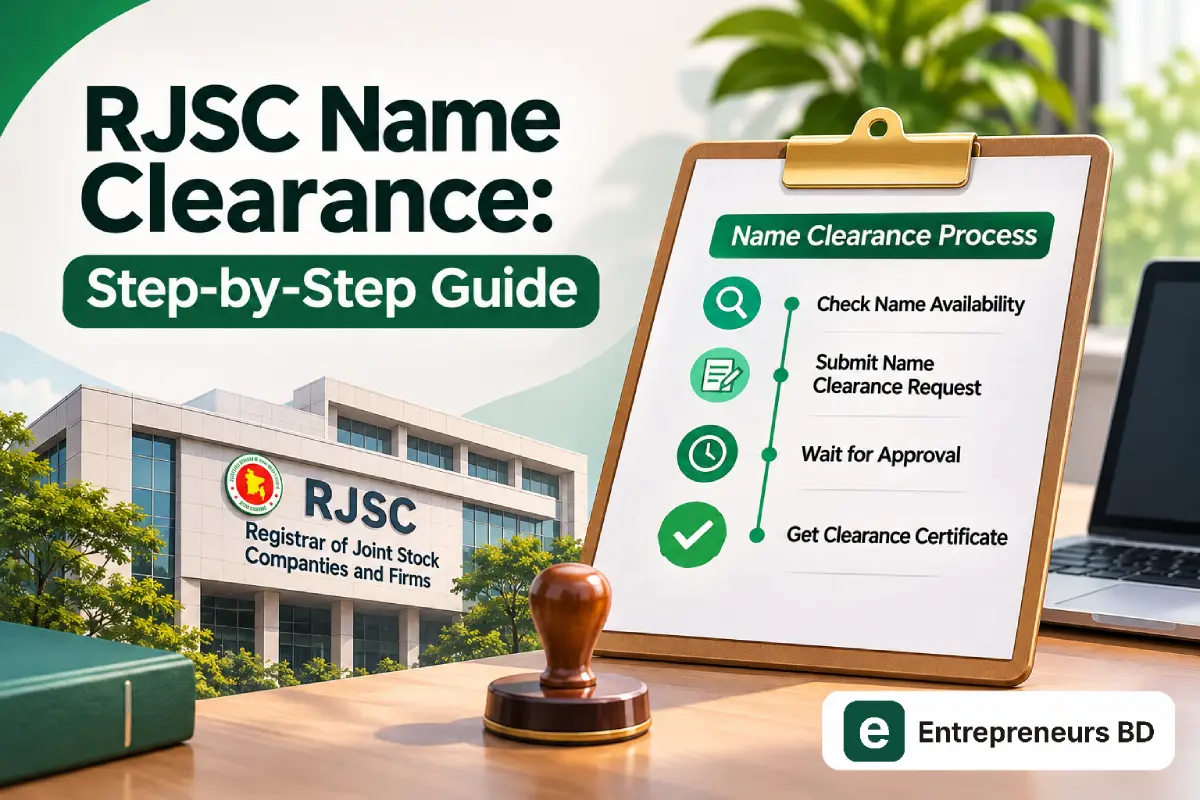
Who Needs RJSC Name Clearance
Name clearance is RJSC's confirmation that your proposed name is available and meets its naming rules. RJSC approves a name only if it does not closely match a name already taken, booked or under registration for the same entity type.
According to the eBRS FAQs, clearance is required before registering most new entities, including private limited companies, public limited companies (PLC), one person companies (OPC), companies under Sections 28 and 29 of the Companies Act, societies and trade organizations. Trade organizations are a separate category, governed by their own law, not a type of Section 28 or 29 company.
Two exceptions need care:
Foreign companies opening a branch or liaison office do not need name clearance.
Partnership firms sit in a grey area. The eBRS FAQ says they are exempt, yet the eBRS fee schedule lists a partnership name clearance fee, and the user manual includes a partnership workflow. Confirm with RJSC before you apply for a firm.
Name clearance is not a trademark. It reserves your legal company name on the RJSC register and nothing more. A brand name or logo needs a separate application to the Department of Patents, Designs and Trademarks (DPDT).
What Changed in November 2026
RJSC's new eBRS name clearance and registration modules went live at 10 am on 12 November 2026, after the old e-service system shut down on 9 November for the switchover, as The Financial Express reported. The portal is at ebrs.rjsc.gov.bd, branded "Smart RJSC".
The changes that matter for name clearance:
Identity is checked live. Your NID number, date of birth, and NID-registered phone number are verified when you sign up.
Names get an automated check, then human review. RJSC said it expects to dispose of applications within 24 hours in the initial phase. Treat that as a target, not a guarantee, because every paid application still goes to an official for review.
Old clearances moved across. An RJSC notice dated 16 November 2026 confirms that name clearance records up to 11 November 2026 were transferred to eBRS.
The Registrar has said the system will not be 100% online straight away, so expect some rough edges in the first months.
RJSC Name Clearance Fees by Entity Type
The current eBRS fee schedule charges per proposed name:
Entity type | Fee before VAT | Total with 15% VAT |
|---|---|---|
Private company | Tk 500 | Tk 575 |
Public company (PLC) | Tk 500 | Tk 575 |
One person company (OPC) | Tk 500 | Tk 575 |
Partnership firm | Tk 500 | Tk 575 |
Trade organization | Tk 500 | Tk 575 |
Section 28 company | Tk 500 | Tk 575 |
Section 29 company | Tk 500 | Tk 575 |
Society | Tk 2,000 | Tk 2,300 |
Foreign company | Not applicable | Not applicable |
Because the fee applies to each name you submit, run the free search thoroughly before you pay. RJSC's materials do not publish a refund policy for unapproved names, so do not count on getting the fee back either way.
Older RJSC schedules listed a Tk 200 charge for extending a clearance. The eBRS fee page does not list one, so confirm with RJSC if you think you will need more time.
For context on total costs, stamp duty on the Memorandum and Articles for a private company starts at Tk 12,000 on the same schedule. Our limited company guide covers the rest of the registration costs.
How to Apply for Name Clearance on eBRS, Step by Step
These steps follow the official eBRS user manual, published 12 November 2026.
Step 1: Create your eBRS account
Go to ebrs.rjsc.gov.bd and choose Sign Up. Select your nationality first, since the form changes with it. Bangladeshi applicants enter their NID number, date of birth as printed on the NID, email, and the mobile number registered under that NID. Foreign applicants enter passport details and upload a scanned passport.
Submit, enter the OTP sent to your phone, then click the activation link in your email. Passwords must use English letters, be at least six characters, and include an uppercase letter, a lowercase letter, and a number.
If your phone number is not registered under your own NID, verification fails. Use a SIM in your name.
Step 2: Open Apply for Name Clearance
From the dashboard's left panel, choose Apply for Name Clearance and select the entity type. Pick carefully: the clearance is tied to that type and cannot be reused for a different structure.
Step 3: Run the RJSC name search
Type the proposed name in English and click Search. The portal adds the required entity word, such as "Ltd.", automatically. You will see one of three results:
Available: continue to applicant details.
Available with a similar-name warning: advisory only, so you can proceed, but the reviewing official will see the same similarity.
Not available: the portal gives a reason, such as a restricted word or a name already in use. Change the name and search again.
Step 4: Enter applicant details
Enter the applicant's nationality, name, NID or passport number, phone, and email. The applicant must be a shareholder, director, partner, or member of the proposed entity.
Step 5: Pay through A-Challan
Click Apply to generate an invoice, then choose Pay Online and pay through A-Challan, the payment route the manual lists for name clearance. An available name is held for up to two days while you complete payment, so pay promptly.
Step 6: Wait for review and download the letter
After payment, you receive SMS and email confirmation, and the application shows as Under Review. Once approved, a clearance number is issued, and the status changes to Approved. Download the Name Clearance Letter from My Activities, then My Name Clearance Applications.
If RJSC does not approve the name, you are notified and can apply again with a different one. Check the current fee and payment terms before resubmitting.
If your name conflicts with an existing one
When the portal marks a name unavailable because it conflicts with an existing name, you can submit a Name Review request from your application list, with a justification and supporting PDFs of 1 MB or less each. Name Review is only for conflicts with existing names. It cannot override the naming conventions below.
Naming Rules the eBRS Portal Checks
The legal basis is Section 11 of the Companies Act, 1994, which bars a name identical to or too closely resembling an existing company's name. The eBRS manual turns this into specific checks.
Required entity wording
Entity type | Required wording | Position |
|---|---|---|
Private limited company | Limited or Ltd. | End |
One person company | OPC | End |
Public limited company | PLC | End |
Partnership firm | M/S or Messrs | Beginning |
Society | Society or Trust | End |
Company under Section 29 | Club, Limited or Ltd. | End |
The entity word is only accepted in its required position, so a name like "Limited Solutions Limited" is rejected. Names may use only letters, digits, spaces and the characters - , . @.
Restricted and reserved words
Restricted words such as Bank, Insurance, and University cannot be used. For some sensitive words, the portal shows a general message without naming the word that caused it. Reserved words such as "Bangladesh" are limited to certain entity types. The manual gives examples rather than complete lists, so if a search fails on a restricted or reserved word, choose another word instead of arguing the case.
Names treated as the same
The portal treats these as matches with an existing name:
Common-word differences only: "ABC Ltd." and "ABC Limited" count as the same name.
Reordered words: "Bangladesh Trading House" matches "Trading House Bangladesh".
Related terms: a word RJSC treats as related, such as "Tech" and "Technology", makes the names match.
Similar spelling or pronunciation triggers only an advisory warning. A name that is registered, or already cleared and locked for another applicant, cannot be used.
Choosing a Name That Is Easier to Clear
The rules above favour names built around a distinctive word. Brands like Chaldal and Pathao show the approach: one uncommon word is far less likely to collide with existing "Tech", "Trade" or "Solutions" companies on the register than a descriptive phrase. A distinctive name reduces similarity conflicts, though it does not guarantee approval or speed.
Before you pay:
Shortlist 10 to 15 options. Our business name generator can help you start.
Run each through the eBRS name search, which costs nothing until you apply.
Drop options that return a similar-name warning unless you have a strong reason to keep them.
Check that the matching domain and social media handles are free.
Search the DPDT trademark database for your top choice. Passing the RJSC check does not mean you pass the trademark check, so do both before spending on a logo, packaging, or marketing.
Apply for the one name you are most confident in.
Your registered name and trading brand can differ. Many companies register a distinctive legal name and trade under a shorter brand. Our guide to brand building in Bangladesh covers the branding side.
After Approval: Validity, Expiry and Registration
There are two separate deadlines to keep apart:
The two-day hold. When a search shows a name as available, it is held for up to two days so you can pay. This happens before approval.
The clearance letter's validity. Once approved, the letter shows its validity dates. Under RJSC's older system, a clearance lasted 30 days from issue. On eBRS, go by the dates printed on your letter.
If your clearance is close to expiry:
Complete the registration application before the date on the letter.
If you need an extension, confirm with RJSC whether one is available and what it costs.
If the clearance expires, do not assume the name is still reserved for you.
To register, enter your submission number and name clearance letter number on the eBRS registration form, and the cleared name fills in automatically.
Name clearance is only the first step. The Financial Express reports that eBRS verifies the NID and e-TIN of Bangladeshi shareholders, directors, members and partners in real time, and that resident shareholders, directors and members must upload proof of submission of income tax returns (PSR). Collect these from your co-founders during the validity window, alongside the other items on your startup legal checklist.
Frequently Asked Questions
How long does RJSC name clearance take in 2026?
How much does RJSC name clearance cost?
What is the difference between the two-day hold and the clearance validity?
Do partnership firms need RJSC name clearance?
Can I still use app.roc.gov.bd for a name search?
Does name clearance protect my brand name?
Your Next Move
Run your shortlist through the eBRS search today, before you pay anything. Fix any name that hits a restricted word, a reordered match or a similarity warning, and only then submit the one you want.
Once the letter arrives, note its expiry date and spend that window collecting NIDs, e-TINs and PSRs from everyone joining the company. For a comparison of company, partnership and proprietorship structures, see our guide to business registration in Bangladesh.

Specializing in SaaS product marketing, SEO strategy, Content marketing, TikTok advertising, PPC, and digital growth.
View Full Profile & ContributionsRelated Articles

The Innovation of Tanvir A. Mishuk: From Fintech Pioneer to AI Entrepreneur
Tanvir A. Mishuk is a fintech entrepreneur recognised for advancing digital financial inclusion in Bangladesh through innovations like e-KYC and USSD based banking access. He has since founded App AI Pty Ltd, an artificial intelligence company based in Australia, applying lessons from financial technology to a new generation of AI driven solutions.

HealthTech in Bangladesh: Opportunities, Regulations, and Early-Stage Players
HealthTech in Bangladesh covers telemedicine, e-pharmacy, diagnostics logistics, and digital health records serving a population with limited doctor access outside major cities. No single unified health-tech law exists yet; founders answer to DGDA, BMDC, and DGHS depending on the product. Early movers like Praava Health and Arogga built durable models around trust and last-mile delivery, not app polish.

What is Social Entrepreneurship in Bangladesh 2026
Quick Answer: Social entrepreneurship in Bangladesh means building a self-sustaining business that solves a social problem, whether poverty, illiteracy, healthcare access, or climate vulnerability, without relying on charity. Bangladesh pioneered this model globally through Grameen Bank and BRAC, and the approach continues to grow across health, agriculture, and clean energy in 2026.
Comments (0)
No comments yet. Be the first to share your thoughts!