What Is a Go-to-Market Strategy? How to Build One for a Bangladesh Launch
A go-to-market strategy is the plan for how a specific product reaches a specific customer: who you sell to first, what you promise them, what you charge, which channels carry the message, and how the product is paid for and delivered. In Bangladesh, the payment and delivery decisions carry as much weight as the marketing ones.
Key Takeaways
A go-to-market (GTM) strategy covers one product and one launch, not the whole company.
Six core decisions make up the plan: customer, value proposition, price, channel, sales motion, and fulfilment.
A focused first segment is usually easier to test, especially when delivery, sales or support capacity is limited.
Pick launch metrics that fit your business model, and check contribution margin before scaling spend.
In Bangladesh, test the mobile checkout, the payment mix (cash on delivery, wallets, Bangla QR) and delivery rules before you expand.
A product can test well and still struggle at launch when nobody has decided, in writing, who the first customers are and how the product will reach them. A go-to-market strategy (GTM strategy) is that decision put on paper.
It sits between two things founders usually do well. On one side is the product, which you have tested and hopefully matched to a real need (if not, start with product-market fit before reading further). On the other side is day-to-day marketing. The GTM strategy connects them: it says which customer comes first, what they will hear, what they will pay, and what happens between "order placed" and "product in hand".
This guide explains what a GTM strategy contains, how it differs from a business plan or a marketing plan, and how to build one that fits how customers in Bangladesh discover, pay for, and receive products. It also covers launch metrics, unit economics, and a sample 90-day schedule.
What is a go-to-market strategy?
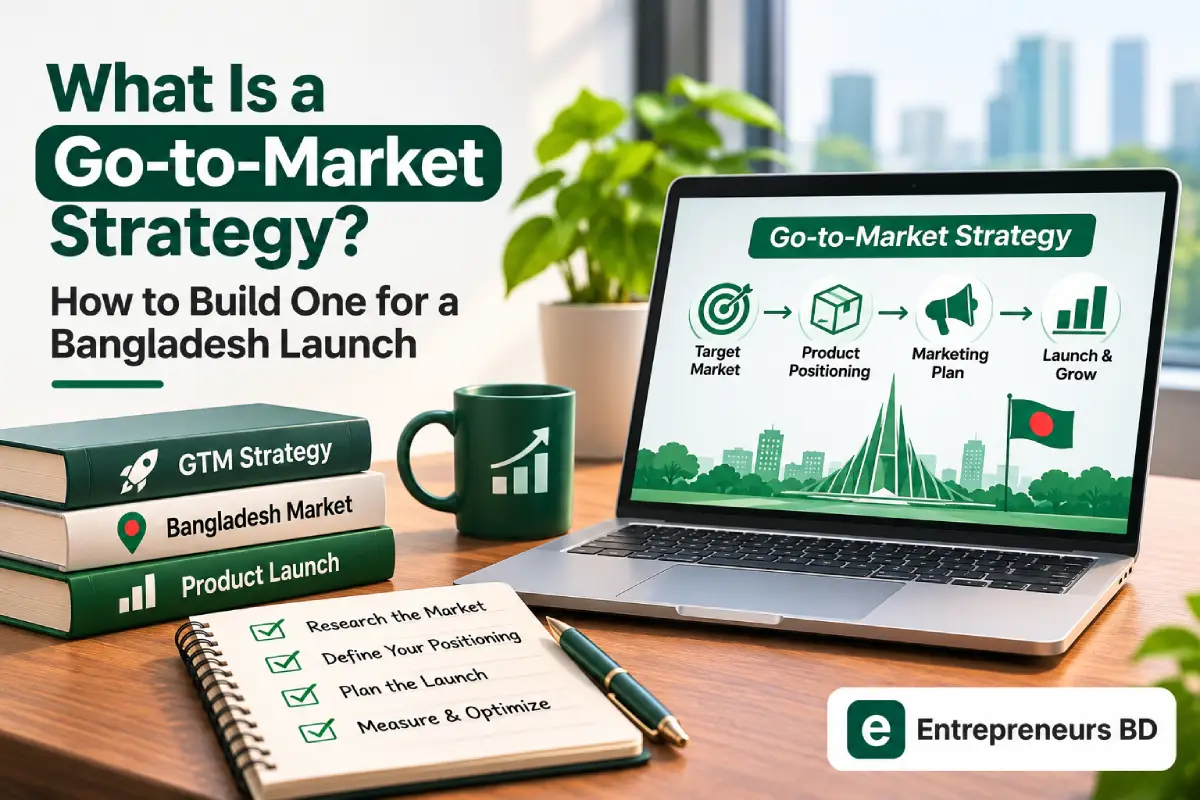
A go-to-market strategy is a focused, launch-specific plan that answers six questions: who is the first customer, what problem do you solve for them, what does it cost, where will they hear about it, how will they buy, and how will it be delivered and supported. It applies to one product entering one market.
GTM strategy vs business plan vs marketing plan
People often confuse a GTM strategy with two other documents. The horizons below are typical, not fixed rules.
Document | Scope | Typical horizon | Main question |
|---|---|---|---|
Business plan | Whole company | Often 3 to 5 years | Is this a viable business? |
Marketing plan | All ongoing promotion | Often 12 months, then renewed | How do we keep demand growing? |
Go-to-market strategy | One product, one launch | The launch period, often a few months | How does this product reach its first paying customers? |
You need a new GTM strategy whenever something material changes: a new product, a new customer segment, or a new geography. A Dhaka brand expanding to Chattogram needs one, even if the product is identical.
The six core components of a go-to-market strategy
Target customer
Define a specific customer segment, then describe a representative buyer or user inside it. "Women aged 18 to 35" is too broad to act on. "Working parents in Mirpur who order groceries late in the evening" names a role, a use case and a buying situation you can go and test.
For B2B products, identify more than the end user. Record who uses the product, who approves the purchase, who controls the budget, and who can block the decision. In a shop, the employee may use the software, the owner may approve it, and the accountant may influence the choice.
Value proposition and positioning
One sentence stating the problem and the result. If the sentence leans on words such as "platform" or "solution", treat that as a warning sign of vague positioning. Then check it against three questions:
Does the target customer recognise the problem?
Are they already spending money or time to solve it?
Is your result meaningfully better than their current alternative?
The current alternative is often not another startup. It may be a paper notebook, a spreadsheet, a Facebook group, a personal contact, or doing nothing.
Pricing and business model
Start with the cost of delivering each sale, including the costs that change with every order: product, packaging, payment fees, delivery subsidy, failed deliveries and returns, discounts, support, and marketplace commission where it applies. A SaaS product or a B2B service has a different cost structure, such as onboarding and account management time.
Then compare competing offers, test willingness to pay, and calculate contribution margin at different prices. A price that attracts customers but leaves too little margin to serve them is not a sustainable launch price. The site's guide to pricing strategy in Bangladesh covers the methods in detail.
Channels
Channels are where the customer hears about you and where they buy. Sometimes these differ: a shopper may discover a brand in a Facebook group and order over WhatsApp. Sometimes one channel does both, as when a SaaS company acquires and converts on its own website. The main types are:
Paid: advertising and sponsored placements
Owned: website, email, app and social accounts
Earned: referrals, reviews, press and organic recommendations
Partner-led: distributors, resellers, marketplaces and strategic partners
Direct sales: outbound prospecting, meetings and field sales
Prioritise the channels where your target customer already looks for solutions.
Sales motion
Self-serve works best when customers can understand, evaluate and buy the product without much help. Assisted sales suit buyers who need guidance. Field sales can make sense when the product needs demonstrations, relationship-building or in-person distribution. Choose by purchase complexity, price, risk and customer behaviour, not only by whether the buyer is a consumer or a business.
Fulfilment and customer support
For physical products, this covers delivery, payment collection, returns and complaints. For digital products, it covers account activation and onboarding, payment confirmation, access delivery, account recovery, technical support, refunds and cancellations, and service availability. Many GTM templates skip this part, yet it shapes the customer's first real experience of the product.
What the six components do not cover
These six decisions do not replace market research or financial planning. Before committing to a launch, estimate how many customers fit the segment and how many you can realistically reach and serve, identify the alternatives they already use, estimate the cost of serving them, and define what evidence would justify expanding beyond the first market.
How B2C and B2B launches usually differ
These are typical patterns, not universal rules.
Area | B2C | B2B |
|---|---|---|
Buyer | Individual consumer or household | Business decision-maker or buying group |
Acquisition | Ads, content, referrals, retail | Outbound, referrals, partners, events |
Conversion | Checkout or assisted purchase | Meetings, proposals, negotiation |
Sales cycle | Often shorter, but varies | Often longer, but varies |
Retention | Repeat purchase or subscription | Renewal, usage and account expansion |
How to build a go-to-market strategy: 8 steps
1. Choose a beachhead market
Choose a focused starting segment that you can reach and serve effectively. This could be one neighbourhood, one profession, one type of shop, or one clearly defined business problem. A physical-goods business often starts with a geography because delivery limits it. A digital product may start with one profession across many locations. The goal is to learn whether customers will buy and whether you can serve them profitably before expanding.
2. Research customers and alternatives
Begin with 15 to 20 conversations in the segment, then continue until the main problems and objections start repeating. Useful questions:
How do you currently solve this problem?
What does that cost you in money or time?
What is frustrating about the current approach?
When did you last experience this problem?
Who decides whether to pay for a solution?
What would make you switch?
Do not only ask whether people like the idea. Past behaviour, current spending and willingness to try a product are stronger evidence than a positive opinion.
3. Write and validate the positioning sentence
Use this template: For [customer] who [problem], [product] is a [category] that [result], unlike [current alternative].
An illustrative example (not a claim about a real product): "For independent grocery shops that struggle to track daily sales and credit, [product] is a digital ledger that lets owners record transactions and check outstanding balances, unlike a paper notebook."
Use the words customers used in interviews to draft your messaging, then test that messaging in real campaigns.
4. Set the price and the launch offer
Decide the launch price and any trial or first-order incentive. A launch offer should specify who qualifies, what exactly is discounted, how long it lasts, whether it applies to the first purchase or to recurring ones, what happens when it ends, and whether it still leaves a workable contribution margin. Repeated or predictable discounts can teach customers to wait for the next one.
5. Select acquisition channels
Start with one or two promising channels. Compare them on where the customer already spends time, whether the channel supports discovery, conversion or both, the expected cost and time to reach customers, whether you can measure results, and whether it can be repeated at a larger scale. Add another channel when the current one has been measured and you have the capacity to test it.
6. Map the customer journey end to end
Write down every step, then go through it yourself as a customer.
Physical product: discovery, enquiry, order, payment, confirmation, dispatch, delivery, return or refund, support.
Digital product: discovery, sign-up, trial or purchase, payment, activation, first successful use, support, renewal.
A test order should check more than delivery. Check payment confirmation, customer messages, tracking, cancellation and refund handling too.
7. Set launch metrics and unit economics
Choose a small set of numbers that fit your business model (see the metrics table later in this guide) and set a target for each before launch. Calculate customer acquisition cost the same way every time, including agency fees and sales labour, not only ad spend. The explainer on customer acquisition cost shows the formula.
8. Assign owners and review dates
Every line in the plan gets a named owner with a deliverable, a deadline, a budget, a success metric, any dependencies, and a review date. Review weekly in the first month.
Bangladesh-specific GTM considerations
A plan copied from another market's playbook will miss several local facts. These are the ones that change real decisions.
Mobile access and digital discovery
BTRC data for August 2026 recorded 137.66 million internet subscriptions, including 122.26 million mobile internet subscriptions, according to the BTRC internet subscriber data. Mobile connections therefore account for close to 89% of the reported total. These are subscription figures, not a count of unique people (BTRC counts any subscription used in the previous 90 days, and one person can hold several). They still underline why you should test your website, product pages and checkout flow on a phone before launch.
Customer affordability and willingness to pay
World Bank data put Bangladesh's 2025 population at about 175.7 million and GDP per capita at about US$2,597, as shown on the World Bank Bangladesh page. These figures give broad economic context. They do not tell you what your segment can afford, and the national population is not your reachable market. Test willingness to pay inside your chosen segment. Depending on the category, smaller pack sizes, entry-level plans or instalments may lower the first-purchase barrier, but their economics need testing too.
Payment options and COD economics
Cash on delivery (COD) is still widely used for online orders of physical goods. Industry estimates generally put it at a clear majority of orders, but there is no single official figure, and the share varies by category, order value, location and seller reputation. Estimate your own COD share, failed-delivery rate and return cost through a small pilot instead of assuming one payment method will dominate.
Digital acceptance changed in 2026. On 1 April 2026 Bangladesh Bank directed banks, MFS providers and payment service providers to replace proprietary merchant QR codes with the interoperable Bangla QR by 30 June, and since 1 July merchant QR payments run on that single standard. The central bank later announced instant settlement and lower merchant costs for Bangla QR payments from 1 October 2026. If you accept in-person or QR payments, ask your provider how Bangla QR onboarding, fees and settlement work for your merchant account. The central bank also publishes monthly MFS transaction statistics if you want to see how wallet usage is moving.
Delivery and digital-commerce compliance
If you sell online, your fulfilment promises have regulatory limits. Under the Digital Commerce Operation Guidelines 2021, a fully paid order generally has to be handed to the delivery person or service within 48 hours. The customer should receive it within five days when buyer and seller are in the same city, or within ten days when they are in different cities or villages. Daily essentials carry a shorter delivery requirement. For products that cannot be handed over for delivery within 48 hours, the guidelines restrict advance payment to 10% of the price unless payment goes through an escrow service approved by Bangladesh Bank.
Read the Ministry of Commerce's Digital Commerce Operation Guidelines (the gazette is in Bangla) before setting delivery and pre-order promises, and see the site's overview of ecommerce regulations for the wider compliance picture.
Language, trust and customer support
Write in the language your segment actually uses: Bangla for mass-market products, and often a mix of Bangla and English for urban professional ones. The guidelines above also expect purchase, return and delivery terms to be shown clearly in Bangla. Give customers visible trust signals: a real phone number, a physical address, genuine reviews, and a clear return policy.
Launch risk checklist
Before launch, decide how you would handle each of these:
Supplier stockouts
Gaps in delivery partner coverage
Payment settlement delays
COD refusals and failed deliveries
Refunds and complaints
Seasonal swings in demand
Currency and import-cost exposure for imported goods
Customer support capacity
Go-to-market examples from Bangladesh
Three companies show different starting choices.
Chaldal launched its grocery delivery service in Dhaka in 2013. It first picked up orders from local grocery stores, then built its own network of small warehouses after product availability proved unreliable. It later expanded to other cities. The lesson: start with a focused geography and adapt operations as you learn.
10 Minute School launched in 2015 with short free video lessons, distributed in its early years largely through YouTube and social media. Paid products such as live classes came later, alongside a free tier. The lesson: free, useful content can be the acquisition channel for a paid product.
TallyKhata offers small shops a free bookkeeping app in Bangla that also works offline. The company later added a digital wallet (TallyPay) and credit services on the same platform. The lesson: solve one daily task first, then layer further services on that usage.
Each example reflects that company's own circumstances. Treat them as patterns to test, not formulas.
A sample 90-day go-to-market launch plan
This is a sample schedule, not a standard timeline. It suits a small consumer launch. B2B products with long procurement cycles, products that need licences, manufacturing or inventory, and businesses that depend on distributors will usually need longer.
Phase | Days | Focus | Output | Decision gate before moving on |
|---|---|---|---|---|
Pre-launch | 1 to 30 | Interviews, positioning, pricing, test orders | A small pilot group suited to the product and sales model | Can target customers explain the problem, and have some agreed to test or buy? |
Launch | 31 to 60 | One or two channels live, regular tracking | First acquisition cost and conversion figures | Is at least one channel producing qualified customers at an acceptable cost? |
Review | 61 to 90 | Cut what failed, increase investment gradually in what met its targets | Decision: scale, adjust, or change segment | Are customers converting, receiving the product successfully, and leaving enough contribution margin to fund growth? |
Two habits keep the plan honest. Avoid changing several variables at once (for example price and message together) unless you are running separate tests, or you will not know what moved the numbers. And write down, before launch, what result would make you stop.
Once a channel is repeatable, the broader playbook for customer acquisition in Bangladesh becomes useful for scaling it.
How to measure GTM success
Launch metrics by business model
The right numbers depend on what you sell. These are suggested metrics, not benchmarks.
Business type | Useful launch metrics |
|---|---|
E-commerce | Paid orders, conversion rate, contribution margin per order, COD failure and return rate, repeat purchase rate |
SaaS | Activated users, trial-to-paid conversion, customer acquisition cost, churn, recurring revenue |
B2B | Qualified leads, sales meetings, proposal-to-close rate, average deal value, sales cycle length |
Marketplace | Active buyers and sellers, completed transactions, repeat transactions, fulfilment success |
Digital education | Paid enrolments, activation, course completion, refunds, repeat purchase |
Unit economics before scale
Contribution margin is what remains from a sale after the costs that change with each sale. For physical products, delivery, returns, discounts and payment fees can change it materially. For SaaS, onboarding and support costs matter. For marketplaces, the economics of each completed transaction matter. If contribution margin per customer does not cover the cost of acquiring that customer within a reasonable period, more ad spend only grows the loss.
Retention and repeat purchases
A launch can attract customers through discounts and paid ads and still fail to create repeat demand. Track the retention measure that fits your model: repeat purchase rate for transactional products, renewal and churn for subscriptions, active usage by cohort for software, and repeat transactions for marketplaces.
Frequently Asked Questions
What is a go-to-market strategy in simple terms?
How is a GTM strategy different from a marketing or sales strategy?
Does a SaaS startup need a different GTM strategy from an e-commerce business?
How do you measure whether a GTM strategy is working?
Can a startup launch without paid advertising?
How long does it take to build a go-to-market strategy?
Start with one segment, one promise, and numbers you can check
A go-to-market strategy is a set of decisions made before the money is spent, and its value comes from making them deliberately. For a Bangladesh launch, that means treating the mobile experience, the payment mix and delivery as core parts of the plan, and confirming the current rules on digital commerce and QR payments before you make promises to customers.
If you take one action today, write the positioning sentence from step 3 and read it to five people in your target segment. If they recognise the problem and ask how to buy, you have the start of a plan. If they look confused, you have learned that cheaply.
Then choose your starting segment, go through your own customer journey as a buyer, and set launch metrics that fit your business model. Expand when the evidence supports it: customers converting at a cost you can afford, orders or accounts fulfilled reliably, and a contribution margin that can fund the next stage.

Specializing in SaaS product marketing, SEO strategy, Content marketing, TikTok advertising, PPC, and digital growth.
View Full Profile & ContributionsRelated Articles

Why Most Bangladeshi Startups Fail — and What You Can Do Differently
Quick Answer: Most Bangladeshi startups fail because of poor market validation, weak financial planning, and founder-market mismatch, not lack of ideas or effort. The founders who survive focus on solving real problems, build lean, and learn from their market before scaling.
Customer Acquisition Strategies That Work for Bangladesh Startups
Quick Answer: The most effective customer acquisition strategies for Bangladesh startups combine low-cost digital channels (Facebook, WhatsApp Business, SEO), mobile financial service integration for frictionless payment, referral-driven growth, and hyperlocal targeting. Startups that blend paid acquisition with retention-focused tactics see the lowest long-term cost per customer.

What Is a Term Sheet? Key Clauses Every Founder Should Understand
A term sheet is a short, mostly non-binding document that sets out the main terms of an investment before lawyers draft the final agreements. It covers how much the investor pays, how much equity they receive, and the rights attached to that equity, such as liquidation preference, board seats, anti-dilution protection, and founder vesting.
Comments (0)
No comments yet. Be the first to share your thoughts!