What Is Customer Acquisition Cost (CAC)? Formula, Benchmarks, and How to Reduce It
Customer acquisition cost (CAC) is the average amount a business spends to win one new paying customer. Divide your sales and marketing costs by the new paying customers those costs brought in. Then compare CAC with each customer's lifetime contribution and how fast it is earned back. A 3:1 LTV:CAC ratio is a common planning benchmark, not a guarantee of profit.
Key Takeaways
CAC is acquisition spending divided by the new paying customers that spending brought in
Count incentives like discounts and free delivery once, in CAC or in margin, never both
Track ads-only, paid-channel, and blended CAC separately so organic growth cannot hide weak ads
CAC means little without contribution-based lifetime value and a realistic payback period
In Bangladesh, failed COD deliveries, non-recoverable ad VAT, and dollar billing can quietly raise CAC
Most founders in Bangladesh know their Facebook cost per click to the poisha. Far fewer know what it costs to win one paying customer. That number is your customer acquisition cost (CAC), and it decides whether growth builds your business or drains it.
A shop can double its orders in a month and still lose money if each new buyer costs more than they will ever contribute. That is why CAC is one of the first numbers investors ask for after revenue.
Our guide to customer acquisition channels covers where to find customers. This one is about measuring what they cost. You will get the formula with a taka example, the three versions of CAC worth tracking, how to read CAC against lifetime value and payback, sensible benchmarks by business model, and the levers that actually lower it.
What Is Customer Acquisition Cost (CAC)?
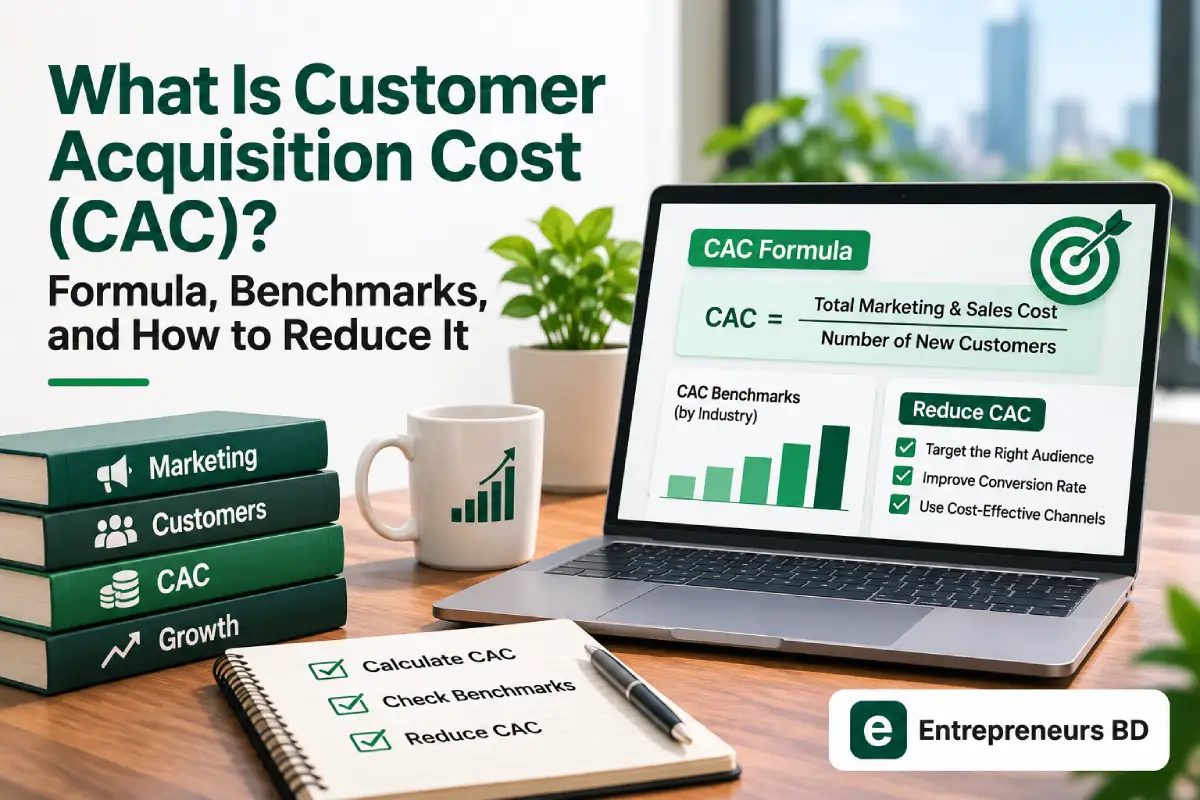
Customer acquisition cost is the average amount a business spends on sales and marketing to win one new paying customer. That customer might come from an ad, a Google search, a referral, or a sales call. CAC covers all of them.
Who counts as a new customer
Decide this before you calculate anything, and keep the rule fixed. For a consumer business, a new customer is usually a unique person or household making a first paid purchase. For B2B, it is a new paying company account, not each employee who logs in. Likes, installs, leads, and free sign-ups do not count until they pay.
The CAC formula
CAC = Acquisition costs ÷ New paying customers acquired by those costs
If your customers buy quickly, as with most Facebook-led e-commerce, dividing one month's acquisition costs by that month's new customers is a fair approximation. When people take weeks or months to decide, that shortcut matches the wrong spending to the wrong customers. Someone who clicks in October and pays in November was acquired by October's spend. For longer cycles, group customers by campaign or first-contact month, or use a rolling three-month figure.
What to include, and what to leave out
Include every cost spent mainly to win new customers:
Ad spend on Facebook, Google, TikTok, and YouTube, plus any VAT you cannot reclaim
The share of staff or freelancer time spent on marketing and sales
Agency, influencer, and content production fees
Marketing tools such as email, chat automation, and design software
Acquisition incentives: first-order discounts, referral credits, free delivery offers, and free samples
Commissions paid on new customers
Leave out the normal cost of producing and delivering what customers paid for. That belongs in contribution margin.
Incentives need care. A first-order discount or free delivery can be treated as an acquisition cost or as lower margin, but never both. Pick one treatment and use it in both your CAC and your lifetime value math. This article counts incentives inside CAC.
A worked example in taka
Picture a small skincare brand in Dhaka selling through Facebook and its website. Its buyers usually order within a day or two of seeing an ad, so a monthly calculation works. In October it spent:
Cost item | Amount (৳) |
|---|---|
Facebook and Instagram ads, including non-recoverable VAT | 1,20,000 |
Content creator (makes the ad creatives) | 25,000 |
Page moderator (half of salary, spent replying to buyers) | 18,000 |
First-order discount codes redeemed | 12,000 |
Total acquisition cost | 1,75,000 |
Each cost appears once. The brand gained 350 new customers whose first orders were delivered and paid for.
CAC = ৳1,75,000 ÷ 350 = ৳500
Counting only ad spend would give ৳343. The ৳157 gap is money the business really spent.
CAC is not cost per lead
Cheap leads do not mean cheap customers. If ৳10,000 of ads produce 100 inbox enquiries, your cost per lead is ৳100. If only five of those people buy, your ads-only CAC is ৳2,000. Always divide by paying customers.
Ads-Only, Paid-Channel, and Blended CAC
One CAC number hides too much. Track three versions, because each answers a different question.
Version | Formula | What it tells you |
|---|---|---|
Ads-only CAC | Ad spend ÷ customers attributed to ads | Whether a campaign is efficient |
Paid-channel CAC | All costs behind paid channels ÷ customers attributed to paid | Whether paid growth can scale profitably |
Blended CAC | All acquisition costs ÷ all new customers | What the business really pays per customer |
The a16z startup metrics guide explains why investors look past blended CAC: strong word of mouth can make it look healthy while paid campaigns lose money.
Back to the skincare brand. Suppose 210 of its 350 customers came through ads. Ads-only CAC is ৳1,20,000 ÷ 210 = ৳571. But the creator makes the ads, and most moderator replies go to ad enquiries. Say ৳35,000 of those salaries and ৳9,000 of the discounts belong to paid. Paid-channel CAC becomes ৳1,64,000 ÷ 210 = ৳781. That is the figure to plan with before doubling the ad budget, alongside a quick ROAS calculation per campaign.
The same logic gives organic CAC: organic costs such as content and community time, divided by organic customers.
One caution: every channel figure depends on attribution. A buyer might find you on YouTube, search your name on Google, see a retargeting ad, then order on WhatsApp. Last-click attribution credits the ad, first-click credits YouTube, and neither is perfect. Choose one rule, write it down, and use it every month.
LTV:CAC and Payback: Can You Afford Your CAC?
CAC tells you what a customer cost. It says nothing about whether that customer is profitable. For that, compare it with lifetime value.
Contribution-based LTV
Here, customer lifetime value (LTV) means the total contribution a customer brings: revenue minus product cost, packaging, courier, payment fees, refunds, and support. Revenue-based LTV looks bigger but overstates what you can afford to spend.
LTV:CAC = Expected lifetime contribution per customer ÷ CAC
Say a skincare customer spends ৳1,400 per order, leaving ৳380 after those costs. Past cohorts placed a first order, then reordered about every two months, averaging four orders in total. Expected LTV is 4 × ৳380 = ৳1,520, so LTV:CAC is ৳1,520 ÷ ৳500, about 3:1.
Treat that as an estimate, not cash in the bank. If your oldest customers are six months old, you do not yet know how long people stay. Use observed cohort data, stay conservative, and recalculate as history builds.
Reading the ratio
Below 1:1: expected lifetime contribution does not cover what you paid to acquire the customer.
At 1:1: it covers acquisition only, with nothing left for rent, salaries, and other overheads.
1:1 to 2:1: some contribution remains, but often too little to fund overheads and growth.
3:1 or more: more breathing room. Harvard Business School's guide to LTV/CAC cites three as a common rule of thumb for a scalable business.
Even 3:1 is a planning benchmark, not proof of profit. It can hide slow payback, thin cash, or retention assumptions that will not hold.
CAC payback
Payback is how long a customer's contribution takes to repay their CAC. How you measure it depends on how customers pay:
Subscription: divide CAC by monthly contribution per customer.
Repeat-purchase e-commerce: add up contribution order by order until it passes CAC.
B2B contracts: follow actual invoice and collection dates.
For the skincare brand, the first order contributes ৳380, leaving ৳120 unrecovered. CAC is repaid on the second order, about two months later, if it happens. Until then, the business funds that customer from its own cash, and long payback shortens your startup runway even when the ratio looks fine.
CAC Benchmarks: What Is a Good Customer Acquisition Cost?
There is no universally good CAC in taka. ৳3,000 is cheap for a software firm billing ৳20,000 a month and fatal for a shop selling ৳600 t-shirts once. Useful benchmarks are about ratios and payback.
No regulator or industry body publishes average CAC for Bangladesh, and most global figures come from US software companies. Treat the ranges below as rough planning references, not validated local standards.
Business model | What to aim for | What decides it |
|---|---|---|
Subscription software or app | LTV:CAC near 3:1, with payback your cash can fund (often under 12 months if bootstrapped) | Gross margin, churn, funding |
Repeat-purchase e-commerce | Cumulative order contribution repays CAC within a period you can finance | Contribution per order, reorder rate |
One-time purchase e-commerce | First-order contribution, not revenue, covers CAC | Margin on a single sale |
Marketplace | Buyer CAC and seller CAC tracked separately | Each side's effect on transactions and retention |
B2B services | Often 3:1 or higher, with longer payback accepted on contracts | Contract length, renewals, service cost |
The one-time row trips people up. A ৳5,000 product with ৳1,000 contribution cannot support a ৳1,500 CAC just because the price tag is large.
A very high ratio, say 8:1, may mean room to spend more on growth. First check that LTV is realistic, CAC is fully loaded, and retention holds as you scale.
CAC also moves over time. The a16z guide notes that costs often rise as you push past early adopters into less responsive audiences, while referrals, brand recognition, and better creative can pull them down. Your own month-on-month trend matters more than any outside benchmark.
Customer Acquisition Cost in Bangladesh: Local Factors That Change the Math
The formula travels well, but some costs are specific to selling here. Miss them and your CAC will look better than it is.
VAT on digital ads
VAT on ad payments depends on the platform, how you are billed, and your own tax status. In 2019 the Daily Star reported that Bangladesh Bank told banks to deduct 15% VAT on overseas payments for digital ads. Since then, Google and other platforms have registered for VAT locally, so some now handle VAT through their own invoicing.
For CAC, record the tax you actually paid. If your business is VAT-registered and can legally claim that VAT back as input credit, it is not an acquisition cost. If you cannot reclaim it, include it. Check your platform invoices and confirm the treatment with a tax adviser.
Failed cash-on-delivery deliveries
Many first-time buyers here choose cash on delivery, and some parcels are never paid for: the buyer refuses it, cannot be reached, or gave a wrong address. Each failure wastes ad spend plus packaging and courier fees.
Handle this in two steps. Count only first orders that were delivered and paid as new customers. Then add the packaging and courier cost of failed first orders to acquisition costs. If a campaign brings 100 first orders and 80 succeed, divide by 80, not 100. Track delivery success and return-to-origin rates separately, and keep post-delivery product returns in their own column.
Reorder frequency sets your CAC ceiling
How often people buy decides how much you can spend to win them. An online grocer like Chaldal sells things households need every week, so one acquired family can order week after week. A gadget shop may see the same buyer once in three years. In a low-frequency category, the first order has to repay CAC on its own.
If you are building in grocery or pharmacy, the story of how Chaldal co-founder Waseem Alim grew the company is a useful case study in winning repeat buyers.
Free products bring users, not paying customers
TallyKhata shows a product-led approach: a free digital ledger gives small merchants a reason to sign up without the company paying for every install. But free users are not paying customers. A business using this model still has to measure how many users stay active, how many later pay for something, and what serving free users costs.
Dollar billing
If your ad platform bills in dollars and you pay from taka, a weaker taka raises your CAC even when campaign results are unchanged. Bank conversion rates and card charges add to it. Record both the dollar amount and the final taka cost each month.
How to Reduce Customer Acquisition Cost
CAC drops in two ways: spend less to reach the right people, or convert more of the people you already reach. Treat each idea below as a test to run, not a guaranteed result.
Compare CAC by channel. Some channels look cheap on clicks or leads but turn out expensive per paying customer. Use the same attribution rule each time so the comparison is fair.
Fix conversion before buying traffic. If spend and traffic quality stay the same, moving from 10 to 15 orders per 1,000 visitors cuts CAC by a third. Slow pages, surprise delivery charges, and missing bKash or Nagad options are common leaks that conversion rate optimization addresses.
Test COD confirmation. A call or WhatsApp message before dispatch can filter out orders likely to be refused. Try it on a sample, then weigh fewer failed deliveries against staff time and any buyers lost to the extra step.
Run a referral programme, then audit it. Referred buyers often arrive with more trust, but rewards also attract people who order once to claim them. Track repeat purchases, contribution, and abuse, not just sign-ups.
Build channels that keep working. SEO, YouTube tutorials, and community content can bring customers long after publication. They still cost writing, editing, and production time, so compare that full cost with the contribution they bring.
Test targeting instead of assuming. Run lookalike audiences against broad targeting with similar budgets and creatives. Pick the winner on paying customers and contribution, not cheap impressions.
Retarget, but check what is truly extra. Retargeted visitors convert well, partly because some would have bought anyway. Watch frequency and audience size, and where possible compare against a small holdout group that sees no retargeting.
Raise lifetime contribution. Bundles, subscriptions, and reorder reminders help only if they lift contribution, not just order value. Strong customer retention habits mean you pay to acquire each buyer once.
When testing, change one major thing at a time where you can. Measure over a period that fits your sales cycle, and do not declare a winner until enough completed purchases have come in to make the comparison meaningful.
Frequently Asked Questions
Should salaries be included in customer acquisition cost?
How often should a startup calculate CAC?
What is the difference between CAC and CPA?
Is a lower CAC always better?
How do I calculate CAC if I don't run paid ads?
Which CAC figure should I show investors?
Know Your CAC Before You Scale
Customer acquisition cost is a simple division, but it forces honest questions. What did we really spend? Who actually became a paying customer? Will they repay that cost, and how soon?
For Bangladeshi founders, failed COD deliveries, non-recoverable ad VAT, and dollar-billed platforms all push CAC higher than global guides suggest. The businesses that grow sustainably here count those costs openly, then work on both sides of the ratio: cheaper acquisition and longer, more profitable customer relationships.
Start this week with a simple spreadsheet:
List every cost you spent last month to win new customers, each once.
Count only first-time customers whose orders were delivered and paid.
Divide to get blended CAC, then calculate paid-channel CAC for your largest channel.
Add up contribution order by order to see when a typical customer repays it.
If payback runs longer than your cash can carry, fix that before you spend the next lakh on ads.

Specializing in SaaS product marketing, SEO strategy, Content marketing, TikTok advertising, PPC, and digital growth.
View Full Profile & ContributionsRelated Articles

The Innovation of Tanvir A. Mishuk: From Fintech Pioneer to AI Entrepreneur
Tanvir A. Mishuk is a fintech entrepreneur recognised for advancing digital financial inclusion in Bangladesh through innovations like e-KYC and USSD based banking access. He has since founded App AI Pty Ltd, an artificial intelligence company based in Australia, applying lessons from financial technology to a new generation of AI driven solutions.

HealthTech in Bangladesh: Opportunities, Regulations, and Early-Stage Players
HealthTech in Bangladesh covers telemedicine, e-pharmacy, diagnostics logistics, and digital health records serving a population with limited doctor access outside major cities. No single unified health-tech law exists yet; founders answer to DGDA, BMDC, and DGHS depending on the product. Early movers like Praava Health and Arogga built durable models around trust and last-mile delivery, not app polish.

What is Social Entrepreneurship in Bangladesh 2026
Quick Answer: Social entrepreneurship in Bangladesh means building a self-sustaining business that solves a social problem, whether poverty, illiteracy, healthcare access, or climate vulnerability, without relying on charity. Bangladesh pioneered this model globally through Grameen Bank and BRAC, and the approach continues to grow across health, agriculture, and clean energy in 2026.
Comments (0)
No comments yet. Be the first to share your thoughts!