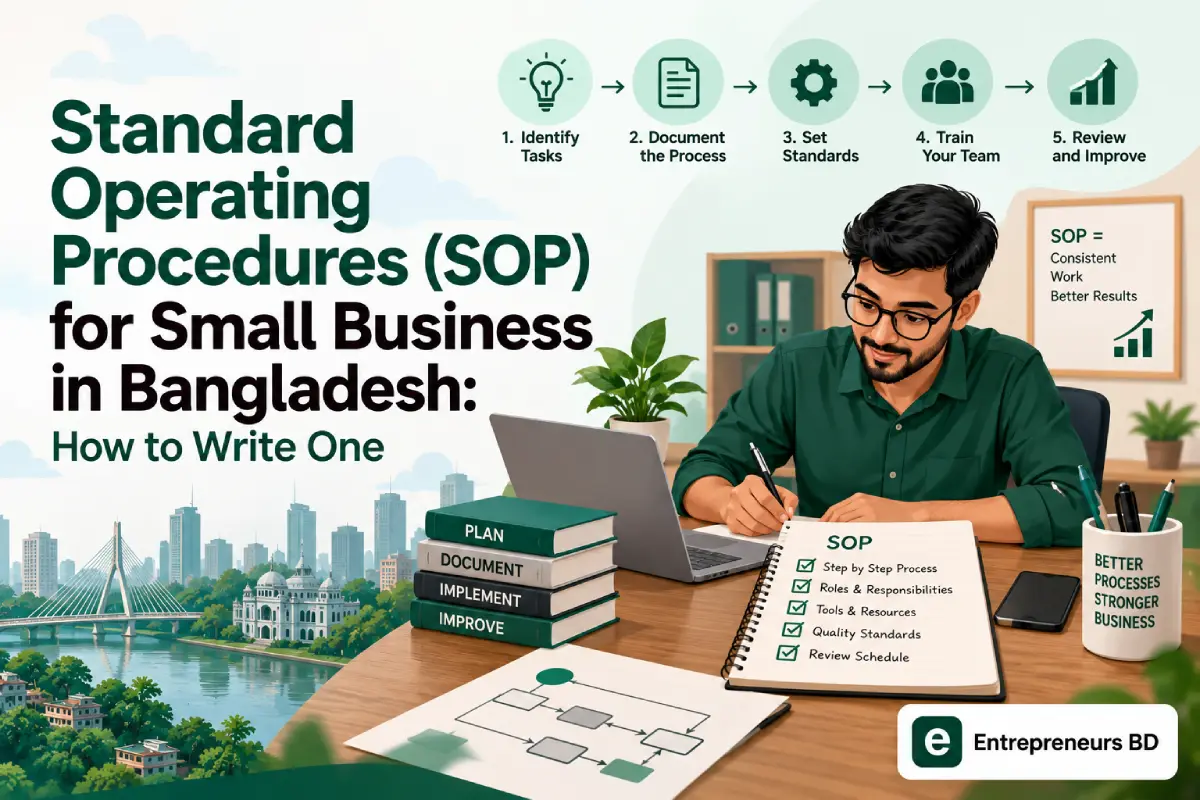
Standard Operating Procedures (SOP) for Small Business in Bangladesh: How to Write One
An SOP (standard operating procedure) for a small business in Bangladesh is a written procedure that shows staff how to carry out a recurring or high-risk process consistently. Start with a few processes that cost money or create risk when done wrong, write them in the language your team understands best, and test each one with a new employee.
Key Takeaways
Keep each SOP focused on one clearly defined process or purpose.
Start with a few high-impact processes: frequent ones that cost money when done wrong, and rare ones that are risky when they happen.
Bangla, English, or a bilingual version all work; use what your staff understands best.
Calling a document an SOP does not take employment terms outside the Labour Act.
Many small shops and Facebook sellers can start with printed SOPs, one controlled shared folder, and WhatsApp reminders.
Many small businesses in Bangladesh run on one person's memory. The owner knows how to close the cash drawer, which courier handles Chattogram orders, and what to say to a customer whose parcel came back. When that person is sick, out buying stock in Gazipur, or simply busy, work tends to slow down or go wrong.
A well-written standard operating procedure can reduce that dependency. An SOP for a small business in Bangladesh does not need to look like a garment factory manual. Often it fits on a page or two, uses the words your staff already use, and answers "how do we do this here?" before anyone has to phone you.
Written procedures also become more useful as you add staff, branches, or order volume, because handing work to a new hire is far easier when the method is not locked in one person's head. If growth is on your plan, our guide to scaling a startup covers the wider picture.
This guide covers what an SOP is, which processes to document first, an eight-step writing method, a template you can copy, three areas where SOPs meet Bangladeshi law, and how to roll SOPs out and keep them current.
What an SOP Is, and What It Is Not
An SOP is a written procedure that explains how a specific process is carried out, who is responsible, and what to do when something goes wrong. SOPs range from a one-page shop routine to multi-role procedures with decision points, safety controls, and approvals.
For a small business, a practical SOP usually has four layers:
Purpose: why the procedure exists and what "done" looks like.
Procedure: the steps, in order.
Controls: what must be checked, recorded, approved, or escalated.
Document control: who owns it, which version is current, when it took effect, and when it is next reviewed.
Homemade SOPs often cover the first two layers and skip the last two. Those last two are what stop old versions and quiet shortcuts from creeping back in.
SOPs are not only a private-business idea in Bangladesh. In 2020, the Department of Inspection for Factories and Establishments (DIFE) approved four SOPs for its own inspection work, covering labour complaints, accident investigation, factory layout approval, and registration.
Owners often blur SOPs with other documents. The table below is a simplified comparison; real documents often overlap.
Document | Main purpose | Example from a small Dhaka business |
|---|---|---|
SOP | Explains how a process is carried out | Packing and handing over a cash-on-delivery order |
Checklist | Confirms required items were completed | Opening checks: lights, fridge temperature, cash float |
Policy | Sets rules, limits, and principles | Returns accepted within 7 days with the original memo |
Job description | Defines a role's responsibilities | Counter staff: sales, cash handling, customer queries |
Service rules | Set employees' terms and conditions of service | Working hours, leave, disciplinary process |
The last row matters in Bangladesh. Employment-related service rules are subject to labour law requirements, while an ordinary operational SOP is generally an internal process document. A procedure can still carry legal significance when it covers safety, food handling, tax records, or a buyer's requirements, as the law section below explains.
A checklist often sits inside an SOP as its final step, for example: "complete the closing checklist and save it to the records folder."
Which Processes Need an SOP First
You do not need dozens of SOPs to start. A small number of well-chosen ones, often three to five, will usually do more than a long manual nobody reads. Use these questions to choose:
Does the process happen often enough that people need to do it the same way, or is it rare but costly or dangerous when it happens?
Does a mistake cost money, a customer, a fine, or someone's safety?
Does only one person know how to do it properly?
As a simple prioritisation rule, put processes with two yeses near the top of your list and handle the ones with three yeses first.
For a retail shop or a Facebook commerce (F-commerce) seller, useful first SOPs may include:
Daily cash closing: reconcile cash and, where you accept them, mobile wallet and card receipts against the day's sales record.
Order confirmation for F-commerce sales, where an unclear reply can lead to a returned parcel. If your page brings most orders, the reply script belongs inside your wider Facebook marketing plan.
Courier handover: weighing, labelling, checking the cash-on-delivery amount, and who signs the courier's pickup sheet.
Stock receiving: counting goods against the supplier's challan (delivery note) before anyone signs it.
Complaints and returns, with a clear limit on what staff can approve without a manager.
Do not leave out safety. A fire, an electrical fault, a gas leak, a workplace injury, or a food contamination complaint may be rare, but a short written procedure with emergency contacts is worth having before the day you need it.
Decision-heavy work can have SOPs too. Hiring, pricing, and campaign launches all need judgement, but parts of them can be standardised: a candidate screening checklist, a discount approval limit, a pre-launch check. The useful question is whether part of a process can be made consistent without removing the judgement it needs.
When an SOP is not worth writing
Skip it, or keep it to a short note, when the process changes every week, when it is so simple that nobody gets it wrong, or when keeping the document current would cost more time than the mistakes it prevents. An out-of-date SOP can be worse than none, because people trust what is written down.
How to Write an SOP for Small Business in Bangladesh in 8 Steps
1. Watch the process being done
Do not write from memory. Stand beside the person who does the process most reliably and note every action, including small ones they no longer notice, such as re-checking the COD amount or calling the customer before dispatch. Those habits may explain why that person gets more consistent results.
2. Define the purpose, the owner, and what comes first
Write one sentence at the top: "When this SOP is done, ___." For cash closing, that might be: the cash count, any wallet or card receipts, and the sales record agree, and the summary is filed.
Then name the role responsible ("evening counter staff", not "Rahim"), since roles survive staff turnover. Add what must be in place before starting, such as system access, the right forms, or a finished previous task.
3. Write in the language your team understands best
For many frontline teams, Bangla is easier to follow quickly; office or software teams may prefer English. Where staff read different languages, a bilingual SOP or a short glossary helps, and safety warnings should appear in every language your staff use. Keep app names, form names, and button labels exactly as they appear on screen.
4. Start each action step with a clear verb
"Count the notes by denomination." "Enter the parcel weight in the courier app." Keep decision points, warnings, and acceptance checks visibly separate from the action steps. Split a step when combining actions would make it hard to follow or check.
5. Add the "if this happens" lines
Staff can usually follow the normal path; exceptions are where they hesitate. Add short branches with thresholds you set for your own business. For example, a pharmacy might decide:
If the cash is short by more than Tk 200, stop and call the manager before closing.
If the customer refuses the parcel, photograph the label and mark it "returned" in the order sheet.
A phrase like "a large difference" can be read differently by different employees, while a number you have chosen cannot. Tk 200 is only an example; set a limit that fits your sales volume.
6. Show as well as tell
A phone photo of a correctly packed parcel, or a short voice note explaining the courier sheet, helps staff who prefer visual or spoken instructions. Hide or blur customer names, phone numbers, and addresses before using any order photo. Link the media from the same controlled location as the written SOP rather than copying it around.
7. Test it with a new person
Give the draft to someone who has not done the process before and stay quiet while they follow it. Each hesitation or question points to a gap; fix those and test again. The SOP is ready when a new employee can complete the normal process on their own and knows when and how to escalate exceptions.
8. Approve, version, and date it
Before the SOP goes live, give it a version number, an effective date, and the name or role of whoever approved it. When you change it, raise the version, note what changed, and remove every old printed copy, so staff are not left following whichever copy they found first.
A Practical SOP Template You Can Copy
A consistent template means staff always know where to look. The fields below suit most small businesses; add safety warnings, definitions, or diagrams when a process needs them. The example column shows a daily cash-closing SOP for an illustrative neighbourhood pharmacy in Mirpur.
Field | What to write | Example: pharmacy cash closing |
|---|---|---|
SOP code and title | Short name plus a code grouped by area | FIN-001: Daily cash closing |
Version and effective date | Current version and the date it applies from | v1.2, effective 1 November 2026 |
Purpose | One sentence on what "done" looks like | Cash count, wallet receipts, and sales record agree; summary filed |
Document owner | Role that keeps the SOP accurate | Store manager |
Performed by | Role that carries out the steps | Evening counter staff |
When | Trigger or time | Daily after the last customer, before closing |
Before you start | Prerequisites | Wallet merchant app logged in; memo book complete |
Tools | Everything needed, named exactly | Cash drawer, sales memo book, wallet merchant app, calculator |
Steps | Numbered actions | 1. Lock the door. 2. Count notes by denomination. 3. Total the memo book. 4. Compare with wallet app totals. |
Exceptions and escalation | If-then lines and who to contact | Short by more than the set limit: stop and call the store manager |
Record | Evidence kept, and where | Photo of summary sheet saved to the shop's records folder |
Review date and approver | Next check and who signed off | Next review March 2027; approved by the owner |
Keep a short revision history at the bottom of each SOP:
Version | Date | Change | Approved by |
|---|---|---|---|
1.2 | 1 Nov 2026 | Raised escalation limit | Owner |
1.1 | 15 Aug 2026 | Added wallet app reconciliation | Owner |
1.0 | 1 Jun 2026 | First version | Owner |
Name SOPs by area so the list stays easy to manage as it grows: FIN for money, OPS for orders and delivery, INV for stock, HR for people, and SAF for safety.
If the shop already records customer dues in a digital ledger app such as TallyKhata, name it in the Tools field and add a step for updating it. Describe the tools your staff actually use, not the ones you plan to buy someday.
Here is a blank version to copy into Google Docs or print:
SOP code and title:
Version: Effective date:
Purpose:
Document owner: Performed by:
When:
Before you start:
Tools:
Steps:
1.
2.
3.
Exceptions and escalation:
If ... then ...
Contact:
Record (what is kept, and where):
Review date: Approved by:
Revision history:
Version | Date | Change | Approved by
Keep SOPs as short as the process allows. One page is a good target for simple routines, but do not drop important steps just to meet a page limit.
Where SOPs Meet Bangladeshi Law
This section is general information, not legal or tax advice. Check with a lawyer, tax adviser, or the relevant authority before relying on it for your business.
Many ordinary SOPs are never submitted to any authority. Even so, a business may need to show relevant procedures or records during a labour inspection, a VAT audit, a food safety inspection, or a buyer's audit. Below are three areas where SOPs commonly meet legal requirements. Others, such as trade licensing, fire safety, and sector-specific licences, may also apply depending on your business.
Employment terms and service rules
Section 3 of the Bangladesh Labour Act, 2006 allows an establishment to have its own service rules, provided they are not less favourable to workers than the Act. Such rules need approval from the head of the labour inspection department (the Chief Inspector in the Act, the Inspector General in the Bangladesh Labour Rules, 2015) before they take effect.
The Act has since been amended substantially, most recently by the Labour (Amendment) Act, 2026. Check the current consolidated text and the applicable rules before drafting any employment document.
The practical point is that a document's legal character depends on its content, not its label. If a document sets or changes employees' terms and conditions of service, such as working hours, leave, overtime, or discipline, it may be treated as a service rule or employment rule even if you call it an SOP. Wage deductions are also limited to those the Act permits, so do not impose a salary deduction simply by writing it into a procedure. Keep employment terms in a separate document reviewed by a labour lawyer.
Billing and VAT invoices
Your billing SOP depends on your tax status. According to NBR's VAT FAQ, a VAT-registered supplier issues a tax invoice in Form VAT-6.3 (Mushak 6.3), while a business enlisted for turnover tax issues a turnover tax invoice in Form VAT-6.9. Requirements can also differ by transaction, for example supplies to withholding entities, and registration thresholds change through annual Finance Acts, so confirm your current status on the VAT Online portal or with a VAT consultant.
A billing SOP should therefore state which invoice your business uses, who issues it, at what point in the sale, and how records are kept. NBR's FAQ says VAT documents should be kept for five years and that accounts can be maintained digitally; the VAT and Supplementary Duty Rules set out the details.
For tax obligations beyond VAT, see our guide to tax basics for startups.
Food handling
Food businesses are subject to requirements set under the Safe Food Act, 2013 and overseen by the Bangladesh Food Safety Authority (BFSA). Relevant rules include the Food Safety (Food Hygiene) Regulations, 2018, listed in a USDA Bangladesh regulations report, and the Food Safety (Obligations of Food Business Operators) Regulations, 2020, which cover areas such as source traceability, record retention, and staff training.
Written procedures for handwashing, separating raw and cooked food, storage, cleaning, supplier records, and staff training can help a food business standardise its practices and document its controls. The procedure is not compliance by itself, though. What happens in the kitchen, and the records you keep, still have to meet the applicable requirements.
What Bangladeshi Businesses Show About Process
Local businesses illustrate why consistency matters once a business grows beyond its founder.
Chaldal lets customers choose a delivery slot for online grocery orders. A promise like that shows why a grocery operation needs consistent picking, packing, and dispatch across different staff and shifts. This is an illustration of the operational pressure, not a description of Chaldal's internal procedures.
Founders who build operations-heavy businesses, such as Chaldal co-founder Waseem Alim, deal with this at a scale most small shops never will. The underlying problem is the same, though: work one person once did by feel has to be done the same way by many people.
Export-oriented garment suppliers offer another angle. If a buyer or audit programme requires documented procedures, suppliers may need to provide written SOPs for the relevant safety or quality processes. If you plan to sell into that supply chain, it is easier to write those procedures before an audit than during one.
Now imagine a six-person shop in Uttara. It faces the same pattern on a smaller scale: tasks repeat, mistakes cost money, and the know-how sits with too few people.
How to Roll Out SOPs and Keep Them Current
A written SOP that sits in a drawer changes little. How you store, train, review, and measure matters as much as the writing.
Keep one master copy
Store the master version of every SOP in one controlled location, such as a shared Google Drive folder where only document owners can edit. Use WhatsApp to share links and reminders, not as the official copy. Printed copies at the counter or packing table are useful, but when an SOP changes, replace them the same day.
Limit access to sensitive information
Some SOPs touch supplier prices, customer data, or payment accounts. Keep those in a restricted folder and never write passwords into an SOP. Where an app allows it, give each staff member their own login instead of a shared one.
Train, record, then check
Walk each staff member through the SOP while they do the process. Keep a simple training record: employee, SOP and version, date, and trainer. Check the first few attempts closely, then move to periodic spot checks, and collect only the evidence you need to confirm the work and look into exceptions.
Involve the people who do the work
The person doing a process daily often spots problems first. Ask at your weekly meeting which step did not work, and update the SOP when their fix is sound. Involving staff in revisions can make SOPs more practical and easier to adopt.
Review based on risk
High-risk or regulated processes, such as cash, food safety, and fire safety: review more often, for example every quarter.
Processes that change often: review whenever they change, such as a new courier partner or POS system.
Stable, low-risk processes: an annual review may be enough.
After any significant error or incident: review straight away.
Measure, then adjust
Pick one measure per SOP, such as cash differences per month or returned parcels per week, and note the baseline before rollout. If it does not improve over a reasonable period, check whether the SOP is clear, whether it is being followed, and whether it addresses the real cause of the problem.
Following an SOP perfectly does not help if the procedure itself is wrong. Treat it as a loop: observe, document, test, measure, revise, train, and monitor.
Done well, SOPs can also free up an owner's time, because fewer routine questions need your answer. Our guide to time management has more on protecting that time.
Frequently Asked Questions
Do small businesses in Bangladesh legally need SOPs?
How long should an SOP be?
Should I write SOPs in Bangla or English?
How many SOPs does a small business need to start?
What is the difference between an SOP and a job description?
What free tools can I use to store and share SOPs?
Start With the Process That Keeps Going Wrong
You do not need a full operations manual to benefit from SOPs. Start with one procedure for the process that caused the most trouble last month: written in your team's language, tested with a new hire, versioned, and kept where the work happens.
For many small businesses in Bangladesh, that first SOP is about money or orders: cash that does not match at night, or parcels that come back unopened. Fixing one of those can make a noticeable difference to how consistently the work gets done.
Then add the next one, and make sure at least one covers safety. Keep employment terms in a separate document, give billing and food handling procedures the extra care the law expects, and review each SOP on a schedule that matches its risk.
Tonight, before closing, ask the staff member who handles your most error-prone process to walk you through it. Write down every step they take. That list is the first draft of your first SOP.

Specializing in SaaS product marketing, SEO strategy, Content marketing, TikTok advertising, PPC, and digital growth.
View Full Profile & ContributionsRelated Articles

Why Most Bangladeshi Startups Fail — and What You Can Do Differently
Quick Answer: Most Bangladeshi startups fail because of poor market validation, weak financial planning, and founder-market mismatch, not lack of ideas or effort. The founders who survive focus on solving real problems, build lean, and learn from their market before scaling.

Customer Acquisition Strategies That Work for Bangladesh Startups
Quick Answer: The most effective customer acquisition strategies for Bangladesh startups combine low-cost digital channels (Facebook, WhatsApp Business, SEO), mobile financial service integration for frictionless payment, referral-driven growth, and hyperlocal targeting. Startups that blend paid acquisition with retention-focused tactics see the lowest long-term cost per customer.

How to Start an Export Business in Bangladesh: Compliance, Buyers, and Logistics
To start an export business in Bangladesh, set up your business with a trade license and tax registration, open a bank account with an authorized dealer bank, and get an ERC from CCI&E. Then confirm your HS code, BIN and product permits, check the buyer's import rules, agree payment terms, and repatriate proceeds within four months.
Comments (0)
No comments yet. Be the first to share your thoughts!